
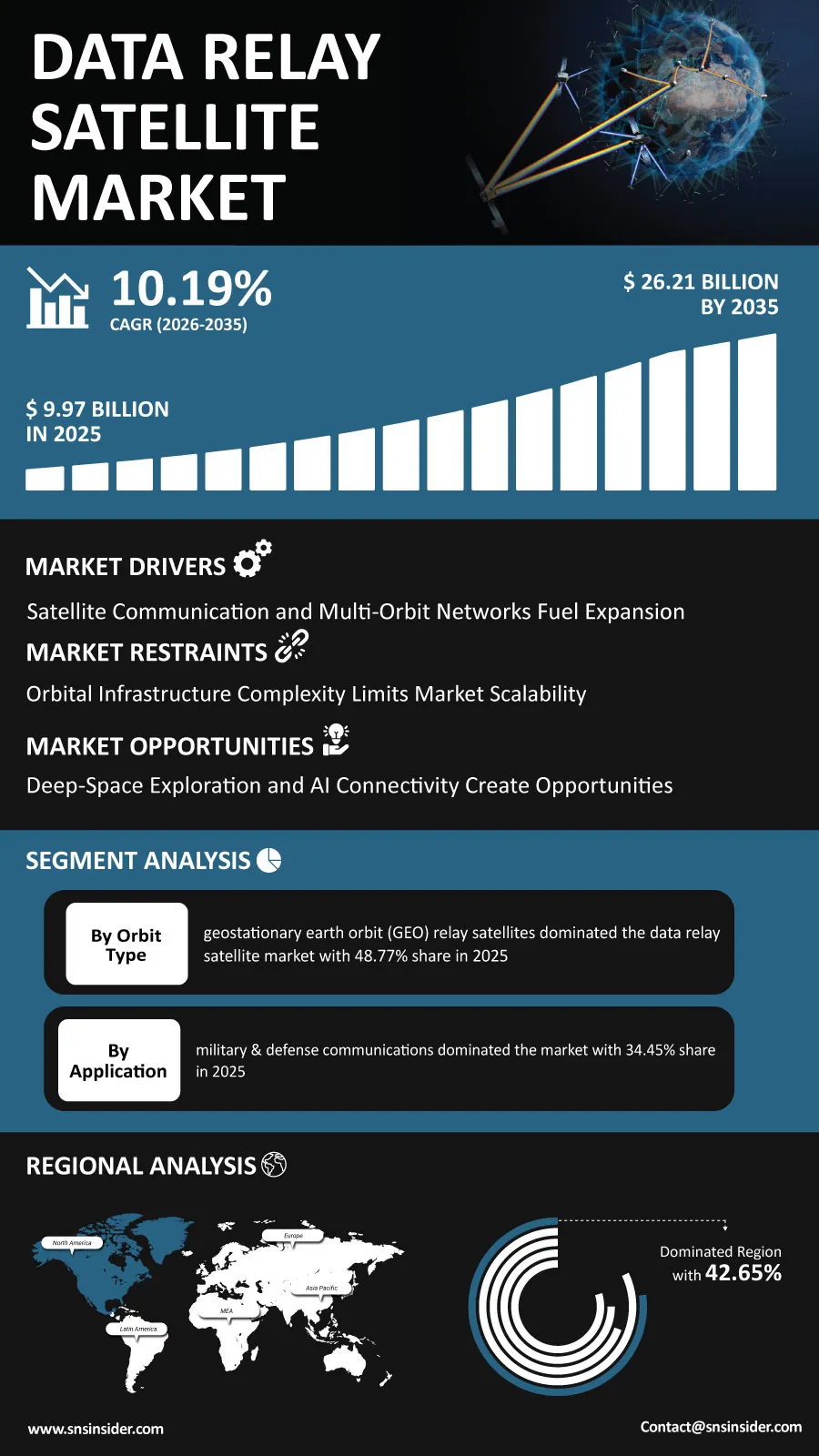
The global Data Relay Satellite Market is gaining momentum as space agencies, defense organizations, and commercial operators seek faster and more dependable ways to move information between satellites and terrestrial networks. “According to a recent study by SNS Insider, the global Data Relay Satellite Market size valued at USD 9.97 billion in 2025, is anticipated to grow to USD 26.21 billion by 2035, registering a CAGR of 10.19% over the 2026–2035 forecast period.”
The fast-paced development of Earth observation satellites, communication platforms, and LEO satellite constellations results in an increasing need for continuous data transmission. Modern operations become more and more reliant on communication infrastructure that can support high amounts of transmitted data independently of ground station visibility. This encourages investments into relay satellites, optical links, radio frequency systems, and network intelligence.
Another significant factor of the increasing need for space communications is the modernization of defense infrastructure. The necessity of real-time intelligence, surveillance, reconnaissance, command communications, and secure data exchange creates the need for reliable communication across complex orbital environments. At the same time, commercial space companies start investigating relay technology.
To Get Detailed Insights on the Data Relay Satellite Market – Request a Sample Report
Multi-Orbit Networks and Deep-Space Programs Open New Growth Opportunities
The proliferation of multi-orbital satellite configurations is creating new opportunities for relay systems. The integration of GEO satellites and LEO satellite constellations can result in increased coverage capabilities as well as increased responsiveness for applications where the quick delivery of information is necessary.
The area of deep space exploration represents another valuable application for relays. Missions to the Moon, planets and for scientific purposes create a great deal of data in terms of imagery, telemetry, scientific observations and operational information. Relay satellites would help establish communication linkages between spacecraft operating far from Earth and mission control facilities.
The evolution of inter-satellite communications via lasers will certainly revolutionize the sector even further. Optical communication provides high-capacity communication with low latency and reduced dependency on spectrum, which makes it an ideal choice for the future.
Key Market Insights Highlight Shifting Demand Patterns
Based on frequency band, Ka-band accounted for 31.56% of market revenue in 2025, reflecting its suitability for high-throughput satellite communications and data-intensive applications. S-band is expected to record the fastest growth through 2035 as smaller spacecraft, telemetry systems, and emerging satellite networks expand.
By orbit type, Geostationary Earth Orbit (GEO) relay satellites represented 48.77% of the market in 2025. Their broad coverage and established infrastructure continue to support mission-critical communications. LEO relay constellation nodes are forecast to grow at the fastest pace as satellite constellations increasingly require low-latency connectivity.
In terms of component, the space segment captured 62.36% of revenue in 2025. However, the user segment, including terminals, transceivers, and modems, is projected to experience faster growth as sophisticated ground and mobile communication equipment becomes more widely deployed.
By application, Military & Defense Communications held the leading 34.45% share in 2025. Meanwhile, Space Exploration & Deep Space Missions are expected to expand at the fastest rate as international lunar, planetary, and scientific programs increase.
Optical Communications and Autonomous Routing Accelerate Space Network Transformation
Innovations in technology have been transforming the way information is being communicated via satellite networks. The use of routing technologies that are supported by artificial intelligence would be useful in identifying the most effective paths of communication.
One other area of development is the optical inter-satellite links. The use of laser-based communications will be helpful in establishing very high speed of transmission of information through satellites for purposes of earth observations and various other uses.
There is a possibility of establishing more resilient satellite networks using hybrid RF/optical architectures. As the complexity of constellations increases, software defined networking, advanced terminals, phased array antennas, and autonomous network management will become key parts of the relay infrastructure.
North America Accounted for 42.65% Market Share in 2025; Asia Pacific Forecast to Expand at an 11.32% CAGR by 2035
North America had about 42.65% of the global Data Relay Satellite Market revenues in 2025, owing to robust space infrastructure, defense spending, presence of satellite companies, and various government space programs. The US is the main contributor, where demand ranges from earth observation, secure defense communications, and exploration missions.
The Asia Pacific region is expected to exhibit the highest CAGR of around 11.32% till 2035, owing to growth of space programs in China, India, Japan, and South Korea along with rising satellite constellations and defense modernization efforts.
Moreover, Europe is also investing in its space communications programs through various collaborations and development of optical data transmission. Additionally, the Middle East, Africa, and Latin American countries are gradually investing in satellite infrastructures for connectivity, earth observation, disaster monitoring, and national space programs.
Industry Participants Prioritize High-Capacity and Resilient Communication Systems
The competitive landscape is evolving as more aerospace and defense companies make investments in cutting-edge relay payloads, optical communications, multiple-orbit capabilities, and secure networking solutions. Collaboration between governments, satellite makers, and commercial space organizations is speeding up innovations in the aerospace sector.
Key companies operating in the global Data Relay Satellite Market include Lockheed Martin Corporation, Northrop Grumman Corporation, Airbus Defence and Space, Thales Group, Boeing, L3Harris Technologies, RTX Corporation, Maxar Technologies, SES S.A., Eutelsat Group, Telesat, Viasat Inc., Iridium Communications Inc., Kratos Defense & Security Solutions, Honeywell, OHB SE, Surrey Satellite Technology Ltd, Rocket Lab USA Inc., SpaceX, and China Satellite Communications Co., Ltd.
An SNS Insider analyst Santosh Bhul commented, “The convergence of proliferated satellite networks, optical communications, and autonomous data management is reshaping the architecture of space connectivity. As defense, Earth observation, and exploration missions demand faster and more resilient information exchange, investment in next-generation relay infrastructure is expected to remain strong through the coming decade.”
About the Author

Get in touch




