
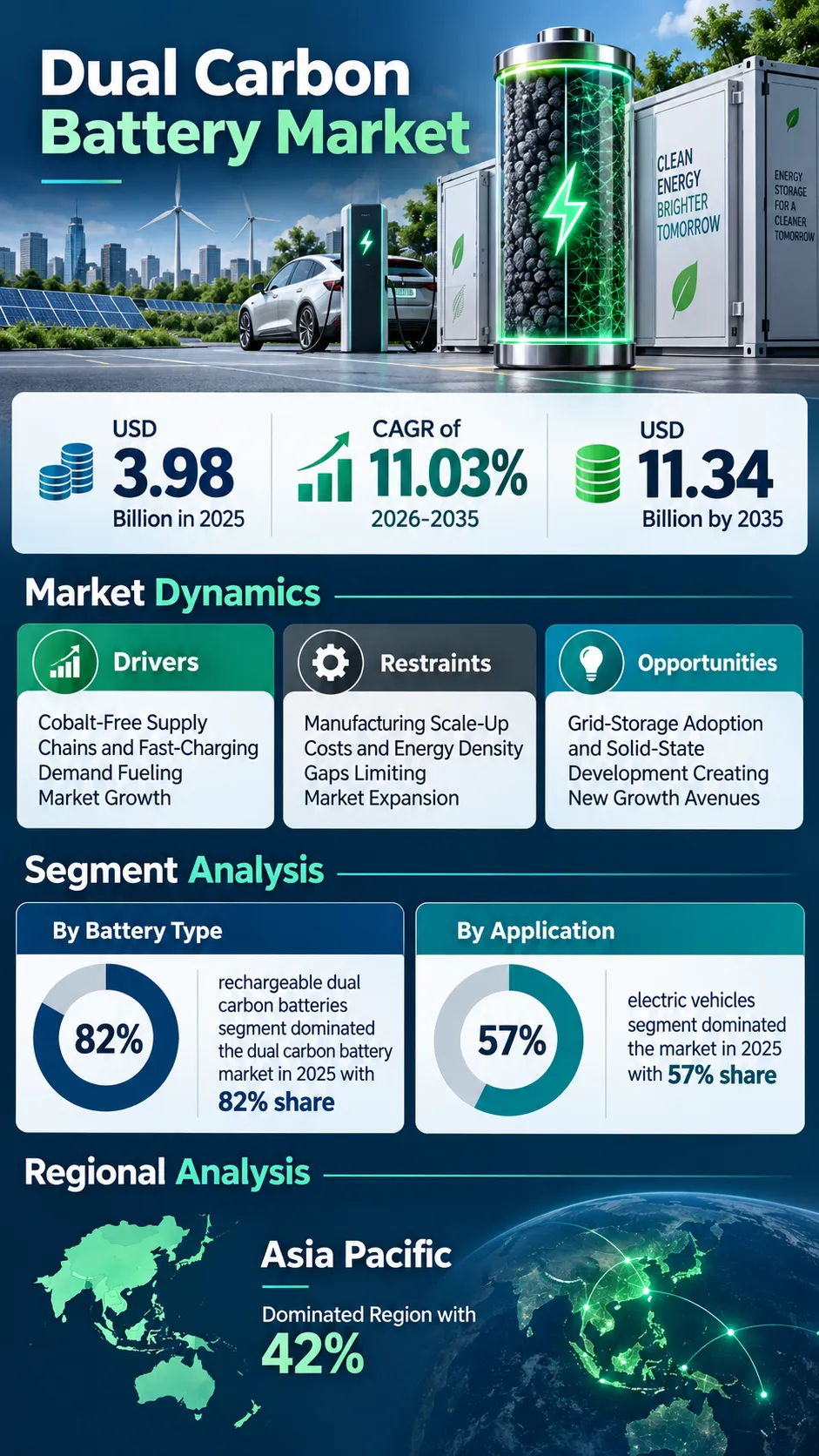
The global Dual Carbon Battery Market is gaining commercial momentum through 2035, as automakers and grid-storage developers look for alternatives to cobalt-dependent lithium-ion chemistry. “According to a recent study by SNS Insider, the global Dual Carbon Battery Market size valued at USD 3.98 billion in 2025, is anticipated to grow to USD 11.34 billion by 2035, registering a CAGR of 11.03% over the 2026-2035 forecast period.”
What was a research curiosity a decade ago is turning into a real commercial category, mostly because dual carbon chemistry solves two problems automakers and utilities both care about at the same time: charging speed and thermal safety. Neither problem is fully solved by conventional lithium-ion improvements alone, which is why several major automakers have started treating dual carbon modules as a complement to their existing battery packs rather than waiting for a full chemistry replacement.
Government incentive programs are accelerating that shift faster than market forces alone would manage, particularly in the U.S. and Japan, where policy support is helping early manufacturers clear the capital hurdle standing between pilot-scale production and genuine commercial volume.
To Get Detailed Insights on the Dual Carbon Battery Market – Request a Sample Report
Hybrid Pack Architecture Speeds Commercialization
Rather than waiting for dual carbon cells to match lithium-ion on every performance metric, several automakers are pairing dual carbon fast-charge modules with conventional high-energy lithium-ion cells in the same pack, capturing the charging-speed benefit immediately while energy density continues improving separately.
This hybrid approach is proving to be the more practical commercialization path, since it lets automakers integrate the new chemistry without redesigning entire vehicle platforms around it.
Materials suppliers and electrolyte developers are responding by optimizing specifically for hybrid-pack compatibility rather than standalone dual carbon systems, which is shaping where near-term R&D investment is concentrated.
Key Market Findings Highlight High-Growth Segments
Rechargeable dual carbon batteries held the largest share of the market in 2025, at 82%, reflecting strong demand from automotive and grid-storage buyers that need cells rated for thousands of charge cycles.
Primary dual carbon batteries are the fastest-growing battery type, expanding at a 13.40% CAGR, pulled forward by disposable electronics and industrial sensor applications where carbon-based chemistry offers a cleaner end-of-life profile.
By application, electric vehicles led with 57% share in 2025, while energy storage systems are growing fastest at a 15.80% CAGR as utilities prioritize chemistries with lower thermal runaway risk.
Liquid electrolyte formulations remained dominant at 64% share, but solid electrolyte formats are expanding fastest, at a 16.90% CAGR, as manufacturers chase improved cold-climate performance.
Safety and Charging Speed Anchor Competitive Positioning
Manufacturers are increasingly competing on two specific metrics, charge rate and thermal stability, rather than the broader performance claims that dominated the category's early research years.
Investment in electrolyte chemistry and solid-state development is becoming the clearest differentiator among manufacturers, particularly as cold-climate performance gaps close and cycle-life claims become easier to verify at commercial scale.
This narrower competitive focus is likely to sharpen further as the market matures.
Asia Pacific Leads as North America Accelerates Fastest
Asia Pacific holds the largest share of global market revenue, reflecting the region's early technological lead and deep base of battery materials research concentrated in Japan. North America, meanwhile, is growing fastest, propelled by federal incentive programs and a wave of new conditional offtake agreements between automakers and domestic dual carbon start-ups.
Europe holds a smaller but steadily developing share, shaped by automotive electrification mandates that are pushing automakers to evaluate the chemistry even where commercial adoption remains cautious.
Leading Companies Drive Innovation and Competition
Competition in this market spans both dedicated dual carbon start-ups and major battery manufacturers exploring the chemistry as a complement to their existing lithium-ion portfolios, with electrolyte innovation emerging as the clearest area of differentiation.
Some of the major companies that operate in the global dual carbon battery market are PJP Eye Ltd., JSR Corporation, Hitachi, Ltd., Contemporary Amperex Technology Co. Limited (CATL), BYD Company Limited, LG Energy Solution Ltd., Panasonic Holdings Corporation, Samsung SDI Co., Ltd.
An SNS Insider Analyst commented, “Dual carbon battery technology has moved past the proof-of-concept stage and into genuine commercial adoption, particularly where automakers and utilities are willing to pair it with existing lithium-ion infrastructure rather than waiting for a full replacement. Manufacturers that can scale solid-state electrolyte production while holding onto the chemistry's inherent safety advantage are the ones best positioned to lead as the category matures.”
About the Author

Get in touch




