
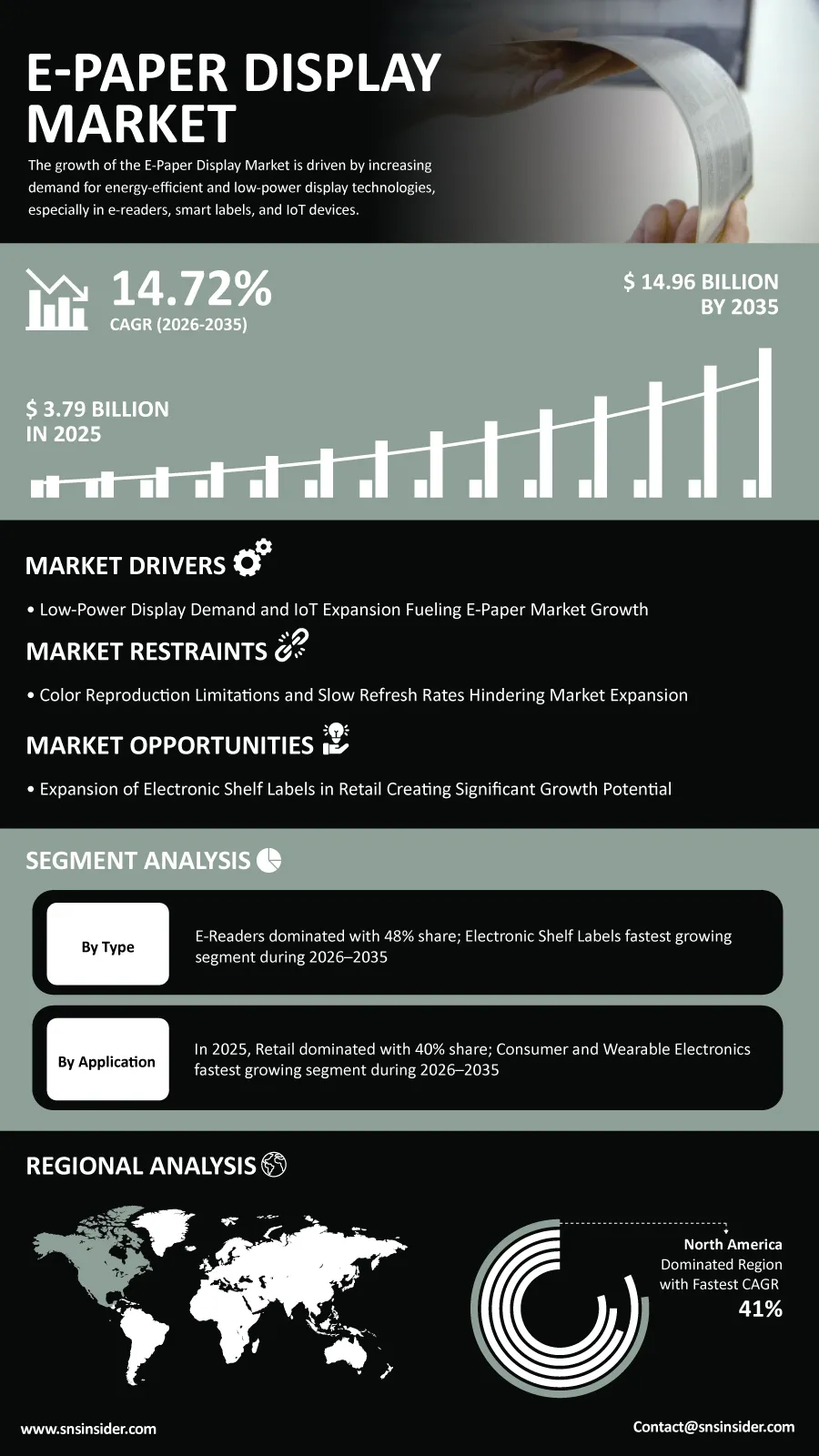
The global E-Paper Display Market is entering a high-growth phase as industries search for display solutions that offer high energy efficiency, durability, and better readability. According to a recent study by SNS Insider, the global Electronic Paper Display Market size valued at USD 3.79 billion in 2025, is anticipated to grow to USD 14.96 billion by 2035, registering a CAGR of 14.72% over the 2026–2035 forecast period.
With the trend towards connected retail, intelligent logistics, wearables, and digital communication, there is a greater possibility for the use of reflective displays. Contrary to traditional display devices, which need constant electrical power to show content, e-paper display technology requires very little electricity to keep the displayed data active.
Businesses, technology firms, schools, and logistics companies have been exploring e-paper technology, given their pursuit of greener businesses and connected customer experiences. Advancements in the flexibility of substrates, colors, and smaller display modules have only added value to the technology.
To Get Detailed Insights on the Electronic Paper Display Market – Request a Sample Report
Smart Retail and IoT Expansion Creates New Growth Opportunities
The increasing digitalization of the retail sector is generating a sizeable addressable market for electronic shelf labels. The trend towards replacing paper price tags with wireless devices that allow central management and dynamic pricing has been gathering pace recently.
The growth in IoT systems is contributing to the demand for e-paper displays. These displays can be an effective graphical interface for use with smart tags, logistic trackers, health care equipment, and home automation products where long battery life is an important factor.
In addition, efforts aimed at increasing sustainability have made organizations look into ways of cutting down their paper consumption in signage, transportation, education, and organizational communication. This presents more opportunities for companies to make use of their display technology.
Key Market Insights Highlight Shifting Demand Patterns
By type, e-readers segment accounted for around 48% of global market revenue in 2025, supported by continued demand for portable digital reading devices offering comfortable viewing and extended battery life. Electronic shelf labels segment is projected to be the fastest-growing type by 2035 as retailers accelerate store automation and adopt real-time pricing and inventory management systems.
Based on application, retail segment dominated with around 40% share of the market revenue in 2025, driven by increasing deployment of electronic shelf labels and digital retail displays. Consumer and wearable electronics segment is expected to experience the fastest growth through 2035 as manufacturers integrate low-power reflective screens into smart devices, wearable products, and connected consumer applications.
The emergence of flexible and colored e-paper has also increased the prospect of diversification. Enhanced display technologies have also made it possible for manufacturers to develop products outside the traditional area of use such as packaging, signage, connected cards, and wearable technology.
Energy Efficiency Remains a Core Market Differentiator
One of the most significant advantages of the e-paper technology is its capability of functioning at an extremely low power level. This is especially beneficial for those products which should work for long periods of time while being continuously charged or having their batteries replaced.
However, issues relating to refresh rates and colors persist, thereby limiting the use of the technology in contexts where smooth movement or bright colors are necessary. It is expected that further research in material science and display technology will help solve this issue.
North America Holds 41% Electronic Paper Display Market Share in 2025 as Asia Pacific Grows at a 9.21% CAGR Through 2035
North America will continue to dominate the regional market with an estimated revenue share of about 41% in 2025. Technology adoption, e-reader penetration, advanced retail system and growing use of electronic shelf labels are helping the region maintain its lead.
The Asia Pacific region will emerge as the fastest growing market with a CAGR of 9.21% during the forecast period up until 2035. Rapid urbanization, increasing adoption of IoT, electronics manufacturing facilities, and growing investments in smart retail and sustainable solutions are creating conducive environment in China, Japan, India, and other economies of the region.
Similar demand trends can be seen in Europe where retailers are adopting electronic shelf labels to reduce paper waste. At the same time, Latin America and Middle East & Africa are slowly but surely adopting electronic shelf label systems through modernized retailing, smart city initiatives, digital signage, and energy efficient technologies.
Industry Participants Focus on Flexible and Connected Display Innovation
The competitive landscape is evolving as display manufacturers expand their portfolios through flexible substrates, improved color reproduction, thinner modules, and connected display solutions. Companies are also increasing production capacity and developing application-specific products to capture opportunities in retail, wearables, smart packaging, and IoT ecosystems.
Key companies operating in the global Electronic Paper Display Market include E Ink Holdings, Sony Corporation, LG Display, Pervasive Displays, Plastic Logic, CLEARink Displays, Visionect, OED Technologies, Tianma Microelectronics, Hanvon Technology, Witdisplay, E Ink Corporation, Reed Exhibitions, Glo E-Paper, Pioneer, Shenzhen Teyang Technology, Dai Nippon Printing, Kyocera Corporation, and Avi-on.
An SNS Insider analyst Sushant Kadam commented, “The combination of ultra-low energy consumption, improved display innovation, and growing digitalization across retail and connected devices is creating a strong foundation for e-paper adoption. As flexible and color technologies mature, manufacturers that successfully address performance limitations while delivering scalable solutions for high-volume applications will be well positioned to capture emerging opportunities.”
About the Author

Get in touch




