
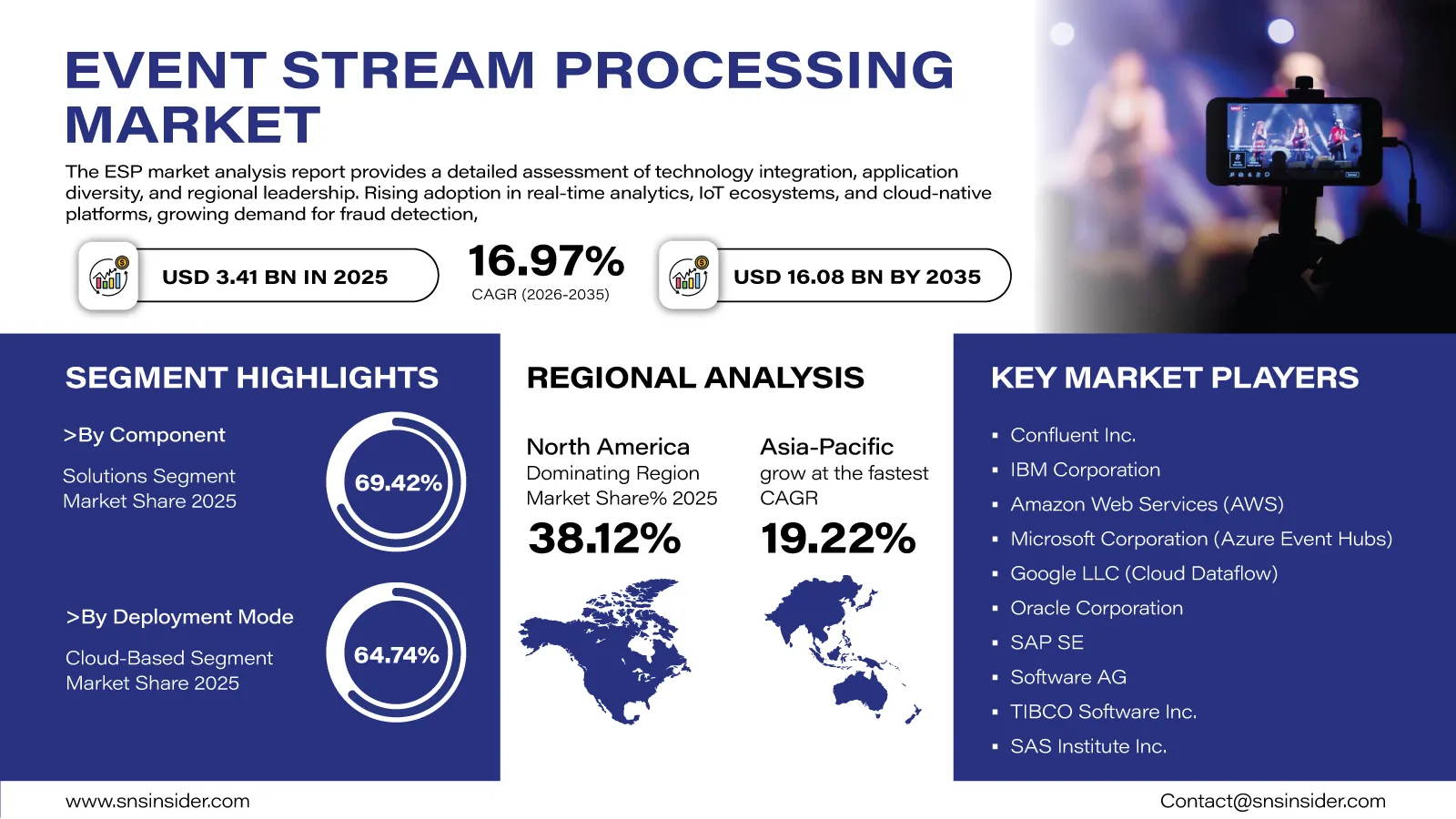
The global Event Stream Processing (ESP) Market is witnessing rapid expansion as enterprises increasingly prioritize real-time data intelligence to improve operational efficiency, customer experiences, and business decision-making. “According to a recent study by SNS Insider, the global Event Stream Processing Market size valued at USD 3.41 billion in 2025, is anticipated to grow to USD 16.08 billion by 2035, registering a CAGR of 16.97% over the 2026–2035 forecast period.”
The organizations have embraced the event-driven architecture at an accelerated pace for analyzing the steady flow of information created by the interconnected devices, financial transactions, software applications, and industrial processes. The rising requirement for making instant decisions has made the event stream processing a very important technology in the fields of fraud detection, preventive maintenance, and customer profiling.
To Get Detailed Insights on the Event Stream Processing Market – Request a Free Sample Report
Deployment patterns in the cloud-native era, artificial intelligence, and IoT are driving even faster adoption. Companies are combining ESP solutions with machine learning algorithms and edge computing to process millions of events per second while increasing scalability and responsiveness of their operations.
Real-Time Intelligence and Cloud Innovation Create Long-Term Growth Opportunities
Organizations are making major strides towards digital transformation through initiatives based on consistent data processing for greater visibility and faster results. Banks, producers, telecommunication companies, and retailers have stepped up investments in platforms supporting intelligent processing of large volumes of data in real-time.
The growth of devices and infrastructures that support IoT technology also opens new possibilities for ESP vendors as organizations start deploying IoT-ready devices in factories, logistics systems, healthcare facilities, and smart cities, and hence continue to require platforms that will help to process complex data streams closer to the source of data.
Simultaneously, improvements in areas such as artificial intelligence, cloud computing, and managed stream processing are helping organizations create scalable and highly reliable environments for processing data.
Key Market Insights Highlight Shifting Demand Patterns
Considering the component, solutions are predicted to contribute around 69.42% of total market revenue for the year 2025 due to wide use of real-time streaming platforms in enterprises for data integration, analytics, and transaction monitoring. The services component is predicted to have the fastest growth rate till 2035 because of growing demands for consulting and implementation expertise in order to create a proper streaming environment.
Deployment mode wise, the cloud deployment mode is estimated to contribute 64.74% of total revenue in the market of 2025 due to its scalability, cost-effectiveness, and ability to integrate with AI and IoT ecosystem. Cloud deployment is also estimated to grow at the fastest rate during the forecast period as companies shift to cloud-native deployment mode.
Considering the type, data integration had 54.83% market share in the year 2025 due to high demand for continuous data integration and processing. The analytics category is predicted to grow at the fastest rate through 2035 as businesses will demand more and more predictive analysis, anomalies detection and intelligent automation.
On the basis of application, fraud detection and risk analytics had 34.86% market share in 2025 while the predictive maintenance is predicted to be the fastest-growing application as businesses will engage in industrial automation processes. On the end-user basis, the BFSI industry held 29.97% market revenue share in 2025 while retail and e-commerce will become the fastest-growing industries in the forecast period.
Advanced Streaming Technologies Accelerate Industry Transformation
The event stream processing market is experiencing rapid change as vendors keep improving their streaming technologies through advanced tools like artificial intelligence and machine learning as well as becoming cloud-native. Today’s ESPs provide faster processing, intelligent automation, improved security, and real-time analytics for mission-critical business processes in heavily regulated sectors.
Businesses are using increasingly complex streaming ecosystems that can operate in hybrid cloud and edge computing settings, perform analytics based on artificial intelligence algorithms. These developments allow companies to gain competitive advantage through resilience improvement, reduced response times, better cybersecurity and higher business value from continuous data flow.
Regional Markets Demonstrate Strong Growth Potential
The North American region is anticipated to capture a market share of 38.12% in the year 2025 due to early adoption of cloud native technologies, robust digital infrastructure, and high level of implementation in BFSI, telecoms, retail and technology industries. Continuous investments in artificial intelligence, cybersecurity and modernization of enterprise have been driving regional leadership.
The Asia Pacific region is predicted to emerge as the fastest growing regional market till 2035 with acceleration of digital transformation initiatives in China, India, Japan, and South Korea. The growth in implementation of IoT, smart manufacturing, fintech and smart cities initiatives is driving the need for advanced event processing solutions.
The European region is another important regional market that has witnessed increasing adoption of Industry 4.0 technologies, growing regulatory compliance needs for real-time compliance and increasing usage of predictive analytics in manufacturing, BFSI and telecom industries. On the other hand, Latin America and the Middle East & Africa region have shown increasing adoption through investment in digital banking, cloud computing, and connected enterprise technologies.
Industry Participants Focus on Innovation and Intelligent Data Streaming Solutions
The competitive landscape remains highly dynamic as leading technology companies continue investing in cloud-native event streaming platforms, artificial intelligence integration, real-time analytics, and enterprise automation capabilities. Product innovation, strategic partnerships, and expansion of managed streaming services are enabling vendors to strengthen their market positions while addressing growing enterprise demand for scalable, secure, and intelligent data processing solutions.
Key companies operating in the global Event Stream Processing Market include Confluent Inc., IBM Corporation, Amazon Web Services (AWS), Microsoft Corporation (Azure Event Hubs), Google LLC (Cloud Dataflow), Oracle Corporation, SAP SE, Software AG, TIBCO Software Inc., SAS Institute Inc., Apache Software Foundation, StreamSets Inc., Cribl Inc., Hazelcast Inc., EsperTech Inc., Red Hat Inc., Cloudera Inc., DataStax Inc., Informatica Inc., and Imply Inc.
An SNS Insider analyst Sakshi Kale commented, "The increasing reliance on real-time business intelligence, AI-driven automation, and cloud-native data architectures is transforming the Event Stream Processing market into a foundational technology for modern enterprises. Organizations investing in scalable streaming platforms, intelligent analytics, and integrated event-driven ecosystems will be well positioned to capitalize on the next generation of digital innovation."
About the Author

Get in touch




