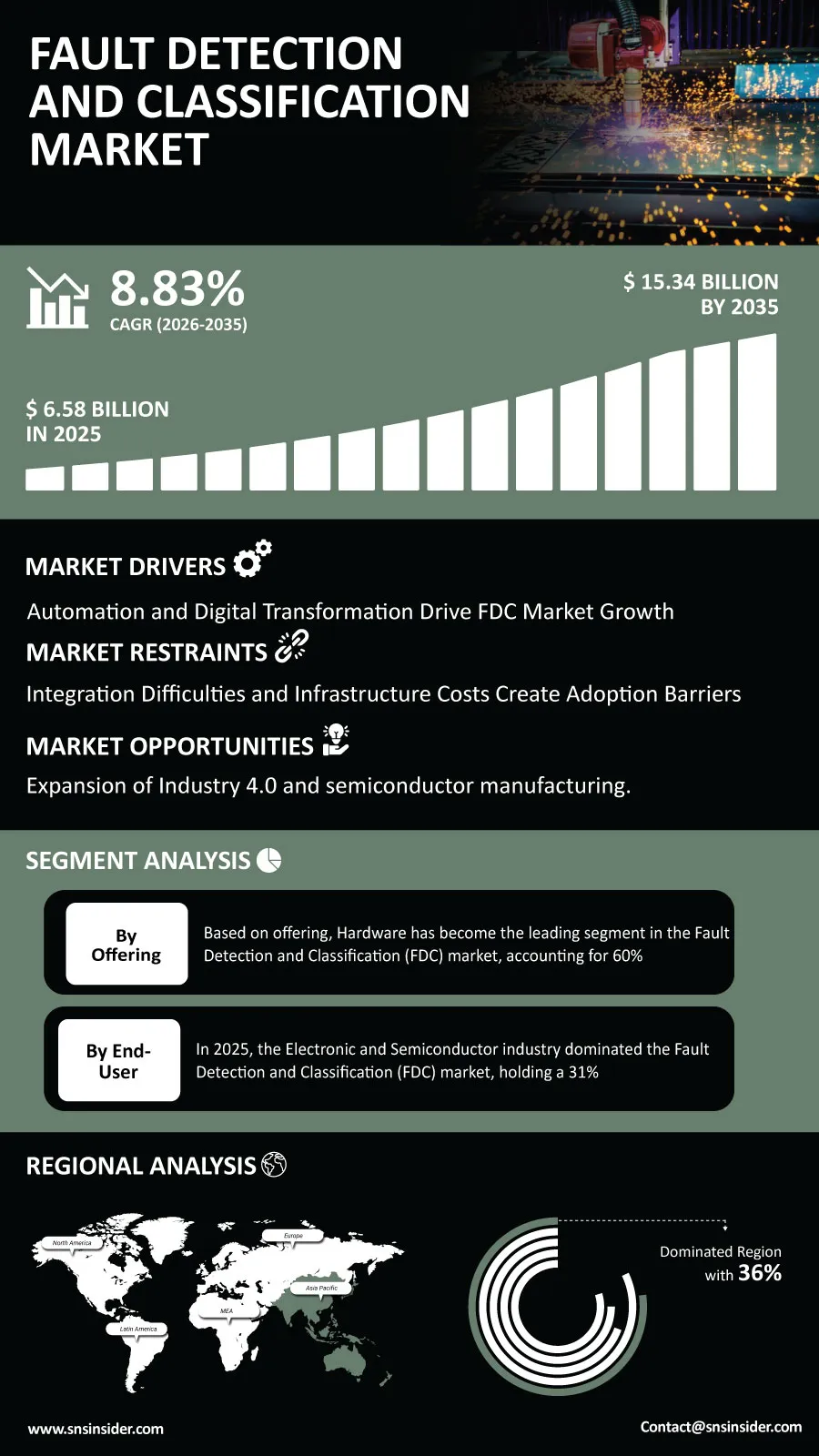
The worldwide Fault Detection and Classification Market is experiencing robust growth as manufacturers increase investments in automated quality assurance, predictive maintenance, and intelligent manufacturing solutions. According to a recent study by SNS Insider, the global Fault Detection and Classification (FDC) Market size valued at USD 6.58 billion in 2025, is anticipated to grow to USD 15.34 billion by 2035, registering a CAGR of 8.83% over the 2026–2035 forecast period.
Companies involved in manufacturing electronics, semiconductors, automobiles, energy, and many more industries are increasingly turning to digital monitoring tools to detect any irregularities in their machines and processes before this result in expensive failures. Using sensors, big data analytics, and artificial intelligence, businesses can evolve from being reactive to proactive when it comes to machine and process monitoring.
Increased complexity in the production environment is also causing the need for diagnostic automation to grow. As more complex manufacturing machines are introduced into the manufacturing environment, FDC technology has become an increasingly vital tool in ensuring process stability and preventing deviations in quality.
To Get Detailed Insights on the Fault Detection and Classification (FDC) Market – Request a Sample Report
Smart Manufacturing Investments Create New Growth Opportunities
The increasing usage of Industry 4.0 technology is providing an enabling environment for FDC technology. Manufacturers are linking their equipment with Industrial Internet of Things and implementing analytics at the edge that will allow processing of data close to where the data originates and any anomaly detected can be acted upon immediately.
Moreover, cloud-based and hybrid systems are increasing the market potential through the ability to aggregate manufacturing intelligence and compare performance of operations at different locations within an enterprise having more than one plant facility. This is especially beneficial for those companies which desire to standardize their quality control process.
Another valuable use case is enabled by predictive maintenance through artificial intelligence. Through the analysis of historical patterns and live data from the machines, an FDC system can assist the maintenance team to spot equipment issues before they arise.
Key Market Insights Highlight Shifting Demand Patterns
Through its provision, it is anticipated that hardware will continue to dominate as the top segment, contributing roughly 60% of worldwide revenues in 2025. Sensors, controllers, and diagnostics devices provide the backbone of automated fault monitoring technology, which facilitates ongoing measurement of various parameters of operations such as temperature, pressure, vibrations, and electricity.
From an end-user standpoint, the electronics and semiconductors sector is forecasted to capture a market share of 31% in 2025. Growth in demand for semiconductor manufacturing technology due to their complex nature and narrow margins of error involved in fabrication is responsible for this growth.
The significance of this segment is further enhanced through the ongoing investments in automated inspection, process improvements, and modern manufacturing plants. Through these investments, semiconductor manufacturers are trying to increase yield while reducing manufacturing losses and need for automated fault classification technology.
AI and Predictive Analytics Strengthen Industrial Quality Control
Machine learning integration in FDC systems is revolutionizing how manufacturers view their equipment's reliability and production processes in terms of quality. Rather than relying on pre-defined set points only, intelligent systems can analyze trends in big operational data sets and detect anomalies that could signal potential issues.
Integration with machine vision, Industrial IoT sensors, and advanced process control system will also be assisting in quicker response. This integration will help in identifying the faults and determining its probable cause at the same time when the manufacturing process is still ongoing.
As organizations focus more on reducing downtime and ensuring steady production, the demand for connected fault monitoring is forecasted to stay high.
Asia Pacific Secures 36% Market Share in 2025 Through Growing Semiconductor and Smart Factory Investments
The Asia-Pacific is anticipated to continue dominating the regional market and account for about 36% of total global revenue share by 2025. The robust presence of manufacturing facilities, increase in semiconductor production, and the implementation of smart-factory technology in the region have been driving the demand for automated fault detection and classification systems. China, Japan, and South Korea will continue contributing significantly as manufacturers adopt sophisticated infrastructure for production.
North America is yet another dominant market, driven by high expenditure on industrial automation, predictive maintenance, artificial intelligence, and digital manufacturing. The established technological ecosystem, along with the objective of increasing production efficiency, has been encouraging enterprises to implement advanced diagnostic systems.
Europe is also experiencing growth in terms of Industry 4.0 implementation and high quality requirements in the automotive, aerospace, electronics, and industrial manufacturing industries. Latin America and the Middle East and Africa regions are slowly gaining momentum due to industrial modernization and digital infrastructure investments.
Industry Participants Focus on Intelligent Diagnostic Solutions
In such competitive environment, the companies providing solutions for the mentioned areas are increasing their competencies in such areas as industrial automation, semiconductor inspection, machine vision, cloud computing, and artificial intelligence. The major emphasis is made on platforms that are able to integrate sensing, data processing, anomaly detection, and predictive maintenance.
Key companies operating in the global Fault Detection and Classification (FDC) Market include ADVANTEST CORPORATION, Amazon Web Services, Inc. (AWS), Applied Materials, Inc., CIM Environmental Pty Ltd., Cognex Corporation, einnoSys Technologies Inc., INFICON, KILI TECHNOLOGY, KLA Corporation, Microsoft, MobiDev, OMRON Corporation, Qualitas Technologies, SAMSUNG SDS, Siemens AG, Synopsys, Inc., Teradyne Inc., and Tokyo Electron Limited.
An SNS Insider analyst Sushant Kadam commented, “The transition toward intelligent manufacturing is making real-time fault identification increasingly central to industrial quality management. As manufacturers seek to reduce downtime, improve yields, and manage increasingly complex production environments, FDC providers that combine AI-driven diagnostics with connected industrial infrastructure are positioned to capture substantial long-term opportunities.”
About the Author

Get in touch