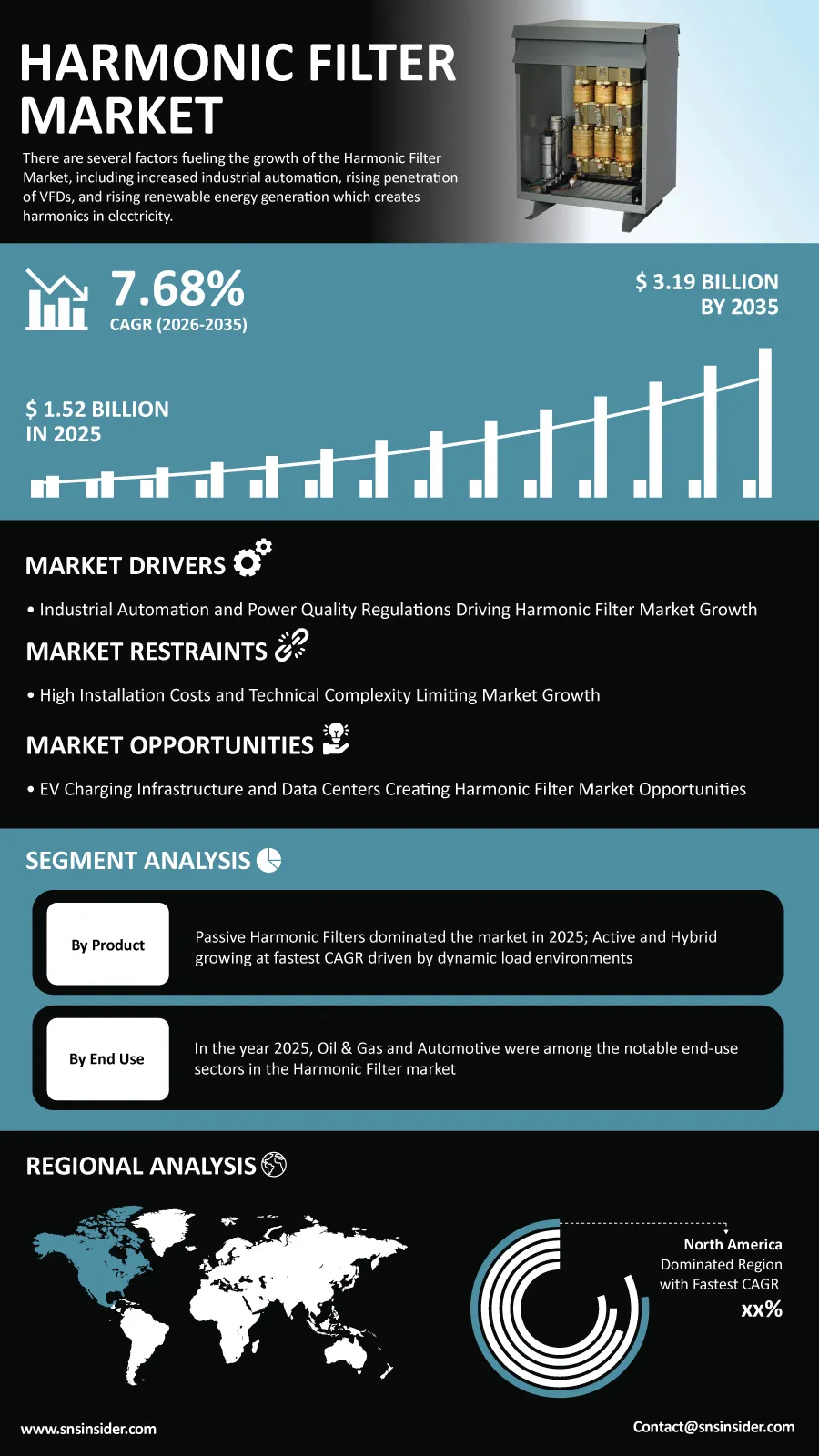
The global Harmonic Filter Market is entering a period of steady expansion as industries, utilities, and infrastructure operators place greater emphasis on power quality, grid stability, and energy-efficient electrical systems. According to a recent study by SNS Insider, the global Harmonic Filter Market size valued at USD 1.52 billion in 2025, is anticipated to grow to USD 3.19 billion by 2035, registering a CAGR of 7.68% over the 2026–2035 forecast period.
Due to the increased use of industrial automation, variable speed drives, and power electronics devices, the number of non-linear loads in electrical systems is growing. Simultaneously, the emergence of new needs in relation to the proper handling of harmonics and uninterruptible electrical performance has appeared because of the data centers, renewable energy sources, semiconductor factories, and electric vehicle charging stations.
In addition, stricter power quality standards and understanding of energy losses related to electrical distortions contribute to the modernization of power systems at enterprises. As industries become more dependent on digital technologies, harmonic control has become an integral part of electrical system design.
To Get Detailed Insights on the Harmonic Filter Market – Request a Sample Report
Industrial Electrification and Digital Infrastructure Create New Growth Opportunities
The swift development of automated manufacturing is spurring the need for harmonic filters. The presence of motors, drives, robots, and power conversion systems within industrial environments may cause harmonics in electricity networks.
Building of hyperscale data centers is another area of demand. Large amounts of computer devices and power conversion systems need an adequate environment in order to operate successfully and not to break down. In the same vein, there are EV charger stations and renewable power generation projects, which offer prospects of utilizing harmonic filters because of growing electrification.
Renewable electricity development is also fueling the growth of the industry. Photovoltaic systems, wind farms, and battery energy storage systems involve inverters that need power quality management to operate effectively.
Key Market Insights Highlight Shifting Demand Patterns
By product, passive harmonic filters were expected to retain their leading position in 2025 due to their established use in industrial facilities and comparatively economical deployment. Active and hybrid harmonic filters are projected to register the fastest growth as industries increasingly require dynamic compensation solutions capable of responding to continuously changing electrical loads.
Based on voltage level, low-voltage systems were anticipated to dominate the market in 2025, supported by extensive deployment across commercial buildings, industrial facilities, and smaller electrical installations. Medium-voltage harmonic filters are expected to witness the fastest growth as utilities and large industrial users invest in higher-capacity power quality solutions for renewable energy projects, manufacturing facilities, and infrastructure applications.
By end use, oil and gas and automotive industries remain significant contributors to demand due to their extensive reliance on high-power machinery, variable frequency drives, and automated production systems. The semiconductor industry is expected to experience the fastest growth as new fabrication facilities require highly stable electrical environments and increasingly sophisticated power quality management.
Power Quality Management Becomes a Strategic Priority
Harmonic filtering is gradually moving from an application that is required in electrical engineering to a need in energy management. The manufacturers have become more interested in solutions that will help them cut down electrical losses, increase their equipment's efficiency, and reduce downtime due to low power quality.
The development of smart active filtering systems is helping facilitate this trend. Such systems are able to adapt to the variations in load requirements, and therefore, such applications are ideal for industrial plants where there are variations in production requirements.
Moreover, there has been increased adoption of connected monitoring systems which enable the detection of issues with power quality based on electrical data.
North America Leads the Harmonic Filter Market with the U.S. Contributing 88% of Regional Revenue
North America is anticipated to retain its dominant position in the global Harmonic Filter Market owing to industrial automation, data center establishment, renewable energy installation, and high standards of power quality. The United States continues to be the leading market in the region, representing around 88% of total North American revenues due to upgrades in electricity supply systems.
The Asia-Pacific region is likely to witness the highest growth rate up until 2035. The fast growing manufacturing sector, along with automation, semiconductor industry, and renewable energy installations, have created significant demand for harmonics filtering solutions in China, India, Japan, South Korea, and other countries.
As industrial electrification accelerates and power networks accommodate increasingly complex loads, demand for advanced filtering solutions is expected to rise across the region.
Industry Participants Focus on Advanced Power Quality Solutions
The competitive landscape remains active as manufacturers expand their portfolios with intelligent, compact, and application-specific harmonic mitigation technologies. Companies are concentrating on improving compensation performance, simplifying installation, and developing solutions capable of supporting dynamic electrical environments.
Key companies operating in the global Harmonic Filter Market include ABB Ltd., Schneider Electric SE, Eaton Corporation plc, Siemens AG, Emerson Electric Co., Danfoss A/S, Comsys AB, TDK-Lambda Corporation, Schaffner Holding AG, MTE Corporation, Sinexcel Power Co. Ltd., Sieyuan Electric Co. Ltd., Delta Electronics Inc., Honeywell International Inc., General Electric Company, Rockwell Automation Inc., Yaskawa Electric Corporation, Kehua Tech Co. Ltd., Mirus International Inc., and REFUsol GmbH.
An SNS Insider analyst Sushant Kadam commented, “The growing concentration of power electronics across industrial facilities, data centers, EV charging networks, and renewable energy systems is making power quality management increasingly critical. Providers that combine dynamic harmonic compensation, intelligent monitoring, and application-specific engineering will be well positioned to capture emerging opportunities as electrical infrastructure becomes more complex.”
About the Author

Get in touch