
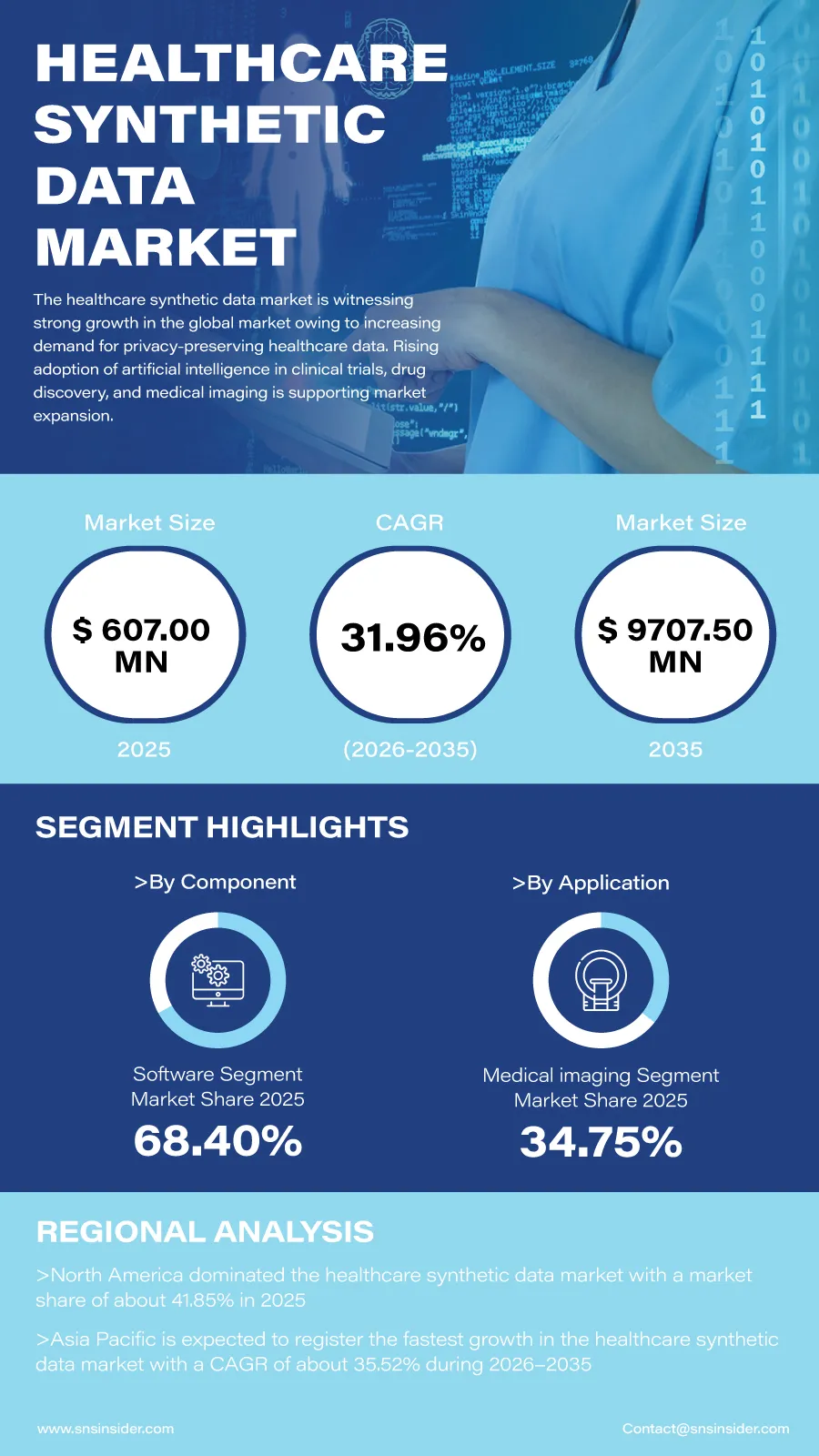
The global Healthcare Synthetic Data Market is poised for exceptional growth as healthcare organizations increasingly adopt privacy-preserving data solutions to support artificial intelligence, clinical research, and advanced healthcare analytics. “According to a recent study by SNS Insider, the global Healthcare Synthetic Data Market size valued at USD 607.00 million in 2025, is anticipated to grow to USD 9707.50 million by 2035, registering a CAGR of 31.96% over the 2026–2035 forecast period.”
The global opportunities for synthetic data solutions across the world exist due to rapid digitalization of healthcare space and increase in demand for secure data sharing methodologies. Hospitals, pharmaceutical companies, biotechnology firms and research organizations: All of them leverage AI for high-level decision-making with innovation and operational optimization at its core without compromising patient privacy.
As digital health tools continue to evolve, the need for synthetic data sets only becomes more significant when you look at AI solutions and how they fit into the constantly shifting legislative and ethical landscape surrounding healthcare information.
To Get Detailed Insights on the Healthcare Synthetic Data Market – Request a Free Sample Report
AI Innovation and Digital Healthcare Fuel Market Expansion
Healthcare providers are progressively embracing artificial intelligence applications in sectors including diagnostics, predictive analytics, healthcare research, and population health management. Such a revolution requires access to diverse sets of high-quality data for complex machine learning applications without the jeopardy of patient privacy.
Recent advancements in generating high-quality realistic synthetic health care data driven by generative AI technology, cloud computing, and data engineering have enabled companies to create realistic health care data sets without any requirement for ex-do-facto example facts. These innovations help healthcare researchers to improve algorithms, appraise new ways of doing things, and progress their research in several medical sectors.
Cooperation among tech companies, healthcare organizations, and life science firms are getting more advances the new fake data platforms.
Key Market Findings Highlight Emerging Growth Opportunities
Among market components, The software segment account for the largest share of 68.40% in terms of revenue from the overall healthcare datasets generator market in 2025 due to high demand for platforms supporting creation and maintenance of synthetic healthcare datasets Simultaneously, services to witness highest CAGR of 34.33% over the forecast period until 2035, owing to growing implementation, validation, consulting and managed data demand.
From an application perspective, medical imaging was projected to be 34.75% of overall revenue share in this market by 2025 indicative for growing importance of AI based image analysis in contemporary healthcare systems over the forecast period. On the other hand, during the forecast period the drug discovery is projected to register the fastest CAGR of 36.94% as synthetic datasets are widely used for better understanding and fostering pharmaceutical R&D activities.
By data type, the structured data segment to achieve 56.80% of the market revenues in 2025 due to its high applicability in a variety of healthcare databases and digital records. However, due to the increasing demand for AI models capable of analyzing medical images, physicians' notes, and pathology reports - unstructured data is projected to be the fastest growing data type; this growth will expand its share with a highest CAGR of 36.97%.
Among end users, pharmaceutical and biotechnology companies held 38.90% of total global revenue. On the other hand Highest CAGR (35.93%upTo2035) growth is expected for The research & academic institutions as well.
An Infographic Representation of the Global Healthcare Synthetic Data Market
Privacy-First Healthcare Strategies Continue to Drive Adoption
Healthcare organizations around the world are prioritizing harnessing their data responsibly and preserving all privacy regulations. Using synthetic data solutions enables them to collaborate, build AI models and research without exposing patient data.
Given the rising healthcare cloud platforms, digital health systems, and analytics; it is time to deliver on par of privacy- safekeeping data technologies.
As we move towards more precision medicine and artificial intelligence in healthcare the use of synthetic datasets will be a huge component.
Regional Markets Present Significant Growth Opportunities
North America accounted for the largest market share in 2025, is marked with around 41.85% as that it holds a leading as state-of-the-art digital health infrastructure, broader adoption of AI across operations and ongoing innovation in healthcare technology. This area will continue to be a baby of education, doling out AI research, pharmaceuticals, and overhaul in digital health.
Meanwhile, The Asia-Pacific region will be the fastest growing regional market over a decade, anticipated to grow at a CAGR of 35.52% until 2035. This region will be a good opportunity given the rapid Digitalization of Healthcare, research studies on biotechnology, investments in AI, and the extremely supportive work done by government in building digital health infrastructure.
Industry Leaders Continue to Expand AI Capabilities
Competition within the healthcare synthetic data market continues to intensify as technology companies, cloud service providers, and healthcare innovators strengthen their artificial intelligence capabilities through strategic partnerships, platform development, and investment in advanced data technologies.
Key companies operating in the global healthcare synthetic data market include Microsoft, Google, Amazon Web Services, Oracle, IBM, NVIDIA, IQVIA, HealthVerity, TriNetX, and Epic Systems.
An SNS Insider analyst Parry Kardani commented, "Healthcare synthetic data is becoming a foundational technology for the future of AI-driven healthcare. As organizations seek to balance innovation with patient privacy, synthetic datasets will play an increasingly important role in advancing clinical research, accelerating drug development, and supporting responsible artificial intelligence across the healthcare ecosystem."
About the Author

Get in touch




