
According to the latest SNS Insider Laminating Adhesives Market report, the global market is moving into a steady growth phase as packaging converters, food and pharmaceutical brands, and industrial manufacturers redesign laminated structures for performance and recyclability. Laminating adhesives make up a small share of the packaging value chain, but every multilayer pouch, lidding film, and sachet depends on them to bond films, foils, and paper into a single working structure.
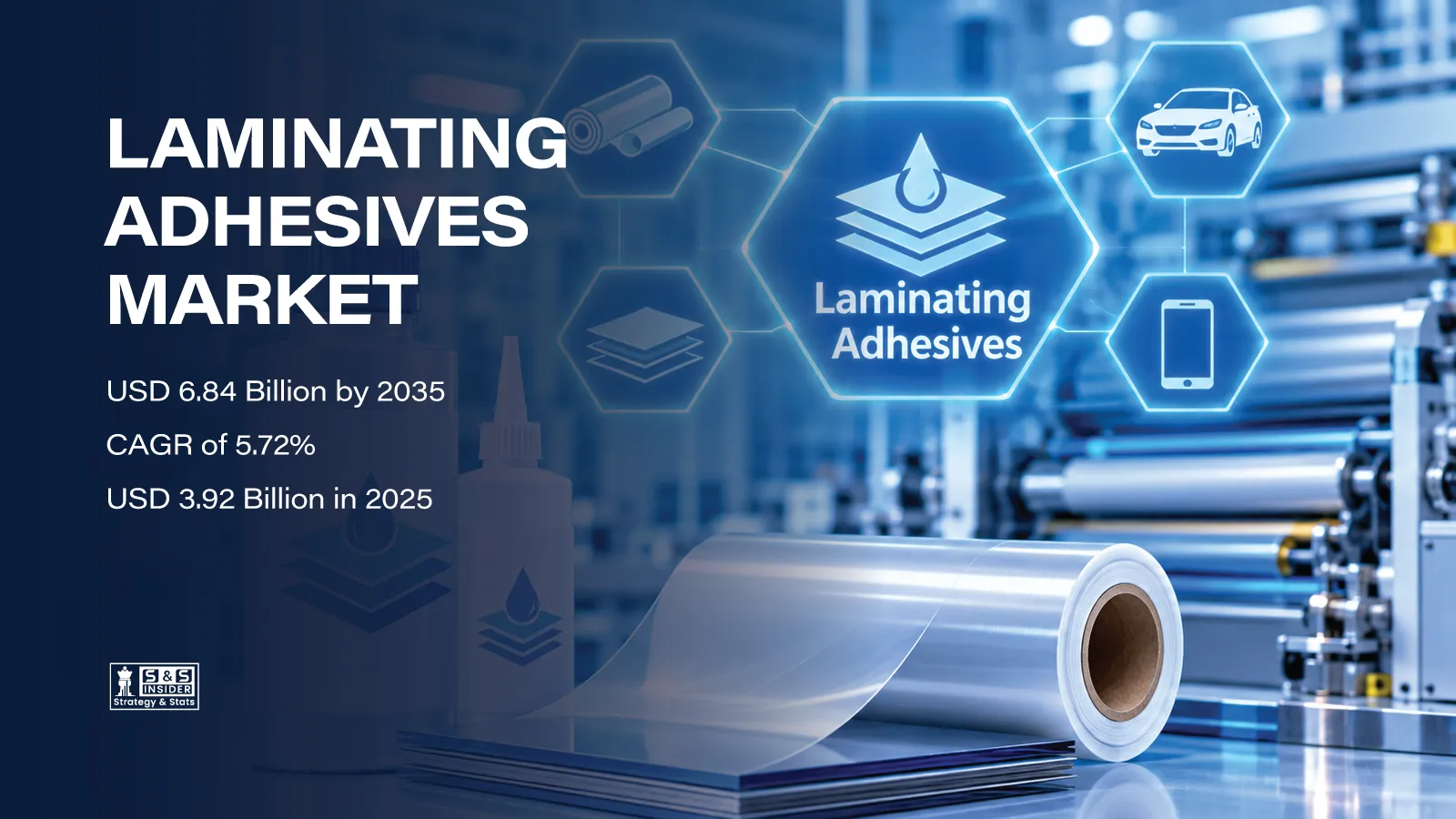
The global laminating adhesives market was valued at USD 3.92 Billion in 2025 and is estimated at USD 4.14 Billion in 2026, expanding to USD 6.84 Billion by 2035 at a CAGR of 5.72% during 2026–2035.
The main demand driver is flexible packaging, backed by processed food, ready meals, pet food and medical packaging. At the same time, converters are transitioning from solvent-based lines to solventless systems to reduce energy use and meet customer sustainability goals. In Europe, North America and Asia, packaging regulations are also driving brand owners to mono-material films that require adhesives that bond reliably without blocking recycling.
Asia Pacific is both the largest and the fastest-growing regional market, supported by large packaging industries and rising consumption of packaged food.
To Get Detailed Insights on the Laminating Adhesives Market – Request a Sample Report
Demand Drivers and Constraints
Primary Demand Drivers
-
Flexible packaging growth: Pouches, wraps, and lidding films protect food and medicines from moisture, oxygen, and light, and each multilayer pack requires an adhesive layer.
-
Shift to solvent-free systems: Solventless adhesives remove drying ovens, reduce energy use, and eliminate residual solvent in packs, which suits converters with sustainability commitments.
-
Recycling and packaging regulation: Rules such as the EU Packaging and Packaging Waste Regulation are pushing brand owners toward mono-material pouches that need compatible adhesives.
-
Pharmaceutical and medical packaging: Blister lidding, sachets, and sterile barrier pouches need adhesives with low extractables and strong seals.
-
Specialty applications: Lithium-ion battery pouches, photovoltaic modules, flexible electronics, and automotive interior films add higher-value uses.
Potential Growth Constraints
-
Raw material price swings linked to isocyanates, polyols, and petrochemical feedstock.
-
Rising compliance costs from chemical regulation, including diisocyanate training and documentation rules in the European Union.
-
Food contact approval requirements that differ by region and slow the entry of a single adhesive into several markets.
-
Narrow converter margins and long-term contracts that limit how much cost increase suppliers can pass on.
-
Supply disruption of solvents and resins, which has led to price increases from some suppliers.
Demand Structure by Resin
Polyurethane (2025 Market Share: 49.18%)
Polyurethane held the largest share of the resin segment at 49.18% in 2025. Two-component polyurethane adhesives offer high bond strength, heat resistance, and the ability to withstand boiling and retort conditions, which suits pouches for ready meals, sauces, and pet food. They bond a wide range of films and foils, and converters have long experience handling and curing them. Product ranges now include aliphatic and ultra-low-monomer grades that meet strict food safety limits. Their proven performance lowers risk for converters running high-value pouches, and this supports continued leadership in demanding structures.
Current trend: Steady use of polyurethane systems in retort, hot-fill, and other high-performance laminates.
Major trends: Ultra-low-monomer grades, aliphatic formulations, low-migration systems, and improved food contact documentation.
Acrylic (Forecast CAGR: 7.42%)
By resin, acrylic adhesives are projected to grow the fastest during the forecast period (at a CAGR of 7.42% during 2026–2035). Water-based and solvent-based acrylics are clear, easy to apply and low odor. They are typically used to laminate paper to film and film to film for dry food, labels and general packaging. They bypass isocyanate handling rules and are easier to operate in plants with poor ventilation. With better resistance to heat and moisture, newer grades are increasingly used in medium-performance structures, and their lower cost per kilogram allows them to compete in price-sensitive packaging applications.
Current trend: Growing use of acrylics in medium-performance and paper-based laminates.
Major trends: Water-based acrylic grades, improved moisture resistance, and low-odor formulations.
Demand Structure by Technology
Solvent-Based (2025 Market Share: 43.26%)
Solvent-based systems accounted for 43.26% of the market in 2025. Converters know these adhesives well, and they deliver consistent bond quality across many substrates on installed laminators with drying tunnels and solvent recovery. Lower cost per kilogram and a wide formulation range support their use in both mid-performance and high-performance structures. Environmental rules and energy costs are pushing users toward alternatives, but the large base of installed lines keeps solvent-based adhesives dominant in many regions.
Current trend: Continued use on existing laminating lines, supported by solvent recovery systems.
Major trends: Line optimization support, emission control, and gradual migration to lower-solvent options.
Solventless (Forecast CAGR: 7.18%)
Solventless technology is expected to expand at the fastest technology CAGR of 7.18% through 2035. These adhesives are applied without solvent carriers, which removes drying ovens, cuts energy use, and eliminates solvent emissions and residual solvent in packs. Modern solventless laminators run at high speed, and suppliers have developed grades that reach safe migration levels within short times. Large converters are adopting them to meet customer sustainability targets and to reduce operating cost per square meter of laminate. Lower solvent inventory also reduces fire risk and storage cost at converting plants.
Current trend: Rising investment in solventless laminators by large converters.
Major trends: Fast-curing low-migration grades, high-speed laminating lines, and recycle-ready bonding performance.
Demand Structure by Application
Packaging (2025 Market Share: 63.54%)
The packaging segment accounted for the largest share of the laminating adhesives market in 2025. Laminated films, made up of print, barrier and sealing layers, are used to make food and beverage pouches, lidding films, snack wraps, and pharmaceutical blister and sachet constructions. Brand owners want higher barriers, using less material. For retort, hot-fill and microwave packs you need adhesives with high heat resistance. Shorter product cycles mean new combinations of adhesives and films have to be qualified frequently, which is keeping demand steady across the segment.
Current trend: Strong consumption from food, beverage, and pet food packaging.
Major trends: Mono-material pouches, high-barrier laminates, retort packaging, and lighter pack designs.
Pharmaceutical and Medical Packaging (Forecast CAGR: 6.92%)
Key applications include pharmaceutical and medical packaging which is expected to grow at the highest CAGR of 6.92% during 2026–2035. Blister lidding, sachets and sterile barrier pouch adhesives must have low extractables, strong seals and complete batch documentation. Driven by aging populations, increasing volumes of prescription, and growth in single dose formats, the laminated pack output is growing. Other requirements are sterilization compatibility and batch traceability, which indicate suppliers with solid quality systems.
Current trend: Rising demand for validated, low-extractable adhesives in medical packs.
Major trends: Sterile barrier systems, single-dose formats, traceable supply, and sterilization-compatible bonding.
Key Market Participants
The laminating adhesives market is moderately consolidated. A handful of global adhesive groups supply large converters under multiyear contracts, while regional formulators serve local printers and laminators with tailored products.
Key participants include Henkel, H.B. Fuller, Arkema, Sun Chemical, Toyo Ink, COIM, Mitsui Chemicals, Sika, Uflex, Pidilite, and Morchem.
Competition increasingly centers on solvent-free and low-migration products, technical service close to the converter, speed of qualification, and the ability to provide food contact documentation. Recent portfolio moves reflect this direction. Sika agreed to acquire the adhesives business of Resonac in October 2026, Henkel completed its acquisition of Stahl Group in the same month, and Sun Chemical introduced its SunLam QA-8000 solvent-free, ultra-low-monomer laminating adhesive in January 2026.
Regional Market Dynamics
Asia Pacific (2025 Market Share: 43.30%)
Asia Pacific dominated the global laminating adhesives market with a share of 43.30% in 2025 and is expected to register the highest regional CAGR of 6.74% by the end of 2035. China, India, Japan, South Korea and Southeast Asia have large packaging industries supported by rising incomes, processed food consumption and e-commerce. Local formulators are increasing capacity to meet demand domestically and for export, while new food contact standards in China are tightening controls on adhesive ingredients.
Direction: Largest and fastest-growing regional market, supported by packaging capacity expansion and rising packaged food demand.
North America (2025 Market Share: 25.30%)
In 2025, North America accounted for 25.30% of the global market. There is a mature flexible packaging industry, large food and pharmaceutical producers and converters that continue to invest in solventless lines in the region. The U.S. market was valued at USD 833.08 Million in 2025, and is projected to reach USD 1,445.87 Million by 2035, growing at a CAGR of 5.58% during the forecast period. Documentation and low-migration chemistry are key to supplier selection under federal food contact rules. In California, packaging recyclability rules are pushing brand owners to use recyclable laminates, and in Canada, food processing and specialty film production are creating new demand.
Direction: Steady growth supported by solventless adoption, recyclable packaging goals, and pharmaceutical packaging demand.
Overall, the laminating adhesives market is positioned for steady expansion through 2035, with competitive success increasingly determined by solvent-free chemistry, food contact compliance, recycle-ready bonding performance, and close technical support for converters.
About the Author

Get in touch




