
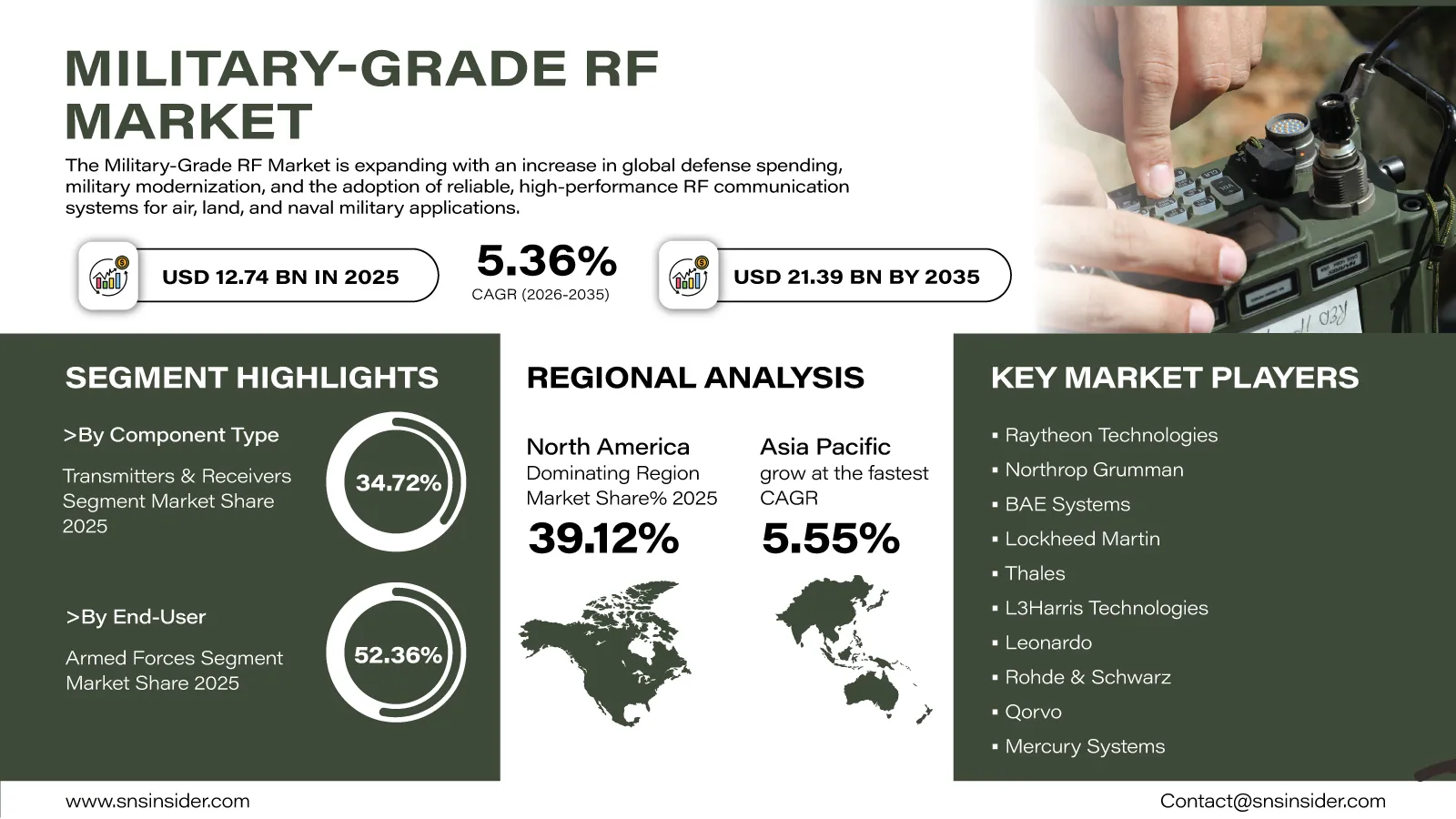
The global Military-Grade RF Market is expected to witness steady expansion over the next decade as defense organizations worldwide accelerate investments in secure communications, electronic warfare capabilities, and next-generation radar technologies. “According to a recent study by SNS Insider, the global Military-grade RF Market size valued at USD 12.74 billion in 2025, is anticipated to grow to USD 21.39 billion by 2035, registering a CAGR of 5.36% over the 2026–2035 forecast period.”
The current trend is for governments to focus more on building resilient communications infrastructure that can perform efficiently in highly hostile situations. The modern age calls for military actions that maintain connectivity in land, air, maritime, cyberspace, and space, and hence there has been continuous procurement of reliable radio frequency (RF) technologies.
To Get Detailed Insights on the Military-grade RF Market – Request a Free Sample Report
At the same time, the rapid evolution of battlefield threats is encouraging armed forces to replace aging communication networks with intelligent RF architectures capable of supporting real-time situational awareness, electronic countermeasures, and integrated command systems.
Defense Modernization Programs Create Long-Term Growth Opportunities
Procurement trends within global military modernization continue to evolve due to changes in the geopolitical landscape. With the advent of new threats to security, defense agencies have been focusing on investments in modern radar technologies, tactical communications, satellite communications, and electronic warfare technology. As a result of such developments, there emerge numerous opportunities for companies that specialize in production of RF technology components.
In addition to that, with more unmanned aircraft systems, autonomous naval vehicles, and next-generation aircraft appearing in the market, the need for reliable RF communication becomes greater. In addition to that, the increasing trend towards interoperability between allied armies results in promotion of standard communication systems for joint missions.
Moreover, development of new semiconductor technologies, software-defined radios, phased array antennas, and millimeter wave communications contribute to better performance and flexibility of these systems.
Key Market Insights Highlight Changing Defense Procurement Trends
In terms of platform, the Aerospace & Defense segment contributed 41.25% of total revenue in the global market in 2025, driven by increasing investment in military aircraft, unmanned aircraft systems, and advanced surveillance platform.
The fastest growing segment over the forecast period from 2021 to 2035 is the Naval Systems segment with a CAGR of 5.62%, driven by rising naval modernization programs and use of radar and electronic warfare systems integrated onto advanced naval ships.
VHF/UHF system has captured 32.48% of market revenue in 2025 due to its extensive use in tactical military communication systems. On the other hand, X-Band, Ku-Band, and Ka-Band technologies will grow with the highest CAGR of 5.65%, driven by advances in satellite communication and defense applications.
Transmitters & Receivers account for 34.72% of market revenue in 2025 owing to their criticality in military communication systems. However, Antennas & Arrays will be the fastest growing product category over the forecast period due to adoption of AESA technology in the defense industry.
Armed Forces segment led the market in terms of revenue share, accounting for 52.36% in 2025, while Homeland Security & Border Protection will be the fastest growing end-use segment over the forecast period.
An Infographic Representation of the Global Military-grade RF Market
Secure Communications and Electronic Warfare Remain Strategic Priorities
The military establishments are constantly spending money on communication devices that can help maintain their effectiveness in the face of electronic jamming. Anti-jamming ability, frequency agility, encryption, and low probability of intercept technologies have emerged as primary buying considerations for defense departments around the world.
The introduction of software-defined radio has made military communications flexible since it makes it possible to update the software without replacing all the hardware. This enables armed forces to change their strategy according to evolving missions while simultaneously prolonging the effective period of communications.
Growing adoption of integrated battlefield management systems is further strengthening demand for RF technologies capable of supporting seamless information exchange across multiple combat domains.
Regional Markets Continue Expanding Defense Investments
North America was responsible for 39.12% of the total Military-Grade RF Market revenues in 2025 owing to robust defense modernization schemes, advanced manufacturing abilities of aerospace equipment, and consistent purchase across all military sectors. It is further anticipated that ongoing expenditure on upgrading radars, satellite communications, and electronic warfare systems will sustain its dominance during the forecast period.
Asia pacific will exhibit the highest regional growth rate of 5.55% during the period 2026 to 2035. Increasing defense budget expenditure along with indigenous production in military equipment and increased spending on next generation fighter aircrafts, ships, and surveillance systems are adding to the growth potential.
As governments continue enhancing national security capabilities and military preparedness, demand for advanced RF communication technologies is expected to remain resilient across both developed and emerging defense markets.
Industry Participants Focus on Innovation and Strategic Partnerships
Competition within the Military-Grade RF Market remains dynamic as leading defense contractors continue expanding investments in advanced RF technologies, electronic warfare capabilities, secure communications, and phased-array radar systems. Companies are increasingly collaborating with government agencies and defense organizations to develop highly reliable solutions capable of addressing future operational challenges.
Key companies operating in the global Military-Grade RF Market include Raytheon Technologies, Northrop Grumman, BAE Systems, Lockheed Martin, Thales, L3Harris Technologies, Leonardo, Rohde & Schwarz, Qorvo, Mercury Systems, Cobham, Elbit Systems, Hensoldt, Saab, Teledyne Technologies, General Dynamics, Analog Devices, Microchip Technology, Honeywell, and Viasat.
An SNS Insider analyst Santosh Bhul commented, "Rising investments in defense modernization, growing adoption of software-defined communications, and increasing emphasis on resilient electronic warfare capabilities are reshaping the Military-Grade RF Market. Manufacturers that prioritize technological innovation, interoperability, and mission-critical performance will be well positioned to capture emerging opportunities as defense procurement continues to evolve globally."
About the Author

Get in touch




