
Rare Disease Genetic Testing Market has emerged as one of the key areas within precision medicine owing to the development of genomic technologies that aid clinicians in quickly and effectively detecting inherited diseases. Increased spending by government and healthcare organizations, along with biotech firms, on genomics for improving diagnostics, providing customized treatments, and studying rare diseases is being observed across the globe.
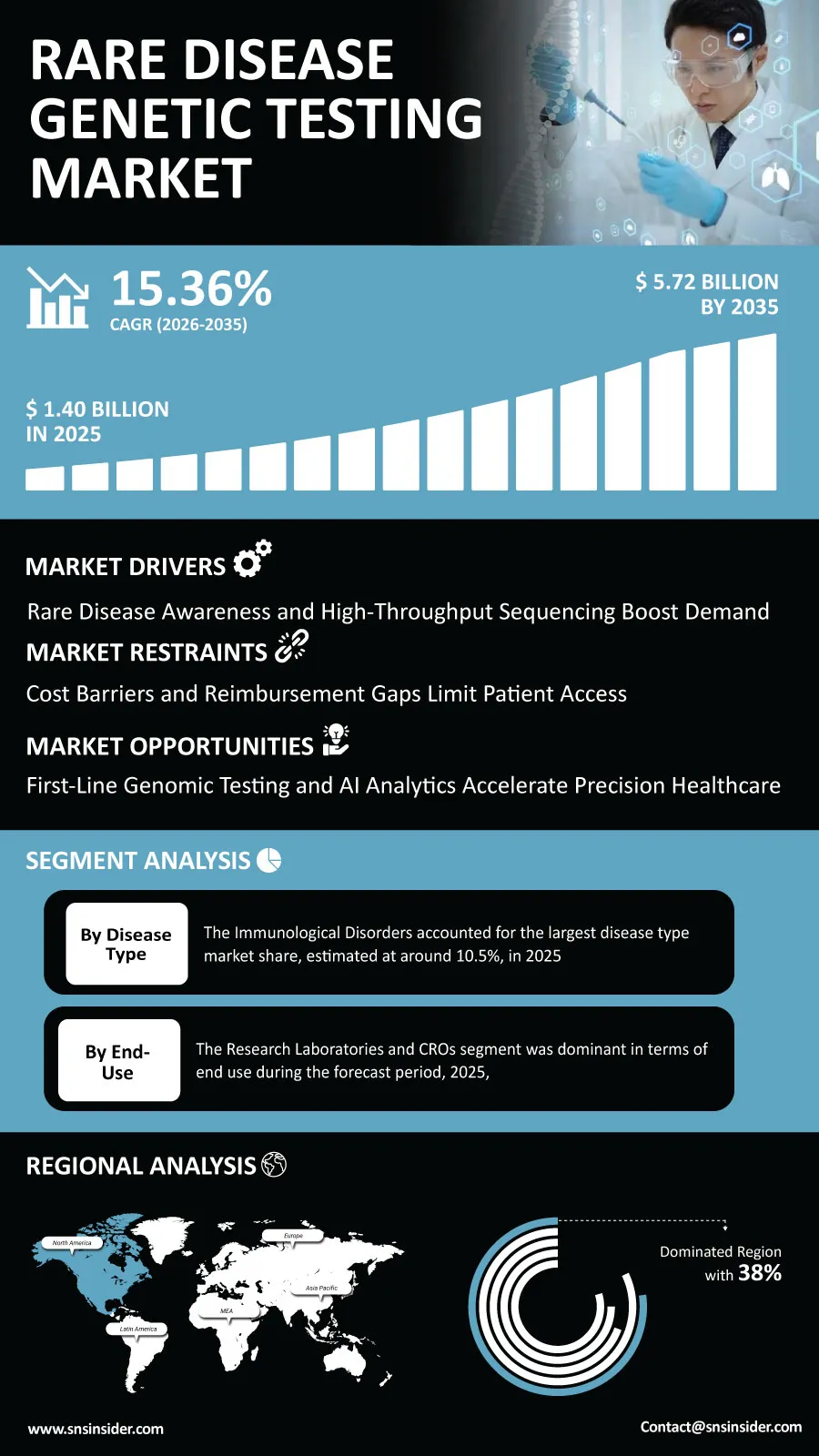
According to a recent study by SNS Insider, the global Rare Disease Genetic Testing Market size valued at USD 1.40 billion in 2025, is anticipated to grow to USD 5.72 billion by 2035, registering a CAGR of 15.36% over the 2026–2035 forecast period. The increasing use of sophisticated sequencing technology, expanded newborn screening programs, and rising use of artificial intelligence for interpreting genomic information are driving sustained growth in the market.
Another area of focus for healthcare systems is the reduction in time needed for identifying rare genetic diseases. In doing so, doctors will be able to diagnose at an earlier stage and help the patient access the appropriate treatment.
To Get Detailed Insights on the Rare Disease Genetic Testing Market – Request a Sample Report
Advances in Genomic Medicine Expand Clinical Applications
The fast pace of technological advancement in sequencing technologies is contributing significantly to the analysis of genetic information with increased efficiency while allowing various diagnostics to be performed in addition. Artificial intelligence is increasingly being used to help interpret the massive amounts of data and detect gene variations causing the diseases.
Increased interest in companion diagnostics is further motivating pharma companies to include genetic testing in their orphan drugs development initiatives. Genetic testing is gradually becoming an indispensable tool in the selection of patients for new treatments of rare hereditary diseases.
Market Segments Reflect Technology-Led Growth
In terms of technology, Next Generation Sequencing (NGS) held about 33.9% share in the year 2025 owing to its capability of testing multiple genes effectively for numerous inheritable diseases. Whole Genome Sequencing (WGS) is anticipated to witness highest growth rate up to 2035 due to reduced sequencing prices along with various national genomics projects.
Segmented by specialty, Molecular Genetic Tests accounted for the largest segment in 2025, whereas Biochemical Genetic Tests are likely to grow at a constant rate over the coming years.
When divided by disease type, Immunological Disorders made up for roughly 10.5% of total market revenue in 2025. Endocrine & Metabolism Diseases are anticipated to grow at the fastest rate over the forecast period due to growing awareness, screening programs, and available treatment options.
Based on end users, Research Laboratories & Contract Research Organizations (CROs) constituted the biggest segment of rare disease genetic testing services market in 2025. Diagnostics Laboratories are predicted to be the fastest-growing segment growing at a CAGR of 17.36% up to 2035.
Precision Diagnostics Gain Momentum Across Healthcare Systems
Increasingly, health care practitioners are integrating genomic testing within their clinical practices to enhance diagnostic capabilities among patients suffering from genetic diseases. The growth in national genomics programs, increased availability of genetic counseling services, and collaboration between research facilities and diagnostic centers are promoting widespread use in both mature and developing healthcare markets.
On the other hand, biotech companies are constantly investing in advanced bioinformatics tools that integrate genomics data with clinical data to enhance diagnostic accuracy while setting up future precision medicine applications.
Regional Markets Continue to Strengthen
North America was still the biggest regional market in 2025, contributing to approximately 38% of global revenue due to the presence of advanced genomics infrastructure, research funding, and regulatory approval routes for rare disease treatments. In the region, the United States made up around 77% of the North American revenue. The U.S. Rare Disease Genetic Testing Market was worth USD 0.42 billion in 2025 and is projected to be worth USD 1.80 billion by 2035, registering a 16.01% CAGR.
Asia Pacific region will register the fastest regional growth over the forecast period because of the continuous expansion of genomics programs and healthcare infrastructure by governments. China contributed about 40% of the regional revenue due to increased spending on precision medicine and genetic testing.
In Europe, the United Kingdom contributed to about 30% of the regional revenue via genomic medicine programs. Brazil contributed around 50% of the Latin American revenue, whereas the United Arab Emirates contributed approximately 34% of the Middle East & Africa region revenue.
Industry Participants Expand Genomic Innovation
The competition dynamics keep changing as the diagnostic players improve their sequencing, artificial intelligence, and multiomic testing technologies. In 2026, some of the major laboratories launched AI-based tools for variant interpretation, while some European healthcare systems came up with reimbursement models to enable whole-genome sequencing in patients with rare diseases without a diagnosis. Some of the earlier milestones include GeneDx's April 2025 upgrade of its whole-exome sequencing technology and Ambry Genetics' August 2024 introduction of ExomeReveal multiomic sequencing platform.
Major companies operating in the global Rare Disease Genetic Testing Market include GeneDx, LLC, Blueprint Genetics (Quest Diagnostics), Invitae Corporation, Ambry Genetics, Baylor Genetics, Centogene N.V., 3billion, Inc., Eurofins Scientific, BGI Group, Revvity (PerkinElmer), Agilent Technologies, Inc., Illumina, Inc., Pacific Biosciences (PacBio), Oxford Nanopore Technologies, and Thermo Fisher Scientific.
An SNS Insider analyst Parry Kardani commented, "Rare disease genetic testing is becoming a cornerstone of precision medicine as advances in sequencing, bioinformatics, and artificial intelligence improve diagnostic accuracy and clinical decision-making. Organizations investing in scalable genomic technologies and integrated diagnostic platforms are expected to play an increasingly important role in the future of personalized healthcare.
About the Author

Get in touch




