
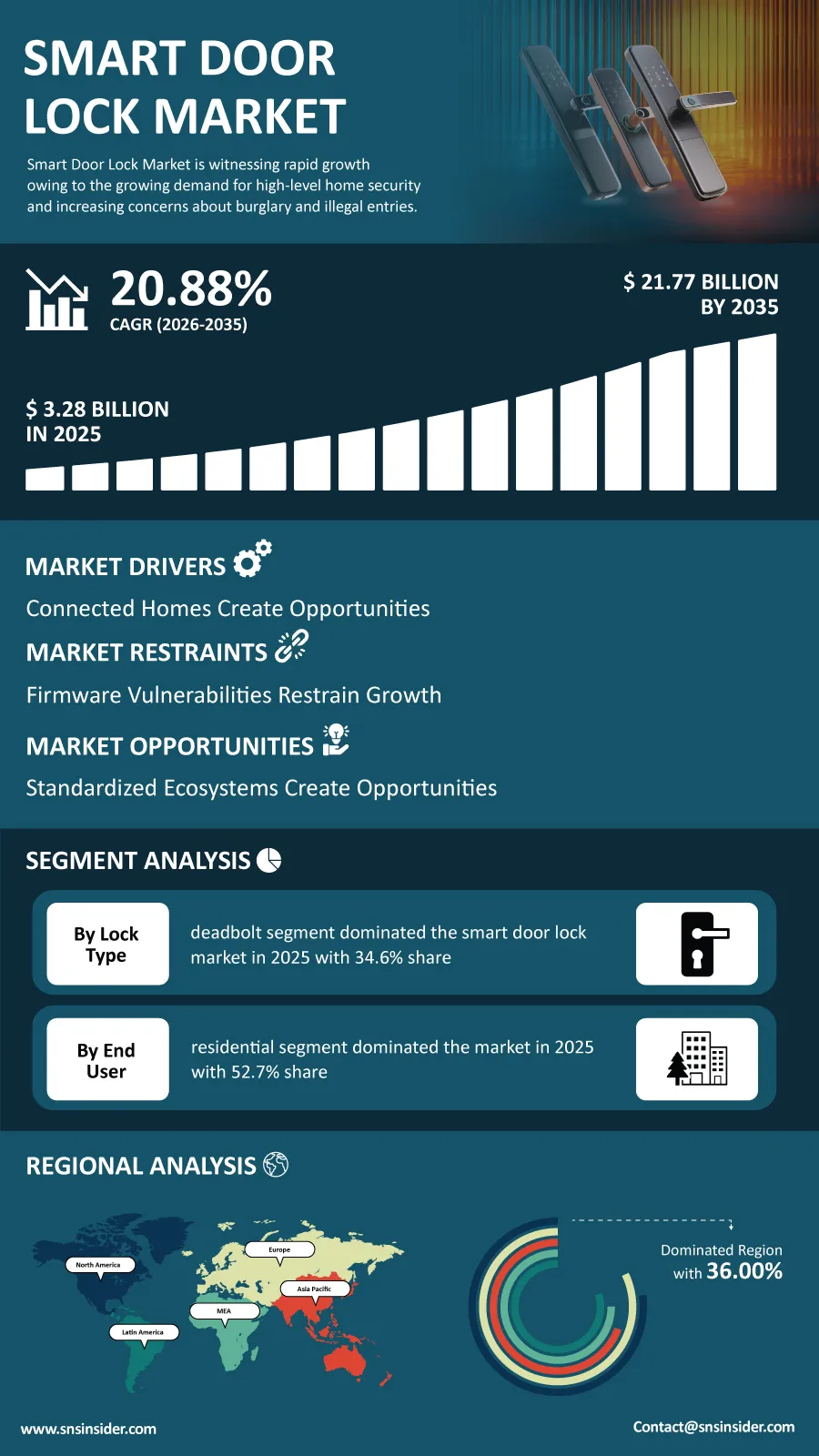
The global Smart Door Lock Market is set to grow at a remarkable rate in the coming years as consumers and corporations alike adopt internet-based security techniques that provide accessibility, comfort, and enhanced security. “According to a recent study by SNS Insider, the global Smart Door Lock Market size valued at USD 3.28 billion in 2025, is anticipated to grow to USD 21.77 billion by 2035, registering a CAGR of 20.88% over the 2026–2035 forecast period.”
The increasing cognizance of safety at private and business workings has helped the world brilliant locking gadget market. Consumers are replacing traditional locks with digital ones that can provide remote monitoring, biometric authentication and smartphone-based access management as urban populations grow and connected living becomes a common practice. These solutions allow more control while enhancing the convenience of users and operational efficiency.
The smart security ecosystem continues to be fortified by rapid advances in Internet of Things (IoT) technology, cloud connectivity, and mobile applications. Integration with smart home automation platforms, voice assistants, and smart surveillance systems help facilitate easy access management and lead to widespread adoption across homes, hospitality facilities, workplaces and rental properties alike.
To Get Detailed Insights on the Smart Door Lock Market – Request a Sample Report
Smart Home Expansion and Digital Security Investments Create Long-Term Growth Opportunities
Governments, real estate developers and technology providers are fast-tracking investments in smart infrastructure with connected security solutions incorporated as a basic building feature. The continued demand for intelligent door lock systems across both developed and emerging markets is further ascribed to the increasing construction of smart residential communities and digitally managed commercial buildings.
The increasing prominence of smart access technologies has been bolstered by the rise in interest for short-stay rental platforms and serviced accommodations. Owners are opting in and deploying keys-in-the-freezer toolkits that allow guests access without a set of keys present, easing operations whilst enhancing guest experience.
On the other hand, the gradual pacing and development in biometric authentication, artificial intelligence, wireless communication technologies, etc., is allowing manufacturers to offer more reliable as well as advanced products that are faster, secure, and consume less power. The next stage of market growth, which improves facial recognition, fingerprint verification, and remote credential management, is expected to bolster.
Key Market Insights Highlight Shifting Demand Patterns
By type of lock, it is estimated that in 2025 deadbolt locks will represent 34.6% of the global market revenue due to their strong security performance, durability and effective use in residential and commercial properties. The retrofit locks segment will see the fastest growth through 2035 due to more homeowners looking for low-cost smart home upgrades without having to replace their locksets.
Based on access mechanism, the segment of biometric smart locks is anticipated to generate 38.9% of total market revenue in 2025 since demand for highly secure authentication through fingerprint and facial recognition technologies continues to increase. Mobile app control is anticipated to grow at the highest CAGR during the forecast period as remote access, monitoring, and digital key sharing through smartphones is becoming a trend among consumers.
On the technology connectivity side, due to its direct Internet connection and interoperation with connected home ecosystems, Wi-Fi is expected to hold a 41.2% market share in 2025. The Matter/Thread-enabled segment is expected to grow at the highest CAGR through 2035 due to increasing adoption of standard-based protocols that enhance compatibility among smart home devices. On the basis of end users, in 2025, the market revenue from residential segment was equal to 52.7%, whereas hospitality sector shall register highest growth due to increasing deployment of keyless guest access systems.
Advanced Smart Security Technologies Accelerate Industry Transformation
Smart door lock technology is improving at a rapid pace thanks to manufacturers incorporating artificial intelligence, biometric verification, cloud-based access management and advanced encryption capabilities into smarts products for the next generation. From better user authentication to reducing the risk of unauthorized access and enabling real-time security monitoring across connected environments, these innovations are hugely helping.
Manufacturers are also catering to this interoperability by ensuring voice assistants, digital wallets, and centralized home automation platforms compatibility. The rapid adoption of Matter-enabled devices along with smart access management solutions continues to enable seamless connected living experiences, increase security and operational efficiency.
North America Held 36.00% of the Smart Door Lock Market Share in 2025; Asia Pacific Projected to Register the Fastest CAGR Through 2035
North America will account for 36.00% share of total market revenues in 2025, propelled by large scale adoption of smart homes, robust consumer awareness regarding residential security and rising installation of connected access solutions across rental properties and commercial buildings. Investment in digital infrastructure and home automation technologies is expected to continue sustaining regional leadership.
Asia Pacific was the biggest regional market & is expected to be the fastest developing region with a CAGR of more than 50% throughout 2035. As one of the fastest-growing rapidly urbanization, middle-class population growth, large-scale government-sponsored smart city initiatives, and rising number of connected residential buildings across China India Japan and South East Asia are driving the demand in the smart door lock market.
Europe meanwhile remains the only market to experience healthy growth, while consumers invest in smart residential pass systems and commercial access control upgrades. On a different note the Middle East, Africa and Latin America are experiencing increasing adoption from smart city development, high-end residential projects as well as mature requriement of intelligent building technologies.
Industry Participants Focus on Innovation and Intelligent Access Solutions
The competitive scenario anticipates to have newer entrants and companies constantly working on artificial intelligence, biometric authentication, cloud-based access management, and even next-generation wireless connectivity technologies. Constant product innovation, partnerships, and growing smart home ecosystems are allowing companies to not only enhance their competitive advantages but also consumer expectations for convenience, security, and interoperability.
Key companies operating in the global Smart Door Lock Market include ASSA ABLOY AB, Allegion plc, dormakaba Group, Spectrum Brands Holdings Inc., Honeywell International Inc., Samsung SDS, Xiaomi Corporation, Vivint Smart Home Inc., Kwikset Corporation, Yale (ASSA ABLOY), Schlage (Allegion), August Home Inc., Ultraloq (U-tec), Level Home Inc., Salto Systems S.L., Godrej & Boyce Manufacturing Co. Ltd., Panasonic Corporation, Hitachi Ltd., Bosch Smart Home, and Onity Inc.
An SNS Insider analyst Sakshi Kale commented, “The accelerating adoption of connected homes, intelligent building infrastructure, and digital access management is transforming the global smart door lock industry. Companies investing in advanced authentication technologies, interoperable smart home platforms, and secure cloud-based access solutions will be well positioned to capitalize on rapidly expanding market opportunities over the coming decade.”
About the Author

Get in touch




