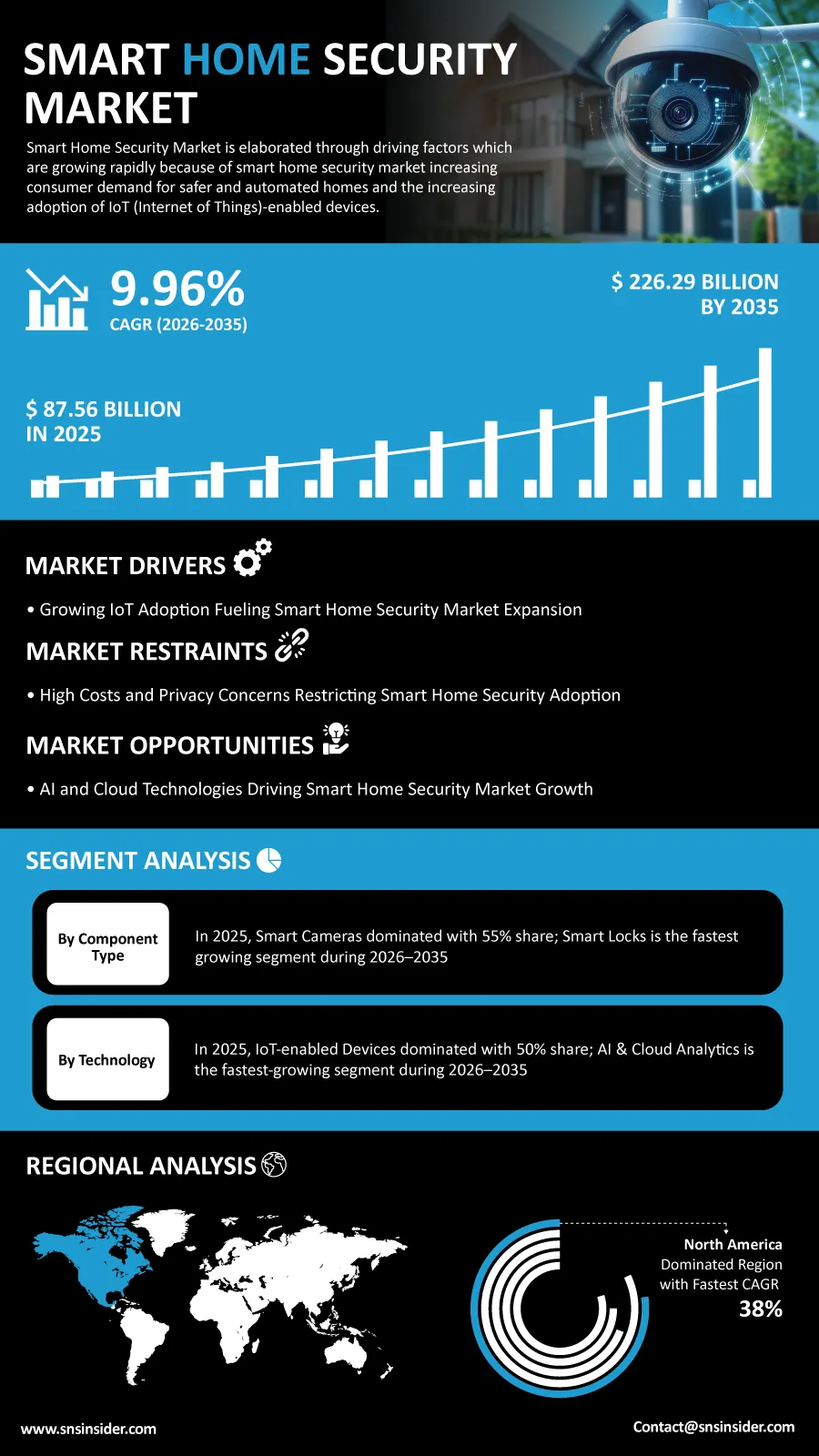
The global Smart Home Security Market is expected to witness robust growth as connected living technologies become an integral part of modern residential and commercial environments. According to a recent study by SNS Insider, the global Smart Home Security Market size valued at USD 87.56 billion in 2025, is anticipated to grow to USD 226.29 billion by 2035, registering a CAGR of 9.96% over the 2026–2035 forecast period.
Consumer awareness regarding security measures, advancement in technology, and increased demands for automation have been altering the trends of home security markets. Homeowners are increasingly investing money in the installation of their security system using surveillance, access control, intrusion detection, and remote monitoring.
The quick evolution of artificial intelligence, cloud computing, and IoT has made the use of smart security systems highly efficient. Real-time alarms, threat prediction, face recognition, and mobile monitoring have made it possible for homeowners and organizations to secure themselves from potential threats.
To Get Detailed Insights on the Smart Home Security Market – Request a Sample Report
Intelligent Home Ecosystems Create New Growth Opportunities
The emergence of smart home ecosystems is leading to positive environmental tendencies regarding future security solutions. Consumers are increasingly interested in interconnected devices, which can be readily connected to voice assistants, applications, and home automation systems to control multiple security components simultaneously.
The availability of cloud services and monitoring packages acts as a driving factor behind the market development by providing regular software updates and enhanced cybersecurity. In connection with the increase in urbanization and interconnection tendencies, smart home security solutions are progressively becoming an essential part of the household infrastructure.
Tech companies persist in investing in AI-driven analytics, wireless connectivity, and intelligent automation capabilities, which ensure improved system performance along with simplified installation and maintenance procedures.
Key Market Insights Highlight Shifting Demand Patterns
By component type, smart camera segments captured about 55% of the global market revenue in 2025 because of its growing deployment in applications such as video surveillance, motion detection, and remote monitoring. Smart lock segments are predicted to experience the fastest growth up to 2035 because of increasing consumer adoption of keyless entry, biometric access systems, and connected access systems.
Based on technology, IoT-enabled devices segments are predicted to dominate the market with the largest share of 50% in terms of market revenue in 2025 due to the ability of these devices to integrate all the security components to form smart homes security systems. Artificial intelligence and cloud analytics technology segments are projected to be the fastest-growing technology segments owing to growing deployment of advanced data analytics and intelligent analytics in modern security platforms.
By application, residential homes segments dominated the market with 48% of the market revenue in 2025 because of increasing spending by homeowners on connected security systems. The multi-family housing application segments are anticipated to experience the fastest growth during the forecast period because of increasing deployment of centralized security systems in apartment buildings.
By end user, homeowners segment held around 60% of market revenue in 2025. Retail and office spaces are expected to expand at the fastest pace as businesses strengthen physical security, employee safety, and intelligent access management through AI-enabled surveillance and cloud-connected monitoring systems.
AI-Powered Security Solutions Continue to Reshape the Market
AI technology is increasingly becoming a distinguishing characteristic of future-generation smart home security solutions. The utilization of intelligent video analytics, behavior pattern detection, threat detection, and cloud-based decision-making is contributing to faster responses and fewer false alarms.
The manufacturers are also increasingly looking at interoperability, where cameras, intelligent locks, sensors, alarm systems, and lighting can all function within ecosystems. The combination not only makes the experience more convenient for users but also facilitates the scalability of security solutions.
North America Accounts for 38% Market Share in 2025 as Asia Pacific Records a 12.8% CAGR
North America is expected to account for 38% of global market revenue in 2025, Backed by well-informed consumers, the increasing uptake of IoT technology, disposable incomes, and investments made in connected home technologies. The region remains at the forefront of using AI-based monitoring platforms and subscriptions of smart security solutions.
The forecasted fastest growing regional market in the coming years is Asia-Pacific, where the compound annual growth rate is expected to grow at a CAGR of 12.8% up until 2035. Urbanization, growth of middle-class population, penetration of smartphones, and smart infrastructure initiatives of the government have boosted the demand for connected home security.
As digital lifestyles continue to evolve, regional demand for integrated security ecosystems is expected to remain strong throughout the forecast period.
Industry Participants Focus on AI Innovation and Connected Security Platforms
The competitive landscape is characterized by continuous investment in artificial intelligence, cloud connectivity, cybersecurity, and intelligent automation. Market participants are introducing advanced cameras, smart locks, cloud-based monitoring services, and subscription-driven platforms that improve user experience while enhancing security performance.
Key companies operating in the global Smart Home Security Market include ADT Inc., Amazon Ring LLC, Google Nest, Honeywell International, Inc., Johnson Controls, Resideo Technologies, Inc., SimpliSafe, Inc., Vivint Smart Home, Inc., Brinks Home Security, Arlo Technologies Inc., Blink Home Inc., Dahua Technology Co., Ltd., Canary Connect Inc., August Home Inc., Aqara (Lumi United Technology Co., Ltd.), Eufy Security (Anker Innovations), EZVIZ Inc., Frontpoint Security Solutions LLC, Kwikset Corporation, and Nuki Home Solutions GmbH.
An SNS Insider analyst Sushant Kadam commented, “The convergence of artificial intelligence, IoT connectivity, and cloud-based monitoring is fundamentally transforming the smart home security industry. Companies delivering integrated, intelligent, and user-friendly security ecosystems that combine automation with advanced threat detection will be best positioned to capitalize on the market's long-term growth potential.”
About the Author

Get in touch