
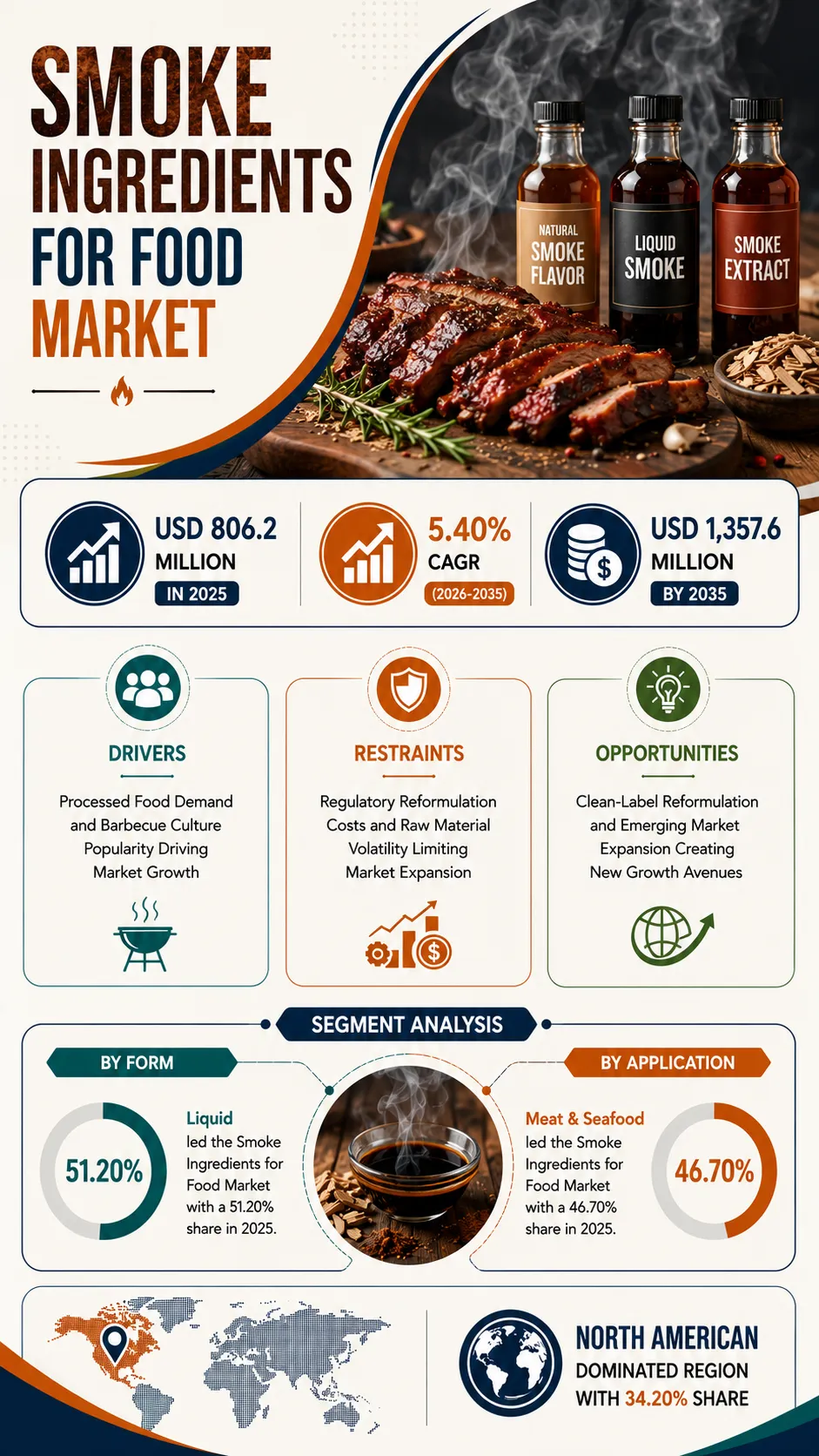
The global Smoke Ingredients for Food Market is set for steady expansion as food and beverage manufacturers worldwide continue relying on authentic smoky flavor formulations. "According to a recent study by SNS Insider, the global Smoke Ingredients for Food Market size valued at USD 806.2 million in 2025, is anticipated to grow to USD 1,357.6 million by 2035, registering a CAGR of 5.40% over the 2026-2035 forecast period."
There have been tremendous changes within smoke ingredient production technology over time due to which many manufacturers who aim at improving flavor authenticity can take advantage of this trend. This includes the need for more compliant, clean-label formulations that will provide brands with the ability to meet tightening regulatory requirements. This applies in situations where smoke ingredients are used in meat and seafood, bakery, snacks, and sauce applications.
Manufacturers are constantly working hard to ensure that their smoke ingredients perform better than before in order to meet various needs of food and beverage companies.
To Get Detailed Insights on This Market – Request a Sample Report
Authentic Flavor Compliance Ecosystems Create New Demand
The smoke ingredients for food market has evolved from basic liquid smoke condensates to more advanced clean-label and regulation-compliant use cases. The growing investment in reformulation technology, powder-based formats, and e-commerce distribution for a variety of applications has required the development of more efficient and reliable flavoring systems.
New designs of smoke ingredients can increase flavor authenticity, extend shelf stability, and allow for regulatory compliance across evolving jurisdictions. This gives manufacturers the possibility to be more effective when reaching food and beverage customers and doing better product differentiation.
Flavor houses, food and beverage manufacturers, and regulatory agencies are increasingly cooperating due to the growing interest in developing future solutions for compliant smoky flavoring.
Key Market Findings Highlight High-Growth Segments
The liquid segment dominated all categories in the smoke ingredients for food market share with a market revenue share of 51.20% in 2025 due to its simple handling and water solubility.
The fastest growing category is expected to be powder which will grow at a CAGR of 7.60% through 2035. This will be possible owing to the increasing need for shelf-stable, easily transportable seasoning formats.
By application, meat and seafood held the largest share of total market revenue of 46.70% in 2025 due to widespread use in bacon, sausages, and cured products. The snacks and convenience segment will see the fastest growth in revenue generation at a CAGR of 7.90%.
Based on distribution channel, direct sales generated a share of 58.10% of market revenue in 2025 due to customization requirements for industrial processing systems. On the other hand, online distribution will be the segment recording the fastest revenue growth at a CAGR of 8.40%.
Distributive trends are changing as well. Traditional meat and seafood applications remain substantial, but snacks and convenience foods will turn out to be the fastest-growing application through 2035, on the back of BBQ-flavored product innovation, ready-to-make offerings, and increased demand from packaged snack manufacturers.
Authenticity, Compliance, and Convenience Gain Importance
In this regard, manufacturers have been looking at ingredients that would make their products more authentic and require less regulatory risk and be more convenient.
Innovation in reformulation technology, clean-label positioning, and powder-based formats has been making it possible for companies to come up with products that can meet increasingly stringent regulatory expectations. In addition to that, increasing emphasis on flavor consistency and traceability is also making it possible for companies to find solutions that optimize consumer trust.
Such trends are likely to become even more prominent in the future.
North America Emerges as the Largest Market with 34.20% Revenue Share Amid Rising Barbecue Culture
The North America region represented 34.20% share of global market revenue in 2025 and was the largest regional market, owing to enhanced ingredient availability and growing food service and processing industry expansion. In addition, Asia Pacific is expected to be the fastest-growing market during the forecast period, propelled by increasing meat consumption and applications across the region's fast-growing dining and foodservice industries.
On the other hand, Europe represented a meaningful share of global market revenue in 2025, aided by the region's leadership in smoky flavor innovation despite navigating significant regulatory reformulation requirements.
Leading Companies Drive Innovation and Competition
The environment continues to stay very dynamic since players continue innovating on products and formulations as well as forming partnerships in order to enhance their position in the industry.
Some of the major companies that operate in the global smoke ingredients for food market are Besmoke Ltd., Kerry Group plc, Frutarom Savory Solutions, Redbrook Ingredient Services Ltd., Red Arrow International LLC, WIBERG GmbH, B&G Foods Inc., Associated British Foods plc, Symrise AG, and Givaudan SA.
An SNS Insider Analyst Santosh Bhul commented, "The rapid regulatory transformation of smoke flavoring standards is creating unprecedented demand for compliant, clean-label smoky flavor solutions. Manufacturers that successfully combine flavor authenticity, regulatory compliance, formulation flexibility, and advanced technical capabilities will be best positioned to capitalize on emerging opportunities across meat, snack, and sauce applications."
About the Author

Get in touch




