
The global signal generators industry is moving into a period of steady commercial growth. Product developers now face shorter design cycles and stricter performance standards. Each new device must pass more test conditions before it reaches the market, and a late test failure can delay a product launch and raise development costs. As a result, accurate signal sources have become a core budget item for engineering teams rather than a supporting lab expense.
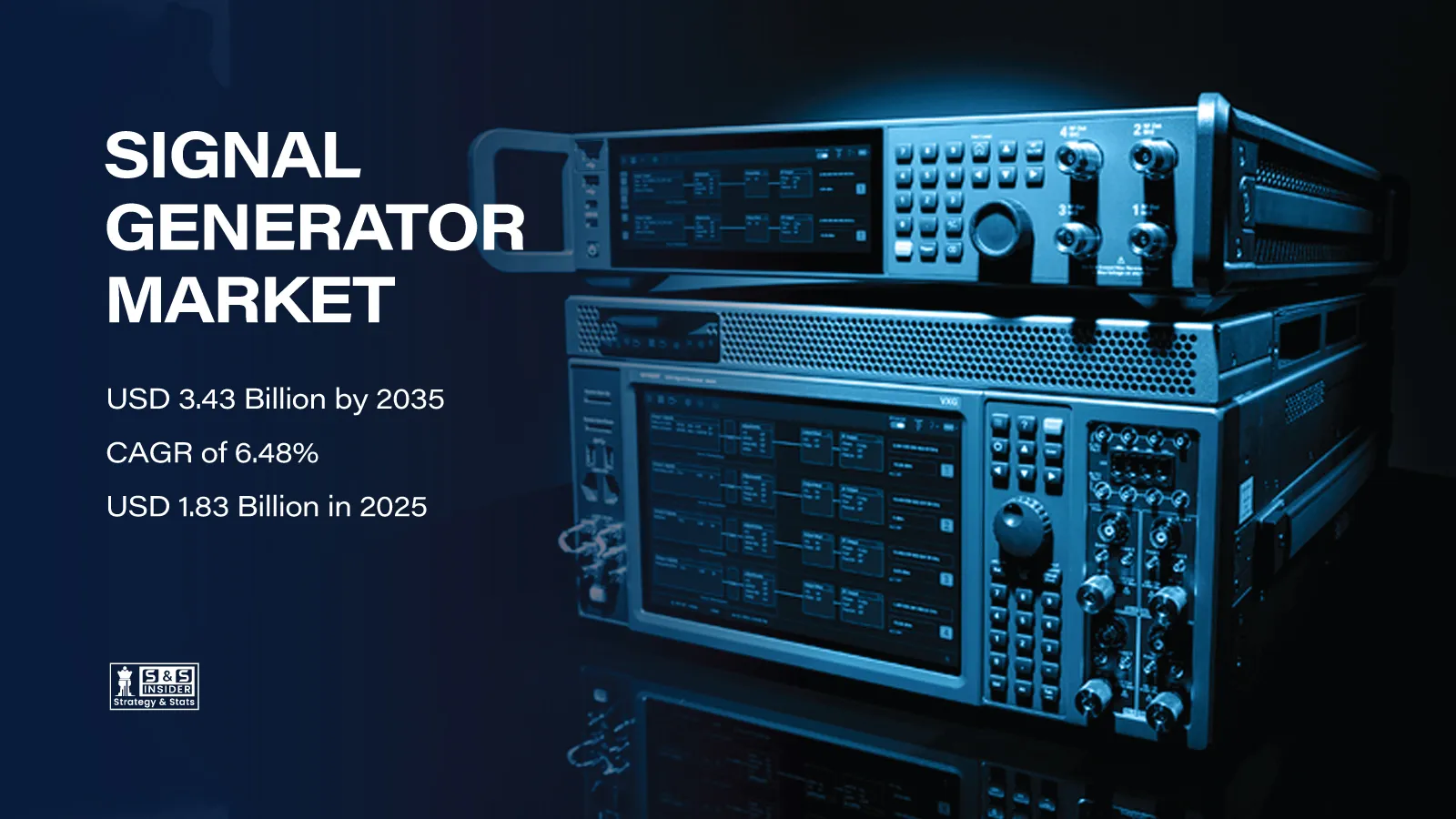
According to a recent study by SNS Insider, the global Signal Generators Market size was valued at USD 1.83 Billion in 2025 and is anticipated to reach USD 3.43 Billion by 2035, registering a CAGR of 6.48% over the forecast period 2026–2035. The market is estimated at USD 1.95 Billion in 2026.
Time-to-Market Pressure Is Turning Test Capability into a Commercial Asset
Product companies now compete on how quickly they can move from prototype to certified product. Every week of delay can affect revenue targets, customer commitments, and the return on research spending. Test equipment that shortens validation work therefore carries direct financial value.
Engineering managers increasingly judge signal generators by the hours they save, not only by their technical specifications. Faster setup, repeatable test routines, and fewer retests all help lower the cost of each design cycle.
Suppliers that can show measurable reductions in validation time are well placed to win budget approval. This shifts the sales discussion away from unit price and toward project-level savings.
To Get Detailed Insights on the Signal Generators Market – Request a Sample Report
Shared Test Infrastructure Opens Opportunities Beyond Single-Unit Sales
Large organizations often run several design teams across different sites. Many of these teams need similar test conditions but use them at different times. This creates demand for test assets that can be shared, scheduled, and controlled remotely.
Networked instruments, centralized test libraries, and remote access tools allow companies to get more use from each unit they buy. Suppliers can build on this need by offering software that manages test setups across a full instrument fleet.
Software licenses, waveform libraries, calibration programs, and upgrade paths can generate recurring revenue. They also keep suppliers in regular contact with customers long after the first equipment sale.
Signal Generators Market Segmentation Highlights
By Type
RF signal generators held the largest market share of 42.60% in 2025, reflecting their broad use in daily radio frequency design and production testing. Arbitrary waveform generators are expected to register the fastest CAGR of 8.12%. This creates room for suppliers that can serve complex test scenarios with flexible, software-defined signal creation.
By Form Factor
Benchtop units held 54.80% of the market in 2025, as most labs still depend on standalone instruments for core test work. Modular systems are expected to register the highest CAGR of 7.72%. They provide opportunities in automated production lines and scalable test racks where space and throughput is important.
By End Use
Telecommunications accounted for the largest market share of 40.40% in 2025. The automotive segment is expected to register a CAGR of 7.36%, supported by commercial opportunities in vehicle radar, connected car modules, and in-vehicle wireless systems.
North America Leads with 36.20% Market Share as Asia Pacific Advances at 8.04% CAGR
North America dominated the Signal Generators Market with the highest revenue share of 36.20% in 2025. The U.S. Market is Estimated at USD 569.72 Million in 2025, While China is Forecast to Grow at a CAGR of 6.14% It is an area of promise for suppliers to defense contractors, chip designers and makers of wireless equipment. Purchasing decisions are based on the accuracy of measurements, the service support over time and the respect of procurement rules."
Asia Pacific contributed 32.90% of revenue in 2025 and is projected to record the fastest CAGR of 8.04% over 2026–2035. Expanding electronics production and growing local chip design activity are creating demand for cost-effective instruments, regional calibration services, and fast delivery.
Europe held a 20.40% share of the global market in 2025, followed by the Middle East & Africa at 6.60% and Latin America at 3.90%. Opportunities in these regions will vary with industrial policy, defense spending, and the pace of network upgrades.
Rental and Test-as-a-Service Models Could Widen the Customer Base
High-end signal generators require a large upfront investment, and many small design firms and startups cannot justify the purchase for short projects. Rental programs, leasing plans, and access to shared test labs give these buyers a practical way to reach advanced test capability.
Manufacturers can reach this group by working with rental firms, contract test labs, and university research centers. These partnerships extend market reach without depending on new capital spending by each customer.
Such models also support recurring income through calibration contracts, software subscriptions, operator training, and upgrade fees.
Competitive Outlook: Test Efficiency to Become a Key Differentiator
Future competition in the signal generators industry is likely to depend on more than frequency range and signal purity. Customers increasingly expect tools that simplify test setup, support automation, and fit into existing lab software.
Suppliers combining reliable hardware, easy-to-use software, responsive support and flexible buying options may be in a stronger market position. Partnerships with chip design firms, test system integrators, and distributors can also help expand commercial reach.
Signal Generators Market Outlook Through 2035
In the next decade, signal generators are expected to have a greater impact on product development planning, production quality control and regulatory compliance activities. Suppliers that can show clear gains in test speed, cost control, and engineering productivity will be best placed to capture new demand across wireless, semiconductor, automotive, and defense programs.
About the Author

Get in touch




