
Thermal Management Fluids Market Report Scope & Overview:
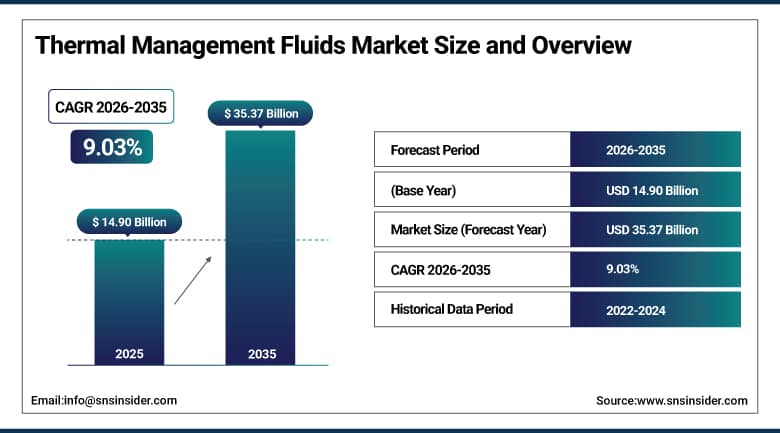
The Thermal Management Fluids Market was valued at USD 14.90 Billion in 2025 and is projected to reach USD 35.37 Billion by 2035, expanding at a CAGR of 9.03% during the forecast period 2026–2035.
Thermal management fluids market is exhibiting strong growth as more and more industries are focusing on efficient heat dissipation, optimization of energy, and reliability in electric vehicles, advanced electronics, manufacturing processes, and data centers. Thermal management fluids ensure that there is efficient heat transfer, no corrosion, and improved longevity of equipment. Electrification of transport, rise in demand for high-end computing processors, batteries, and artificial intelligence-based computing platforms is playing an important part in the market development Technological developments in immersion cooling, battery thermal management systems, and sustainable heat transfer methods have also helped this market grow.
Manufacturers are focusing on developing synthetic and fluorinated dielectrics with high thermal conductivity, excellent electrical insulating properties, resistance to oxidation, and good environmental properties. Increasing investments in hyperscale data centers, semiconductor fabs, renewable energy sources, and industrial automation are driving innovation in fluid formulation. In 2025, major hyperscale cloud companies in the United States expanded liquid-cooling facilities for AI-powered servers, further encouraging the adoption of advanced dielectric fluids in next-generation data centers. Announcements of major cloud providers and semiconductor firms continue to encourage investments in liquid thermal management systems.
Market Size and Forecast
-
Market Size 2026E: USD 16.24 Billion
-
Market Size 2035: USD 35.37 Billion
-
CAGR: 9.03% from 2026 to 2035
-
Fastest Growing Region: Asia Pacific
-
Largest Region: North America
To Get More Information On Thermal Management Fluids Market - Request Free Sample Report
Thermal Management Fluids Market Trends
-
Rising adoption of immersion cooling technologies for AI-powered data centers.
-
Increasing demand for advanced battery thermal management in electric vehicles.
-
Growing development of low-global-warming-potential dielectric cooling fluids.
-
Expansion of liquid cooling solutions across high-performance semiconductor manufacturing.
-
Rising investments in sustainable synthetic heat transfer fluid technologies.
The U.S. Thermal Management Fluids Market Size Outlook
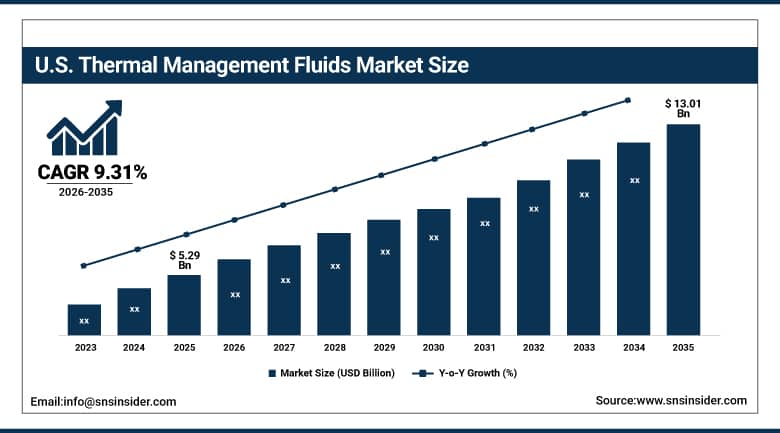
The U.S. Thermal Management Fluids Market was valued at USD 5.29 billion in 2025 and is expected to reach approximately USD 13.01 billion by 2035, expanding at a CAGR of 9.31% during 2026–2035.
Increases in investments in hyperscale data centers, semiconductor manufacturing, renewable energy production, and industrial automation are helping to drive new fluid technologies. In 2025, top hyperscale cloud companies in the US started enhancing their liquid cooling technology in server systems using artificial intelligence, which resulted in the introduction of high-performance dielectric fluids in the subsequent generation of data centers. The announcements from cloud computing firms and semiconductor firms continue to drive investments in liquid cooling. Large utilities and independent generators are increasingly using artificial intelligence, digital monitoring solutions, predictive asset maintenance services, and advanced grid automation technologies to increase renewable energy reliability and effectiveness.
Investments in domestic thermal management fluids production, business procurement of renewable energy and industrial electrification strengthen the leadership position of the country along the entire renewable energy value chain. The U.S. market is also enjoying growing manufacturing capabilities of batteries, investments in hydrogen technologies, and rapid deployment of smart grids able to handle larger amounts of renewable energy. In 2025, a number of utility-scale solar plants, battery energy storage installations, and domestic Thermal Management Fluids manufacturing projects were completed under federal Thermal Management Fluids incentive program.
Thermal Management Fluids Market Segment Analysis
-
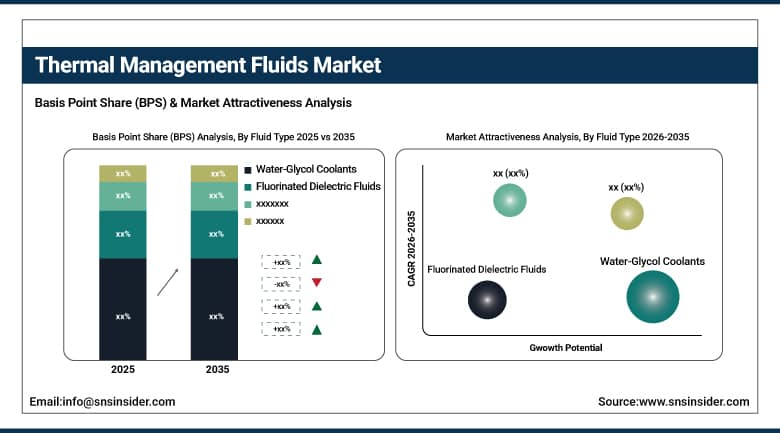
By Fluid Type, water-glycol coolants dominated the market with 38.00% share in 2025, while fluorinated dielectric fluids are projected to witness the fastest growth with 12.48% CAGR during the forecast period.
-
By Application, automotive & electric vehicles dominated the market with 32.00% share in 2025, while data centers & high-performance computing are projected to witness the fastest growth with 13.76% CAGR during the forecast period.
-
By End-User Industry, automotive & transportation dominated the market with 30.00% share in 2025, while information technology & data centers are projected to witness the fastest growth with 13.54% CAGR during the forecast period.
By Fluid Type, water-glycol coolants dominated, while fluorinated dielectric fluids grows fastest.
Water-glycol coolants held the top position in the thermal management fluids market with a share of 38.00% in 2025. The segment dominates owing to high adoption in automotive cooling systems, industrial machinery, HVAC equipment, and renewable energy applications thanks to good heat transfer ability, frost-resistance properties, anti-corrosion, and cost-effectiveness. Water-glycol coolants have become a popular choice for battery cooling solutions in electric vehicles as well as for traditional thermal systems as they ensure reliable operation in different climatic conditions without any compatibility issues with current cooling infrastructure. In 2025, BASF SE increased the number of its advanced heat transfer fluid technologies to boost the energy efficiency and overall performance of industrial and mobility applications.
Fluorinated dielectric fluids will witness the highest CAGR of 12.48% in 2026-2035. Growing application of immersion cooling technology for AI servers, hyperscale data centers, high-performance computing, and advanced semiconductor manufacturing drives the need for electrically non-conductive coolants. This product range delivers high dielectric strength, thermal stability, reduced evaporation, and system reliability with the support of high rack densities and energy savings. In 2025, Chemours widened its portfolio of dielectric fluids for two-phase immersion cooling applications in advanced computing and electronics.
By Application, automotive & electric vehicles dominated, while data centers & high-performance computing grows fastest.
The market share of automotive & electric vehicles segment was the largest and accounted for 32.00%. Electrification of transportation industry, production of battery electric vehicles, hybrid electric vehicles, and fuel cell platforms have created high demand for thermal management fluids. Modern battery packs, power electronics, electric motor, and charging system need proper thermal management to improve safety, charging speed, energy efficiency, and battery life. During 2025, General Motors continued investing in battery production to provide next-generation electric vehicle platforms which require liquid thermal management technologies.
Data centers & high-performance computing segment will grow with the highest CAGR of 13.76% over the forecast period. Increasing use of artificial intelligence, cloud computing, machine learning workloads, and high density servers have resulted in growing adoption of liquid cooling and immersion cooling solutions. Air cooling is becoming less effective due to very high thermal loads in case of next generation processors, therefore liquid cooling is increasingly being used for such processors due to better energy efficiency, cost effectiveness, and higher density of computations. In 2025, Microsoft continued using liquid cooled data centers infrastructure for AI to enhance energy efficiency and support HPC workloads.
By End-User Industry, automotive & transportation dominated, while information technology & data centers grows fastest.
The automotive & transportation market share held 30.00% of the global thermal management fluids market in 2025. Rising demand for thermal fluid management systems in light of growing demand for electric vehicles, commercial transportations, rail networks, and advanced mobility solutions have considerably increased the demand for thermal management fluids that can help maintain the temperature at optimum level under tough operating conditions. In 2025, Ford Motor Company increased their investments in advanced electric vehicles having advanced battery thermal management system.
Information technology & data centers is estimated to register the highest CAGR of 13.54% from 2026 to 2035. Growing adoption of AI infrastructures, hyperscale cloud data centers, semiconductor chip fabrication plants, and High Performance Computing Clusters has considerably driven the demand for efficient cooling fluids that can support advanced processing capabilities and low energy consumption rate. Growing use of immersion cooling and direct-to-chip liquid cooling techniques has helped the operators to improve the power usage effectiveness of the facility. In 2025, Schneider Electric launched advanced liquid cooling solutions for next-gen AI-enabled data center infrastructure.
Regional Analysis
|
Region |
Major Country |
Share within Region, 2025 (%) |
|---|---|---|
|
North America |
United States |
91.00% |
|
Europe |
Germany |
27.00% |
|
Asia Pacific |
China |
26.00% |
|
Middle East & Africa |
UAE |
4.00% |
|
Latin America |
Brazil |
4.00% |
North America Thermal Management Fluids Market Insights
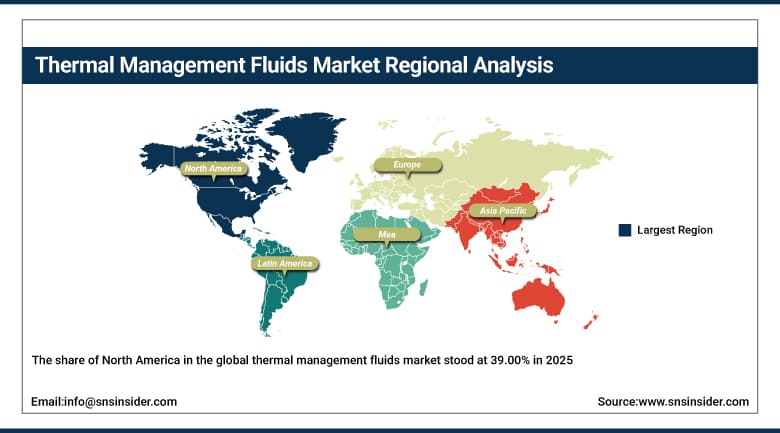
The share of North America in the global thermal management fluids market stood at 39.00% in 2025, continuing to hold the top market position owing to increased investments in the manufacture of electric vehicles, hyperscale data centers, semiconductors, and automation in industries. North America is positively impacted by the presence of major OEMs, cloud companies, chemical firms, and technology companies that are continuously leveraging advanced fluid cooling technology for battery systems, artificial intelligence computing infrastructure, and industrial machinery.
The rising focus on energy-efficient cooling technology, growing usage of immersion cooling technology, and continuous expansion of battery manufacturing plants are some additional factors boosting regional market demand. Government policies in support of domestic manufacturing and development of renewable energy infrastructures in the country are also significantly contributing to regional market growth. In 2025, Intel Corporation made further investments in advanced semiconductors manufacturing in the US market.
Get Customized Report as Per Your Business Requirement - Enquiry Now
Europe Thermal Management Fluids Market Insights
Europe is one of the important regional markets, characterized by stringent decarburization policies, fast uptake of electric vehicles, and investment in industrial sustainable manufacturing. Countries such as Germany, France, the United Kingdom, Italy, and the Nordic nations are investing a lot in batteries, integration of renewable energy, industrial automation, and energy-efficient cooling solutions. Europe is also experiencing increased use of environmentally friendly heat transfer fluids that not only conform to changing environmental regulations but also offer better thermal efficiency.
Modernization of manufacturing plants, development of advanced computing power, and installation of more sophisticated HVAC systems will drive the need for heat transfer fluids in the coming years. In 2025, BASF SE launched new developments aimed at sustainable heat transfer fluids that can be used in both industrial and mobility sectors of Europe.
Asia Pacific Thermal Management Fluids Market Insights
The Asia Pacific region is set to experience the highest CAGR of 9.64% over the forecast period, owing to growing production of electric vehicles, manufacture of semiconductors, battery energy storage, and rapid development of digital infrastructure. Nations such as China, Japan, South Korea, India, and the Southeast Asian economies have been continuously making huge investments in electronics manufacturing, hyperscale cloud data centers, renewable energy initiatives, and advanced manufacturing processes.
Growing government support towards the production of electric vehicles, increased localization of batteries, and consistent growth of artificial intelligence-driven computing facilities are fueling the demand for advanced thermal management fluids. Advanced manufacturing capabilities and consistent investments in next-generation cooling solutions will drive the Asia Pacific region to become the fastest-growing region over the coming decade. In 2025, CATL made huge investments in the manufacture of batteries and advanced thermal management fluids for next-generation electric vehicles in Asia.
Middle East & Africa and Latin America Thermal Management Fluids Market Insights
The Middle East & Africa region has experienced growth from gradual investments in industrial diversification, renewable energy initiatives, efficient cooling solutions, and advanced data centers. Countries such as UAE, Saudi Arabia, and South Africa have been investing in the development of digital infrastructure, development of energy storage utilities, and advanced industrial manufacturing facilities. The need for efficient cooling solutions in extreme operating environments has led to the use of advanced thermal fluids with enhanced stability and efficiency. Ongoing investments in smart infrastructure and industrial diversification are likely to offer good growth prospects in the future.
The Latin American market has continued to grow due to the increase in the production of automobiles, industrial output, renewable energy initiatives, and commercial cooling solutions. Brazil and Mexico have been key players in this region owing to the increased production of automobiles, industrial output, and investments in digital and battery technology infrastructure. In 2025, Shell launched advanced thermal fluids in emerging regions to cater to heat transfer needs of industries and provide efficient cooling solutions.
Market Dynamics
Growth Drivers: Increased usage of electric vehicles, AI infrastructure and advanced liquid cooling systems.
Growing electrification in transport and developing infrastructure for artificial intelligence are among the key drivers of growth in the market for thermal management fluids. Thermal management systems are required in electric vehicles for controlling battery temperatures, increasing efficiency in charging, and extending battery life. Consequently, more companies have started using advanced liquid cooling systems based on water-glycol coolants, synthetic hydrocarbon fluids, and fluorinated dielectric fluids to increase the efficiency, reduce energy consumption, and increase the reliability of the equipment. In 2025, NVIDIA extended its collaboration with infrastructure partners for deploying liquid-cooled AI data centers architectures for next generation GPU platforms.
Restraints: The high cost of development and environmental regulations of specialty thermal fluids.
While there is rapid market growth, the high costs involved in the production of specialty thermal fluids remain a major problem. The production of advanced dielectric fluids, fluorinated heat transfer fluids, and synthetic cooling fluids requires advanced manufacturing processes, premium quality materials, and product qualification due to the demanding nature of industrial applications. Moreover, environmental regulations regarding fluorinated materials, sustainability, and lifecycle emissions are making the manufacturers to re-formulate their products while preserving high thermal and insulation properties. In 2025, Chemours was making further investments in next-generation environmentally friendly dielectric fluid technology.
Opportunities: Growth in immersion cooling and next-generation semiconductors production.
The quick adoption of immersion cooling technologies can be considered one of the best long-term opportunities for thermal management fluid manufacturers. The rapid emergence of AI clusters, cloud computing infrastructure, edge computing sites, and the advanced development of semiconductor fabrication technologies need cooling technologies that are able to cope with much greater thermal densities along with electricity saving and decreased costs. Advanced dielectric fluids and other non-conductive coolants allow immersing the electronic parts directly into a coolant which provides superior performance and greater durability of hardware parts.
The increased funding for semiconductor fabrication sites, battery gig factories, renewable energy storage, and advanced computing infrastructure are expected to create great opportunities for manufacturers producing efficient thermal management fluids with lower impact on the environment and greater service life. Engineered Fluids, in 2025, expanded their line of immersion coolants to serve hyperscale AI infrastructures and high-performance computers. Electrified manufacturing are likely to offer new commercial opportunities going forward.
Recent Developments
-
2026: Shell expanded its advanced thermal fluids portfolio for industrial heat transfer, battery cooling, and next-generation energy applications.
-
2025: Chemours introduced enhanced dielectric fluid technologies designed to improve immersion cooling efficiency for AI-driven data center infrastructure.
-
2025: Engineered Fluids expanded high-performance immersion cooling solutions supporting hyperscale computing and advanced electronics.
-
2026: BASF SE advanced development of sustainable heat-transfer fluid technologies for industrial manufacturing and e-mobility applications.
Thermal Management Fluids Market Key Players are:
-
Exxon Mobil Corporation
-
Shell plc
-
Chevron Corporation
-
BASF SE
-
Eastman Chemical Company
-
Dow Inc.
-
Honeywell International Inc.
-
Chemours Company
-
Engineered Fluids Inc.
-
Arteco NV
-
Dynalene Inc.
-
Paratherm Corporation
-
Valvoline Global Operations
-
Castrol Limited
-
TotalEnergies SE
-
FUCHS SE
-
Clariant AG
-
Phillips 66 Company
-
Petro-Canada Lubricants Inc.
-
LANXESS AG
Thermal Management Fluids Market Report Scope:
| Report Attributes | Details |
|---|---|
| Market Size in 2025 | USD 14.90 Billion |
| Market Size by 2035 | USD 35.37 Billion |
| CAGR | CAGR of 9.03% From 2026 to 2035 |
| Base Year | 2025 |
| Forecast Period | 2026-2035 |
| Historical Data | 2022-2024 |
| Report Scope & Coverage | Market Size, Segments Analysis, Competitive Landscape, Regional Analysis, DROC & SWOT Analysis, Forecast Outlook |
| Key Segments | • By Fluid Type (Water-Glycol Coolants, Mineral Oil & Synthetic Hydrocarbon Fluids, Fluorinated Dielectric Fluids, Silicone-Based Fluids, Others) • By Application (Automotive & Electric Vehicles, Data Centers & High-Performance Computing, Industrial Equipment & Manufacturing, HVAC, Others) • By End-User Industry (Automotive & Transportation, Information Technology & Data Centers, Industrial Manufacturing, Energy, Utilities & Battery Storage, Healthcare, Others) |
| Regional Analysis/Coverage | North America (US, Canada), Europe (Germany, UK, France, Italy, Spain, Russia, Poland, Rest of Europe), Asia Pacific (China, India, Japan, South Korea, Australia, ASEAN Countries, Rest of Asia Pacific), Middle East & Africa (UAE, Saudi Arabia, Qatar, South Africa, Rest of Middle East & Africa), Latin America (Brazil, Argentina, Mexico, Colombia, Rest of Latin America). |
| Company Profiles | Exxon Mobil Corporation, Shell plc, Chevron Corporation, BASF SE, Eastman Chemical Company, Dow Inc., Honeywell International Inc., Chemours Company, Engineered Fluids Inc., Arteco NV, Dynalene Inc., Paratherm Corporation, Valvoline Global Operations, Castrol Limited, TotalEnergies SE, FUCHS SE, Clariant AG, Phillips 66 Company, Petro-Canada Lubricants Inc., LANXESS AG |
Frequently Asked Questions
The Thermal Management Fluids Market was valued at USD 14.90 Billion in 2025.
The market is projected to reach USD 35.37 Billion by 2035.
Water-Glycol Coolants accounted for the largest market share of 38.00% in 2025.
