
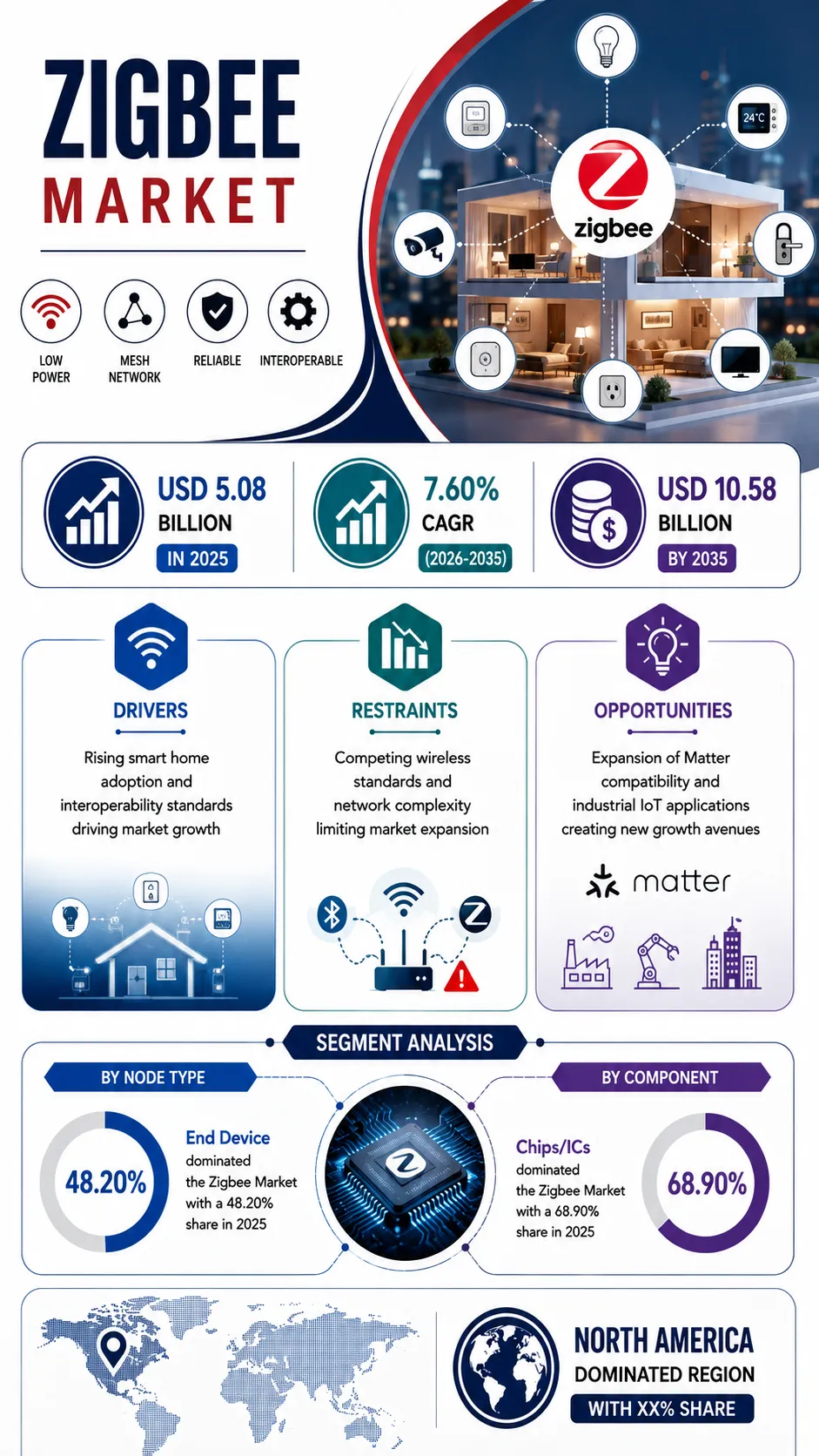
The global Zigbee Market is set for significant expansion as smart home adoption and Matter interoperability standards continue to reshape connected device networking worldwide. “According to a recent study by SNS Insider, the global Zigbee Market size valued at USD 5.08 billion in 2025, is anticipated to grow to USD 10.58 billion by 2035, registering a CAGR of 7.60% over the 2026–2035 forecast period.”
There have been tremendous changes within wireless connectivity technology over time, due to which many manufacturers who aim at improving interoperability of their devices can take advantage of this trend. This includes the need for more unified, multi-protocol chipset architectures that will provide device makers with the ability to support Zigbee alongside Thread, Wi-Fi, and Bluetooth Low Energy from a single silicon platform. This applies in situations where Zigbee supports residential automation, industrial control, and healthcare monitoring applications. Manufacturers are constantly working hard to ensure that their connectivity solutions perform better than before in order to meet various interoperability and reliability requirements.
To Get Detailed Insights on the Zigbee Market – Request a Sample Report
Matter Interoperability Creates New Demand
The Zigbee market has evolved from a single-purpose wireless protocol to an increasingly interoperable, multi-standard connectivity platform. The growing investment in Matter-compatible silicon, multi-protocol chipset design, and mesh network scalability across manufacturers of all sizes has required the development of more unified and future-proof Zigbee device architectures.
New chipset and module designs can increase interoperability, improve mesh network coverage, and allow for expansion into increasingly demanding industrial and smart city sensor network applications. This gives device manufacturers and end users the possibility to build connected ecosystems that seamlessly bridge multiple wireless standards under a single management framework.
Semiconductor manufacturers, module suppliers, and smart home ecosystem providers are increasingly cooperating thanks to the growing interest in developing future solutions for unified, Matter-compatible connectivity across residential, commercial, and industrial applications.
Key Market Findings Highlight High-Growth Segments
The residential automation segment dominated all categories in the Zigbee market share with a market revenue share of 38.60% in 2025 due to surging smart home device adoption globally. The fastest growing category is expected to be industrial automation which will grow at a CAGR of 9.20% through 2035, owing to rising sensor network investment in manufacturing and process monitoring.
By node type, end devices held the largest share of total market revenue at 48.20% in 2025 due to their status as the most numerous node type in Zigbee networks. Routers will see the fastest growth in revenue generation at a CAGR of 12.80%, driven by growing network complexity and expanding geographic coverage requirements.
Based on protocol type, single-protocol Zigbee generated a share of 61.80% of market revenue in 2025 thanks to its established, cost-effective installed base. On the other hand, multi-protocol devices will be the segment recording the fastest revenue growth at a CAGR of 13.40%, supported by growing enterprise demand for unified platform architectures.
Distributive component trends are changing as well. Chips and ICs accounted for a 68.90% revenue share in 2025 owing to their essential role as the foundational semiconductor component. But modules will turn out to be the fastest-growing component category through 2035, on the back of concentrated smart home and LED lighting manufacturing in China and Taiwan.
Interoperability, Energy Efficiency, and Network Scalability Gain Importance
In this regard, device manufacturers have been looking at Zigbee connectivity solutions that would deliver more seamless cross-standard interoperability while requiring less power consumption and simpler network management.
Innovation in multi-protocol silicon design, mesh network optimization, and Matter certification compliance has been making it possible for companies to come up with products that can operate effectively across increasingly diverse smart home and industrial deployment scenarios. In addition to that, increasing emphasis on battery-free Green Power sensing is also making it possible for manufacturers to find solutions that expand monitoring applications without frequent maintenance. Such trends are likely to become even more prominent in the future.
North America Emerges as the Largest Market Amid Rising Smart Home Adoption
The North America region represented the largest share of regional market revenue in 2025, owing to strong domestic demand for smart home devices supported by an extensive installed base of connected lighting, security, and climate control systems. On the other hand, Asia Pacific is experiencing rapid growth and is expected to be the fastest-growing market during the forecast period through 2035, propelled by urbanization, industrial expansion, and government initiatives promoting smart cities and IoT infrastructure.
Leading Companies Drive Innovation and Competition
The environment continues to stay very dynamic since players continue innovating on multi-protocol silicon design and Matter compatibility as well as forming partnerships in order to enhance their position in the industry. Some of the major companies that operate in the global Zigbee market are Texas Instruments, NXP Semiconductors, Microchip Technology, Silicon Laboratories, Digi International, Qualcomm, STMicroelectronics, Intel, Infineon Technologies, and EnOcean.
An SNS Insider analyst Santosh Bhul commented, "The accelerating shift toward Matter-compatible, multi-protocol connectivity is creating unprecedented demand for unified, interoperable Zigbee silicon and device architectures. Manufacturers that successfully combine multi-protocol design, energy efficiency, and mesh network scalability will be best positioned to capitalize on emerging opportunities across residential, industrial, and smart city applications."
About the Author

Get in touch




