
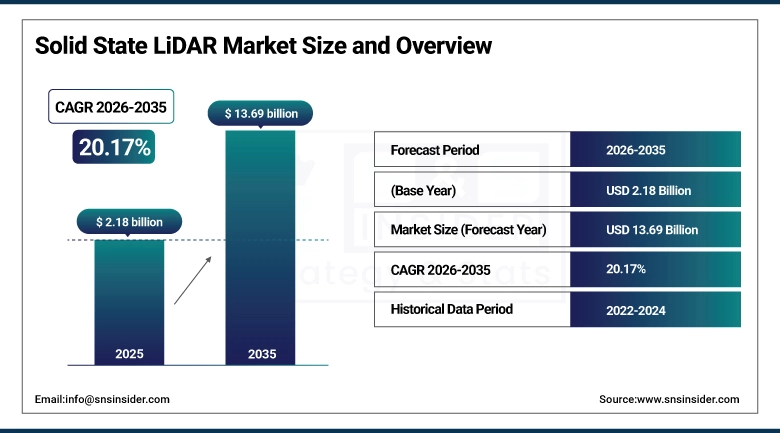
As per the SNS Insider Report titled, Solid State LiDAR Market by Technology, by Component, by Application, by End Use, and Region | Global Forecast 2026-2035, “The global Solid State LiDAR Market size valued at USD 2.18 billion in 2025, is anticipated to grow to USD 13.69 billion by 2035, registering a CAGR of 20.17% over the 2026–2035 forecast period.”
Key Takeaways
-
Flash LiDAR accounted for nearly 44.30% of the market share in 2025, driven by its compact architecture, lower moving parts requirement, and growing deployment in autonomous sensing applications.
-
Scanning LiDAR is projected to witness the fastest growth during 2026–2035 with a CAGR of 29.23% due to increasing demand for high-resolution environmental mapping and advanced object detection systems.
-
Processing Unit dominated the component segment with a 27.40% revenue share in 2025 owing to rising integration of advanced AI-enabled processing capabilities within LiDAR systems.
-
Processing Unit is also expected to register the fastest CAGR of 24.28% through 2035 supported by increasing demand for real-time data processing, sensor fusion, and autonomous navigation technologies.
-
Autonomous Vehicles held approximately 43.20% share in 2025, supported by rapid advancements in self-driving vehicle technologies and ADAS deployment.
-
Robotics is anticipated to emerge as the fastest-growing application segment during the forecast period with a CAGR of 29.01% due to increasing adoption of LiDAR-enabled robotic navigation and industrial automation systems.
-
Automotive represented nearly 48.20% of the market revenue in 2025 owing to growing implementation of LiDAR sensors in electric vehicles, ADAS platforms, and autonomous driving technologies.
-
Environmental Monitoring is projected to record the fastest CAGR of 23.26% from 2026 to 2035 driven by increasing use of LiDAR systems for climate analysis, forestry management, and terrain mapping applications.
-
North America captured around 37.60% of total market revenue in 2025 supported by strong investments in autonomous mobility technologies and advanced sensing systems.
-
Asia-Pacific is projected to record the fastest CAGR of 23.26% from 2026 to 2035 driven by rapid automotive innovation, robotics adoption, and increasing smart infrastructure development.
Why Solid State LiDAR Market is Growing?
Rapid growth in the Solid State LiDAR Market can be attributed to rising demand for sensing and perception technologies for various applications including autonomous driving, robotics, industrial automation, and smart infrastructures. Solid state LiDAR systems have an edge over traditional mechanical LiDAR systems owing to compact size, increased durability, low power consumption, and minimal maintenance.
Growth in investments towards autonomous driving systems and ADAS solutions is also boosting market growth considerably. The automotive industry is incorporating solid state LiDAR technology in the development of new-age cars for improved object recognition capabilities, navigation, and safety on roads.
Rapid growth in the fields of robotics, warehouse automation, and smart manufacturing operations is fueling growth in demand for effective LiDAR systems as well. Various robotic platforms depend upon LiDAR technology for navigating through environments safely without obstacles.
Further technological breakthroughs related to semiconductor photonics, advanced processing systems, and sensor fusion are also helping boost market growth to a considerable extent.
Solid State LiDAR Market Statistics
-
The automotive manufacturers are incorporating solid-state LiDAR solutions into their autonomous vehicles to enhance navigation and detection abilities.
-
The need for LiDAR sensors that are small-sized and power-efficient has been growing as a result of robotics and industrial automation applications.
-
AI-powered processing modules have become essential for the analysis of LiDAR data and sensor fusion applications.
-
Smart city projects and environmental monitoring efforts have led to the use of LiDAR devices for mapping and surveillance.
-
The development of semiconductors and silicon photonics is decreasing manufacturing costs of LiDAR sensors.
-
Electric car companies are using high-tech sensing devices for ADAS and autonomous driving systems.
-
The Asia-Pacific region has continued to grow owing to innovation in the automotive sector, robotics market growth, and smart city projects.
Emerging Trends
Some of the trends influencing the development of the Solid State LiDAR Market include increased use of AI-enabled perception systems and sensor fusion technologies for use in autonomous navigation systems. Innovations in this industry include the enhancement of the accuracy, resolution, miniaturization, and processing speeds to help develop next-generation systems of mobility and automation.
The use of scanning LiDARs is considered one of the growth areas within the industry owing to its ability to provide enhanced capabilities of environmental mapping and imaging at high resolutions. Industries such as robotics and industrial automation are also beginning to adopt LiDAR systems in warehouse operations and intelligent manufacturing processes.
Another trend shaping the growth of the Solid State LiDAR market includes the integration of silicon photonics and edge AI processors and cloud analytics platforms within the LiDAR systems. Other areas of innovation include investments in smart transport infrastructure, autonomous drone technology, digital mapping, and environmental monitoring systems.
Top 10 Companies
-
Velodyne Lidar Inc.
-
Luminar Technologies Inc.
-
Innoviz Technologies Ltd.
-
Ouster Inc.
-
Hesai Technology
-
RoboSense
-
Aeva Technologies Inc.
-
Cepton Inc.
-
Quanergy Systems Inc.
-
Valeo SA
About the Author

Get in touch




