
Postpartum Depression Digital Therapeutics & Telehealth Market Report Scope & Overview:
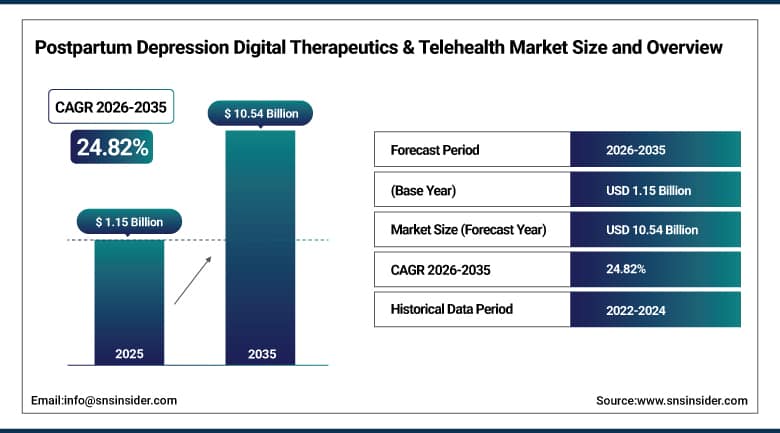
The Postpartum Depression Digital Therapeutics & Telehealth Market was valued at USD 1.15 billion in 2025 and is expected to reach USD 10.54 billion by 2035, growing at a CAGR of 24.82% from 2026–2035.
The postpartum depression digital therapeutics & telehealth market is witnessing rapid growth in the global market owing to increasing awareness of maternal mental health. Rising prevalence of postpartum depression and expanding access to virtual healthcare services are boosting adoption. Growing investments in digital behavioral therapies and telepsychiatry platforms are supporting market expansion. Providers are focusing on evidence-based interventions and personalized remote care solutions. Rising demand for accessible mental health support, continuous patient monitoring, and integrated care pathways is driving innovation. Increasing use of mobile health applications and AI-enabled therapeutic platforms is further accelerating market adoption.
Postpartum depression is estimated to affect about 10% of women in high-income countries and close to 20% in low- and middle-income countries according to the World Health Organization.
According to the CDC, 13% of women show signs of postpartum depression on average in the United States. Digital therapeutics are increasingly being adopted due to telehealth expansion in over 70% of the WHO Member States.
To Get More Information On This Market - Request Free Sample Report
Postpartum Depression Digital Therapeutics & Telehealth Market Trends
-
The growing popularity of personalized digital therapeutics using AI is contributing to more precise treatments, increased patient engagement, and improved mental well-being after childbirth.
-
Development of telehealth infrastructure makes possible convenient remote consultations and greater accessibility of depression therapy for women after childbirth in urban and rural areas.
-
Predictive analytics is gaining momentum to help healthcare professionals determine which women have a higher risk and offer prevention through behavioral intervention.
-
The rising penetration of smartphones and use of mHealth applications is facilitating the adoption of digital cognitive behavioral therapy and other support programs.
-
There is an increasing trend in healthcare organizations partnering with tech companies to create evidence-based digital therapies for maternal mental health.
-
Reimbursement-friendly policies and favorable regulations are promoting the adoption of telehealth services and digital mental health technologies.
The U.S. Postpartum Depression Digital Therapeutics & Telehealth Market Outlook
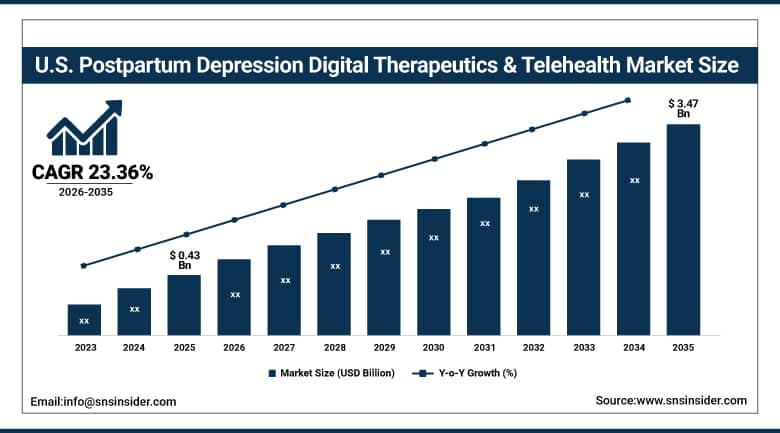
The U.S. Postpartum Depression Digital Therapeutics & Telehealth Market was valued at USD 0.43 billion in 2025 and is expected to reach around USD 3.47 billion by 2035, growing at a CAGR of 23.36% from 2026–2035.
The U.S. postpartum depression digital therapeutics & telehealth market is expanding rapidly owing to increasing awareness of maternal mental health conditions. Rising postpartum depression prevalence and wider telehealth adoption are supporting sustained market growth. Growing integration of digital cognitive behavioral therapy platforms is driving implementation across healthcare organizations. Expansion of remote patient monitoring and virtual behavioral health services is further accelerating demand. Providers are focusing on personalized digital interventions and evidence-based therapeutic programs. Increasing use of AI-enabled mental health platforms and mobile care applications is strengthening market penetration.
Postpartum depression is said to affect one in eight women who give birth. Increased flexibility in using telehealth services through Medicare has improved access to virtual behavioral healthcare. Over 99% of all non-federal acute care hospitals in the country have been found by the Office of the National Coordinator for Health Information Technology to use certified electronic health records.
Postpartum Depression Digital Therapeutics & Telehealth Market Segment Analysis
-
By Therapy Type, digital cognitive behavioral therapy (dCBT) dominated the market with 34.82% share in 2025; while peer support & counseling is the fastest growing segment with CAGR of 29.88% during 2026 to 2035.
-
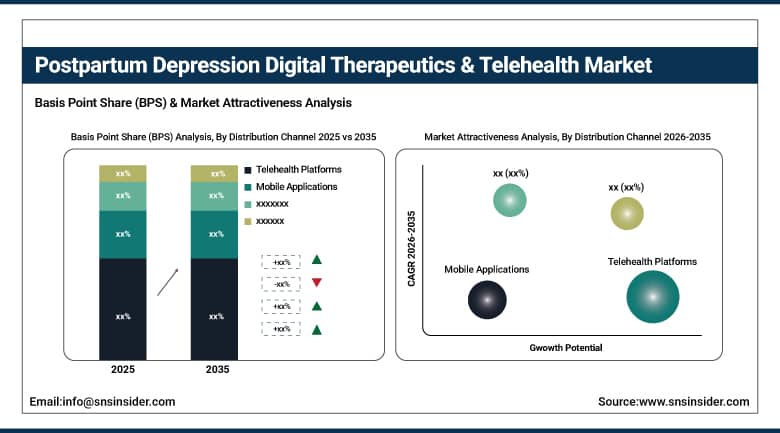
By Distribution Channel, telehealth platforms dominated the market with 38.47% share in 2025; while mobile applications/web platforms are the fastest growing segment with CAGR of 29.05% during 2026 to 2035.
-
By End User, homecare & individual patients dominated the market with 34.91% share in 2025; while maternity & women's health clinics is the fastest growing segment with CAGR of 28.08% during 2026 to 2035.
By Distribution Channel, telehealth platforms dominated the market, while mobile applications/web platforms are the fastest growing segment.
Telehealth Platforms category accounted for the dominated revenue share in the postpartum depression digital therapeutics & telehealth market. High adoption rates in hospitals and behavioral health centers ensured extensive use throughout maternal care processes. The secure teleconsultation process, reimbursement, and electronic health records enabled easier access to continuous care. Increasing need for tele psychiatric services and presence of qualified specialists helped boost adoption through developed healthcare systems.
Mobile applications/web platforms category would register the fastest CAGR in the forecast period 2026-2035. Increase in the usage rate of smartphones and high acceptance of self-guided mental health services will help in the adoption of applications. The provision of AI-assisted therapies, mood monitoring, and personalized cognitive behavior therapy will help engage more patients and adhere to treatment. Increasing internet availability, affordable service charges, and innovations will drive market growth.
By Therapy Type, digital cognitive behavioral therapy (dCBT) dominated the market, while peer support & counseling is the fastest growing segment.
The digital cognitive behavioral therapy (dCBT) segment captured the dominated revenue share in the postpartum depression digital therapeutics & telehealth market in 2025. This dominance can be mainly credited to the segment's clinical acceptance and adoption into various telehealth solutions. Healthcare professionals favored this type of therapy because of its measurable results as well as the option of accessing it remotely. The increasing funding for this therapy, customized treatment modules, and high patient compliance have been major factors driving its adoption.
The peer support & counseling segment is anticipated to witness the fastest CAGR over the forecast period. With the growing awareness of the need for emotional support for the postpartum period, the use of this segment is witnessing a rise among mothers who are new to motherhood. Patients are connected through digital platforms to counselors and peers to maintain continuity of care.
By End User, homecare & individual patients dominated the market, while maternity & women's health clinics is the fastest growing segment.
Homecare & individual patients segment accounted for dominated revenue share in postpartum depression digital therapeutics & telehealth market in 2025 owing to growing inclination towards easy and convenient home mental health care after pregnancy. Increase in use of telehealth services and mental therapy mobile applications has made services easily accessible to pregnant mothers. Increasing need for privacy, constant monitoring, reduction in cost of treatment and flexibility in virtual consultation has led to increase in use in homecare and individuals.
Maternity & women's health clinics segment is projected to exhibit fastest CAGR during 2026-2035. This growth will be attributed to increasing integration of digital mental health evaluation into general maternal health services. Increased collaboration with telehealth service providers will make postpartum depression treatment more accessible to patients. Increased focus on early diagnosis, personal behavioral therapy, multidisciplinary care coordination and reimbursement support will drive adoption in maternity and women's health clinics around the globe.
Regional Analysis
|
Region |
Major Country |
Share within Region, 2025(%) |
|---|---|---|
|
North America |
United States |
88.64% |
|
Europe |
Germany |
24.80% |
|
Asia Pacific |
China |
38.60% |
|
Middle East & Africa |
UAE |
17.20% |
|
Latin America |
Brazil |
46.10% |
North America Postpartum Depression Digital Therapeutics & Telehealth Market Insights.
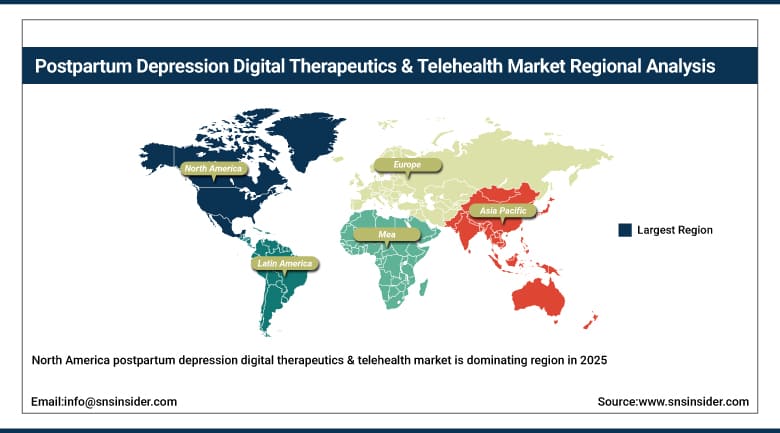
North America postpartum depression digital therapeutics & telehealth market is dominating region in 2025, accounting for about 41.82% share, driven by advanced digital healthcare infrastructure and strong maternal mental health awareness. The region benefits from widespread telehealth adoption and favorable reimbursement policies. Increasing investments in digital behavioral health platforms are significantly strengthening service utilization. Expansion of remote maternal care programs is accelerating demand. A strong focus on early diagnosis and personalized virtual interventions further reinforces the region's dominant position in the market.
As per the United States' Centers for Disease Control and Prevention, roughly one out of eight women having recently delivered her baby suffers from postpartum depression symptoms. According to the data published by CDC, about 87.4% and 79.1% of women undergo depression screening during postpartum care and prenatal visits respectively. The high rate of depression screening along with the increased utilization of telemedicine facilities is helping the adoption of digital therapeutics.
Get Customized Report as Per Your Business Requirement - Enquiry Now
Europe Postpartum Depression Digital Therapeutics & Telehealth Market Insights.
Europe postpartum depression digital therapeutics & telehealth market is characterized by stable growth in 2025 owing to expanding digital mental healthcare adoption. Key countries include Germany, France, United Kingdom, Italy, and Spain. Rising investments in maternal mental health services are driving adoption. Increasing awareness of postpartum depression is boosting demand. Growth in telepsychiatry and digital cognitive behavioral therapy programs is further supporting market expansion. Supportive healthcare policies are encouraging innovation across digital maternal health platforms.
As per the World Health Organization European Region, about 99% of all births are handled by skilled health care providers within Europe. As per the monitoring of the Digital Decade by the European Commission, the eHealth maturity level score of the EU-27 stands at 83%. Almost all of the member states have enabled secure access to electronic health records. Digital therapeutics for postpartum mental health care is getting facilitated owing to telemedicine integration.
Asia Pacific Postpartum Depression Digital Therapeutics & Telehealth Market Insights.
Asia Pacific is the fastest growing region in the postpartum depression digital therapeutics & telehealth market, registering a CAGR of about 27.94% during 2026–2035. Rapid digital healthcare expansion and improving maternal health awareness are driving strong demand across China, India, Japan, South Korea, and Australia. Increasing smartphone penetration and internet accessibility are boosting market growth. Rising investments in telehealth infrastructure are further accelerating adoption. Growth in digital healthcare ecosystems is supporting large scale market expansion.
According to World Health Organization and UNICEF, about 20% of women in many low- and middle-income countries suffer from postpartum depression or any other maternal mental disorder. As per WHO, more than 70% of the member countries have developed a national digital health strategy. Moreover, according to ITU, internet penetration in Asia Pacific region exceeds 77%.
Middle East & Africa and Latin America Postpartum Depression Digital Therapeutics & Telehealth Market Insights.
The Middle East & Africa along with Latin America regions are witnessing steady growth due to expanding telehealth infrastructure and improving maternal healthcare access. Key contributing countries include Brazil, Mexico, UAE, Saudi Arabia, and South Africa. Increasing awareness of postpartum mental health is driving adoption. Growth in digital healthcare services is further supporting market expansion. Rising government investments in telemedicine platforms are boosting regional demand.
Telemedicine forms part of digital health strategy in over 120 nations as indicated by the World Health Organization and the International Telecommunication Union. As per WHO, about 10% of pregnant women and 13% of postnatal mothers have mental health illnesses including depression. The increased adoption of mobile internet services in Latin America and Sub-Saharan Africa, which is more than 70% and 44%, respectively, facilitates telehealth.
Market Dynamics
Growth Drivers: Telehealth expansion and digital platforms improve postpartum care accessibility and engagement.
The fast-paced build-up of telehealth technology is revolutionizing the way postpartum mental health services are provided in both developed and developing healthcare systems. Growth in the use of smartphones and availability of internet connection is helping to facilitate access to scientifically-proven therapeutic interventions. The adoption of telemedicine technology that provides patients with personalized therapy sessions, tracking of symptoms and patient engagement is being pursued by healthcare facilities. Artificial intelligence and remote monitoring solutions are helping improve patient compliance and decision-making process. The favorable reimbursement scenario and policy framework is fueling the growth of this market.
As per the World Health Organization and UNICEF, around 20% of women living in low- and middle-income countries suffer from postpartum depression. More than 70% of the WHO Member States have put into place national policies on digital health that incorporate telemedicine. As reported by the Organisation for Economic Co-operation and Development, telehealth is still being used at higher rates compared to before the pandemic.
Restraints: Privacy concerns, data security risks, and validation issues restrict digital therapeutic adoption.
The issue of protecting the privacy of patients still poses a challenge since the digital platform will be collecting sensitive information regarding the mental well-being of mothers using connected apps. Hospitals need robust cybersecurity protocols to prevent their patient's confidential data from being accessed or any breach of data. Lack of proven clinical evidence for some of the digital therapies available will affect the confidence of doctors in adopting the products. The compliance issues make it more difficult to implement and develop the technology.
Opportunities: AI integration and personalized digital therapeutics enhance maternal mental healthcare delivery opportunities.
Expanding integration of artificial intelligence is enabling personalized treatment recommendations based on individual behavioral patterns and symptom progression. Advanced analytics are helping healthcare providers identify high-risk mothers and deliver timely preventive interventions. Digital platforms incorporating predictive algorithms and adaptive therapeutic content are improving patient engagement and clinical effectiveness. Increasing collaboration between healthcare organizations and technology companies is accelerating innovation across digital mental healthcare. Growing investment in intelligent healthcare solutions is strengthening commercialization opportunities. These advancements are creating significant growth potential for the postpartum depression digital therapeutics & telehealth market.
As per the World Health Organization, more than 70% of member states of WHO have implemented digital health strategies that enable the use of telemedicine and AI-powered healthcare facilities. As estimated by WHO, around 10% of women in the world suffer from postpartum depression, with 20% of women from low- and middle-income nations facing the problem. In 2025, FDA approved 331 AI-powered medical devices.
Recent Developments
-
2026: Maven Clinic launched Maven Intelligence, an AI-powered orchestration layer designed to streamline women’s and family healthcare delivery.
-
2025: Headspace secured a strategic partnership with the United States Navy to provide digital mindfulness and mental health support applications.
-
2025: Seven Starling raised 8 million dollars in a Series A funding round to expand its integrated healthcare model.
-
2024: Wildflower Health upgraded its digital application platform to enhance data-tracking features for comprehensive pregnancy and postpartum metrics.
Microprinting Market Key Players are:
-
Curio Digital Therapeutics
-
Maven Clinic
-
Babyscripts
-
Seven Starling
-
Mahmee
-
FamilyWell Health
-
Mammha
-
Canopie
-
Wildflower Health
-
Talkspace
-
Headspace
-
Teladoc Health
-
Wysa
-
Woebot Health
-
SonderMind
-
Marani Health
-
Lōvu Health
-
Click Therapeutics
-
Youper
-
Origin
Postpartum Depression Digital Therapeutics & Telehealth Market Report Scope:
| Report Attributes | Details |
|---|---|
| Market Size in 2025 | USD 1.15 Billion |
| Market Size by 2035 | USD 10.54 Billion |
| CAGR | CAGR of 24.82% From 2026 to 2035 |
| Base Year | 2025 |
| Forecast Period | 2026-2035 |
| Historical Data | 2022-2024 |
| Report Scope & Coverage | Market Size, Segments Analysis, Competitive Landscape, Regional Analysis, DROC & SWOT Analysis, Forecast Outlook |
| Key Segments | • By Therapy Type (Digital Cognitive Behavioral Therapy (dCBT), Mindfulness-Based Therapy, Behavioral Activation Therapy, Psychoeducation Programs, Peer Support & Counseling, Medication Management Support, Others) • By Distribution Channel (Healthcare Providers, Telehealth Platforms, Mobile Applications/Web Platforms, Direct-to-Consumer, Others) • By End User (Hospitals, Maternity & Women's Health Clinics, Behavioral Health Centers, Homecare & Individual Patients, Employers & Healthcare Organizations, Others) |
| Regional Analysis/Coverage | North America (US, Canada), Europe (Germany, UK, France, Italy, Spain, Russia, Poland, Rest of Europe), Asia Pacific (China, India, Japan, South Korea, Australia, ASEAN Countries, Rest of Asia Pacific), Middle East & Africa (UAE, Saudi Arabia, Qatar, South Africa, Rest of Middle East & Africa), Latin America (Brazil, Argentina, Mexico, Colombia, Rest of Latin America). |
| Company Profiles | Curio Digital Therapeutics, Maven Clinic, Babyscripts, Seven Starling, Mahmee, FamilyWell Health, Mammha, Canopie, Wildflower Health, Talkspace, Headspace, Teladoc Health, Wysa, Woebot Health, SonderMind, Marani Health, Lōvu Health, Click Therapeutics, Youper, Origin |

Frequently Asked Questions
The digital cognitive behavioral therapy (dCBT) dominated due to proven effectiveness, telehealth integration, personalized care, strong clinical acceptance, and high patient adherence.
The postpartum depression digital therapeutics & telehealth market is expected to grow at a CAGR of 24.82% from 2026 to 2035.
North America dominated the Postpartum depression digital therapeutics & telehealth market in 2025.
The postpartum depression digital therapeutics & telehealth market was valued at USD 1.15 billion in 2025.
The major growth factors include increasing maternal mental health awareness, rising postpartum depression prevalence, expanding telehealth adoption, growing digital behavioral therapy investments, AI-enabled personalized therapeutics, and wider mobile health application and remote patient monitoring adoption.
