
AI-Based Gas Analyzer Market Report Scope & Overview:
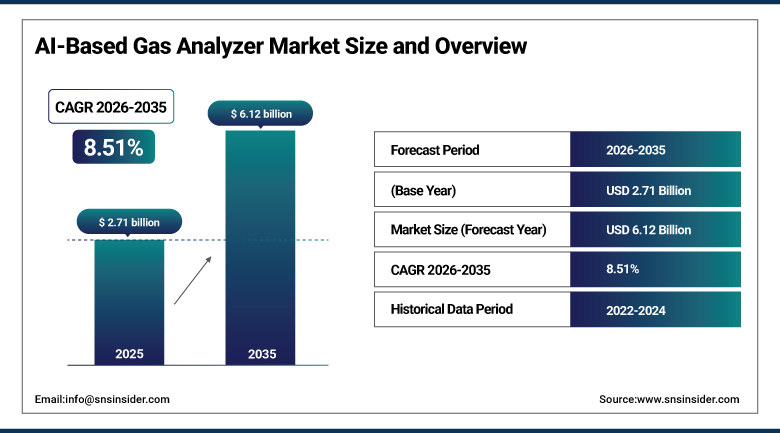
The AI-Based Gas Analyzer Market was valued at USD 2.71 Billion in 2025 and is projected to reach USD 6.12 Billion by 2035, expanding at a CAGR of 8.51% during the forecast period 2026–2035.
Rapid market growth is evident in the international AI-based gas analyzer market due to the increasing use of intelligent gas sensors by organizations in order to enhance their safety, compliance with regulations, efficiency in processes, and predictive maintenance. The combination of artificial intelligence technology in advanced gas analysis equipment allows real-time detection, automated identification of any anomalies, predictive diagnostics, and monitoring through cloud solutions in industrial plants. High adoption rates of these analyzers in sectors such as oil & gas, chemical, manufacturing, medical, and environmental sectors is propelling the commercialization of these solutions. Growth in investments in Industry 4.0, industrial automation, smart manufacturing, and digital process control further facilitates the expansion of the market.
To Get more information AI-Based Gas Analyzer Market - Request Free Sample Report
AI-Based Gas Analyzer Market Trends
-
Increasing deployment of AI-powered continuous gas monitoring systems across industrial facilities.
-
Growing adoption of cloud-connected gas analyzers integrated with predictive maintenance platforms.
-
Rising implementation of Industry 4.0 and Industrial IoT technologies supporting intelligent gas detection.
-
Expanding utilization of AI-driven emission monitoring systems for regulatory compliance and sustainability initiatives.
-
Increasing integration of machine learning algorithms for predictive leak detection and process optimization.
The U.S. AI-Based Gas Analyzer Market Size Outlook
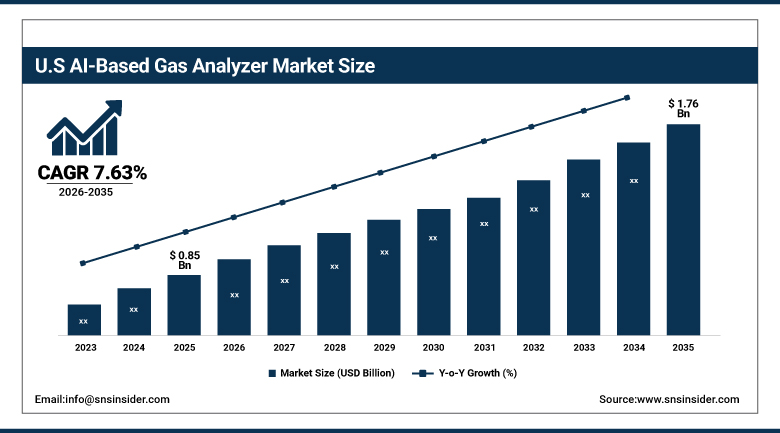
The U.S. AI-Based Gas Analyzer Market was valued at USD 0.85 billion in 2025 and is expected to reach approximately USD 1.76 billion by 2035, expanding at a CAGR of 7.63% during 2026–2035.
The USA still dominates the AI enabled gas analyzers market owing to the extensive use of automated systems in industry and stringent environmental policies, as well as considerable investments made in intelligent manufacturing. There is increasing usage of AI enabled gas analyzers in various industries such as oil & gas, chemicals, energy, pharmaceuticals, and health care for better safety at work place, regulatory compliance, improved efficiencies, and predictive maintenance of assets. Increasing deployment of Industrial Internet of Things, cloud based monitoring systems, and intelligent emission management systems is driving the growth of this market. Further investments in the digitalization of industries, carbon emissions reductions programs, and process optimization will ensure continued dominance in coming years.
AI-Based Gas Analyzer Market Segment Analysis
-
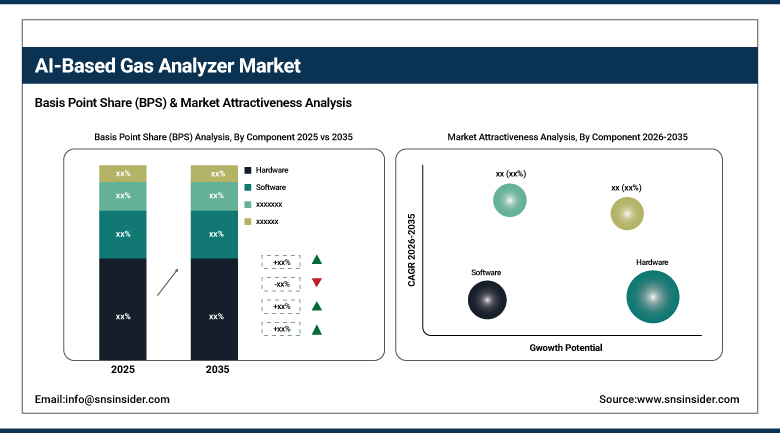
By Component, hardware dominated the market with 48.00% share in 2025, while cloud analytics & AI platforms are projected to witness the fastest growth with 11.94% CAGR during the forecast period.
-
By Technology, infrared spectroscopy dominated the market with 31.00% share in 2025, while photoionization & laser spectroscopy are projected to witness the fastest growth with 11.87% CAGR during the forecast period.
-
By Application, environmental monitoring dominated the market with 29.00% share in 2025, while healthcare & medical diagnostics are projected to witness the fastest growth with 10.07% CAGR during the forecast period.
-
By End User Industry, oil & gas dominated the market with 28.00% share in 2025, while healthcare & life sciences are projected to witness the fastest growth with 10.78% CAGR during the forecast period.
By Component, hardware dominated, while cloud analytics & AI platforms fastest-growing.
In terms of revenue share, the hardware segment dominated the market with 48.00% in 2025 due to growing use of advanced gas sensors, optical analyzers, AI processor embedded systems, infrared detectors, laser-based measuring devices, and edge computing devices in industries. Industries are investing in sophisticated gas analysis devices that are capable of offering real-time monitoring, predictive diagnosis, and process optimization in real time. Growing deployment of industrial automation systems, stringent safety regulations at the workplace, and adoption of intelligent gas monitoring devices in industries will fuel the growth of hardware in the global market of AI-based gas analyzer.
In terms of CAGR, the segment of cloud analytics & AI platforms is expected to grow with the highest growth rate of 11.94% during the forecast period due to growing use of cloud-based industrial monitoring systems, AI-based predictive analysis, and asset management platforms. The companies are deploying gas analyzers with cloud computing technologies to offer remote monitoring capabilities, automated reports, predictive maintenance, and operational intelligence at an enterprise level. Growth of Industrial IoT, digital twins, machine learning algorithms, and software platforms is driving the growth of cloud-based AI gas monitors in the industry.
By Technology, infrared spectroscopy dominated, while photoionization & laser spectroscopy fastest-growing.
Infrared spectroscopy technology held the maximum market share of 31.00% in 2025 on account of their high degree of accuracy, non-invasive measurements, superior selectivity properties, and applicability in the continuous monitoring of industrial gases. Increasing use of infrared spectroscopy systems for applications such as emission monitoring, combustion improvement, process control, and environmental compliance in the oil and gas industry, chemical process industry, manufacturing industry, and electricity generation industry is anticipated to drive the growth of the technology over the forecast period.
Photoionization & laser spectroscopy technology is expected to grow at the highest CAGR of 11.87% from 2026 to 2035, driven by growing need for ultra-sensitive detection of volatile organic compounds and toxic gases. Technologies involving laser spectroscopy in combination with artificial intelligence help provide superior levels of measurement precision, fast response time, predictive diagnostics, and calibration automation. Adoption of these technologies in applications such as environmental monitoring, industrial safety, pharmaceuticals manufacturing, semiconductor fabrication, and healthcare diagnostics is expected to fuel their growth in the forecast period.
By Application, environmental monitoring dominated, while healthcare & medical diagnostics fastest-growing.
Environmental monitoring constituted the largest revenue contribution of 29.00% in 2025 attributed to growing importance being accorded worldwide to air quality management, monitoring of emissions from industrial facilities, climate compliance, and continuous monitoring of pollutants. The use of AI-based gas analyzers for monitoring greenhouse gases, hazardous emissions, and ambient air quality by government authorities and industrial establishments is also contributing positively to this growth trend. Growth will continue being driven by increasing regulations, smart cities initiatives, and intelligent monitoring systems in both developing and developed countries.
The healthcare & medical diagnostics segment is expected to record the highest CAGR of 10.07% during the forecast period fueled by rising adoption of AI-based gas analysis devices in respiratory diseases diagnosis, breath analysis, monitoring of anesthesia, and clinical research studies. Intelligent gas analyzers equipped with artificial intelligence are increasingly being used by healthcare providers to increase accuracy in diagnosing conditions and improving patient monitoring processes. Advancements in non-invasive diagnostic tools and precision medicine practices are creating many opportunities in the field of healthcare applications.
Regional Analysis
|
Region |
Major Country |
Share within Region, 2025 (%) |
|---|---|---|
|
North America |
United States |
92.00% |
|
Europe |
Germany |
27.00% |
|
Asia Pacific |
China |
30.00% |
|
Middle East & Africa |
UAE |
5.00% |
|
Latin America |
Brazil |
4.00% |
North America AI-Based Gas Analyzer Market Insights
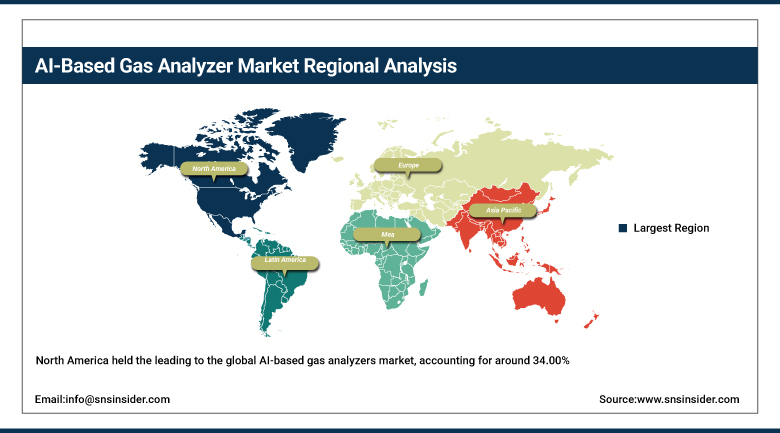
North America held the leading share in terms of revenue contribution to the global AI-based gas analyzers market, accounting for around 34.00%. Factors driving the dominance of North America include adoption of industrial automation technologies, strict workplace safety guidelines, compliance with environmental policies, and artificial intelligence initiatives in manufacturing and processing sectors. Gas analyzers based on AI technology combined with Industrial IoT, cloud computing, and predictive maintenance are being widely adopted by oil & gas companies, chemical producers, electricity generating plants, and environmental regulatory agencies in the region.
Investments in smart manufacturing, emission monitoring, and industrial digitization further enhance the leadership of North America in the global market. Honeywell launched a range of AI-based gas analysis and connected worker safety solutions to enhance predictive monitoring capabilities and industrial process safety.
Get Customized Report as per Your Business Requirement - Enquiry Now
Europe AI-Based Gas Analyzer Market Insights
Europe was backed up with tough environmental laws, industry decarburization activities, and large-scale use of intelligent emission monitoring systems. The countries such as Germany, France, United Kingdom, Italy, and the Netherlands have been investing in intelligent gas analysis systems for their application in chemical production, pharmaceutical industry, environmental monitoring, and industrial safety. The growing application of Industry 4.0 technology, smart factories, and carbon emissions reduction programs will drive the use of AI-based gas analyzer in industries. Further investment in sustainable manufacturing and occupational safety will help expand the regional market over the years. The European Commission has continued to increase the monitoring requirements in industries through its environmental and industrial decarburization activities.
Asia Pacific AI-Based Gas Analyzer Market Insights
The fastest growth rate of 10.50% CAGR is estimated for Asia Pacific in terms of value owing to industrialization, growing demand for environmental monitoring systems, rising manufacturing activities, and investments in smart industrial infrastructure in countries such as China, Japan, India, South Korea, and Southeast Asia. The increase in the adoption of AI-based gas analyzers for petrochemical plants, semiconductor industry, pharmaceuticals manufacturing, mining applications, and environmental monitoring applications is driving the growth of the market in this region.
Government policies for promoting automation, reduction of emissions, and workplace safety along with growing use of IoT technology have maintained its position as the fastest-growing region. Yokogawa Electric Company kept adding new solutions in the field of industrial process monitoring and gas analysis using artificial intelligence in Asia Pacific.
Middle East & Africa and Latin America AI-Based Gas Analyzer Market Insights
Middle East & Africa, backed by the rise in investments made towards the development of oil & gas infrastructures, petrochemical production, industrial safety, and environment monitoring systems. Countries such as Saudi Arabia, UAE, and South Africa have been seen investing in AI-based gas analyzers to enhance the safety, emissions, and predictive maintenance processes in their energy and industrial sectors. The increasing number of digital transformation projects will be helpful in boosting the market growth.
Latin America , fueled by the increase in mining operations, oil & gas operations, industrial manufacturing, and compliance measures for the environment in countries like Brazil, Mexico, Chile, and Argentina. Increasing investments in smart industrial monitoring, workplace safety, and process automation will drive the use of AI-based gas analyzers. The modernization of industries and environmental regulations are likely to bring more growth opportunities during the forecast period. Saudi Aramco increased the use of digital monitoring technologies, which include smart gas sensing and predictive analytics solutions in its upstream and downstream operations.
Market Dynamics
Growth Drivers: Industrial automation and increasing emission monitoring are promoting the use of AI-based gas analyzers.
Fast deployment of Industry 4.0 technologies, smart manufacturing systems, and intelligent process automation is strongly influencing the global market for AI-based gas analyzers. Industrial companies are increasingly implementing AI-powered gas analyzers combined with machine learning, Industrial IoT, cloud analytics, and predictive maintenance solutions in order to increase operational efficiency, ensure worker safety, and comply with regulations.
The growing number of environmental regulations concerning industrial emissions, dangerous gases detection, and workplace air quality is also fueling market growth in the oil & gas, chemicals, power generation, pharmaceuticals, and manufacturing sectors. Ongoing investment in industrial digital infrastructure and intelligent monitoring solutions will keep supporting market growth for years to come. ABB extended its line of AI-powered gas analyzers and industrial automation systems in order to enhance real-time emissions monitoring, predictive maintenance, and process optimization at energy and manufacturing plants.
Restraints: High costs and complexities of deployment are still hindering widespread adoption in the market.
Even with rapid advances in technology, the market for AI-based gas analyzers is still hindered by various issues such as high capital requirements, integration complexity, and cyber security threats. The advanced AI-based gas analyzers are built using advanced sensing technology, cloud technologies, industry networking technologies, and advanced analytics platforms, hence making them expensive to deploy especially for SMEs. Customization to integrate the devices into existing process control systems, process control systems, and enterprise software is another challenge.
Data security, compatibility, and maintenance costs have been hampering the adoption of the technology in industries and in developing countries. The United States Cyber security and Infrastructure Security Agency (CISA) released industrial control system cyber security guidance for improving cyber security of industrial monitoring and automation systems.
Opportunities: The expansion of predictive analytics using AI technology platforms.
The rising trend towards cloud computing, IoT, artificial intelligence, and predictive analytics is creating great opportunities in the future for the market of AI-based gas analyzers. There is a growing trend toward the use of intelligent gas analyzer systems that can diagnose remotely, automatically calibrate, predict leaks, and monitor the performance of distributed industrial assets in real time.
The rising trend towards the development of smart factories, hydrogen production plants, carbon capture projects, semiconductors manufacturing processes, and pharmaceutical manufacturing processes will create more opportunities for the use of highly accurate gas analyzers based on artificial intelligence. Innovation in the fields of machine learning, edge AI computing, and digital twins is expected to drive the commercialization process and application possibilities throughout the forecast period. Siemens enhanced its AI-driven digitalization of industrial operations with its Industrial Operations X product range.
Recent Developments
-
2026: ABB Ltd. expanded its AI-powered continuous emissions monitoring and process gas analysis portfolio by integrating advanced analytics and cloud-based diagnostics to improve industrial safety, regulatory compliance, and predictive maintenance across energy and manufacturing facilities.
-
2026: Siemens AG enhanced its industrial AI portfolio through Industrial Operations X, strengthening intelligent gas monitoring, predictive maintenance, and digital process optimization capabilities for chemical, oil & gas, and process manufacturing industries.
-
2025: Honeywell International Inc. introduced enhancements to its connected gas detection and industrial safety solutions by incorporating AI-enabled analytics, remote asset monitoring, and predictive maintenance capabilities for hazardous industrial environments.
-
2025: Yokogawa Electric Corporation expanded deployment of AI-integrated process analyzers and industrial automation solutions supporting continuous emissions monitoring, operational optimization, and digital transformation across process industries.
AI-Based Gas Analyzer Market Key Players are:
-
ABB Ltd.
-
Siemens AG
-
Honeywell International Inc.
-
Emerson Electric Co.
-
Yokogawa Electric Corporation
-
Endress+Hauser Group
-
AMETEK, Inc.
-
Thermo Fisher Scientific Inc.
-
SICK AG
-
Drägerwerk AG & Co. KGaA
-
Mettler-Toledo International Inc.
-
Fuji Electric Co., Ltd.
-
HORIBA, Ltd.
-
Teledyne Technologies Incorporated
-
Servomex Group Limited
-
California Analytical Instruments, Inc.
-
Bosch Sensortec GmbH
-
Figaro Engineering Inc.
-
Senseair AB
-
Aeroqual Limited
AI-Based Gas Analyzer Market Report Scope:
| Report Attributes | Details |
|---|---|
| Market Size in 2025 | USD 2.71 Billion |
| Market Size by 2035 | USD 6.12 Billion |
| CAGR | CAGR of 8.51% From 2026 to 2035 |
| Base Year | 2025 |
| Forecast Period | 2026-2035 |
| Historical Data | 2022-2024 |
| Report Scope & Coverage | Market Size, Segments Analysis, Competitive Landscape, Regional Analysis, DROC & SWOT Analysis, Forecast Outlook |
| Key Segments | • By Component (Hardware, Software, Services, Cloud Analytics & AI Platforms) • By Technology (Infrared Spectroscopy, Electrochemical Sensors, Gas Chromatography, Photoionization & Laser Spectroscopy, Others) • By Application (Environmental Monitoring, Industrial Process Monitoring, Oil & Gas Leak Detection, Healthcare & Medical Diagnostics, Others) • By End User Industry (Oil & Gas, Chemical & Petrochemical, Power Generation, Healthcare & Life Sciences, Others) |
| Regional Analysis/Coverage | North America (US, Canada), Europe (Germany, UK, France, Italy, Spain, Russia, Poland, Rest of Europe), Asia Pacific (China, India, Japan, South Korea, Australia, ASEAN Countries, Rest of Asia Pacific), Middle East & Africa (UAE, Saudi Arabia, Qatar, South Africa, Rest of Middle East & Africa), Latin America (Brazil, Argentina, Mexico, Colombia, Rest of Latin America). |
| Company Profiles | ABB Ltd., Siemens AG, Honeywell International Inc., Emerson Electric Co., Yokogawa Electric Corporation, Endress+Hauser Group, AMETEK, Inc., Thermo Fisher Scientific Inc., SICK AG, Drägerwerk AG & Co. KGaA, Mettler-Toledo International Inc., Fuji Electric Co., Ltd., HORIBA, Ltd., Teledyne Technologies Incorporated, Servomex Group Limited, California Analytical Instruments, Inc., Bosch Sensortec GmbH, Figaro Engineering Inc., Senseair AB, Aeroqual Limited |

Frequently Asked Questions
North America dominated the global AI-Based Gas Analyser Market in 2025.
The market is projected to reach USD 6.12 Billion by 2035.
The market is expected to expand at a CAGR of 8.51% during the forecast period.
The AI-Based Gas Analyser Market was valued at USD 2.71 Billion in 2025.
Hardware accounted for the largest revenue share of 48.00% in 2025.
