
AI Security Posture Management (AI-SPM) Market Report Scope & Overview:
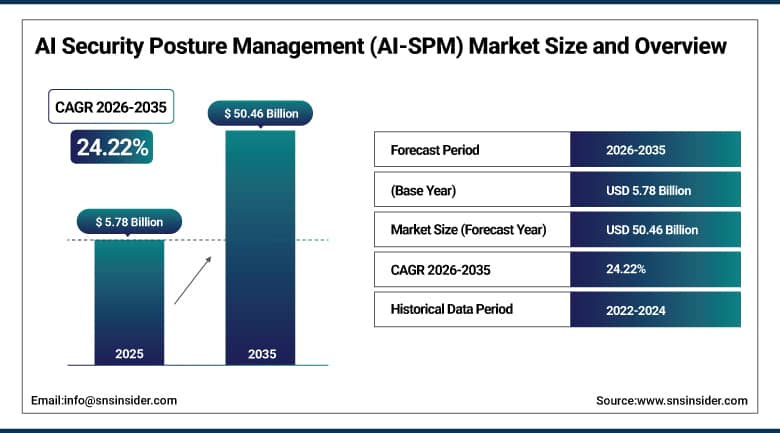
AI Security Posture Management (AI-SPM) Market was valued at USD 5.78 Billion in 2025 and is expected to reach USD 50.46 Billion by 2035, growing at a CAGR of 24.22% from 2026–2035.
The major drivers fuelling the expansion of the global AI security posture management (AI-SPM) market are the rapid adoption of artificial intelligence across enterprise environments, increasing deployment of generative AI and large language models (LLMs), and the growing need to secure AI models, data, and infrastructure against evolving cyber threats. Organizations are increasingly implementing AI security posture management (AI-SPM) solutions to discover AI assets, identify misconfigurations, monitor model behavior, enforce governance policies, and strengthen AI risk management. In addition, the rising adoption of cloud-native AI workloads, increasing regulatory requirements for AI governance and compliance, growing investments in responsible
Microsoft expanded its Microsoft Security Copilot and Microsoft Defender portfolio with enhanced AI-powered security capabilities that enable organizations to identify AI-related risks, continuously monitor AI workloads, detect misconfigurations, and strengthen governance across generative AI applications and hybrid cloud environments.
Market Size and Forecast
-
Market Size 2026E: USD 7.17 Billion
-
Market Size 2035: USD 50.46 Billion
-
CAGR: 24.22% from 2026 to 2035
-
Fastest Growing Region: Asia-Pacific
-
Largest Region: North America
To Get More Information On AI Security Posture Management (AI-SPM) Market - Request Free Sample Report
AI Security Posture Management (AI-SPM) Market Trends
-
Growing adoption of cloud-native AI workloads is driving demand for AI security posture management (AI-SPM) solutions.
-
AI asset discovery, continuous monitoring, and automated remediation strengthen AI security and governance.
-
Integration with cloud platforms, AI models, and security tools improves AI risk visibility and compliance.
-
AI governance, policy enforcement, and runtime protection help reduce AI-related cyber risks.
-
Cloud-based and hybrid deployments enable scalable, centralized AI security across enterprise environments.
The U.S. AI Security Posture Management (AI-SPM) Market Outlook
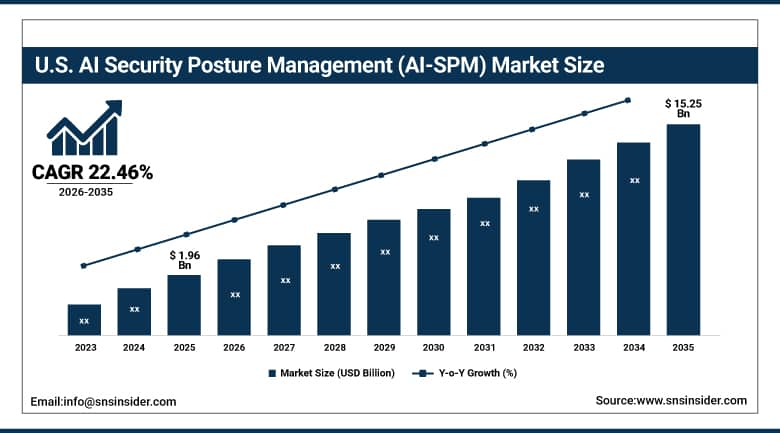
The U.S. AI Security Posture Management (AI-SPM) Market was valued at USD 1.96 Billion in 2025 and is expected to reach around USD 15.25 Billion by 2035, growing at a CAGR of 22.46% from 2026–2035.
There is a surge in the growth of the AI security posture management (AI-SPM) market in the United States due to the rapid adoption of artificial intelligence, generative AI applications, and cloud-native AI workloads across enterprises. Organizations across industries are increasingly deploying AI security posture management (AI-SPM) solutions to discover AI assets, identify security misconfigurations, monitor AI model behavior, and enforce governance policies. These solutions help strengthen AI risk management, automate compliance, secure AI models and data, and provide continuous monitoring across hybrid and multi-cloud environments. In addition, growing investments in responsible AI, AI governance frameworks, zero trust security, and AI risk management initiatives are further accelerating the growth of the AI security posture management (AI-SPM) market.
In April 2025, Microsoft introduced enhanced AI security capabilities within Microsoft Defender in the United States, enabling enterprises to discover AI assets, identify AI security misconfigurations, strengthen AI governance, and continuously monitor generative AI applications across hybrid and multi-cloud environments.
AI Security Posture Management (AI-SPM) Market Segment Analysis
-
By Component, AI asset discovery & inventory dominated the AI security posture management (AI-SPM) market with a 34.20% share in 2025, while runtime monitoring & behavioral analytics is projected to be the fastest-growing segment, registering a CAGR of 29.25% during 2026–2035.
-
By Deployment Mode, cloud-based dominated the AI security posture management (AI-SPM) market with a 57.80% share in 2025, while hybrid is projected to be the fastest-growing segment, registering a CAGR of 30.97% during 2026–2035.
-
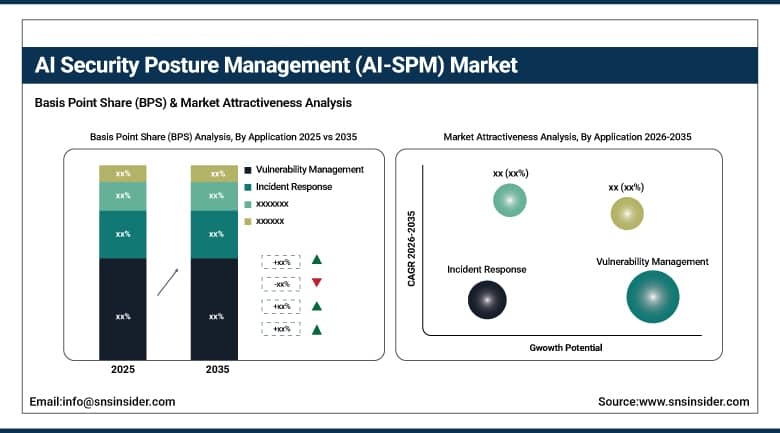
By Application, vulnerability management dominated the AI security posture management (AI-SPM) market with a 35.10% share in 2025, while incident response is projected to be the fastest-growing segment, registering a CAGR of 27.80% during 2026–2035.
-
By Organization Size, large enterprises dominated the AI security posture management (AI-SPM) market with a 47.50% share in 2025, while Small Enterprises are projected to be the fastest-growing segment, registering a CAGR of 27.60% during 2026–2035.
-
By End-User Industry, BFSI dominated the AI security posture management (AI-SPM) market with a 31.80% share in 2025, while IT and telecommunications is projected to be the fastest-growing segment, registering a CAGR of 26.71% during 2026–2035.
By Application, vulnerability management dominated the AI security posture management (AI-SPM) market, while the Incident response segment is expected to grow fastest
According to Application, Vulnerability management held the leading market share in the AI security posture management (AI-SPM) market, whereas the Incident response segment is projected to have the highest growth rate during the forecast period. The Vulnerability management segment was the largest in 2025 owing to the increasing need to identify AI security weaknesses, detect misconfigurations, prioritize risks, and strengthen the security posture of AI models, datasets, and supporting infrastructure across enterprise environments.
The Incident response segment is expected to register the highest CAGR in the future owing to the growing need for real-time detection, investigation, and remediation of AI-related cyber threats, including model manipulation, prompt injection attacks, unauthorized access, and data leakage. As enterprises expand the deployment of generative AI and mission-critical AI applications, demand for advanced incident response capabilities to automate threat containment, accelerate remediation, and improve cyber resilience is expected to grow significantly.
By Component, AI asset discovery & inventory dominated the AI security posture management (AI-SPM) market, while Runtime monitoring & behavioral analytics is expected to grow fastest
In 2025, the AI asset discovery & inventory sub-segment held the largest share of the AI security posture management (AI-SPM) market due to the increasing need for comprehensive discovery and inventory of AI models, datasets, applications, and supporting infrastructure across enterprise environments. Organizations increasingly adopted AI asset discovery & inventory solutions to improve visibility into AI ecosystems, identify unmanaged AI assets, detect security misconfigurations, and strengthen AI governance, compliance, and risk management across hybrid and multi-cloud environments.
The Runtime monitoring & behavioral analytics sub-segment is expected to be the fastest-growing during the forecast period due to the rising demand for continuous monitoring of AI models, real-time threat detection, anomaly identification, behavioral analysis, and automated response capabilities. As enterprises expand the use of generative AI and mission-critical AI applications, the need to detect model abuse, prompt injection attacks, data leakage, and abnormal AI behavior is expected to drive significant adoption of runtime monitoring & behavioral analytics solutions.
By End-User Industry, BFSI dominated the AI security posture management (AI-SPM) market, while the IT and Telecommunications segment is expected to grow fastest
As per End-User Industry, BFSI accounted for the largest market share in the AI Security Posture Management (AI-SPM) market, while the IT and Telecommunications segment is expected to exhibit the highest growth rate during the forecast period. The BFSI segment dominated the market in 2025 due to growing usage of AI-driven fraud detection, identity verification, risk management, and cybersecurity solutions that protect sensitive financial information from potential cyberattacks and also help organizations meet stringent regulations.
The IT and Telecommunications segment is expected to witness the highest CAGR during the forecast period due to fast adoption of generative AI, cloud-native AI applications, and large AI infrastructure at digital enterprises. With the growing usage of AI in software development, network operations, customer service, and business automation processes, there will be an increased demand for AI security posture management (AI-SPM) solutions to provide continuous monitoring, threat detection, AI governance, and automated remediation.
Regional Analysis
|
Region |
Major Country |
Share within Region, 2025(%) |
|---|---|---|
|
North America |
United States |
88.20% |
|
Europe |
Germany |
25.80% |
|
Asia Pacific |
China |
43.60% |
|
Middle East & Africa |
Saudi Arabia |
31.40% |
|
Latin America |
Brazil |
40.30% |
North America AI Security Posture Management (AI-SPM) Market Insights.
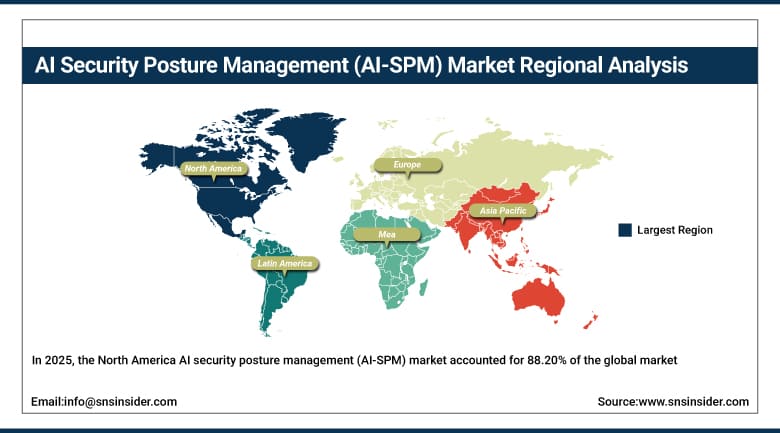
In 2025, the North America AI security posture management (AI-SPM) market accounted for 88.20% of the global market value due to the rapid adoption of artificial intelligence, generative AI applications, cloud-native AI infrastructure, and advanced cybersecurity frameworks across enterprises. Additionally, the United States represented 88.20% of the North America AI security posture management (AI-SPM) market in 2025, driven by the presence of leading AI technology providers, cloud service vendors,cybersecurity companies, and significant investments in AI governance and enterprise AI security initiatives.
Growing adoption of large language models (LLMs), cloud-based AI platforms, hybrid and multi-cloud environments, and AI-powered business applications is driving market growth across the region. In addition, increasing emphasis on AI governance, continuous monitoring of AI assets, detection of AI security misconfigurations, compliance with evolving AI regulations, and protection against AI-specific cyber threats is accelerating the adoption of AI security posture management (AI-SPM) solutions, thereby driving market growth in the United States and North America.
Get Customized Report as Per Your Business Requirement - Enquiry Now
Europe AI Security Posture Management (AI-SPM) Market Insights
Europe remains a key region in the AI security posture management (AI-SPM) market due to the increasing adoption of artificial intelligence, generative AI applications, cloud-native AI infrastructure, and stringent cybersecurity and AI governance regulations. Germany accounted for 25.80% of the Europe AI security posture management (AI-SPM) market in 2025, supported by its strong industrial base, advanced digital transformation initiatives, and growing investments in enterprise AI, cybersecurity, and secure AI deployment across critical industries.
The growth of the AI security posture management (AI-SPM) market in Europe is driven by the rising adoption of AI-powered business applications, large language models (LLMs), hybrid and multi-cloud environments, and AI governance frameworks. Furthermore, increasing investments in AI risk management, continuous AI asset monitoring, AI security compliance, automated threat detection, and responsible AI initiatives across manufacturing, BFSI, healthcare, IT & telecommunications, retail, and public sector organizations are expected to support sustained market growth over the forecast period.
Asia Pacific AI Security Posture Management (AI-SPM) Market Insights
The Asia-Pacific AI security posture management (AI-SPM) market is expected to register the highest CAGR during the forecast period, driven by the rapid adoption of artificial intelligence, generative AI applications, cloud-native AI infrastructure, and expanding enterprise digital transformation initiatives. China accounted for 43.60% of the Asia-Pacific AI security posture management (AI-SPM) market in 2025, supported by its large enterprise base, expanding AI ecosystem, significant investments in AI innovation, and growing deployment of AI across manufacturing, finance, healthcare, and public sector organizations.
Growing adoption of large language models (LLMs), AI-powered business applications, hybrid and multi-cloud environments, and enterprise AI platforms is creating significant growth opportunities across the region. Furthermore, increasing investments in AI governance, AI risk management, continuous AI asset discovery, automated threat detection, and compliance with evolving AI regulations are expected to accelerate the adoption of AI security posture management (AI-SPM) solutions throughout the forecast period.
Middle East & Africa and Latin America Insights
The Middle East & Africa AI security posture management (AI-SPM) market is growing steadily due to rising investments in artificial intelligence, cloud infrastructure, and cybersecurity. Organizations are deploying AI security posture management (AI-SPM) solutions to secure AI models, monitor AI workloads, and strengthen governance. Saudi Arabia accounted for 31.40% of the regional market in 2025, supported by national AI initiatives, cloud expansion, and increasing enterprise AI adoption.
The Latin America AI security posture management (AI-SPM) market is expanding with growing adoption of enterprise AI, cloud computing, and digital transformation initiatives. Brazil led the regional market in 2025, driven by investments in AI-powered applications and cloud security. Rising demand for AI governance, automated risk management, continuous compliance monitoring, and real-time threat detection is expected to accelerate AI security posture management (AI-SPM) adoption across the region.
Market Dynamics
Growth Driver: Rising adoption of enterprise AI and AI governance accelerating AI security posture management (AI-SPM) market growth
Increasing use of artificial intelligence, generative AI, large language models (LLMs), and cloud-native AI workloads have emerged as one of the major drivers boosting the adoption of AI security posture management (AI-SPM). The need to deploy AI security posture management (AI-SPM) solutions to detect AI assets, security misconfigurations, model behavior, automation of policy enforcement, and governance in cloud and hybrid environments is becoming common among organizations. The increasing number of enterprise AI, AI-driven applications, and AI risk management activities is also driving the market.
Increasing deployment of AI governance framework, high demand for continuous visibility into AI assets, automated threat detection, security policies enforcement, and compliance are expected to fuel the AI security posture management (AI-SPM) market. Furthermore, increasing spending on responsible AI, AI security, cloud-native AI infrastructures, hybrid/multi-cloud environment, and real-time monitoring of AI systems are projected to fuel the growth of the market.
Restraints: High implementation costs, AI governance complexity, and integration challenges may restrain AI security posture management (AI-SPM) market growth
High deployment cost and integration complexity continue to hinder growth in the AI security posture management (AI-SPM) market. The deployment of AI security posture management (AI-SPM) solutions may involve huge investments in AI security platforms, cloud infrastructure, continuous monitoring solutions, governance mechanisms, and cybersecurity and AI professionals, which makes it an expensive process for SMEs. Moreover, compatibility problems with legacy IT systems, multiple AI models, segmented AI ecosystems, and hybrid and multi-cloud environments may hamper the implementation process and create complications in the deployment process.
Besides, companies will have to tackle challenges related to AI governance, regulatory compliance, transparency of AI models, continuous monitoring of AI assets, and policy enforcement at the time of integration of AI models, data pipelines, cloud platforms, SIEM solutions, IAM solutions, and other security solutions in the enterprise environment. Lack of AI security expertise, regulatory requirements, AI model risks, and difficulties in integration with enterprise security ecosystems may also pose some constraints on the growth of the AI security posture management (AI-SPM) market during the forecast period.
Opportunities: Growing adoption of enterprise AI, AI governance, and responsible AI initiatives
The increasing adoption of enterprise AI, generative AI, and large language models (LLMs) presents significant growth opportunities for the AI security posture management (AI-SPM) market. Organizations are deploying advanced AI security posture management (AI-SPM) solutions to discover AI assets, strengthen AI governance, automate policy enforcement, continuously monitor AI workloads, and improve AI risk management across enterprise environments. Continuous advancements in AI governance frameworks, runtime monitoring, automated remediation, and AI threat detection are further expanding the capabilities of AI security posture management (AI-SPM) solutions.
In addition, rising investments in responsible AI, expanding adoption of hybrid and multi-cloud AI infrastructures, and increasing enterprise demand for secure AI deployment are creating new opportunities for market participants. Growing demand for unified AI security platforms across cloud and on-premises environments, increasing implementation of AI governance and regulatory compliance frameworks, and continuous innovation in AI security technologies are expected to support the long-term growth of the AI security posture management (AI-SPM) market.
Recent Developments
-
2026: Microsoft expanded Security Copilot with AI security capabilities for continuous AI risk monitoring and governance.
-
2025: Google Cloud launched AI Protection to strengthen AI asset discovery, risk assessment, and security posture management.
-
2024: Palo Alto Networks enhanced Prisma Cloud with AI security capabilities for AI governance and threat protection.
-
2023: Protect AI introduced advanced AI model scanning to improve machine learning security and AI risk management.
AI Security Posture Management (AI-SPM) Market key players are:
-
Microsoft Corporation
-
Palo Alto Networks, Inc.
-
Google LLC
-
Amazon Web Services, Inc.
-
IBM Corporation
-
Cisco Systems, Inc.
-
CrowdStrike Holdings, Inc.
-
Zscaler, Inc.
-
Wiz, Inc.
-
SentinelOne, Inc.
-
Check Point Software Technologies Ltd.
-
Trend Micro Incorporated
-
Fortinet, Inc.
-
Orca Security Ltd.
-
Tenable Holdings, Inc.
-
Lacework, Inc.
-
Sysdig, Inc.
-
HiddenLayer, Inc.
-
Protect AI, Inc.
-
Apex Security, Inc.
AI Security Posture Management (AI-SPM) Market Report Scope:
| Report Attributes | Details |
|---|---|
| Market Size in 2025 | USD 5.78 Billion |
| Market Size by 2035 | USD 50.46 Billion |
| CAGR | CAGR of 24.22% From 2026 to 2035 |
| Base Year | 2025 |
| Forecast Period | 2026-2035 |
| Historical Data | 2022-2024 |
| Report Scope & Coverage | Market Size, Segments Analysis, Competitive Landscape, Regional Analysis, DROC & SWOT Analysis, Forecast Outlook |
| Key Segments | • By Component (AI Asset Discovery & Inventory, AI-Specific Vulnerability Scanning, Runtime Monitoring & Behavioral Analytics, Policy Enforcement & Automated Remediation) • By Deployment Mode (Cloud-Based, On-Premises, Hybrid) • By Application (Vulnerability Management, Compliance Management, Threat Intelligence, Incident Response) • By Organization Size (Small Enterprises, Medium Enterprises, Large Enterprises) • By End-User Industry (BFSI, Healthcare, IT and Telecommunications, Others) |
| Regional Analysis/Coverage | North America (US, Canada, Mexico), Europe (Eastern Europe [Poland, Romania, Hungary, Turkey, Rest of Eastern Europe] Western Europe] Germany, France, UK, Italy, Spain, Netherlands, Switzerland, Austria, Rest of Western Europe]), Asia Pacific (China, India, Japan, South Korea, Vietnam, Singapore, Australia, Rest of Asia Pacific), Middle East & Africa (Middle East [UAE, Egypt, Saudi Arabia, Qatar, Rest of Middle East], Africa [Nigeria, South Africa, Rest of Africa], Latin America (Brazil, Argentina, Colombia, Rest of Latin America) |
| Company Profiles | Microsoft Corporation, Palo Alto Networks, Inc., Google LLC, Amazon Web Services, Inc., IBM Corporation, Cisco Systems, Inc., CrowdStrike Holdings, Inc., Zscaler, Inc., Wiz, Inc., SentinelOne, Inc., Check Point Software Technologies Ltd., Trend Micro Incorporated, Fortinet, Inc., Orca Security Ltd., Tenable Holdings, Inc., Lacework, Inc., Sysdig, Inc., HiddenLayer, Inc., Protect AI, Inc.,Apex Security, Inc. |
Frequently Asked Questions
The AI security posture management (AI-SPM) market was valued at USD 5.78 billion in 2025.
The market is driven by the increasing adoption of artificial intelligence, generative AI, large language models (LLMs), cloud-native AI workloads, and the growing need for AI governance, continuous AI asset monitoring, and protection against AI-specific cyber threats.
The AI Asset Discovery & Inventory segment dominated the AI security posture management (AI-SPM) market in 2025 with a 34.20% share.
North America dominated the AI security posture management (AI-SPM) market in 2025 with a 38.80% share.
