
Firefighting Aircraft Market Report Scope & Overview:
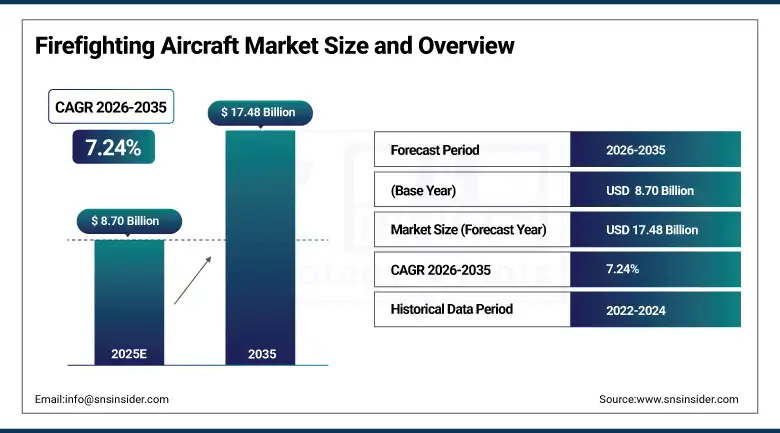
The Firefighting Aircraft Market size was valued at USD 8.70 Billion in 2025 and is projected to reach USD 17.48 Billion by 2035, growing at a CAGR of 7.24% during 2026–2035.
The Firefighting Aircraft Market is witnessing a steady growth rate because of the rise in the number and ferocity of wildfires, owing to climate change, drought, and a general rise in global temperatures. The government is actively investing in advanced firefighting aircraft to respond to emergencies and minimize damage to the environment and infrastructure. Firefighting aircraft are instrumental in controlling and managing fires in remote and difficult terrains by dropping water or fire retardants from the air. The constant developments in technology are helping firefighting operations to be more efficient and effective.
In Aug 2025, several aviation and emergency response agencies increased investments in advanced firefighting aircraft and aerial suppression technologies to strengthen wildfire response capabilities and improve rapid containment of large-scale forest fires.
To Get more information On Firefighting Aircraft Market - Request Free Sample Report
Firefighting Aircraft Market Trends:
-
Increasing integration of advanced surveillance technologies such as thermal imaging, infrared sensors, and real-time data systems to improve wildfire detection and monitoring.
-
Rising demand for amphibious firefighting aircraft due to their ability to scoop water quickly from nearby water bodies and perform rapid multiple drops.
-
Growing public–private partnerships as governments collaborate with private aerial firefighting operators to expand fleet capacity and improve emergency response.
-
Ongoing fleet modernization and aircraft upgrades to replace aging platforms with advanced, fuel-efficient, and high-capacity firefighting aircraft.
-
Increasing adoption of multi-role aircraft capable of performing fire suppression, surveillance, rescue, and logistics support in a single platform.
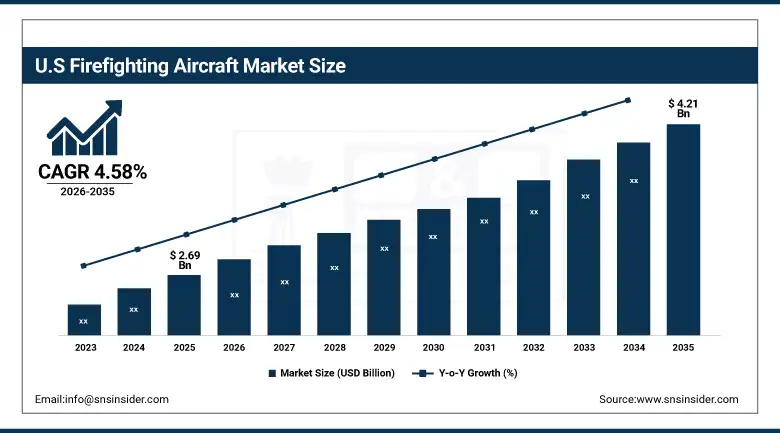
The U.S. Firefighting Aircraft Market has been valued at USD 2.69 Billion in 2025 and is expected to reach USD 4.21 Billion in 2035, growing at a CAGR of 4.58% from 2026 to 2035, owing to factors such as a rise in the number of wildfire cases, a rise in government spending on firefighting aircraft, modernization of aging aircraft, and the use of advanced surveillance systems, among others.
Firefighting Aircraft Market Drivers:
-
Rising wildfire incidents and government investment drive demand for aerial firefighting fleets.
The primary factor driving the Firefighting Aircraft market is the growing number of wildfires in regions such as North America, Europe, and Australia, which has been attributed to climate change coupled with drought conditions. The government is investing significantly in modern technologies to enhance the efficiency of fire response measures. Technological innovations in the payload capacity of the aircraft, as well as the navigation systems, are also driving the market. The growing number of public-private partnerships to address the wildfire response measures, as well as the modernization of old fire response aircraft, is also driving the market.
Firefighting Aircraft Market Restraints:
-
High acquisition and operational costs limit adoption of specialized firefighting aircraft.
The market for Firefighting Aircraft has a number of challenges that might hinder its growth in the future. The first is the cost of procuring specialized aircraft, such as large air tankers and amphibious firefighting aircraft, which might prove to be a constraint, especially for smaller countries and regions in the case of developing countries. Secondly, operational costs, such as maintenance, pilots' training, fuel, and modification, are very high, thereby adding to the overall cost of operation. Thirdly, there is a shortage of experienced pilots and technical staff, and aviation safety and environmental issues are a constraint in the operation of firefighting aircraft.
Firefighting Aircraft Market Opportunities:
-
Fleet modernization and advanced aerial firefighting technologies create new growth opportunities.
The growing need for firefighting aircraft fleet replacements with new technology and the adoption of advanced firefighting aircraft technology are creating tremendous opportunities for aircraft manufacturers. Governments are investing in the latest technology for the next generation of amphibious aircraft, large air tankers, and advanced technology with thermal imaging and data transmission technology. The use of artificial intelligence, satellite technology, and wildfire modeling technology is also improving firefighting strategies. These technologies are expected to create tremendous opportunities for aircraft manufacturers.
Firefighting Aircraft Market Segment Analysis:
-
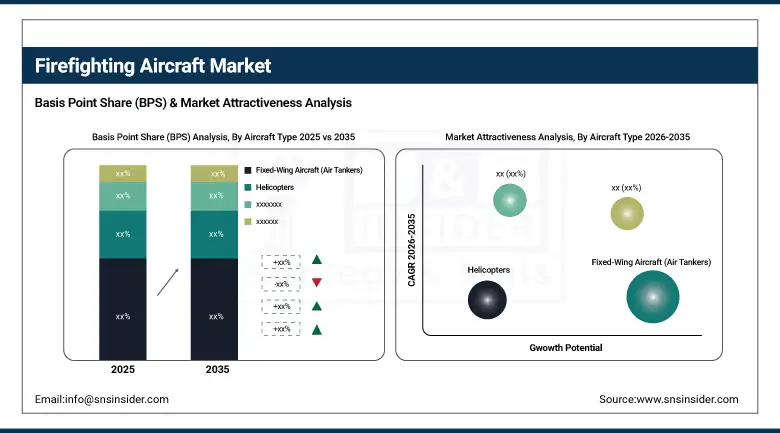
By Aircraft Type: In 2025, Fixed-Wing Aircraft (Air Tankers) dominated with 54% share; Amphibious Aircraft / Scoopers fastest growing segment during 2026-2035
-
By Payload Capacity: In 2025, More than 10,000 Liters dominated with 47% share; 5,000–10,000 Liters fastest growing segment during 2026-2035
-
By Application: In 2025, Fire Suppression (Water/Retardant Dropping) dominated with 62% share; Surveillance & Fire Mapping fastest growing segment during 2026-2035
-
By End User: In 2025, Government & Forestry Agencies dominated with 59% share; Private Aerial Firefighting Operators fastest growing segment during 2026-2035
By Aircraft Type: Fixed-Wing Aircraft Dominate, Amphibious Aircraft Fastest-Growing
Fixed Wing Aircraft (Air Tankers) lead the aircraft type segment in the market, holding a share of approximately 54%, owing to their high payload capacity and effectiveness in covering larger areas of wildfires. Fixed Wing Aircraft, in particular, have been largely adopted by government agencies for conducting fire-retardant activities on a larger scale, thus facilitating the faster suppression of wildfires in forests and other areas. The long-range capabilities of Fixed Wing Aircraft, along with their usage in prominent wildfire-affected areas like North America and Europe, have contributed to their leadership in the market.
Amphibious Aircraft/Scoopers is the fastest-growing type of aircraft, mainly because of their ability to refill on any water body and take off again without needing to go back to an air base. This is a great advantage, as it reduces turnaround time in suppression activities. Wildfire incidents are on the rise, particularly in regions where density is high for water bodies such as lakes and seas. Additionally, investments in quick-response firefighting aircraft are also contributing to increased demand for amphibious firefighting aircraft.
By Payload Capacity: More than 10,000 Liters Dominate, 5,000–10,000 Liters Fastest-Growing
The category with over 10,000 liters payload capacity has dominated this segment with approximately 47% in terms of market share due to its primary use in tackling massive and widely spreading forest fires. The aircraft in this category have the ability to drop massive quantities of fire retardant or water in one go, thus increasing efficiency in firefighting operations. The aircraft have been widely used by governments in tackling forest fires and other infrastructure protection operations.
The 5,000–10,000 liters segment is the fastest-growing, supported by increasing demand for medium-capacity aircraft that provide better maneuverability and flexibility in diverse terrains. These aircraft are particularly useful for regional wildfire response and initial attack operations, where quick deployment and cost efficiency are critical.
By Application: Fire Suppression Dominates, Surveillance & Fire Mapping Fastest-Growing
Fire Suppression (Water/Retardant Dropping) holds a significant market share of around 62% in the application segment, as it is mainly used to directly combat and extinguish wildfires by dropping water or chemical retardants. This is a critical function that helps to slow down or stop the spread of fires, especially in areas that are hard to reach by ground crews. The rise of wildfires around the globe has resulted in an increased need for such suppression systems.
Surveillance & Fire Mapping is the fastest-growing segment, driven by the increasing trend of incorporating sophisticated imaging systems, thermal sensors, and real-time monitoring systems. This helps firefighting teams identify fires earlier, understand fire spread patterns, and implement response strategies more effectively, thus improving the management of wildfires.
By End User: Government & Forestry Agencies Dominate, Private Aerial Firefighting Operators Fastest-Growing
Government & Forestry Agencies lead the end user segment in terms of market share, which is around 59%. Government and forestry agencies are responsible for wildfire management and disaster response activities. They have their own fleet of aircraft for firefighting or hire aircraft for their wildfire management and disaster response activities. Government funding is high for wildfire mitigation activities.
Private Aerial Firefighting Operators are the fastest-growing segment, which is attributed to the increasing trend of firefighting service outsourcing by governments and forestry departments. This segment comprises private companies that provide specialized fleets of aircraft, crew, and rapid response capabilities, making them the most viable alternative for cost-effective firefighting operations.
Regional Analysis:
North America Firefighting Aircraft Market Insights:
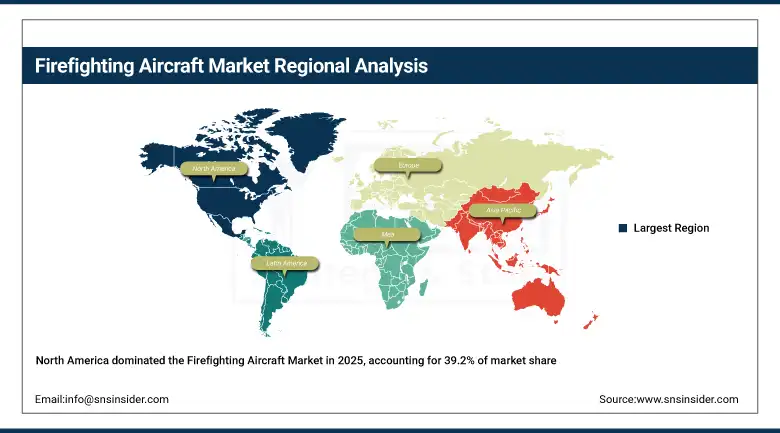
North America holds the highest position in the global Firefighting Aircraft Market in terms of total market share, which amounts to 39.2%. This strong position of the North American region in the global Firefighting Aircraft Market can be attributed to the high number of wildfires, especially in the United States and Canada, which require high levels of aerial support for their suppression. The high level of funding from governments, established wildfire management practices, and the presence of technologically advanced aircraft for aerial firefighting support the strong position of the North American region in the global Firefighting Aircraft Market. The presence of high levels of investment in the modernization of aircraft fleets, the use of large air tankers and amphibious aircraft, and cooperation with private aerial firefighting services have further strengthened the position of the North American region in the global Firefighting Aircraft Market.
Get Customized Report as per Your Business Requirement - Enquiry Now
Europe Firefighting Aircraft Market Insights:
The Europe Firefighting Aircraft Market is experiencing growth, driven by the increasing instances of seasonal wildfires, especially in Mediterranean countries such as Spain, Greece, Italy, Portugal, and France. The government of these countries is enhancing their aerial firefighting capabilities, investing in new aircraft, and improving the coordination of international response to wildfires. The European Union has implemented measures for the management of wildfires, including the sharing of aerial firefighting resources, for the betterment of disaster response preparedness. Moreover, the implementation of advanced surveillance technology, the installation of early detection systems, and the focus on environmental protection are also fueling the Europe Firefighting Aircraft Market.
Asia-Pacific Firefighting Aircraft Market Insights:
Asia-Pacific Firefighting Aircraft Market has been identified as the fastest-growing market, and it is expected to register a CAGR of 14.82% from 2026 to 2035. This is because there has been a rise in the number of wildfires in countries such as Australia, China, and India, and there has been a rise in investments by the government in the field of disaster management and firefighting aircraft. The scope for forest conservation activities, advances in aviation technology, and the use of amphibious aircraft for firefighting activities are some factors that contribute to the growth of this market. The governments of different countries in the Asia-Pacific region are focusing on the modernization and rapid response capabilities for wildfire management, and this has contributed to the growth of this market.
Latin America Firefighting Aircraft Market Insights:
The Latin America Firefighting Aircraft Market is growing steadily due to increasing forest fires in Brazil, Chile, and Argentina. Governments and forestry agencies are strengthening aerial firefighting capabilities, while rising investments in wildfire monitoring, rapid response infrastructure, and aircraft fleet modernization support regional market growth.
Middle East & Africa (MEA) Firefighting Aircraft Market Insights:
The MEA Firefighting Aircraft Market is gradually expanding, supported by rising wildfire risks, increasing government focus on disaster preparedness, and growing adoption of aerial surveillance and firefighting aircraft.
Firefighting Aircraft Market Competitive Landscape:
Lockheed Martin Corporation was formed in 1995 and is a global security and aerospace company based in the USA. Lockheed Martin is a defense and technology company that offers a variety of products and technologies to customers in the fields of defense and commercial applications around the globe. Lockheed Martin products include military aircraft systems, helicopters, surveillance systems, and other defense products that can be used during disaster relief and firefighting. Lockheed Martin Corporation has operations in over 50 countries and has over 120,000 employees worldwide.
-
In June 2024, Lockheed Martin supported aerial firefighting operations by providing advanced mission systems and surveillance technologies that enhance wildfire detection, monitoring, and response capabilities for government agencies.
De Havilland Aircraft of Canada Limited was established in 1928 and has been a prominent aircraft manufacturing company, especially for rugged and reliable aircraft for utility and special missions, including firefighting and transportation. The company manufactures aircraft like the DHC-515 Firefighter and the Dash 8 series, which have been utilized for various aerial firefighting missions. De Havilland has facilities in Canada and provides services to various aircraft operators in North America, Europe, and Asia.
-
In March 2024, De Havilland announced progress in the development of the DHC-515 Firefighter, an advanced amphibious aircraft designed to enhance global aerial firefighting capacity with improved water-scooping and fire suppression capabilities.
Textron Inc. was founded in 1923 and is a diversified multinational company that operates across aerospace, defense, and industrial sectors. Through its Bell division, the company manufactures advanced helicopters used for firefighting, search and rescue, and emergency response operations. Bell helicopters are widely deployed for aerial water-bucket firefighting missions due to their maneuverability and operational flexibility. Textron operates in multiple countries and employs approximately 34,000 people worldwide.
-
In February 2024, Bell Textron highlighted the increasing deployment of its Bell 412 and Bell 429 helicopters in aerial firefighting operations, supporting government agencies and private operators with enhanced wildfire suppression capabilities.
Firefighting Aircraft Market Key Players:
-
Lockheed Martin Corporation
-
De Havilland Aircraft of Canada Limited
-
Textron Inc. (Bell Helicopter)
-
Airbus SE
-
Boeing Company
-
Leonardo S.p.A.
-
Viking Air Ltd.
-
ShinMaywa Industries, Ltd.
-
Beriev Aircraft Company
-
Conair Group Inc.
-
Coulson Aviation
-
Bridger Aerospace Group Holdings, Inc.
-
Erickson Incorporated
-
Aero-Flite, Inc.
-
10 Tanker Air Carrier, LLC
-
Neptune Aviation Services, Inc.
-
Air Tractor Inc.
-
Dauntless Air, Inc.
-
HeliQwest Aviation
-
Kaman Corporation
| Report Attributes | Details |
|---|---|
| Market Size in 2025 | USD 8.70 Billion |
| Market Size by 2035 | USD 17.48 Billion |
| CAGR | CAGR of 7.24% From 2026 to 2035 |
| Base Year | 2025 |
| Forecast Period | 2026-2035 |
| Historical Data | 2022-2024 |
| Report Scope & Coverage | Market Size, Segments Analysis, Competitive Landscape, Regional Analysis, DROC & SWOT Analysis, Forecast Outlook |
| Key Segments | • By Aircraft Type: (Fixed-Wing Aircraft (Air Tankers), Helicopters, Amphibious Aircraft / Scoopers) • By Payload Capacity: (Less than 5,000 Liters, 5,000–10,000 Liters, More than 10,000 Liters) • By Application: (Fire Suppression (Water/Retardant Dropping), Surveillance & Fire Mapping, Rescue & Logistics Support) • By End User: (Government & Forestry Agencies, Military & Defense Authorities, Private Aerial Firefighting Operators) |
| Regional Analysis/Coverage | North America (US, Canada), Europe (Germany, UK, France, Italy, Spain, Russia, Poland, Rest of Europe), Asia Pacific (China, India, Japan, South Korea, Australia, ASEAN Countries, Rest of Asia Pacific), Middle East & Africa (UAE, Saudi Arabia, Qatar, South Africa, Rest of Middle East & Africa), Latin America (Brazil, Argentina, Mexico, Colombia, Rest of Latin America). |
| Company Profiles | Lockheed Martin Corporation, De Havilland Aircraft of Canada Limited, Textron Inc. (Bell Helicopter), Airbus SE, Boeing Company, Leonardo S.p.A., Viking Air Ltd., ShinMaywa Industries Ltd., Beriev Aircraft Company, Conair Group Inc., Coulson Aviation, Bridger Aerospace Group Holdings Inc., Erickson Incorporated, Aero-Flite Inc., 10 Tanker Air Carrier LLC, Neptune Aviation Services Inc., Air Tractor Inc., Dauntless Air Inc., HeliQwest Aviation, Kaman Corporation. |
Frequently Asked Questions
The Firefighting Aircraft Market is expected to grow at a CAGR of 7.24% during 2026–2035.
The market was valued at USD 8.70 Billion in 2025 and is projected to reach USD 17.48 Billion by 2035.
The key drivers of the Firefighting Aircraft Market include the rising frequency and intensity of wildfires worldwide, increasing government investments in aerial firefighting fleets, and growing adoption of advanced aircraft technologies for rapid wildfire detection and suppression.
The Fixed-Wing Aircraft (Air Tankers) segment dominated during the projected period.
North America dominated the Firefighting Aircraft Market in 2025.
