
Aircraft DC-DC Converter Market Report Scope & Overview:
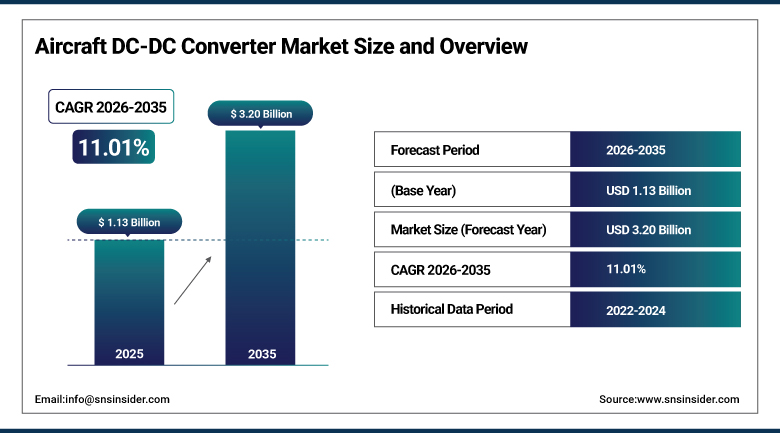
The Aircraft DC-DC Converter Market was valued at USD 1.13 Billion in 2025 and is expected to reach USD 3.20 Billion by 2035, growing at a CAGR of 11.01% from 2026-2035.
The growth of the Aircraft DC-DC Converter Market is being fueled mainly due to the increasing shift in the aviation industry towards the more-electric aircraft architecture that depends greatly on power conversion systems to control voltage levels and facilitate power distribution among various electronic systems such as avionics, cabin systems, and mission critical systems in aircrafts. With the increase in the complexity of aircraft electrical distribution system, DC-DC converters have now become an important part and not just an auxiliary part of aircraft systems, enabling systems such as flight controls and navigation systems to in-flight entertainment and communication systems. The increased use of wide band gap semiconductors like silicon carbide and gallium nitride which allow higher power density and efficient operation in small form factor converters has been driving demand further. The increased production of next generation commercial and military aircraft as well as new technologies such as Urban Air Mobility and eVTOLs will drive growth in the coming decade.
In 2024, Honeywell completed its acquisition of CAES for approximately USD 1.9 billion, extending the company's radiation-hardened power module portfolio to serve defense satellite and advanced air mobility applications. The transaction reflects continued consolidation among leading aerospace power electronics suppliers as companies seek to combine complementary radiation-hardened and high-reliability converter technology to serve an expanding range of defense, space, and advanced air mobility platforms.
To Get more information Aircraft DC-DC Converter Market - Request Free Sample Report
Aircraft DC-DC Converter Market Trends
-
Rising adoption of wide-bandgap silicon carbide and gallium nitride semiconductor technology in converter design.
-
Growing demand for high-density, lightweight converters supporting more-electric aircraft architectures.
-
Increasing integration of digital control algorithms and real-time diagnostics into converter modules.
-
Expanding urban air mobility and eVTOL platform development driving new converter design requirements.
-
Continued industry consolidation as suppliers combine radiation-hardened and high-reliability converter technology portfolios.
U.S. Aircraft DC-DC Converter Market Outlook
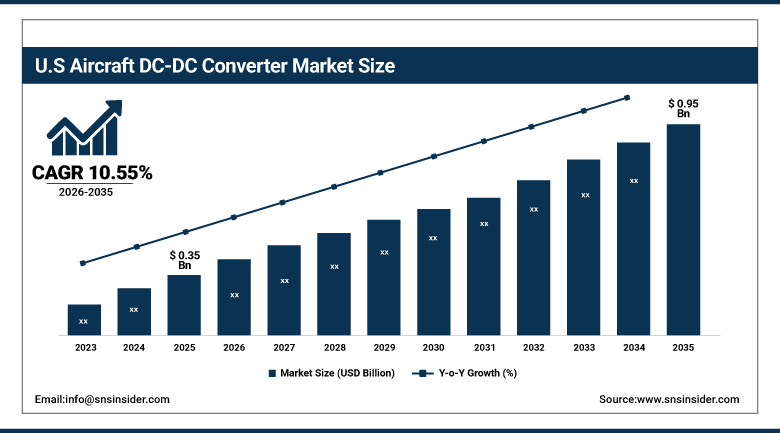
The U.S. Aircraft DC-DC Converter Market was valued at USD 0.35 Billion in 2025 and is expected to reach USD 0.95 Billion by 2035, growing at a CAGR of 10.55% from 2026-2035.
The growth of the U.S. Aircraft DC-DC Converter Market is being bolstered by the presence of major investment in the modernization of defense systems, the manufacturing of commercial aircraft, and the country’s dominance of leading power electronics companies and aerospace majors. The demand from the domestic market is also driven by the government spending on space research that involves radiation-resistant power conversion technology, which helps in creating a diversified supply of vendors including aerospace companies as well as power electronics companies.
In 2025, Vicor Corporation was awarded a contract to supply DC-DC converter modules for NASA's Lunar Gateway program, supporting critical power management functions for the space station's onboard systems. The award reflects continued domestic investment in high-reliability power conversion technology for space applications as government space programs increasingly require compact, radiation-tolerant converter modules capable of sustained operation in extreme environments.
Aircraft DC-DC Converter Market Segment Analysis
-
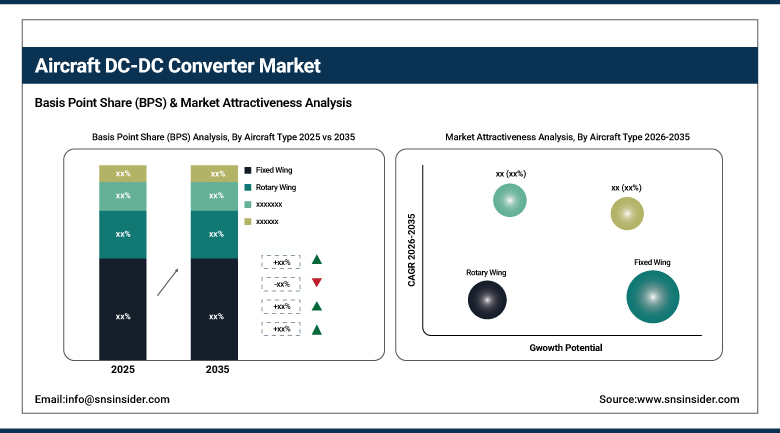
By Aircraft Type, the Fixed Wing segment dominated the Aircraft DC-DC Converter Market with approximately 68.40% share in 2025, while the Air Taxis/eVTOL segment is the fastest growing with a CAGR of approximately 15.35%.
-
By Type, the Isolated segment dominated the Aircraft DC-DC Converter Market with approximately 61.50% share in 2025, while the Non-Isolated segment is the fastest growing with a CAGR of approximately 12.20%.
-
By Output Power, the 250W-1kW segment dominated the Aircraft DC-DC Converter Market with approximately 54.70% share in 2025, while the Above 1kW segment is the fastest growing with a CAGR of approximately 12.80%.
-
By Platform, the Commercial Aviation segment dominated the Aircraft DC-DC Converter Market with approximately 52.50% share in 2025, while the Military Aviation segment is the fastest growing with a CAGR of approximately 12.90%.
By Aircraft Type, Fixed Wing dominates and Air Taxis/eVTOL grows fastest
The Fixed Wing Aircraft segment continues to be the leading aircraft category segment in the Aircraft DC-DC Converter Market because of the enormous fleet size of fixed-wing aircraft compared to that of rotary wing and vertical take-off aircraft. The segment is able to draw on a wealth of accumulated knowledge of integrating power electronics into narrow-body and wide-body aircraft, business jets, and military fixed-wing aircraft, where converters are usually located in several subsystems of an aircraft. Next-generation commercial aircraft production continues to fuel robust demand for converters in the established aircraft category.
Air Taxis and eVTOL platforms are emerging as the fastest-growing aircraft type segment, driven by accelerating development of urban air mobility programs that require compact, lightweight, high-efficiency power conversion systems to manage distributed electric propulsion architectures. This segment focuses on converters engineered for battery-electric and hybrid-electric powertrains, where power density and thermal efficiency directly affect vehicle range and payload capacity. As multiple eVTOL manufacturers progress toward commercial certification, suppliers with early converter qualification experience are positioned to capture a disproportionate share of this rapidly expanding segment over the coming decade, particularly as air taxi operators begin scaling initial commercial routes in dense urban markets.
By Type, Isolated dominates and Non-Isolated grows fastest
Isolated DC-DC converters have continued to dominate the type segment of the Aircraft DC-DC Converter Market because of the emphasis on galvanic isolation in aerospace applications where critical power is distributed. The benefit here is that the converter protects the electronics and controls from electrical malfunctions, a factor which overrides the additional cost and bulky nature of the isolation transformer used for protection. Certification requirements for flight-critical systems also make isolated converters the default specification for most aircraft architectures, especially in avionics bays where different power pathways need to be independent due to fault tolerance requirements set out by aviation safety agencies.
The non-isolated converter segment is witnessing robust growth due to increasing usage in applications that do not require galvanic isolation like cabin lights, entertainment systems, and other ancillary equipment where non-isolated converters offer significant benefits in terms of weight, size, and price over isolated converters. Non-isolated converters offer higher efficiency at reduced size, which makes them suitable for use in tight equipment bays, which is becoming an important factor for aircraft manufacturers looking to integrate systems further. As more electric architecture continues to increase the number of electrical sub-systems in an aircraft, non-isolated converters have significant growth potential for such secondary power distribution applications.
By Output Power, 250W-1kW dominates and Above 1kW grows fastest
The 250W-1kW output power segment continues to be the leading one in terms of market shares in the Aircraft DC-DC Converter Market due to its versatility, which allows it to accommodate all the requirements for the majority of the avionics, communication, and cabin systems' power supply systems in terms of output power. The ability of converters of the 250W-1kW output power segment to handle power demands of a significant number of subsystems using compact packaging without creating bulky thermal management systems and existing manufacturing technologies make them suitable for mass production to satisfy the majority of the current market requirements.
The Above 1kW segment is currently seen as the fastest-growing one due to the increase in the electrical load of modern "more-electric" aircraft systems (environmental control system, de-icing, actuators) traditionally supplied with hydraulic or pneumatic power. The main requirement of the converters in the above 1kW output power segment is the ability to handle the increased power loads while maintaining the compactness of aerospace components. With the continuous replacement of mechanical and hydraulic systems with electric ones, the demand for higher-power converters is likely to grow.
By Platform, Commercial Aviation dominates and Military Aviation grows fastest
Commercial Aviation remains the dominant platform segment within the Aircraft DC-DC Converter Market, reflecting the sheer scale of global commercial aircraft production and the extensive power conversion requirements across passenger comfort, communication, and navigation systems. This segment benefits from sustained commercial aircraft order backlogs at major airframers, along with growing retrofit demand as airlines upgrade avionics and cabin systems on existing fleets. Continued introduction of new commercial aircraft programs incorporating more-electric architectures further reinforces commercial aviation's position as the largest platform segment by converter volume, with each new aircraft delivery adding dozens of individual converter units across its distributed electrical system.
Military Aviation is emerging as the fastest-growing platform segment, driven by defense modernization programs and increasing demand for high-reliability converters supporting radar, electronic warfare, and mission-critical avionics systems. This segment focuses on ruggedized, high-frequency power management solutions capable of meeting stringent military qualification standards under extreme operating conditions. As defense agencies worldwide continue investing in next-generation combat aircraft, unmanned systems, and electronic warfare platforms, military aviation is positioned to capture disproportionate converter demand growth relative to its share of overall aircraft production volume, reflecting the premium defense programs place on high-reliability, mission-assured power electronics.
Regional Analysis
|
Region |
Major Country |
Share within Region, 2025 (%) |
|---|---|---|
|
North America |
United States |
85.50% |
|
Europe |
France |
33.60% |
|
Asia Pacific |
China |
46.80% |
|
Latin America |
Brazil |
44.60% |
|
Middle East & Africa |
Israel |
38.90% |
North America Aircraft DC-DC Converter Market Insights
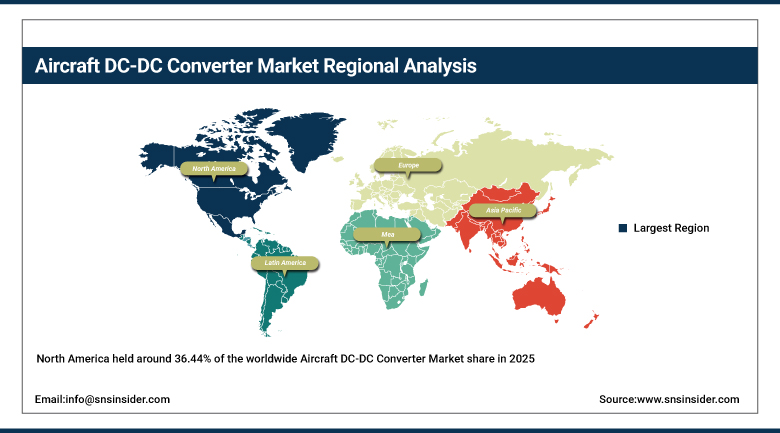
North America held around 36.44% of the worldwide Aircraft DC-DC Converter Market share in 2025, thanks to the region's well-developed aerospace industry and many defense modernization efforts in place. The United States forms a large share of regional consumption, owing to its dominance in leading power electronics manufacturers, commercial aircraft manufacturing, and continuous investments by the government in military and space power conversion technology. North America maintains its supremacy due to the presence of research & development in wide-bandgap semiconductors that continuously raise the bar for power conversion efficiency and density for the whole industry.
Other than the United States, Canada adds regional demand through its participation in North American aerospace value chain and defense procurement programs. Investments in next-generation commercial aircraft platforms, rising space exploration programs that require power conversion technology that is radiation-hardened, and growth in urban air mobility development activities will ensure the dominance of North America as the largest regional market of aircraft DC-DC converters in the coming years.
Get Customized Report as per Your Business Requirement - Enquiry Now
Asia Pacific Aircraft DC-DC Converter Market Insights
Asia Pacific is projected to expand at the fastest CAGR of approximately 12.50% across the Aircraft DC-DC Converter Market during the 2026-2035 forecast period, driven by rapidly growing commercial aircraft fleets and expanding domestic aerospace manufacturing capability across the region. China represents the largest single contributor within the region, supported by substantial government investment in indigenous commercial aircraft programs and growing domestic defense modernization initiatives requiring advanced power conversion technology for military platforms, alongside continued expansion of domestic component supply chains intended to reduce reliance on imported aerospace power electronics.
India and Japan contribute additional regional growth, with India's expanding commercial aviation sector and growing domestic defense aerospace programs supporting rising converter demand, while Japan's established electronics manufacturing base contributes advanced power conversion component development. Continued regional investment in urban air mobility infrastructure and growing domestic aerospace supply chain capability further reinforce Asia Pacific's position as the fastest-growing global market for aircraft DC-DC converter technology, as regional governments prioritize aerospace self-sufficiency across both commercial and defense platforms, supporting sustained multi-year capital investment in domestic power electronics manufacturing capacity.
Europe Aircraft DC-DC Converter Market Insights
urope presents a considerable regional market for DC-DC converter technologies driven by French dominance in the aerospace industry and presence of key aircrafts. The significance of France in the region is attributed to its dominance in the final assembly lines of commercial aircrafts and its research and development in the area of power electronics for the aerospace industry. Other contributing countries include Germany and the UK with the presence of an aerospace component industry and military modernization efforts that necessitate advanced power electronics in new-build aircrafts as well as existing fleets.
Further investments in next-generation commercial aircraft and increased collaboration on defense aerospace in the region drive constant demand for DC-DC converter technology. In addition, increasing interest in eVTOL and urban air mobility in the region, in addition to investments in the development of power electronics in space programs, places Europe as a center for innovation in aerospace power conversion technology despite being behind in the volume of demand compared to North America and rapidly growing Asia Pacific market.
MEA & Latin America Aircraft DC-DC Converter Market Insights
Latin America's Aircraft DC-DC Converter Market is led by Brazil, which accounts for the majority of regional demand on the strength of its established commercial aircraft manufacturing sector and growing defense modernization initiatives. Brazil's aerospace industry, anchored by significant regional aircraft production, continues to drive steady demand for power conversion components across both commercial and military aircraft programs, while gradual expansion of domestic defense procurement and growing regional export activity to neighboring markets support incremental regional market growth throughout the forecast period.
The Middle East & Africa region continues to grow in strategic importance, with demand concentrated in markets such as Israel, which maintains a well-established defense aerospace and power electronics development ecosystem supporting both domestic military aircraft programs and export activity. Gulf Cooperation Council markets contribute additional regional demand through growing defense procurement and expanding commercial aviation fleets, as regional governments continue investing in modernizing both military and commercial aerospace capabilities across the broader region, with several nations pursuing indigenous aerospace manufacturing partnerships to reduce dependence on imported platforms.
Market Dynamics
Growth Drivers: More-Electric Aircraft Architecture and Semiconductor Advancement
The rapid move towards more electric aircraft (MEA) architecture in the aviation sector is the biggest factor driving growth in the Aircraft DC-DC Converter Market because MEAs tend to rely on electricity for operations in place of pneumatic and hydraulic systems, necessitating advanced power conversion through DC-DC converters. This trend will continue to add to the quantity of DC-DC converters that go into each plane, helping to keep up the high rate of growth even as the overall number of planes produced increases relatively modestly. The increased use of wide-bandgap semiconductors like silicon carbide and gallium nitride in aircraft DC-DC converters allows for greater power density and efficiency in ever-smaller packages, which makes it possible to cope with rising electrical loads without making the system heavier.
Increasing military spending on modernization and increased production of new generation military and civilian aircraft is another source of demand. Increasing expenditure on urban air mobility and eVTOL aircraft programs will also contribute to the development of the market since such types of aircraft need specially designed high-efficiency DC-DC converters that will be used in distributed electric propulsion and battery powered flight.
Restraints: Certification Complexity and Long Qualification Cycles
The lengthy and rigorous certification processes required for aviation power electronics, including compliance with environmental and safety standards such as DO-160, represent a significant restraint on the Aircraft DC-DC Converter Market, as these requirements extend development timelines and increase costs substantially relative to comparable non-aerospace power conversion applications. This dynamic is particularly challenging for smaller manufacturers and new market entrants without established certification track records, favoring incumbent suppliers with proven qualification experience and long-term component availability commitments spanning decades of aircraft service life, a barrier that continues to concentrate program awards among a comparatively small group of established suppliers.
High development costs associated with radiation-hardened and military-qualified converter designs restrict the pace of new product introduction, particularly for specialized space and defense applications requiring extensive testing and validation. Continued volatility in specialty semiconductor and rare-earth material supply chains adds further uncertainty to long-term manufacturing cost planning, as suppliers must balance investment in next-generation wide-bandgap technology against the extended qualification cycles inherent to aerospace power electronics development, often requiring several years between initial design and first flight-certified delivery.
Opportunities: Wide-Bandgap Semiconductors and Urban Air Mobility Expansion
Continued advancement of wide-bandgap semiconductor technology presents a substantial growth opportunity for the Aircraft DC-DC Converter Market, as silicon carbide and gallium nitride devices enable significant improvements in power density, efficiency, and thermal performance relative to conventional silicon-based converter designs. Suppliers that can demonstrate validated, certifiable wide-bandgap converter technology are well positioned to capture share as aircraft manufacturers increasingly prioritize weight reduction and efficiency improvements across both new-build and retrofit aircraft programs seeking to reduce fuel consumption and extend operational range, particularly as airlines face mounting pressure to lower per-seat emissions on existing fleets.
Rapid growth in urban air mobility and eVTOL platform development presents a longer-term opportunity for converter manufacturers to extend their technology into an entirely new category of electric-powered aircraft. As multiple eVTOL programs progress toward commercial certification and initial production, suppliers with early development experience in distributed electric propulsion power management are positioned to capture a disproportionate share of this emerging demand, particularly as certification pathways for these novel aircraft categories continue to mature alongside the underlying vehicle technology and initial commercial air taxi services begin entering revenue service in key launch markets.
Recent Developments:
-
In 2024, Infineon Technologies entered a partnership with Lockheed Martin to co-develop next-generation DC-DC converters for military aircraft, focusing on higher efficiency and reliability for defense applications.
-
In 2025, Crane Aerospace & Electronics announced a partnership with Embraer to deliver advanced DC-DC power solutions for Embraer's new generation of regional jets.
-
In 2024, Bel Fuse completed its USD 320 million acquisition of Enercon Technologies, doubling the company's aerospace revenue share to approximately 31% and adding rugged converter technology for harsh-environment platforms.
-
In 2024, TDK-Lambda announced a strategic partnership with a leading aerospace OEM to co-develop next-generation power modules integrating advanced gallium nitride transistors for commercial aircraft and UAV applications.
Aircraft DC-DC Converter Market Key Players
-
Honeywell International Inc.
-
TDK-Lambda Corporation
-
Murata Manufacturing Co., Ltd.
-
Advanced Energy Industries, Inc.
-
Vicor Corporation
-
Collins Aerospace
-
Safran S.A.
-
Astronics Corporation
-
Eaton Corporation plc
-
Crane Aerospace & Electronics
-
Texas Instruments Incorporated
-
Cincon Electronics Co., Ltd.
-
KGS Electronics
-
Analog Devices, Inc.
-
Infineon Technologies AG
-
GE Aerospace
-
Thales Group
-
North Atlantic Industries, Inc.
-
Data Device Corporation
-
Bel Fuse Inc.
Aircraft DC-DC Converter Market Report Scope:
| Report Attributes | Details |
|---|---|
| Market Size in 2025 | USD 1.13 Billion |
| Market Size by 2035 | USD 3.20 Billion |
| CAGR | CAGR of 11.00% From 2026 to 2035 |
| Base Year | 2025 |
| Forecast Period | 2026-2035 |
| Historical Data | 2022-2024 |
| Report Scope & Coverage | Market Size, Segments Analysis, Competitive Landscape, Regional Analysis, DROC & SWOT Analysis, Forecast Outlook |
| Key Segments | • by Aircraft Type (Fixed Wing, Rotary Wing, UAV, and Air Taxis/eVTOL) • by Type (Isolated and Non-Isolated) • by Output Power (Less than 250W, 250W-1kW, and Above 1kW) • by Platform (Commercial Aviation and Military Aviation) |
| Regional Analysis/Coverage | North America (US, Canada), Europe (Germany, UK, France, Italy, Spain, Russia, Poland, Rest of Europe), Asia Pacific (China, India, Japan, South Korea, Australia, ASEAN Countries, Rest of Asia Pacific), Middle East & Africa (UAE, Saudi Arabia, Qatar, South Africa, Rest of Middle East & Africa), Latin America (Brazil, Argentina, Mexico, Colombia, Rest of Latin America). |
| Company Profiles | Honeywell International Inc., TDK-Lambda Corporation, Murata Manufacturing Co., Ltd., Advanced Energy Industries, Inc., Vicor Corporation, Collins Aerospace, Safran S.A., Astronics Corporation, Eaton Corporation plc, Crane Aerospace & Electronics, Texas Instruments Incorporated, Cincon Electronics Co., Ltd., KGS Electronics, Analog Devices, Inc., Infineon Technologies AG, GE Aerospace, Thales Group, North Atlantic Industries,Inc., Data Device Corporation, Bel Fuse Inc. |

Frequently Asked Questions
Leading companies in the Aircraft DC-DC Converter Market include Honeywell International, TDK-Lambda, Murata Manufacturing, Advanced Energy, and Vicor Corporation, among others.
Key opportunities include continued advancement of wide-bandgap semiconductor technology improving power density and efficiency, and rapid growth in urban air mobility and eVTOL platform development.
The aviation industry's accelerating transition toward more-electric aircraft architectures, combined with rising adoption of wide-bandgap semiconductor materials, is the major factor driving market growth.
The Commercial Aviation segment dominated the Aircraft DC-DC Converter Market with approximately 52.50% share in 2025.
North America dominated the Aircraft DC-DC Converter Market in 2025 with approximately 36.44% share, reflecting the region's robust aerospace manufacturing base, led by the United States.
