
Thermal Imaging for Defense Market Report Scope & Overview:
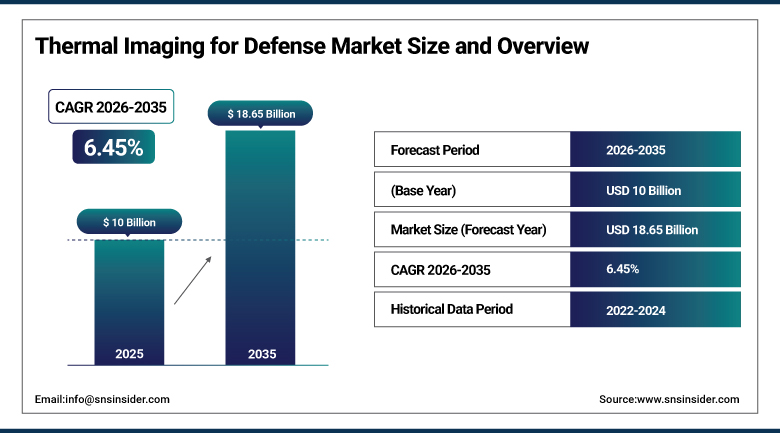
The Thermal Imaging for Defense Market size is valued at USD 10 Billion in 2025 and is expected to reach USD 18.65 Billion by 2035 and grow at a CAGR of 6.45% over the forecast period 2026-2035.
Thermal Imaging for Defense market is likely to witness a steady development in terms of surveillance, target acquisition, and situational awareness applications with the increasing demand for high-accuracy all-weather and night-vision imaging systems. Growing operational challenges in the contemporary defense scenario and growing spend for advanced infrared sensor technology are expected to further drive market growth for thermal imaging applications. Cooled and uncooled sensors, multi-spectral imaging, AI-infused image processing capabilities, and platform integration are driving improved detection accuracy, expanded operational distance with rugged packaging characteristics and scaled payload management optimized for land, airborne and naval forces supporting greater commercialization in military border surveillance and defense surveillance sectors.
Industry research shows that around 60% of market demand is driven by defense and military modernization programs, which suggests adoption in its initial phase where Thermal Imaging for Defense technology is mainly deployed in army, air force, and naval operations for surveillance, target acquisition, and situational awareness applications.
To Get more information Thermal Imaging for Defense Market - Request Free Sample Report
Thermal Imaging for Defense Market Trends:
-
Growing shift toward compact and lightweight thermal imaging systems to enable next-generation surveillance, target acquisition, and situational awareness capabilities.
-
Rising adoption of AI-enabled and multi-spectral sensor architectures for improved detection accuracy, operational scalability, and platform integration.
-
Increasing focus on advanced thermal cameras, infrared sensors, and image processing units for high-performance mission-critical defense applications.
-
Expansion of land, air, and naval platform deployments leveraging enhanced all-weather and night-vision capabilities.
-
Advancements in cooled, uncooled, and hybrid thermal imaging technologies improving system reliability, resolution, and operational efficiency.
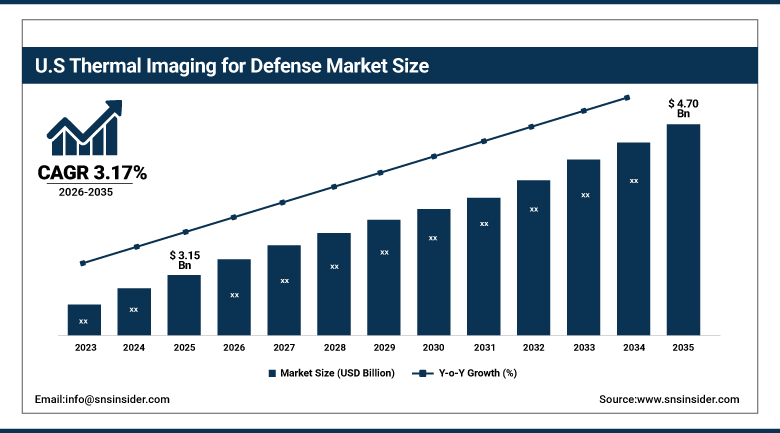
The U.S. Thermal Imaging for Defense Market size is USD 3.15 Billion in 2025 and is expected to reach USD 4.70 Billion by 2035, growing at a CAGR of 3.17% over the forecast period of 2026-2035.
Increasing demand for U.S. Thermal Imaging for Defense market by new program included in military modernization, defense research centers and advanced technology companies are expected to drive the growth of market. Machine vision-based image-processing, multispectral sensors integration and cooled as well as uncooled IR technologies will make systems more precise, compact and reliable. These factors are contributing to the growth of Thermal Imaging for Defense market in surveillance, target acquisition and situational awareness applications. Heavy spending on defense, strategic partnerships and government procurement programs are some of the reasons that favoring the U.S. to become a key player in Thermal Imaging for Defense market.
Thermal Imaging for Defense Market Growth Drivers:
-
Rising Demand for Advanced Defense Surveillance and Targeting Systems
Rise in demand for night vision, all-weather and high performance thermal imaging systems is expected to escalate the growth of Thermal Imaging for Defense market worldwide. Improvements in AI-based image processing, multi-spectral sensors, and combination of cooled with uncooled imaging technologies contribute to system accuracy and operational reliability, as well as scalability. Industry studies show that 60% of today's adoption is driven by military modernization programs, defense R&D centers, and strategic platform rollouts, reflecting the broadening role of thermal imaging in land, airborne and naval systems. Furthermore, rising applications of autonomous systems, UAVs and integrated battlefield management solution is driving overall market growth.
Thermal Imaging for Defense Market Restraints:
-
High System Cost and Technical Complexity
Market growth is hindered by the expensive price tag and technical complexity of high-performance thermal imaging systems, preventing widespread use among small defense suppliers and nascent markets. They are complex to integrate, require fine environmental tuning and need to be compatible with existing defense electronics platforms. Adoption barriers in terms of sensor calibration/miniaturization and real-time processing are production challenges encountered by around 35% potential end-users. In addition, the lack of standards among platforms and compatibility barriers are still hindering a fast adoption.
Thermal Imaging for Defense Market Opportunities:
-
Expansion Across Multi-Platform Defense Applications and AI-Enhanced Imaging
The market is ripe with opportunities as thermal imaging technology becomes more prevalent in land vehicles, naval vessels, airborne platforms, and UAVs for improved surveillance, targeting and situational awareness. The combined use of AI-based image analysis, multi-sensor fusion, as well as autonomous systems is now unlocking all new paths for innovative solutions and operational excellence. According to industry studies, defense R&D spending on thermal imaging technologies is growing in excess of 15% a year and the outlook for future utilization appears promising. Key partnerships, defense procurement programs and modernization plans will further push the growth in the matured as well as emerging defense markets.
Thermal Imaging for Defense Market Segment Analysis:
-
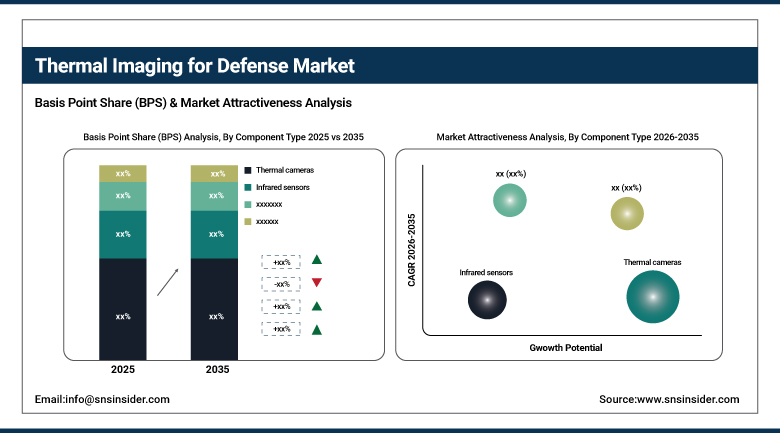
By Component Type: In 2025, thermal cameras dominated with 50% share; image processing units are the fastest-growing segment during 2026–2035.
-
By Technology: In 2025, cooled thermal imaging dominated with 45% share; multi-spectral thermal imaging is the fastest-growing segment during 2026–2035.
-
By Application: In 2025, surveillance and reconnaissance dominated with 55% share; target acquisition and weapon sighting is the fastest-growing segment during 2026–2035.
-
By End User: In 2025, army and ground forces dominated with 60% share; air force and airborne units are the fastest-growing segment during 2026–2035.
By Component Type: Thermal Cameras Lead as Image Processing Units Expand Rapidly.
The thermal cameras segment is the largest category in Thermal Imaging for Defense market and the trend is anticipated to continue during forecast period, as they offer higher level of accuracy for detection, provide multi-sensor integration flexibility across various platforms, and are increasingly being adopted in military & defense R&D centers, strategic surveillance programs. These are commonly found in land vehicles, aerial platforms, and naval operations, used for surveillance, target acquisition and situational awareness.
The image processing unit market will grow significantly due to rise in real-time image analysis, AI-based target identification and multi-sensor data fusion requirements. Advancements in AI algorithms, platform integration and sensor fusion is expected to result higher adoption especially for UAV payloads, autonomous systems and C4I defense-in-platforms.
By Technology: Cooled Thermal Imaging Lead as Multi-Spectral Thermal Imaging Accelerates.
Cooled thermal imaging systems remain a market leader and are used extensively for long-range detection, high-resolution imagery, and strategic military applications. They are essential for night vision, all-weather, and precision targeting on defense systems.
Multispectral thermal imagery continues to evolve as a core technology to enable fused infrared, visual and other sensor modalities with increased situational awareness and improved mission flexibility. Surging interest towards AI-based analytics, autonomous systems and advanced surveillance is fostering the multi-spectral thermal camera industry growth.
By Application: Surveillance and Reconnaissance Lead as Target Acquisition and Weapon Sighting Expand.
The application of these UAVs are used mainly for surveillance and reconnaissance purposes along with other applications such as persistent monitoring, border security and battle field intelligence. With thermal imaging, targets are detected with precision even in conditions of limited visibility and bad weather, enhancing operational availability and decision quality.
The target acquisition and weapon sighting has become a growing application, due to the gradual demand for precision guided operations and targeting, while getting integrated real-time with the defense systems. For its enhanced applications, such as multi-platform deployment and AI-aided image processing, the theoretical investigation reveals that its usage is continuously extended.
By End User: Army and Ground Forces Lead as Air Force and Airborne Units Expand.
By end user, the army & ground force segment is expected to grow at a higher CAGR drive due to increasing use of thermal imaging in armored vehicles, infantry units, and ground surveillance. Air force and airborne that is soon to come on top are adopting quickly too as UAS/ UAVs, helicopters and fighter aircraft receive advanced thermal sensors for targeting surveillance, reconnaissance.
Navies are also increasing their use for naval shipboard monitoring, coastal defense and maritime surveillance applications due to all-weather operability requirement and high-performance imaging platform.
Thermal Imaging for Defense Market Regional Analysis:
North America Thermal Imaging for Defense Market Insights:
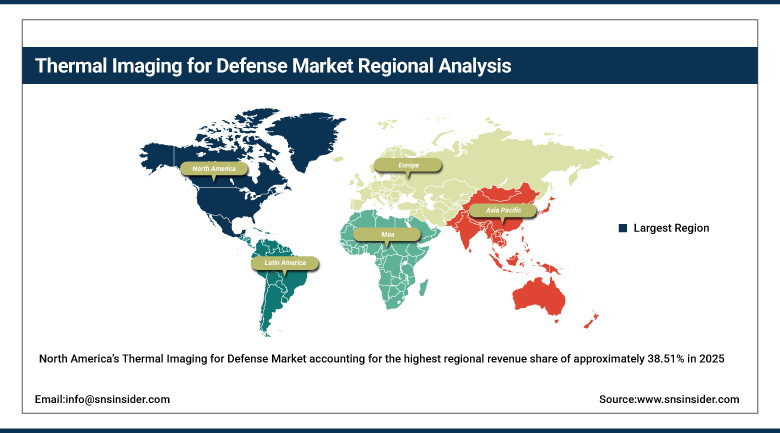
In 2025, North America’s Thermal Imaging for Defense Market accounting for the highest regional revenue share of approximately 38.51% in 2025. The market is dominated by North America due to the presence of strong defense modernization programs, established homeland security infrastructure and the growing demand for technologically advanced surveillance systems. Strong representation of leading defense contractors, dynamic R&D landscape, and ongoing government investment on infrared sensing, night-vision systems, and AI-based imaging solutions are driving regional implementation. The prospects for the North American market are enhanced with the advanced capabilities in sensor integration, image processing, and deployment across land, naval, and airborne forces which makes North America a force to be reckoned with the Thermal Imaging for Defense.
Get Customized Report as per Your Business Requirement - Enquiry Now
U.S. and Canada Thermal Imaging for Defense Market insights:
The U.S. and Canada Thermal Imaging for Defense market is driven by strong government defense spending, continuous military modernization initiatives, and rising investments in border security and surveillance systems. The presence of leading defense manufacturers, advanced R&D capabilities, and early adoption of AI-enabled thermal imaging and multi-sensor fusion technologies support widespread deployment across land, air, and naval platforms. Additionally, increasing focus on homeland security, Arctic surveillance, and interoperability with allied defense systems continues to strengthen market growth across both countries.
Asia Pacific Thermal Imaging for Defense Market Insights:
Asia Pacific represents a high-growth region for the Thermal Imaging for Defense market, registering a CAGR of 9.70% during 2026–2035. This rapid market expansion is due to the growing defense modernization programmes, and military spending in prominent Asia Pacific nations along with a surge in geopolitical tensions. Increasing investments towards in-house defense production, monitoring systems and border securing equipment is enhancing the adoption of thermal imaging technology for land, naval and airborne domains. Furthermore, fast adoption of UAV platforms, autonomous systems and AI-based surveillance solutions under the aegis of government-led defense programs and PPPs are promoting market dynamics for advanced thermal imaging in the region over 2026-2035.
Europe Thermal Imaging for Defense Market Insights:
The Europe Thermal Imaging for Defense market’s is anticipated to register substantial growth due to the rising defense modernization programs, rising emphasis on border security, and the dominance of key defense & electro-optics manufacturers in the space. Technology development: Government-funded defense programs, NATO-led capability developments and industry-academia joint efforts on advanced sensing, night vision and surveillance technology support regional conversion. Technological developments in infrared detector materials (such as long-wave and mid-wave infrared), on-board image processing algorithms, and multi-sensor integration have improved system accuracy, reliability, and interoperability by the end of the second forecast period 2026–2035 throughout Europe.
Latin America Thermal Imaging for Defense Market Insights:
The Latin America Thermal Imaging for Defense market is projected to register a steady growth on the account of increasing homeland security investments, border reconnaissance and military upgrades in countries such as Brazil, Mexico and Chile. Growing demand for thermal imaging systems to surveillance, reconnaissance and maritime security is also driving regional demand. Support made by government for defense programs, modest growth in domestic capabilities, and collaboration with international defense providers are driving the demand space of advanced thermal imaging solutions to rise on a continuous basis till 2035.
Middle East and Africa Thermal Imaging for Defense Market Insights:
The adoption of thermal imaging in defense in Middle East & Africa is driven by rising security concerns, growing military spending and increasing need for advanced surveillance & reconnaissance systems. For example, Saudi Arabia, the UAE, Israel and South Africa are spending a significant amount of their defense budgets on thermal imaging for border security, critical infrastructure protection and battlefield awareness. The development of regional defense manufacturing hubs, technology transfer agreements, and ongoing advancements in infrared sensor performance and imaging materials will slowly underpin market growth across the region to 2035.
Thermal Imaging for Defense Market Competitive Landscape:
Teledyne FLIR LLC is a leading global provider of thermal imaging, infrared sensors, and advanced electro-optical systems, with a strong focus on defense, security, and surveillance applications. The company is recognized for its deep expertise in cooled and uncooled thermal imaging technologies, integrated imaging solutions, and advanced image processing capabilities that support battlefield awareness, reconnaissance, and target acquisition across land, air, and naval platforms.
-
In 2025: Teledyne FLIR expanded its defense portfolio with enhanced AI-enabled thermal imaging systems designed for next-generation ISR, unmanned platforms, and soldier-borne applications, strengthening its position as a key supplier to global defense forces.
Lockheed Martin Corporation is a major global defense contractor actively involved in the development and integration of advanced thermal imaging and infrared sensing technologies across aerospace, missile defense, and military systems. Leveraging strong R&D capabilities and system-level integration expertise, the company incorporates thermal imaging into fighter aircraft, missile warning systems, and advanced surveillance platforms to enhance situational awareness and mission effectiveness.
-
In 2025: Lockheed Martin increased investments in next-generation infrared sensing and multi-sensor fusion technologies to support advanced combat systems, hypersonic defense, and autonomous platforms, reinforcing its leadership in high-performance defense imaging solutions.
Raytheon Technologies Corporation is a prominent defense and aerospace company with extensive capabilities in infrared sensors, electro-optical targeting systems, and thermal imaging solutions for military applications. The company’s technologies are widely used in missile guidance, airborne targeting pods, naval surveillance, and ground-based defense systems, emphasizing precision, reliability, and all-weather operational performance.
-
In 2025: Raytheon Technologies advanced its portfolio of multi-spectral and long-range thermal imaging systems through enhanced R&D and defense contracts, supporting next-generation targeting, missile defense, and intelligence, surveillance, and reconnaissance (ISR) programs worldwide.
Thermal Imaging for Defense Market Key Players:
-
Teledyne FLIR LLC
-
Lockheed Martin Corporation
-
Raytheon Technologies Corporation
-
BAE Systems plc
-
L3Harris Technologies Inc
-
Northrop Grumman Corporation
-
Leonardo DRS Inc
-
Thales Group
-
Elbit Systems Ltd
-
General Dynamics Corporation
-
Saab AB
-
Hensoldt AG
-
Israel Aerospace Industries
-
Rheinmetall AG
-
CONTROP Precision Technologies Ltd
-
Moog Inc
-
Thermoteknix Systems Ltd
-
Ophir Optronics Solutions Ltd
-
Collins Aerospace
-
Active Defense Imagers Inc
| Report Attributes | Details |
|---|---|
| Market Size in 2025 | USD 10 Billion |
| Market Size by 2035 | USD 18.65 Billion |
| CAGR | CAGR of 6.45% From 2026 to 2035 |
| Base Year | 2025 |
| Forecast Period | 2026-2035 |
| Historical Data | 2022-2024 |
| Report Scope & Coverage | Market Size, Segments Analysis, Competitive Landscape, Regional Analysis, DROC & SWOT Analysis, Forecast Outlook |
| Key Segments | • By Component Type: (Thermal cameras, Infrared sensors, Image processing units) • By Technology: (Cooled thermal imaging, Uncooled thermal imaging, Multi spectral thermal imaging) • By Application: (Surveillance and reconnaissance, Target acquisition and weapon sighting, Navigation and situational awareness) • By End User: (Army and ground forces, Naval forces, Air force and airborne units) |
| Regional Analysis/Coverage | North America (US, Canada), Europe (Germany, UK, France, Italy, Spain, Russia, Poland, Rest of Europe), Asia Pacific (China, India, Japan, South Korea, Australia, ASEAN Countries, Rest of Asia Pacific), Middle East & Africa (UAE, Saudi Arabia, Qatar, South Africa, Rest of Middle East & Africa), Latin America (Brazil, Argentina, Mexico, Colombia, Rest of Latin America). |
| Company Profiles | Teledyne FLIR LLC, Lockheed Martin Corporation, Raytheon Technologies Corporation, BAE Systems plc, L3Harris Technologies Inc, Northrop Grumman Corporation, Leonardo DRS Inc, Thales Group, Elbit Systems Ltd, General Dynamics Corporation, Saab AB, Hensoldt AG, Israel Aerospace Industries, Rheinmetall AG, CONTROP Precision Technologies Ltd, Moog Inc, Thermoteknix Systems Ltd, Ophir Optronics Solutions Ltd, Collins Aerospace, Active Defense Imagers Inc. |
Frequently Asked Questions
The land platforms segment dominated the Thermal Imaging for Defense market, driven by high adoption of thermal cameras and sensors in ground vehicles and infantry operations.
The Thermal Imaging for Defense market is expected to grow at a CAGR of 6.45% during 2026-2035.
The key drivers of the Thermal Imaging for Defense market are rising defense modernization programs, increasing demand for all-weather and night-vision surveillance, growing border security needs, and advancements in infrared sensor and imaging technologies.
The market was valued at USD 10 Billion in 2025 and is projected to reach USD 18.65 Billion by 2035.
North-America dominated the Thermal Imaging for Defense market in 2025.
