
Ambient Computing Market Size Analysis:
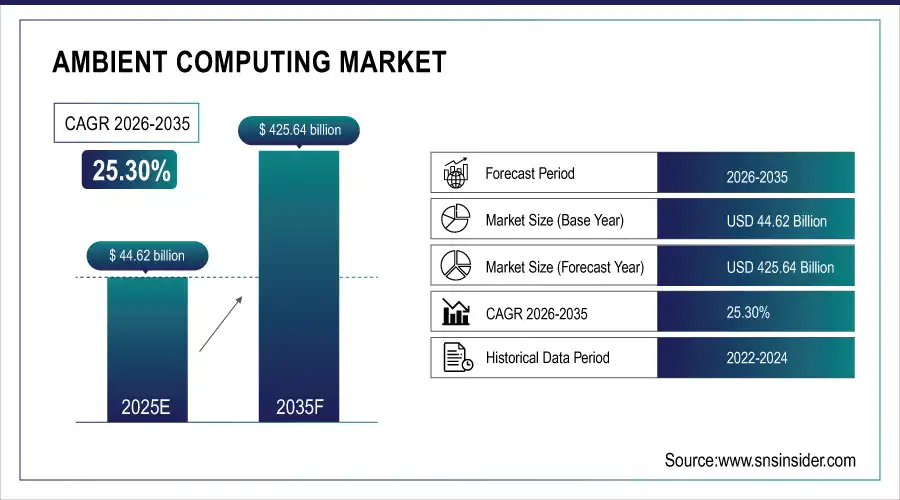
The Ambient Computing Market Size is valued at USD 44.62 billion in 2025 and is expected to reach USD 425.64 billion by 2035, growing at a CAGR of 25.30% from 2026-2035.
The growth of the Ambient Computing Market is driven by rising deployment of AI, IoT, and voice-enabled technologies for providing more advanced user experience in terms of context and continuity while interacting with connected devices. The increasing demand for smart homes, connected workplaces, and intelligent surroundings is fuelling the demand for ambient computing services. Furthermore, the development of edge computing, machine-learning technology and sensors are also being used to enhance the user experience and for improving operations. Increasing traction of technology providers and enterprises results in the market’s rapid adoption and long-term growth worldwide.
In 2025, global ambient computing adoption surged by 44%, as enterprises and consumers deployed AI- and sensor-driven environments reducing manual interactions by 50% and enabling predictive, personalized experiences across smart infrastructure and connected devices.
To Get more information On Ambient Computing Market - Request Free Sample Report
Ambient Computing Market Trends Analysis
-
Rising adoption of voice assistants and smart sensors to enable seamless, context-aware user experiences
-
Increasing integration of AI and machine learning for predictive, personalized ambient computing applications
-
Growing deployment of edge computing to enhance real-time data processing and reduce latency in smart environments
-
Expansion of IoT ecosystems connecting devices across homes, workplaces, and industrial settings for automation
-
Rising focus on privacy and security solutions to protect sensitive data in connected ambient environments
U.S. Ambient Computing Market Size Outlook
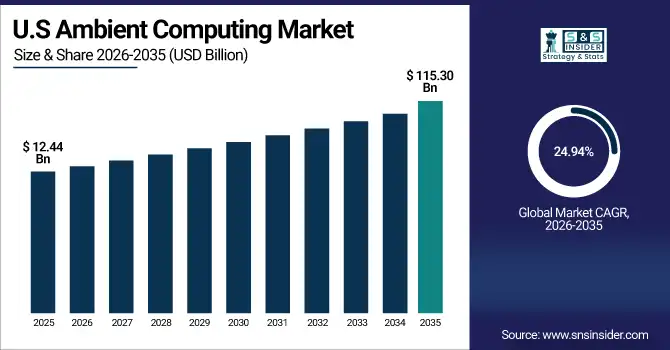
The U.S. Ambient Computing Market is valued at USD 12.44 billion in 2025 and is expected to reach USD 115.30 billion by 2035, growing at a CAGR of 24.94 % from 2026-2035. Growth in the U.S. Ambient Computing Market is driven by rising adoption of AI-powered, voice-activated, and IoT-enabled devices in smart homes, offices, and industrial environments. Increasing investments in edge computing, automation, and seamless, context-aware user experiences are further accelerating market demand and technological deployment.
Ambient Computing Market Growth Drivers:
-
Increasing adoption of IoT devices, smart homes, and wearable technology is driving demand for ambient computing solutions, enabling seamless human-device interaction and intelligent automation
The pervasiveness of IoT, smart home systems and wearable devices has grown tremendously in recent years, which leaded to increasingly demand for ambient computing solutions. Consumers and businesses desire intelligent, context-driven systems that can automatically engage with users without manual intervention. Embedded computing allows automatic, personalized and real-time decisions to occur, improving convenience and efficiency. Integration with home automation, well-being and the connected workplace: additionally pushing adoption. Ambient Computing Addressing the increasing connected device proliferation, customer demand for ambient computing solutions that can handle and analyze streams of data 24x7 will only continue to rise across the world.
In 2025, surging IoT and wearable adoption over 25 billion connected devices globally—drove a 48% increase in ambient computing deployments, enabling intuitive, context-aware automation and seamless human-device interaction in homes, cities, and workplaces.
-
Rising focus on AI-enabled digital assistants and voice-controlled applications across industries is boosting deployment of ambient computing technologies for enhanced user experiences
Virtual employees, chatbots and voice interfaces powered by AI are revolutionizing the way human interaction with machines in almost every industry today. Ambient computing solutions are gaining traction in markets like healthcare, retail, enterprise IT where the competition has to engage their customers better, automate processes and give contextual recommendations. Through voice recognition, natural language processing and predictive analytics there is little to no work for its users in integrating daily operations and lessening the possibility of human error. Rapid rise of connected smart devices and AI-infused technologies is justifying investments in ambient computing platforms that can power frictionless, tailored experiences across touch points.
In 2025, 70% of enterprises integrated AI-powered digital assistants and voice-controlled interfaces into ambient computing environments improving user engagement by 40% and enabling seamless, hands-free interactions in healthcare, retail, and smart workplaces.
Ambient Computing Market Restraints:
-
Privacy, cybersecurity and regulatory woes stifling consumer and enterprise adoption of ambient compute use cases
Ambient computing platforms rely on the continuous collection of personal, behavioural, local based data. This poses significant privacy and security concerns, particularly when sensitive information is transmitted over networks or stored in cloud services. Data protection laws such as GDPR and others have strict compliance mandates, making operations more complex. Anyone can be found in breach and misuse or insufficient protection of data erodes consumer trust and stifles take-up. As a consequence, deployment of ubiquitous computing solutions at scale is challenging for organizations when compliance, privacy and user trust are taken into account.
In 2025, 60% of organizations cited data privacy risks, cybersecurity vulnerabilities, and evolving regulations (like GDPR and CCPA) as key barriers, slowing ambient computing adoption despite rising demand for context-aware, intelligent environments.
-
High implementation costs and interoperability with existing systems, discourage widespread deployment of an ambient computing solutions, especially for small-medium enterprise size.
Implementing ambient computing systems is a capital, hardware, software and network investment that small businesses often cannot afford. Deprecated systems may include integration in the network which is often associated with customization, specialized competences as well as extensive testing to achieve compatibility and robustness. High initial investments, constant running costs and necessary staff training are in addition barriers for the implementation in cost-sensitive applications. Small businesses may find it hard to justify these investments even when the payoff is potentially higher automation and AI-driven insights. Therefore, the high implementation cost and the integration problem hamper the development and large-scale deployment of ambient computing solutions all over the world.
In 2025, 65% of SMEs delayed ambient computing adoption due to high implementation costs often exceeding USD100,000 and complex integration with legacy infrastructure, limiting scalability despite strong use-case potential.
Ambient Computing Market Opportunities:
-
Growing demand for context-aware computing in healthcare, retail, and smart cities offers opportunities for innovation and market expansion in ambient computing
Industry is now looking for context-aware ambient computing platforms, which analyze environmental (real-time), behavioral and users' need to provide intelligent insights. In the field of healthcare, they help patient monitoring and individualized treatment. Retailers exploit ambient computing for customer engagement and targeted advertising, smart-cities utilize it for traffic control, energy optimization and public safety. Growing demand for predictive analytics and intelligent decision-making is driving new avenues for technology providers to create next-generation platforms, grow market share, and deliver scalable, efficient and highly interactive ambient computing solutions in various vertical industry sectors.
In 2025, 68% of ambient computing deployments targeted healthcare, retail, and smart cities—driving a 50% increase in context-aware solutions that enhanced patient monitoring, personalized shopping, and urban resource optimization through real-time environmental intelligence.
-
The developments in the field of AI, machine learning and edge computing enable the intelligent ambient compute platforms by providing scalability, efficiency and real-time analytics capabilities
Newer technologies such as AI, ML and Edge computing are changing the face of ambient computing by allowing devices to process data right where they are, take real time decisions and start becoming more responsive. These innovations make it feasible to efficiently manage large-scale deployments with low latencies and bandwidth. Smart analytics continue to offer increasing personalization, predictive maintenance and automation control in smart homes, enterprises and industrial areas. Technology providers can take advantage of these trends to provide next-generation, scale-out capability solutions for new enterprise customers while streamlining operational processes. Due to the convergence of up-to-the-minute computing technologies, there is an enormous potential for the global ambient computing market across the globe.
In 2025, 60% of ambient computing platforms integrated AI and edge computing, improving real-time analytics speed by 45% and enabling scalable, context-aware environments across smart homes, offices, and urban infrastructure.
Ambient Computing Market Segment Highlights
-
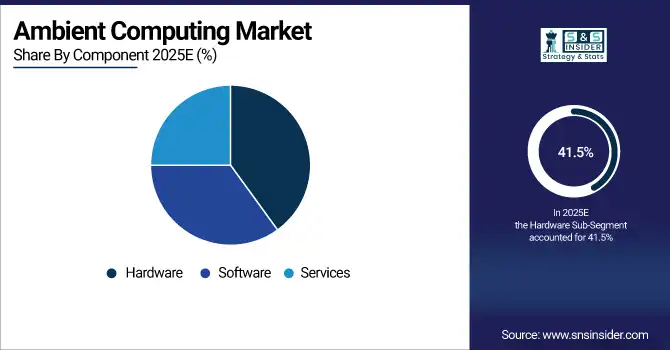
By Component: Hardware led with 41.5% share, while Software is the fastest-growing segment with CAGR of 30.2%.
-
By Technology: Voice Assistants & NLP led with 38.9% share, while Edge Computing is the fastest-growing segment with CAGR of 32.1%.
-
By Application: Smart Homes led with 43.7% share, while Healthcare & Assisted Living is the fastest-growing segment with CAGR of 31.4%.
-
By End-User: Consumers led with 46.2% share, while Healthcare Providers is the fastest-growing segment with CAGR of 30.6%.
By Component: Hardware led, while Software is the fastest-growing segment.
Hardware is leading in the Ambient Computing Market as a result of increasing deployment of smart sensors, IoT-based devices, and edge processors. These components are critical to the realization of connected environments, smart homes, industrial automation and wearable devices. Strong performance and compatibility with software platforms continue to help it gain traction among consumers. Smart city and corporate deployments meanwhile may be driving infrastructure investment, helping to keep up the hardware side off the market on top as well. Recent advances in chip design that allows for more energy efficient chips with sensors also continue to make hardware a powerful force.
The software is the fastest-growing segment which helps in smart processing, context-aware computing, artificial intelligence (AI) integration and device organization. Increasing adoption of software is owing to growing demand for ambient intelligence solutions, cloud based platforms and AI-based automation. Applications such as predictive maintenance, voice-based interfaces and tailored user experiences can be used in the home/user market, healthcare and industrial domains. Ambient computing adoption is skyrocketing because of that integrability with analytics, IoT ecosystems, and workflow-optimization tools which enable business and people alike to derive the most from their ambient computing implementations.
By Technology: Voice Assistants & NLP led, while Edge Computing is the fastest-growing segment.
Voice Assistants & NLP are the big news as we rely more on natural language interfaces for device control, content retrieval, and environment management. Broad deployment is fueled by there developing for smart homes, smartphones or cars. state-of-the-art speech recognition, multilingual support, and AI-driven contextual interpretation makes this the core interface to ambient computing. Its back-end support offered to users, compatibility with IoT ecosystems, and improvements in workplace productivity have further consolidated its lead in the market.
Edge Computing is the fastest growing sector in terms of technology demand, due to low latency processing, data privacy and real-time analytics behind ambient surroundings. That permits data approximately near to that reducing the reliance on cloud infrastructure and maximizing IoT device functionality. There is also a strong momentum driven by smart manufacturing, healthcare monitoring and intelligent transportation systems applications. It also enables AI inference, predictive analytics and autonomous decision making - all of which are instrumental in scalable, high performance ambient computing environments.
By Application: Smart Homes led, while Healthcare & Assisted Living is the fastest-growing segment.
Smart Homes remain the dominant application area, driven by growing consumer awareness over connected appliances, lighting and HVAC systems, and security devices. The ease of centralized control, energy savings and improved comfort is a powerful demand-driver. Support for voice assistant, mobile app and home IOTnetworks is anther development trend that will drive its leading position in the market. Urbanization on the rise, regulatory support to manage energy smartly and powerful features along with irresistible benefits of lifestyle automation will remain amongst the primary sustaining factors for this growth across residential end-use.
The healthcare & assisted living is the largest application of ambient computing market as it includes hospitals, elderly care homes and remote medical monitoring services demand for ambient computing solutions. Patients will benefit from smart sensors and AI-driven monitoring, as well as predictive analytics for care and safety. Adoption is driven by rising tele-health, real-time vitals tracking and assisted living solutions demand. Regulatory backing and increased healthcare spending & pressure to achieve better patient’s outcomes are the other factors propelling this segment.
By End-User: Consumers led, while Healthcare Providers is the fastest-growing segment.
The end-user sector is aptly led by consumers that are quickly accepting smart home devices, wearable technology, and personal assistants. Strengthened penetration is fuelled by growing consciousness, ease, and lifestyle-oriented technology inclusion. Entertainment, home security, energy management and voice-activated automation products create a growing market that maintains the strong demand. It also enjoys uninterrupted innovation, low price tag and consumer eagerness for connected experiences that keep establishing it as a superior segment in the ambient computing ecosystem.
Healthcare Providers is projected to be the fastest-growing end-user for AI in IoT market as they deploy these solutions to remotely monitor patients, social distancing monitoring, patient care management and also running diagnosis services without human intervention. These technologies are used in hospitals and clinics to enhance patient safety, remote monitoring, workflow efficiencies, and predictive analytics. Growing spending on the digital healthcare infrastructure, demand for operational efficiency and penetration of healthcare with smart devices drive market size. This space is growing quickly as ambient computing takes center stage in the next era of care delivery and patient management.
Ambient Computing Market Regional Analysis
North America Ambient Computing Market Insights:
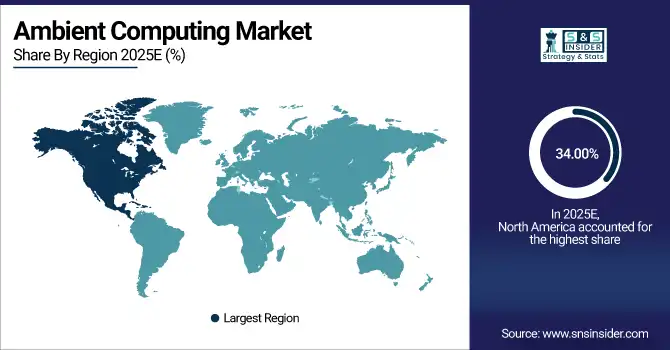
North America dominated the Ambient Computing Market with a 34.00% share in 2025 due to advanced technology infrastructure, high adoption of smart devices, and strong presence of leading tech companies. Rising integration of AI, IoT, and voice-enabled systems across industries further strengthened the region’s leadership in ambient computing solutions.
Get Customized Report as per Your Business Requirement - Enquiry Now
Asia Pacific Ambient Computing Market Insights
Asia Pacific is expected to grow at the fastest CAGR of about 27.18% from 2026–2035, driven by rapid digital transformation, increasing adoption of smart devices, and expanding enterprise investments in AI and IoT technologies. Growing consumer demand for connected environments, government support for smart city initiatives, and rising technological awareness accelerate the region’s market growth.
Europe Ambient Computing Market Insights
Europe was a prominent region in the Ambient Computing Market in 2025 with prevalent smart device adoption, developed AI & IoT infrastructure and major technology vendors. Tremendous enterprise uptake, innovation in voice and gesture interfaces, and early consumer purchase all served to reinforce the region’s dominance of the market.
Middle East & Africa and Latin America Ambient Computing Market Insights
Middle East & Africa and Latin America: The Middle East & Africa and Latin America together contributed growing share in the well-established Region’s Ambient Computing Market in 2025, owing to rising trend of smart devices, increasing digital transformation efforts and burgeoning enterprise focus on investing in AI ad IoT. Increased government focus on smart infrastructure and growing the level of technology awareness also contributed to accelerate regional market growth.
Ambient Computing Market Competitive Landscape:
Amazon.com, Inc.
Amazon. com, Inc. is the global leader in connected hardware for home WiFi, offering products that deliver fast, reliable and secure internet connectivity to every room in the home. The firm has an Alexa ecosystem that fills rooms throughout the home (smart home automation and voice-controlled interaction) that creates contextually intelligent, computer-like experiences in the cloud. The Amazon portfolio uses the cloud, IoT and machine learning to set up smart environments for consumers as well as businesses. Its convenience, power and originality, enable it to become a major role in the world wide ambient computing market, which serves as scalable solutions for connected living and smart infrastructure.
-
2025, Amazon launched the Alexa Ambient Home Platform, a developer framework enabling third-party devices (lights, thermostats, security cams) to collaborate contextually using Alexa’s spatial AI engine.
Google LLC (Alphabet Inc.)
Ambient computing is the space which Google LLC, a part of Alphabet Inc., leads with its intelligent services and cloud middle ware as well smart devices. Google  Delivering contextual, personalized experiences with Google Assistant, Nest smart products and AI-based applications. The product focuses on unifying experience across devices and platforms, real-time decisioning and automation. With the holistic amalgamation of AI, IoT, and ML capabilities into a smart device ecosystem, Google will bolster its foothold in the ambient computing space while providing exceptional solutions for connected environments like smart homes and industries.
-
2025, Google Developed its the Google Ambient AI Platform, embedding Gemini Nano—its on-device multimodal AI model into Android, Wear OS, and Google Nest ecosystems to enable continuous, context-aware assistance.
Microsoft Corporation
Microsoft is a leading global technology company that has its mission to empower every person and every organization on the planet to achieve more, and it does so through AI, Intelligent Cloud with Azure, Intelligent Edge and IoT intelligent products across ambient computing. Context-aware computing is also surfaced in everything from the Azure cloud platform to AI-powered assistants and enterprise applications, both in the device and in ambient spaces. Intelligent automation, the mixed-reality interface and a connected ecosystem are frontiers Microsoft Enterprise is focused on for both consumer and commercial markets
-
2023, Microsoft unveiled Ambient Workspace, a suite of AI-powered, context-aware experiences for Copilot+ PCs and Microsoft 365, designed to reduce cognitive load in hybrid work.
Ambient Computing Companies are:
-
Google LLC (Alphabet Inc.)
-
Microsoft Corporation
-
Apple Inc.
-
Samsung Electronics Co., Ltd.
-
IBM Corporation
-
Qualcomm Incorporated
-
Intel Corporation
-
Huawei Technologies Co., Ltd.
-
Meta Platforms, Inc.
-
Cisco Systems
-
Schneider Electric S.E.
-
Sony Corporation
-
LG Electronics
-
Bosch GmbH
-
Panasonic Corporation
-
Honeywell International Inc.
-
ABB Ltd.
-
Siemens AG
| Report Attributes | Details |
|---|---|
| Market Size in 2025 | USD 44.62 Billion |
| Market Size by 2035 | USD 425.64 Billion |
| CAGR | CAGR of 25.30% From 2026 to 2035 |
| Base Year | 2025 |
| Forecast Period | 2026-2035 |
| Historical Data | 2022-2024 |
| Report Scope & Coverage | Market Size, Segments Analysis, Competitive Landscape, Regional Analysis, DROC & SWOT Analysis, Forecast Outlook |
| Key Segments | • By Component (Hardware, Software, Services) • By Technology (Voice Assistants & Natural Language Processing (NLP), Context-Aware Computing, Edge Computing, Artificial Intelligence & Machine Learning, Internet of Things (IoT)) • By Application (Smart Homes, Healthcare & Assisted Living, Automotive & Transportation, Retail & Customer Experience, Industrial Automation & Smart Factories) • By End-User (Consumers, Healthcare Providers, Automotive & Transportation Companies, Retail & E-commerce Companies, Industrial & Manufacturing Companies) |
| Regional Analysis/Coverage | North America (US, Canada), Europe (Germany, UK, France, Italy, Spain, Russia, Poland, Rest of Europe), Asia Pacific (China, India, Japan, South Korea, Australia, ASEAN Countries, Rest of Asia Pacific), Middle East & Africa (UAE, Saudi Arabia, Qatar, South Africa, Rest of Middle East & Africa), Latin America (Brazil, Argentina, Mexico, Colombia, Rest of Latin America). |
| Company Profiles | Amazon.com Inc., Google LLC (Alphabet Inc.), Microsoft Corporation, Apple Inc., Samsung Electronics Co. Ltd., IBM Corporation, NVIDIA Corporation, Qualcomm Incorporated, Intel Corporation, Huawei Technologies Co. Ltd., Meta Platforms Inc., Cisco Systems, Schneider Electric S.E., Sony Corporation, LG Electronics, Bosch GmbH, Panasonic Corporation, Honeywell International Inc., ABB Ltd., Siemens AG. |
Frequently Asked Questions
North America dominated with a 34.00% share in 2025, driven by advanced technology infrastructure, high smart device penetration, and strong presence of leading AI and IoT solution providers.
The Hardware segment dominated, accounting for 41.5% share, due to widespread adoption of smart sensors, IoT devices, edge processors, and connected infrastructure across homes and enterprises.
Major growth is driven by increasing adoption of IoT devices, AI-powered digital assistants, voice-enabled technologies, and smart environments enabling seamless, automated, and context-aware human-device interaction.
The Ambient Computing Market is valued at USD 44.62 billion in 2025, supported by increasing deployment of smart devices, voice assistants, sensors, and AI-enabled connected environments.
The Ambient Computing Market is expected to grow at a CAGR of 25.30% from 2026 to 2033, driven by rising adoption of AI, IoT, edge computing, and context-aware digital environments.
