
Aseptic Paper Packaging Market Report Scope & Overview:
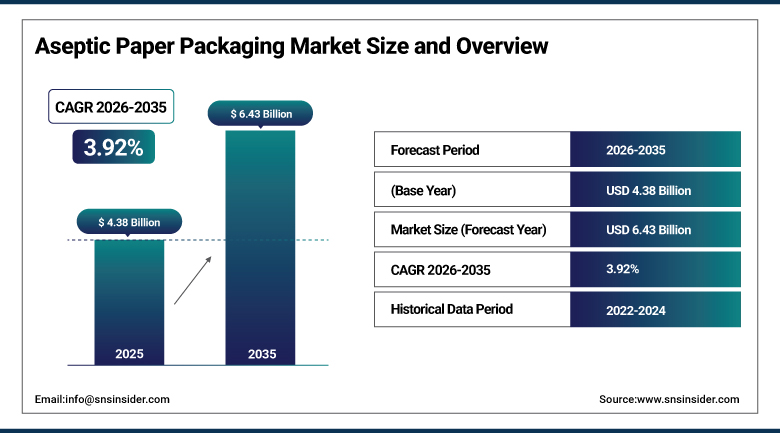
The Aseptic Paper Packaging Market was valued at USD 4.38 Billion in 2025 and is expected to reach USD 6.43 Billion by 2035, growing at a CAGR of 3.92% from 2026-2035.
Aseptic paper packaging keeps dairy, juice, and other liquid food products shelf-stable for months without refrigeration or preservatives by sealing sterilized product into a sterilized paperboard carton under a fully sealed, sterile environment. Brands lean on it wherever cold-chain logistics are expensive or simply unavailable, since a carton that survives ambient shipping and warehouse storage removes an entire layer of supply chain cost. The format's layered construction, paperboard bonded to thin plastic and aluminum films for barrier performance, has proven difficult to beat on cost and shelf presentation even as sustainability pressure pushes brand owners to look harder at the plastic and aluminum layers themselves.
Tetra Pak opened an expanded carton production line at its Denton, Texas facility in 2024, adding regional capacity specifically to reduce lead times for U.S. dairy and juice customers who had previously relied on cartons shipped from the company's other North American plants. The investment reflects how much aseptic carton demand has grown among mid-size U.S. beverage brands that don't have the volume to justify their own filling lines but still want the shelf-stability advantage, a customer segment Tetra Pak and its main rivals have been courting more aggressively as large dairy accounts mature.
To Get more information Aseptic Paper Packaging Market - Request Free Sample Report
Aseptic Paper Packaging Market Trends
-
Lightweighting of paperboard layers continues reducing material use per carton without compromising barrier performance or shelf-life claims.
-
Brands are increasingly specifying recyclable, mono-material-leaning carton constructions to meet retailer and regulatory packaging waste targets.
-
Flat top and brick-style cartons continue gaining share over gable top formats in export-oriented dairy and juice categories.
-
Online grocery and direct-to-consumer beverage brands are driving incremental demand for smaller-format aseptic cartons suited to e-commerce shipping.
-
Regional converters are expanding capacity closer to major dairy and juice processing hubs to shorten carton delivery lead times.
U.S. Aseptic Paper Packaging Market Outlook
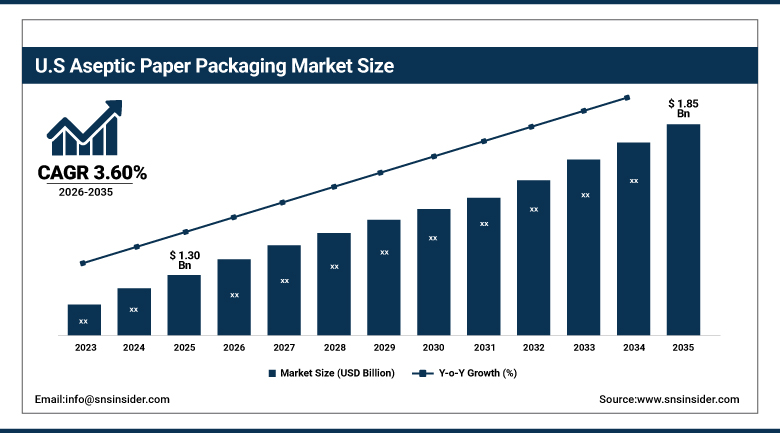
The U.S. Aseptic Paper Packaging Market was valued at approximately USD 1.30 Billion in 2025 and is expected to reach approximately USD 1.85 Billion by 2035, growing at a CAGR of approximately 3.60%.
U.S. demand is anchored by a large dairy and juice processing base that has relied on aseptic cartons for decades to reach rural and underserved retail markets without refrigerated trucking, alongside growing plant-based milk and ready-to-drink beverage brands adopting the format for its shelf-stability advantage. Retailer sustainability scorecards are increasingly pushing national brands toward recyclable carton specifications, even as paperboard's established recyclability profile already gives it an edge over multilayer plastic pouch alternatives in most curbside programs.
Elopak expanded its Pure-Pak aseptic carton portfolio for the U.S. market in 2023, introducing a fully attached cap design intended to improve recyclability by keeping the cap connected through the recycling stream rather than becoming a loose piece that recovery facilities routinely discard. The move came as several major U.S. dairy processors began requesting attached-cap formats specifically to meet updated retailer packaging scorecards, signaling that carton hardware details once left entirely to converter discretion are now a genuine point of customer specification.
Aseptic Paper Packaging Market Segment Analysis
-
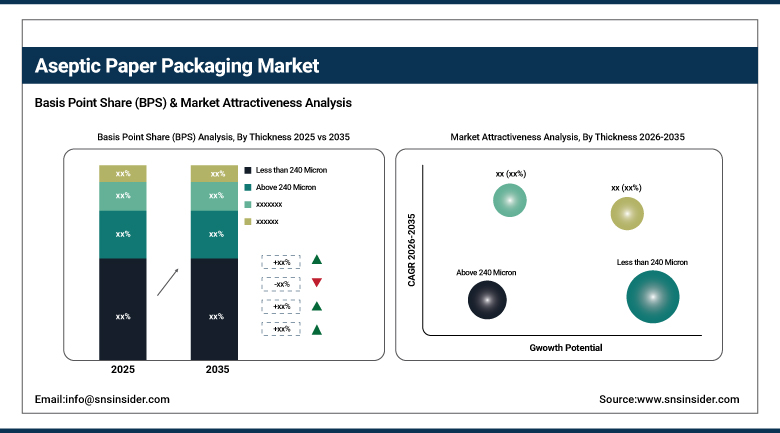
By Thickness, the Less than 240 Micron segment dominated the Aseptic Paper Packaging Market with approximately 62.00% share in 2025, while the Above 240 Micron segment is the fastest growing with a CAGR of approximately 5.80%.
-
By Application, the Beverages segment dominated the Aseptic Paper Packaging Market with approximately 44.50% share in 2025, while the Dairy Products segment is the fastest growing with a CAGR of approximately 5.40%.
-
By Packaging Type, the Flat Top Cartons segment dominated the Aseptic Paper Packaging Market with approximately 38.60% share in 2025, while the Gable Top Cartons segment is the fastest growing with a CAGR of approximately 5.60%.
-
By Distribution Channel, the Supermarkets & Hypermarkets segment dominated the Aseptic Paper Packaging Market with approximately 41.20% share in 2025, while the Online Retail segment is the fastest growing with a CAGR of approximately 6.90%.
By Thickness, less than 240 micron dominates, above 240 micron grows fastest
Cartons thinner than 240 microns dominated the thickness segment in 2025, holding approximately 62.00% share, because this range delivers the lightest material footprint and lowest per-unit cost while still meeting the barrier requirements of small-volume dairy packs and beverage cartons. Nearly two-thirds of manufacturers favor this thickness specifically for its cost efficiency and compatibility with high-speed filling lines, making it the practical default for standard retail-format cartons across most beverage and dairy applications. Its flexibility and reduced material usage also make it ideal for high-speed filling operations, where converters need consistent, predictable board behavior across long production runs without frequent line adjustments.
Cartons above 240 microns are the fastest-growing thickness segment, expanding at a CAGR of approximately 5.80% over the forecast period, as brands packaging denser liquid foods and premium products increasingly specify heavier board for improved rigidity and shelf presentation. Growing demand for larger institutional and food-service carton formats, which require greater structural strength to survive bulk handling, continues pushing this segment's growth ahead of the lighter, high-volume standard. Institutional and food-service buyers purchasing in bulk also favor the extra structural margin heavier board provides against damage during warehouse stacking and multi-leg distribution.
By Application, beverages dominates, dairy products grows fastest
Beverages dominated the application segment in 2025 with approximately 44.50% share, driven by strong demand for shelf-stable juice, ready-to-drink tea, and plant-based drinks that rely on aseptic cartons to reach ambient retail shelves without refrigeration. Roughly 63% of fruit juice brands rely on aseptic packaging for its shelf-stability advantage, and a growing share of carbonated and alcoholic beverage producers are testing aseptic cartons as they introduce healthier, portable product lines. Additionally, roughly 52% of carbonated beverage producers are exploring aseptic cartons to introduce healthier product lines without sacrificing the shelf presence conventional cans and bottles provide.
Dairy products is the fastest-growing application, expanding at a CAGR of approximately 5.40% over the forecast period, as ultra-high-temperature milk and dairy alternatives continue gaining share in markets with limited cold-chain infrastructure. Growing plant-based milk adoption, which frequently launches in aseptic carton format to control cost and reach broader retail distribution, continues reinforcing this segment's above-market growth. Growing consumer preference for extended-shelf-life dairy in regions with inconsistent refrigeration continues to widen the addressable market beyond the traditional UHT milk category into flavored and functional dairy drinks.
By Packaging Type, flat top cartons dominates, gable top cartons grows fastest
Flat top cartons dominated the packaging type segment in 2025, favored for their compact, stackable shape that maximizes pallet and shelf space efficiency relative to peaked formats, an advantage that matters directly to retailers managing tight cooler and dry-goods shelf real estate. Their straightforward, high-speed filling compatibility also keeps per-unit production costs lower than more structurally complex carton designs. Retailers managing dense cooler and dry-goods sections consistently favor suppliers offering flat top formats precisely because of this space efficiency advantage over bulkier peaked alternatives.
Gable top cartons are the fastest-growing packaging type, expanding at a CAGR of approximately 5.60% over the forecast period, as premium dairy and juice brands continue favoring the format's traditional, recognizable silhouette for shelf differentiation. Growing brand interest in resealable pour-spout options built into gable top designs continues supporting this format's above-market growth relative to flat top and brick-style alternatives. Converters are also introducing improved fold geometries that reduce leakage risk at the gable seam, addressing a historical quality concern that had limited adoption among some premium dairy brands.
By Distribution Channel, supermarkets & hypermarkets dominates, online retail grows fastest
Supermarkets and hypermarkets dominated the distribution channel segment in 2025, remaining the primary purchase point for shelf-stable dairy and beverage products given their large ambient and refrigerated shelf footprint and their ability to stock the full range of carton sizes and brands that smaller format stores cannot accommodate. Their year-round foot traffic and established cold-and-ambient shelf planograms make them the natural first listing point for any new aseptic carton product launch. Hypermarkets in particular continue to expand private-label aseptic beverage lines, adding incremental volume that reinforces this channel's leading position.
Online retail is the fastest-growing distribution channel, expanding at a CAGR of approximately 6.90% over the forecast period, as e-commerce grocery delivery continues to grow and aseptic cartons' shelf-stability makes them particularly well-suited to shipping without cold-chain packaging. Direct-to-consumer beverage brands launching exclusively online continue to favor the format specifically because it avoids the added packaging cost of insulated shipping. Subscription-based beverage delivery services are also emerging as a meaningful sub-channel, favoring aseptic formats specifically for their ability to withstand extended transit times without spoilage risk.
Regional Analysis
|
Region |
Major Country |
Share within Region, 2025 (%) |
|---|---|---|
|
North America |
United States |
79.40% |
|
Europe |
Germany |
26.80% |
|
Asia Pacific |
China |
35.90% |
|
Latin America |
Brazil |
37.60% |
|
Middle East & Africa |
Saudi Arabia |
24.10% |
North America Aseptic Paper Packaging Market Insights
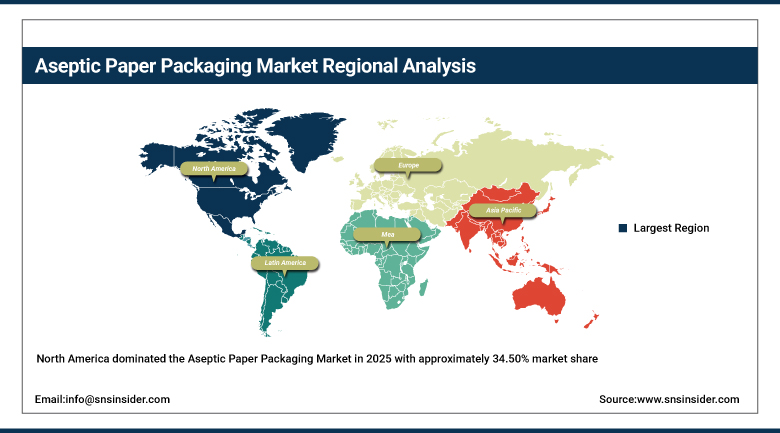
North America dominated the Aseptic Paper Packaging Market in 2025 with approximately 34.50% market share, supported by a large, mature dairy and juice processing base and extensive retail distribution reach into rural markets that rely on shelf-stable cartons to avoid costly refrigerated logistics. Growing plant-based beverage brand adoption of the format continues reinforcing this lead. Retailer sustainability scorecards across major U.S. grocery chains continue pushing national dairy and juice brands toward recyclable carton specifications ahead of most other packaging categories. Growing plant-based beverage brand launches, which frequently debut in aseptic carton format from day one, continue to add incremental volume to an already well-established regional demand base.
The United States accounts for the substantial majority of regional demand, with Canada contributing steady additional volume through its own dairy and juice processing sector, which similarly leans on aseptic cartons to serve geographically dispersed retail markets. Cross-border supply relationships mean major converters typically serve both countries from shared production networks. Mexican beverage manufacturers are also gradually increasing aseptic carton adoption as regional cold-chain limitations continue to make shelf-stable formats commercially attractive outside major metropolitan markets. Canadian dairy cooperatives continue investing in expanded aseptic filling capacity to serve remote northern communities where refrigerated distribution remains costly and logistically difficult.
Get Customized Report as per Your Business Requirement - Enquiry Now
Asia Pacific Aseptic Paper Packaging Market Insights
Asia Pacific is the fastest-growing region in the Aseptic Paper Packaging Market, expanding at a CAGR of approximately 5.20% over the forecast period, with China driving much of the regional growth as domestic dairy consumption rises and local carton converters scale production to reduce reliance on imported cartons. Government dairy industry modernization programs across the region continue funding new aseptic filling line installations well ahead of what private investment alone would support. Rising local converting investment is also gradually narrowing the region's historical dependence on cartons imported from established Western and Japanese suppliers.
India's growing dairy and juice sector continues adding meaningful regional demand, supported by government cold-chain infrastructure gaps that make aseptic packaging's shelf-stability especially valuable outside major cities. Southeast Asian markets are similarly expanding local converting capacity to serve rising regional beverage consumption. Japan and South Korea continue to serve as technology leaders for premium carton design, with innovations frequently filtering into other Asian markets as production costs decline over time. Vietnam and Indonesia are also beginning to scale domestic dairy processing capacity, gradually building regional demand for locally sourced aseptic carton supply.
Europe Aseptic Paper Packaging Market Insights
Europe represents a mature, technologically advanced aseptic carton market, with Germany leading regional demand through its large dairy processing base and strong domestic packaging manufacturing presence. EU packaging waste regulation continues pushing converters toward more recyclable carton constructions. Ongoing consolidation among European carton converters is also improving delivery reliability for smaller regional dairy processors that previously depended on slower, centralized supply arrangements. France and Italy contribute meaningful additional demand, both markets favoring aseptic cartons for their established recyclability credentials within national packaging waste reduction programs.
France and the UK contribute meaningful additional demand, both markets favoring aseptic cartons for their established recyclability profile relative to flexible plastic pouch alternatives. Nordic countries continue to lead on carton recycling infrastructure, often serving as an early proving ground for new recyclable carton designs. Growing retailer emphasis on recyclable packaging labeling across the region continues reinforcing paperboard cartons' competitive position relative to flexible plastic pouch alternatives. Continued Nordic investment in fiber-based packaging innovation keeps the broader European market at the technological forefront of recyclable carton design.
MEA & Latin America Aseptic Paper Packaging Market Insights
The Middle East and Africa represent a smaller but growing aseptic carton market, with Saudi Arabia driving regional demand as domestic dairy processing capacity expands under broader food security investment initiatives. Growth elsewhere in the region remains tied to the pace of cold-chain infrastructure limitations. The UAE is pursuing a similar strategy, positioning itself as a regional hub for modern dairy processing and packaging capability serving neighboring Gulf markets. Egypt's growing dairy processing sector is likewise adding incremental regional demand as urban retail infrastructure continues to expand.
Latin America is a growing market led by Brazil, where a large domestic dairy sector continues to favor aseptic cartons for distribution into markets lacking reliable refrigerated logistics. Mexico contributes meaningful secondary demand as its beverage sector continues expanding shelf-stable product lines. Argentina and Chile round out the region's secondary demand base, both gradually expanding aseptic carton adoption within their domestic dairy and juice processing sectors. Colombia rounds out the region's demand base, gradually expanding aseptic carton adoption within its domestic beverage processing sector.
Market Dynamics
Growth Drivers: Cold-chain avoidance and sustainable packaging demand fueling adoption
The ability to skip refrigerated logistics entirely remains the single strongest driver of aseptic carton demand, since brands selling into markets with unreliable or expensive cold-chain infrastructure can reach far more retail shelves with a shelf-stable product than a refrigerated equivalent ever could. That advantage only grows more valuable as beverage brands expand into secondary cities and rural markets. Brand owners entering new geographic markets increasingly treat this logistics flexibility as a core part of their initial market entry strategy rather than a secondary packaging consideration. This factor is particularly pronounced in emerging markets where refrigerated warehouse and transport infrastructure remains limited relative to overall population and retail footprint growth.
Rising consumer and regulatory pressure for recyclable, paper-based packaging continues favoring aseptic cartons over flexible plastic pouches and multilayer film alternatives, since paperboard's established curbside recyclability profile already gives converters a sustainability story that competing flexible formats generally cannot match without significant reformulation. Retailers are increasingly incorporating recycled content and recyclability criteria directly into supplier scorecards, giving paperboard-based cartons a structural advantage that is difficult for competing flexible formats to replicate quickly. Several major retailers have publicly committed to phasing out non-recyclable multilayer packaging entirely within the next several years, directly reinforcing carton demand.
Restraints: Barrier layer recyclability and raw material cost volatility limiting growth
The thin plastic and aluminum layers bonded to paperboard for barrier performance remain a genuine sustainability sticking point, since these composite layers complicate full recyclability even as the paperboard component itself is broadly accepted in curbside programs, creating an ongoing tension between shelf-life performance and end-of-life material simplicity. Regulators in several European markets have begun tightening labeling requirements around composite packaging recyclability claims, adding compliance complexity that smaller regional converters find harder to manage than larger, better-resourced suppliers. Ongoing material science investment aims to close this gap, but full mono-material recyclability at commercial scale remains a multi-year development horizon for most suppliers.
Volatile pulp and paperboard input costs continue to complicate long-term carton pricing for converters, occasionally compressing margins during periods of sustained board price inflation that cannot be immediately passed through to beverage and dairy customers operating on thin category margins themselves. Smaller regional converters without long-term fiber supply contracts are particularly exposed to this volatility, occasionally facing tighter margins than the larger, vertically integrated global suppliers. Currency fluctuation adds a further layer of cost unpredictability for converters sourcing pulp internationally rather than from domestic fiber supply chains.
Opportunities: Recyclable carton innovation and e-commerce format expansion widening demand
Development of improved recyclable barrier coatings and attached-cap hardware designs presents a genuine opportunity for converters to close the remaining gap between aseptic cartons and fully mono-material recyclable packaging, a technical improvement several major suppliers are actively pursuing to strengthen retailer scorecard positioning. Early commercial pilots of fully recyclable carton constructions have already demonstrated strong retailer interest, suggesting genuine near-term commercial viability rather than a purely experimental technology category. Suppliers that achieve genuine mono-material recyclability ahead of competitors stand to capture premium contracts from sustainability-focused brand owners willing to pay for verified environmental credentials.
Growing e-commerce grocery and direct-to-consumer beverage brand demand presents an opportunity for converters to develop smaller, shipping-optimized carton formats specifically suited to parcel delivery, a category that barely existed in aseptic packaging a decade ago but is expanding quickly alongside broader online grocery adoption. Converters that move early to standardize shipping-optimized formats are positioned to capture a disproportionate share of this emerging demand before it becomes a commoditized, price-competitive category. Partnerships between converters and e-commerce logistics providers could further accelerate standardization of shipping-optimized carton dimensions across the broader direct-to-consumer beverage category.
Recent Developments:
-
2024- Tetra Pak opened an expanded carton production line at its Denton, Texas facility, adding regional capacity to reduce lead times for U.S. dairy and juice customers previously served from other North American plants.
-
2023- Elopak expanded its Pure-Pak aseptic carton portfolio for the U.S. market with a fully attached cap design intended to improve recyclability by keeping the cap connected through the recycling stream.
-
2023- SIG Group announced a new signature pack format for its aseptic carton range, aimed at premium dairy and plant-based beverage brands seeking differentiated shelf presentation.
-
2022- Amcor plc expanded its paper-based aseptic packaging development program, targeting reduced plastic content in barrier layers for liquid food and beverage carton customers.
Aseptic Paper Packaging Market Key Players
-
Tetra Pak International S.A.
-
SIG Group AG
-
Elopak ASA
-
Amcor plc
-
Greatview Aseptic Packaging Co., Ltd.
-
IPI S.p.A.
-
Reliance Industries Limited (Ravanti)
-
ProAmpac LLC
-
Coesia S.p.A.
-
Nampak Ltd.
-
UFlex Limited
-
Adam Pack S.A.
-
Weig Group
-
Bemis Company, Inc.
-
Toppan Inc.
-
Huhtamaki Oyj
-
Fuso Manufacturing Co., Ltd.
-
Shandong Xinjufeng Packaging
-
Jiangsu Xinsu Packaging
-
Weihai Global Weal Packaging
Aseptic Paper Packaging Market Report Scope:
| Report Attributes | Details |
|---|---|
| Market Size in 2025 | USD 4.38 Billion |
| Market Size by 2035 | USD 6.43 Billion |
| CAGR | CAGR of 3.92% From 2026 to 2035 |
| Base Year | 2025 |
| Forecast Period | 2026-2035 |
| Historical Data | 2022-2024 |
| Report Scope & Coverage | Market Size, Segments Analysis, Competitive Landscape, Regional Analysis, DROC & SWOT Analysis, Forecast Outlook |
| Key Segments | • By Thickness (Less than 240 Micron, Above 240 Micron) • By Application (Beverages, Dairy Products, Liquid Food, Others) • By Packaging Type (Flat Top Cartons, Gable Top Cartons, Brick Cartons, Others) • By Distribution Channel (Supermarkets & Hypermarkets, Convenience Stores, Online Retail, Specialist Retailers) |
| Regional Analysis/Coverage | North America (US, Canada), Europe (Germany, UK, France, Italy, Spain, Russia, Poland, Rest of Europe), Asia Pacific (China, India, Japan, South Korea, Australia, ASEAN Countries, Rest of Asia Pacific), Middle East & Africa (UAE, Saudi Arabia, Qatar, South Africa, Rest of Middle East & Africa), Latin America (Brazil, Argentina, Mexico, Colombia, Rest of Latin America). |
| Company Profiles | Tetra Pak International S.A., SIG Group AG, Elopak ASA, Amcor plc, Greatview Aseptic Packaging Co., Ltd., IPI S.p.A., Reliance Industries Limited (Ravanti), ProAmpac LLC, Coesia S.p.A., Nampak Ltd., UFlex Limited, Adam Pack S.A., Weig Group, Bemis Company, Inc., Toppan Inc., Huhtamaki Oyj, Fuso Manufacturing Co., Ltd., Shandong Xinjufeng Packaging, Jiangsu Xinsu Packaging, Weihai Global Weal Packaging |
Frequently Asked Questions
Key players in the Aseptic Paper Packaging Market include Tetra Pak International S.A., SIG Group AG, Elopak ASA, Amcor plc, and Greatview Aseptic Packaging Co., Ltd., among others.
Key opportunities in the Aseptic Paper Packaging Market include development of improved recyclable barrier coatings and attached-cap hardware, and growing e-commerce grocery demand for shipping-optimized carton formats.
The market is driven by the ability of aseptic cartons to skip refrigerated logistics entirely, combined with rising consumer and regulatory pressure for recyclable, paper-based packaging over flexible plastic alternatives.
The Less than 240 Micron segment dominated the Aseptic Paper Packaging Market, accounting for approximately 62.00% market share.
North America dominated the Aseptic Paper Packaging Market in 2025 with approximately 34.50% share, supported by a large dairy and juice processing base and extensive rural retail reach.
