
Sand Battery Market Report Scope & Overview:
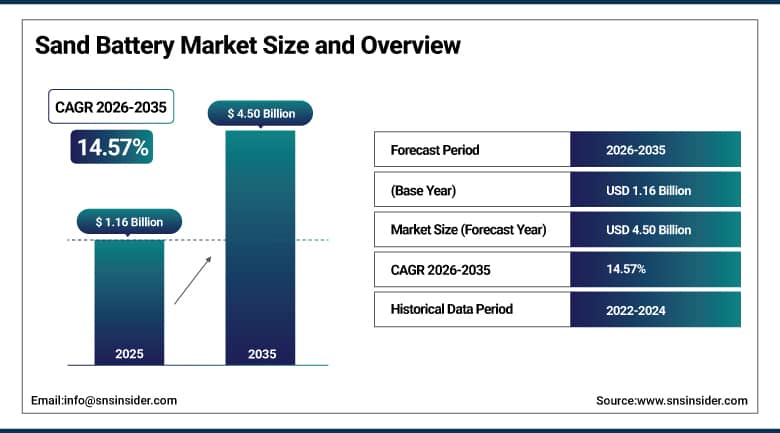
The Sand Battery Market was valued at USD 1.16 Billion in 2025 and is projected to reach USD 4.50 Billion by 2035, expanding at a CAGR of 14.57% during the forecast period 2026–2035.
The sand battery market is really taking off now because utilities and cities and factories are putting a lot of money into storing energy for a long time. This helps us use renewable energy and less fossil fuels for heating. Sand batteries are a way to do this. They take renewable electricity and turn it into very hot thermal energy using sand, which is cheap and easy to find. This makes them a good choice for heating homes and businesses and for storing energy for a time.
A lot of countries in Europe and other places are trying to reduce their carbon footprint and make their energy grids more flexible, which is making sand batteries more popular. New technologies are also helping, like insulation and computer systems that can manage energy. All of this is making sand batteries work better and last longer. As we get renewable energy and try to reduce our use of fossil fuels sand batteries are going to become even more important. Many governments are setting goals to be carbon neutral, which will create a lot of opportunities, for sand battery systems to be used on a scale.
Market Size and Forecast:
-
Market Size 2026E: USD 1.32 Billion
-
Market Size 2035: USD 4.50 Billion
-
CAGR: 14.57% from 2026 to 2035
-
Fastest Growing Region: Asia Pacific
-
Largest Region: North America
To Get More Information On Sand Battery Market - Request Free Sample Report
Sand Battery Market Trends:
-
Increasing deployment of long-duration thermal energy storage systems for renewable energy balancing and seasonal heat storage.
-
Rising investments in district heating modernization utilizing high-temperature sand battery technology.
-
Growing industrial adoption of thermal storage for decarbonizing process heat and reducing natural gas consumption.
-
Expansion of power-to-heat integration projects supporting renewable electricity utilization and grid flexibility.
-
Continuous technological advancements in high-temperature thermal storage materials, intelligent energy management software, and large-scale commercial sand battery installations.
U.S. Sand Battery Market Size Outlook:
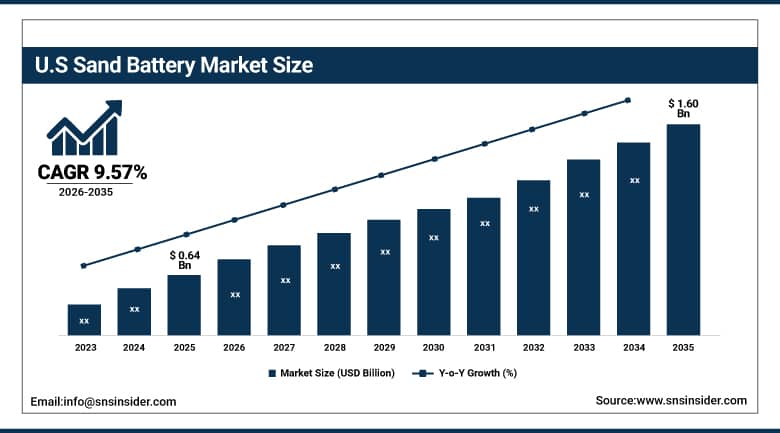
The U.S. Sand Battery Market was valued at USD 0.64 billion in 2025 and is expected to reach approximately USD 1.60 billion by 2035, expanding at a CAGR of 9.57% during 2026–2035.
The United States is getting more into the sand battery market. This is because utilities and energy developers want to store energy for a time. They want to use this energy when the sun is not shining and the wind is not blowing. The government is helping by investing in energy systems and trying to reduce carbon emissions. This is making companies want to use sand batteries to store energy from solar and wind power.
Many industries like chemicals and food processing are looking at sand batteries. They want to use fossil fuel and be more energy efficient. Sand batteries are a choice because they are made from cheap materials and last a long time. This makes them a good option, for energy projects. Companies that make sand batteries are also making them better. They are improving the insulation and the computer systems that control the heat. This makes the sand batteries work efficiently and flexibly. People are starting to use sand batteries with panels and wind turbines.
Sand Battery Market Segment Analysis:
-
By System Type, stationary sensible-heat sand batteries dominated the market with 68.00% share in 2025, while moving-particle thermal storage systems are projected to witness the fastest growth with 21.69% CAGR during the forecast period.
-
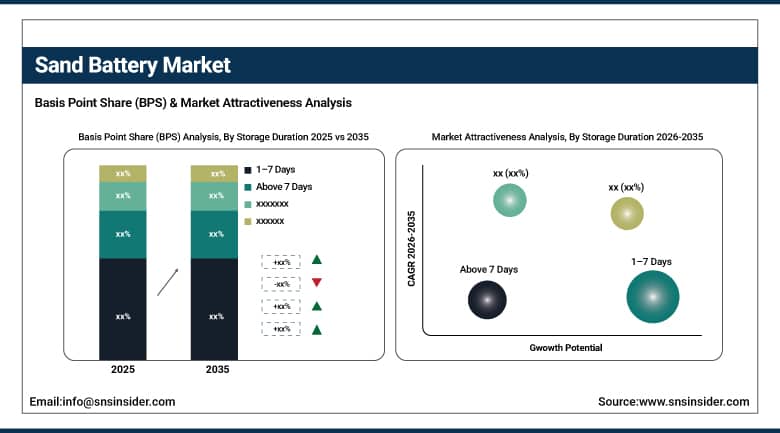
By Storage Duration, 1–7 days dominated the market with 39.00% share in 2025, while above 7 days is projected to witness the fastest growth with 20.16% CAGR during the forecast period.
-
By Application, district heating dominated the market with 44.00% share in 2025, while industrial process heat is projected to witness the fastest growth with 20.66% CAGR during the forecast period.
By Storage duration, 1–7 days dominated, while above 7 days fastest-growing.
The 1–7 days category, it occupied a revenue share of 39.00% in 2025. The medium-duration storage of thermal energy is increasingly becoming the favorable choice for district heating utilities and industries since it can help balance renewable energy supply and storage efficiently and reliably on a daily and weekly basis. The thermal storage duration matches the energy fluctuations of both wind and solar energies, helping utility companies save on fossil fuel-based generation capacity and maximize their renewable electricity generation. Ongoing investments in renewable-based heat generation systems and electrification of industrial heat process remain supportive of the one-to-seven-day thermal storage system globally.
The fastest-growing segment during the forecast period is the above 7 Days category with a CAGR of 20.16%. The seasonal thermal energy storage is increasingly gaining popularity due to the ongoing efforts by government and utility companies towards net-zero heating solutions that store renewable energy for long periods. Long-duration storage not only provides increased energy security in winters but maximizes renewable electricity generation during periods of low energy demands. Advances in insulation, thermal storage, and energy management technologies could make commercialization more feasible, especially for district heating systems and large-scale industries.
By System Type, stationary sensible-heat sand batteries dominated, while moving-particle thermal storage systems fastest-growing.
In 2025, the stationary sensible-heat sand batteries segment would be huge, accounting for 68.00% of the market share. This is because it forms part of the thermal energy storage system of the district heating network and industrial thermal energy storage. The Stationary Sensible-Heat Sand Batteries can store thermal energy for some period and cost little to operate. They store energy using sand and simple concepts. As such, they are excellent for utilities and municipal organizations looking to exploit thermal energy. The Stationary Sensible-Heat Sand Batteries can also convert electrical energy to heat energy. This gives them the capability to be utilized in cycles without undergoing degradation. This is why they are gaining acceptance as energy storage devices.
On the other hand, the moving-particle thermal storage systems segment would grow at an exponential rate. During the period between 2026 and 2035, it would record a compound annual growth rate of 21.69%. The desire for systems that have capacity to withstand temperature extremes and environmental friendly systems are pushing organizations to invest in Moving-Particle Thermal Storage Systems. These systems allow for constant particle flow. This makes them perfect for industries such as cement and steel production.
By Application, district heating dominated, while industrial process heat fastest-growing.
The largest market share is attributed to the district heating segment at 44.00%. This market segment is mainly led by the rising application of centralized heating systems which make use of renewable electricity stored as high-temperature thermal energy. The ability of sand batteries to store energy derived from renewable sources, such as wind and solar energy for long time periods before delivering the stored energy to meet heating needs is highly suitable for the district heating segment. Investments in thermal energy storage systems made in northern European countries to promote energy security and reduce dependency on fossil fuel continue to boost the performance of this market segment.
The industrial process heat segment is anticipated to be the fastest-growing segment with a CAGR of 20.66%. Medium and high-temperature heating processes carried out in energy-intensive industries such as cement, chemical, steel, mining, food processing, and pulp & paper will adopt sand battery systems to meet their heating requirements through the adoption of renewable thermal energy storage systems. The rising cost of carbon as well as regulations limiting the emissions of industries and net-zero commitment of companies will drive manufacturers in industries to shift to sand batteries from fossil fuel fired boilers.
Regional Insights:
|
Region |
Major Country |
Share within Region, 2025 (%) |
|---|---|---|
|
North America |
United States |
88.00% |
|
Europe |
Germany |
13.00% |
|
Asia Pacific |
China |
17.00% |
|
Middle East & Africa |
UAE |
3.00% |
|
Latin America |
Brazil |
4.00% |
North America Sand Battery Market Insights
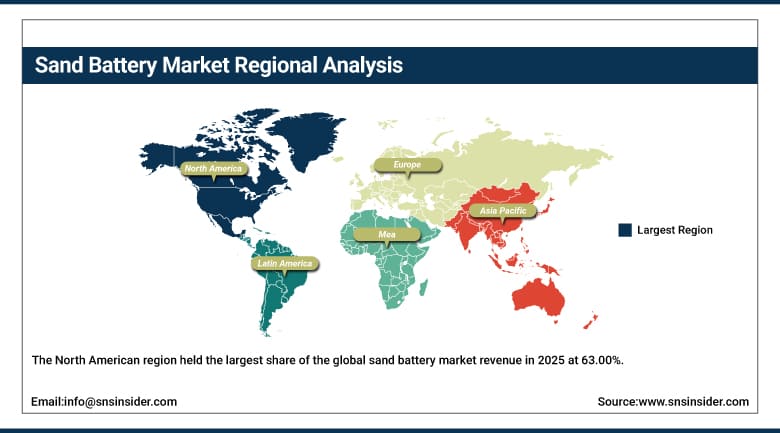
The North American region held the largest share of the global sand battery market revenue in 2025 at 63.00%. This can be attributed to investments in the integration of renewable energy, development of long-duration energy storage systems, industrial electrification. Various utilities in the US and Canada have been looking into the option of thermal energy storage in order to ensure that it provides an affordable method to improve the flexibility of grids with rapidly growing generation of wind and solar energy. Investments in green energy along with government funding for new technologies continues to expedite the commercialization process. Industrial players are also investing in thermal energy storage in order to reduce their natural gas consumption and meet their decarburization goals.
Get Customized Report as Per Your Business Requirement - Enquiry Now
Europe Sand Battery Market Insights
It is predicted that Europe will continue to be one of the most strategically significant markets for sand battery technology owing to its ambitious decarburization strategies, well-developed district heating network, and high priority given to integrating renewable sources into the grid. The countries such as Finland, Germany, Sweden, Denmark, and the Netherlands are spending large amounts of money on long-term thermal energy storage in order to ensure energy security and decrease dependency on foreign oil and gas resources. Climate policies and commitments to achieve carbon neutrality motivate electric companies and industries to implement thermal energy storage systems able to use excess wind and solar power. Continued investments in smart heating systems and energy-efficient infrastructure will make Europe even more attractive.
Asia Pacific Sand Battery Market Insights
Asia Pacific is estimated to witness the highest CAGR of 21.27% during the forecast period. The increasing industrialization along with the rising capacity of renewable energy and electricity consumption is driving the investments in the latest thermal energy storage in China, Japan, South Korea, India, and Australia. The governments of the region are encouraging the development of grids and clean technologies to enhance energy security while minimizing the emission of greenhouse gases. The increasing installations of large-scale solar power plants created a need for long-duration thermal energy storage that can provide balanced production of energy from renewables, the growing industrialization needs for high-temperature process heat is expected to drive the adoption of sand batteries in the region.
Middle East & Africa and Latin America Sand Battery Market Insights
In Middle East and Africa, the sand battery market in Middle East and Africa region is slowly but steadily gaining momentum due to diversification in energy portfolio and increased spending on renewable energy generation. Countries such as UAE and Saudi Arabia are incorporating thermal energy storage in large-scale solar farms in order to ensure reliability of power grid and harness maximum renewable energy available. Increased investments in carbon neutral industrial facilities and sustainable infrastructure will lead to greater opportunities for sand batteries.
There is an ongoing growth in the sand battery market in Latin America due to growth in the renewable energy sector and increased efforts in electrification. Brazil, Chile and Mexico are investing in renewable energy facilities and upgrading existing power infrastructure to make it more reliable. Due to need of cost-effective long-duration energy storage systems, there will be increased acceptance of sand batteries in Latino America in coming years.
Growth Drivers: Growing investments in long-term thermal energy storage for renewables integration
The growing adoption of renewable sources for power generation has been driving up the demand for long-term energy storage systems which help stabilize power supplies from these sources. Sand batteries offer a cost-effective solution as they enable conversion of the excess energy generated from renewable energy sources such as wind and solar power into thermal energy and store it. With their extended life span and maintenance-free nature, along with utilization of easily available materials, sand batteries present an alternative to other battery storage systems for use by utilities and industries. Growing investments on the part of governments in smart grids, district heating systems and industrial decarburization have helped increase the deployment of sand batteries in developed and developing countries alike.
Restraints: Commercial limitations and lack of a standardized infrastructure on a large scale
Although there is a lot of potential for the technology on the long term basis, the market still experiences problems related to the stage of early commercialization of sand battery technology. There are not many large-scale installations, and as a result, there is little experience in operations and conservative decision making from utilities and industrial consumers. Moreover, the developers have to combine the thermal storage with the existing heat networks, renewable sources of energy and industries, which implies that specific engineering solutions are needed that raise the price of implementation and increase project duration. There is also a lack of standardized technical standards for various thermal storage technologies, which makes it difficult to predict the returns on investment.
Opportunities: Decarburization of industry and development of district heating systems
Increasing initiatives worldwide to cut down carbon footprint in industrial operations have resulted in ample opportunities for the sand battery concept. Industries which consume large quantities of energy need heat of moderate or high temperature, which till now relied heavily on fossil fuels, thus presenting a good prospect for decarburization through energy storage. At the same time, district heating systems based on renewable energy and waste heat recovery technologies are being developed by governments to increase efficiency and cut down greenhouse gas emissions. The sand batteries are capable of storing thermal energy for several days, if not weeks, thus ensuring the availability of heat in case of non-availability of renewable sources of energy.
Recent Developments:
-
2026: Polar Night Energy announced the expansion of its commercial high-temperature sand battery technology for large-scale district heating applications, focusing on improving long-duration thermal storage efficiency and supporting renewable energy integration across municipal heating networks. The project strengthens the commercialization of seasonal thermal energy storage in Northern Europe.
-
2025: Kyoto Group ASA continued expanding its Heatcube thermal energy storage portfolio through new industrial partnerships aimed at replacing fossil-fuel-based process heat with renewable thermal storage solutions. The development supports industrial decarburization while improving energy flexibility for manufacturing facilities.
-
2026: Brenmiller Energy Ltd. announced further deployment of its thermal energy storage technology for industrial and utility-scale applications, strengthening renewable energy integration and enabling low-carbon heat supply for energy-intensive industries. The expansion reflects increasing commercial demand for long-duration thermal storage infrastructure worldwide.
-
2025: Rondo Energy expanded commercialization of its high-temperature thermal energy storage systems through new industrial decarburization projects designed to deliver continuous renewable heat for manufacturing operations while reducing dependence on fossil fuels.
Sand Battery Market Key Players:
-
Polar Night Energy
-
Kyoto Group ASA
-
Rondo Energy, Inc.
-
Siemens Energy AG
-
MAN Energy Solutions SE
-
Storworks Power
-
ENERGYNEST AS
-
Malta Inc.
-
E2S Power AG
-
Stiesdal A/S
-
MGA Thermal Pty Ltd.
-
Azelio AB
-
Kraftblock GmbH
-
Fourth Power Inc.
-
Electrified Thermal Solutions, Inc.
-
Synhelion SA
-
ENOWA
-
Hyme Energy ApS
Sand Battery Market Report Scope:
| Report Attributes | Details |
|---|---|
| Market Size in 2025 | USD 1.16 Billion |
| Market Size by 2035 | USD 4.50 Billion |
| CAGR | CAGR of 14.57% From 2026 to 2035 |
| Base Year | 2025 |
| Forecast Period | 2026-2035 |
| Historical Data | 2022-2024 |
| Report Scope & Coverage | Market Size, Segments Analysis, Competitive Landscape, Regional Analysis, DROC & SWOT Analysis, Forecast Outlook |
| Key Segments | • By System Type (Stationary Sensible-Heat Sand Batteries, Moving-Particle Thermal Storage Systems, Power-to-Heat-to-Power Systems, Hybrid Heat-and-Power Systems) • By Storage Duration (Below 12 Hours, 12–24 Hours, 1–7 Days, Above 7 Days) • By Application (District Heating, Industrial Process Heat, Renewable Energy Integration & Grid Balancing, Electricity Generation, Others) |
| Regional Analysis/Coverage | North America (US, Canada), Europe (Germany, UK, France, Italy, Spain, Russia, Poland, Rest of Europe), Asia Pacific (China, India, Japan, South Korea, Australia, ASEAN Countries, Rest of Asia Pacific), Middle East & Africa (UAE, Saudi Arabia, Qatar, South Africa, Rest of Middle East & Africa), Latin America (Brazil, Argentina, Mexico, Colombia, Rest of Latin America). |
| Company Profiles | Polar Night Energy, Kyoto Group ASA, Brenmiller Energy Ltd., Rondo Energy, Inc., Siemens Energy AG, MAN Energy Solutions SE, Storworks Power, ENERGYNEST AS, Malta Inc., E2S Power AG, Stiesdal A/S, Antora Energy, Inc., MGA Thermal Pty Ltd., Azelio AB, Kraftblock GmbH, Fourth Power Inc., Electrified Thermal Solutions, Inc., Synhelion SA, ENOWA, Hyme Energy ApS |

Frequently Asked Questions
North America dominated the global Sand Battery Market in 2025.
Stationary Sensible-Heat Sand Batteries accounted for the largest revenue share of 68.00% in 2025.
The market is projected to reach USD 4.50 Billion by 2035.
The market is anticipated to expand at a CAGR of 14.57% during the forecast period.
The Sand Battery Market was valued at USD 1.16 Billion in 2025.
