
Building and Construction Tapes Market Report Scope & Overview:
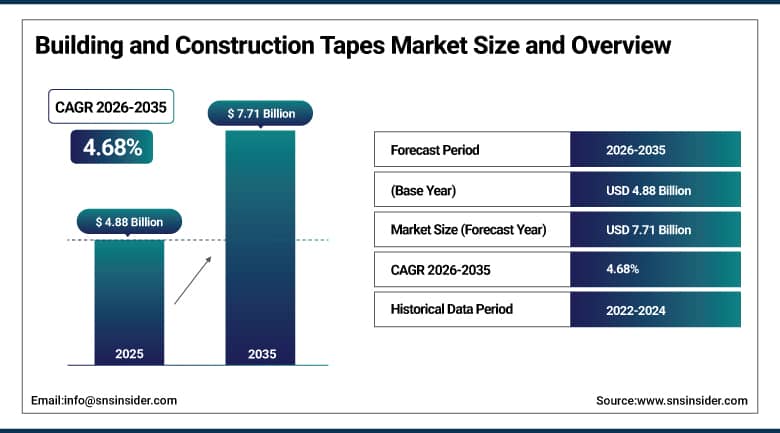
The Building and Construction Tapes Market was valued at USD 4.88 Billion in 2025 and is expected to reach USD 7.71 Billion by 2035, growing at a CAGR of 4.68% from 2026-2035.
Building and construction tapes have gradually developed into one of the most flexible materials in a contractor's toolkit, used to seal gaps, bond trim pieces, wrap ductwork and shield surfaces in a way that avoids the laborious process and messy approach involved in conventional fasteners. This is not only a matter of convenience but it also a response to building codes and energy efficiency standards that increasingly reward the use of a material that creates a better and more durable seal against water and other elements. With construction methods moving towards more efficient building and shorter construction cycles, there is an increased need for tapes capable of performing in extreme conditions.
In March 2025, 3M rolled out Scotch Construction Tape Pro-X, a notable product expansion featuring enhanced UV resistance and adhesion specifically engineered for exterior building applications. It's a launch that reflects where the whole category is heading, exterior-facing tapes need to survive years of direct sun exposure, temperature cycling, and driving rain without losing their grip, and 3M's move to push adhesion and UV performance further shows how competitive this space has become even among tape formulations that might look interchangeable to an outside observer.
To Get More Information On Building and Construction Tapes Market - Request Free Sample Report
Building and Construction Tapes Market Trends
-
Rising adoption of PFAS-free tape formulations that maintain weather and UV resistance without hazardous chemicals.
-
Growing use of building envelope tapes supporting stricter energy compliance and mandatory air leakage testing requirements.
-
Expanding demand for tapes compatible with prefabricated and modular construction assembly methods.
-
Increasing focus on specialty tapes for structural glazing and radon mitigation applications.
-
Rising acquisition and partnership activity as tape manufacturers expand fabric and seam tape portfolios.
-
Growing preference for tapes offering extreme weather resilience amid more frequent severe weather events.
U.S. Building and Construction Tapes Market Outlook
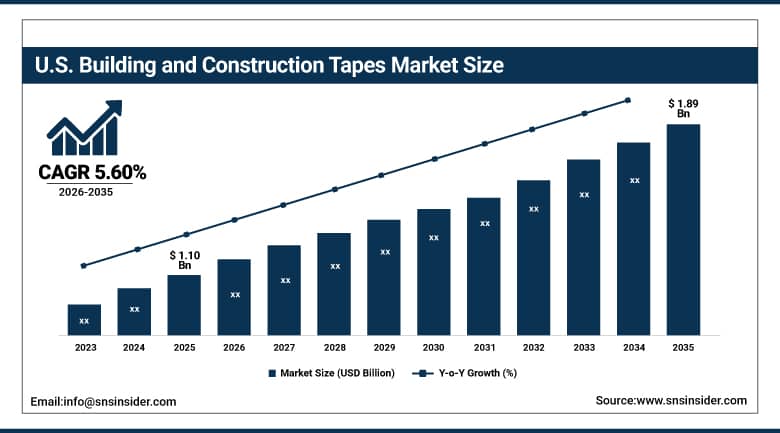
The U.S. Building and Construction Tapes Market was valued at USD 1.10 Billion in 2025 and is expected to reach USD 1.89 Billion by 2035, growing at a CAGR of 5.60% from 2026-2035.
The domestic market is being reshaped in a very concrete way by the 2024 International Energy Conservation Code, which brought mandatory air leakage testing into much broader use and, in doing so, made reliable sealing tapes something close to a recurring necessity rather than an optional upgrade. That regulatory push, combined with a genuinely substantial ageing building stock that keeps needing renovation and resealing, has kept demand for building envelope tapes remarkably steady even as broader construction activity has its usual cyclical ups and downs. Add in a residential renovation boom that shows little sign of slowing and growing demand for prefabricated construction, which relies heavily on tape-based assembly methods, and it's clear why the U.S. remains such an active market for tape innovation.
In April 2025, Avery Dennison Performance Tapes launched its Flashing and Seaming Portfolio, a new lineup of pressure-sensitive adhesive solutions engineered for the wide variety of substrates found across modern building envelopes. The launch comes on the heels of the company's November 2024 acquisition of ProTapes' industrial seam tape business, a deal that expanded its fabric seam tape portfolio and strengthened manufacturing capability across North America and Europe. Taken together, these moves show a company deliberately building out a comprehensive building envelope tape offering rather than relying on a single flagship product, positioning itself to capture demand across the full range of substrates contractors actually encounter on a job site.
Building and Construction Tapes Market Segment Analysis
-
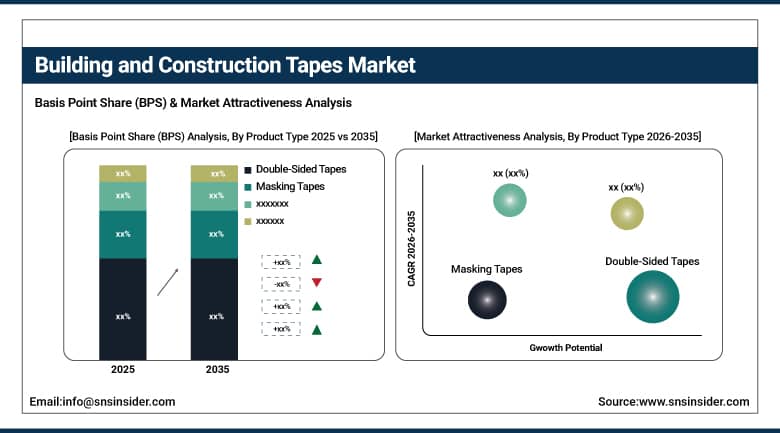
By Product Type, the Double-Sided Tapes segment dominated the Building and Construction Tapes Market with approximately 34.60% share in 2025, and is also the fastest growing with a CAGR of approximately 6.20%.
-
By Backing Material, the Polyethylene segment dominated the Building and Construction Tapes Market with approximately 32.60% share in 2025, while the Polypropylene segment is the fastest growing with a CAGR of approximately 5.60%.
-
By Application, the Walls & Ceilings segment dominated the Building and Construction Tapes Market with approximately 28.60% share in 2025, while the Windows & Doors segment is the fastest growing with a CAGR of approximately 5.80%.
-
By End-Use, the Residential segment dominated the Building and Construction Tapes Market with approximately 44.60% share in 2025, and is also the fastest growing with a CAGR of approximately 5.40%.
By Product Type, Double-Sided Tapes Dominates the Building and Construction Tapes Market and Also Grows Fastest
Double-sided tapes hold a dominating share in this market which can be attributed to their ability to address an issue common to contractors, which is how one gets a secure yet seamless connection between two substrates without any traces of screws, nails, or brackets showing through. Double-sided tapes provide effective adherence from both ends and allow installers to affix their trims, panels, and other accessories in a way that looks purposeful instead of makeshift, making them a real hit in the construction industry, among others.
Double-sided tapes is also the fastest-growing product type, which suggests contractors and manufacturers alike are still finding new applications for it rather than treating it as a mature, settled category. Continued improvements in bonding strength, easier application, and damage-free removal keep expanding where double-sided tape makes sense, and as more building components get engineered around adhesive rather than mechanical assembly, this segment looks set to keep outpacing the broader market.
By Backing Material, Polyethylene Dominates the Building and Construction Tapes Market and Polypropylene Grows Fastest
Polyethylene backing holds the dominating share owing to a combination for everyday construction use. It is affordable, flexible, and holds up well across the range of temperatures and moisture conditions a job site typically throws at it. That practical versatility has made it the default choice for a huge swath of general-purpose construction tape applications where cost matters as much as performance.
Polypropylene is gaining ground faster, largely because it brings a lighter weight and often better moisture resistance to the table, qualities that matter increasingly as tapes get specified for more demanding building envelope and weatherproofing applications. As specifications get more exacting and installers look for materials that perform reliably in wetter or more variable climates, polypropylene's particular strengths are winning it a growing share of new tape formulations.
By Application, Walls & Ceilings Dominates the Building and Construction Tapes Market and Windows & Doors Grows Fastest
Walls and ceilings represent the dominating application because there's so much surface area involved in any building project, and tape plays a role at nearly every stage, from sealing drywall joints to providing a clean, quality covering between plaster borders. Fiberglass drywall tape alone accounts for a substantial volume of usage, and the sheer ubiquity of wall and ceiling work across residential, commercial, and industrial projects alike keeps this application firmly in the lead.
Windows and doors, particularly glazing applications, are growing fastest, and that's largely a function of how central these openings have become to a building's overall energy performance. Getting a genuinely airtight, weatherproof seal around window and door frames is one of the most direct ways to improve a building's insulation performance, and as energy codes keep tightening, tape specified for glazing and window sealing is seeing outsized demand growth relative to more established applications.
By End-Use, Residential Dominates the Building and Construction Tapes Market and Also Grows Fastest
Residential construction accounts for the dominating share of tape demand, reflecting both the sheer volume of homes being built and renovated worldwide and how many individual tape applications a typical house actually involves, sealing, insulation, trim work, and general assembly all draw on tape somewhere along the way. The steady drumbeat of new home construction and remodeling activity keeps this end-use segment firmly in the lead.
Residential construction is also the fastest-growing end-use category, which tracks with the broader renovation boom happening across many developed markets as homeowners upgrade aging housing stock rather than move. As more of that renovation work touches building envelope performance, energy efficiency upgrades, better window sealing, weatherproofing, tape demand tied specifically to residential projects keeps climbing at a pace that's outrunning commercial and industrial construction.
Regional Analysis
|
Region |
Major Country |
Share within Region, 2025 (%) |
|---|---|---|
|
Asia Pacific |
China |
39.60% |
|
Europe |
Germany |
29.60% |
|
North America |
United States |
84.60% |
|
Latin America |
Brazil |
27.60% |
|
Middle East & Africa |
United Arab Emirates |
24.60% |
Asia Pacific Building and Construction Tapes Market Insights
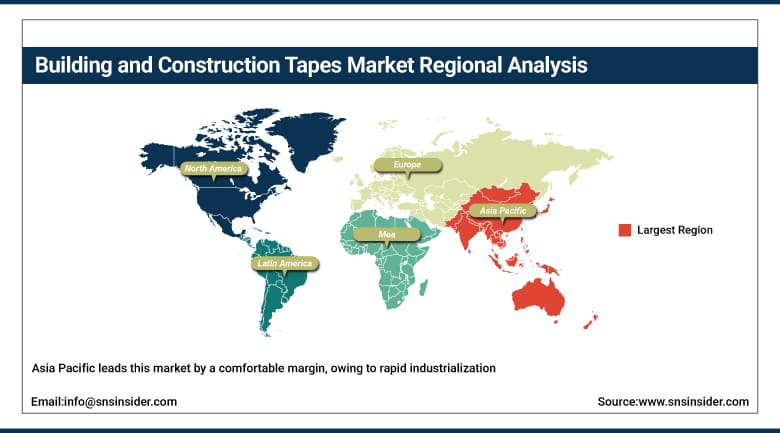
Asia Pacific leads this market by a comfortable margin, owing to rapid industrialization, an enormous pipeline of infrastructure development, and construction activity that shows little sign of slowing across the region's fastest-growing economies. China, India, and Indonesia in particular continue adding new construction volume at a pace that keeps regional tape manufacturers and importers busy.
China's manufacturing base gives the region a genuine cost and scale advantage in tape production itself, while India's construction boom continues pulling in demand from both domestic producers and international suppliers looking to establish local footholds. Japan and South Korea round out the region with more mature, quality-focused construction markets that favor higher-performance specialty tapes, helping keep Asia Pacific firmly in the lead through the forecast period.
Get Customized Report as Per Your Business Requirement - Enquiry Now
North America Building and Construction Tapes Market Insights
North America is the region where the growth is taking place at the fastest pace, and it is largely due to regulatory pressure. The combination of mandatory air leakage testing in the 2024 energy code, along with the need to refurbish the aged stock of buildings in the market, has generated steady, recurring demand for premium building tape.
The United States anchors regional demand by a wide margin, home to several of the industry's biggest players and a construction culture that has increasingly embraced building science practices over older, less airtight assembly methods. Canada is contributing steadily as its own building codes move in a similar direction, and the strong presence of domestic tape manufacturers headquartered in the region continues fueling product innovation that keeps North America at the leading edge of this market's growth.
Europe Building and Construction Tapes Market Insights
Europe carries substantial weight in this market too, anchored by Germany's deep construction and manufacturing base. The region's stringent energy efficiency standards and long-standing emphasis on building performance have made high-quality construction tape something close to a baseline expectation rather than a premium add-on.
The trim and window bonding applications that first established double-sided tape's popularity in the region continue driving steady demand, and European manufacturers remain at the forefront of developing sustainable, PFAS-free tape formulations that meet the continent's increasingly strict environmental regulations without sacrificing weather performance.
MEA & Latin America Building and Construction Tapes Market Insights
The Middle East & Africa market remains comparatively modest, though growing construction activity across the United Arab Emirates and Saudi Arabia is starting to pull in more demand for higher-performance tape products suited to the region's extreme temperature conditions. Most sophisticated tape products in the region still arrive through imports.
Latin America's tape market centers on Brazil, where a sizable domestic construction sector keeps demand fairly steady. Mexico is adding incremental growth as nearshoring continues drawing manufacturing and construction investment northward, though across the broader region adoption still skews toward larger contractors and commercial projects with the budget for premium tape solutions.
Market Dynamics
Growth Drivers: High-Performance Adhesive Demand and Energy-Efficient Building Practices
The primary factor that drives growth in this particular market is nothing but a change in the expectations of the construction industry from the adhesives and tapes. With the changing building processes, tapes that are more durable and resistant to changes in moisture and temperature are gaining prominence and that’s what keeps driving the manufacturers to innovate with every new year.
Growing focus on energy-efficient building practices adds a second major push. As more jurisdictions tighten building codes around air leakage and thermal performance, tape has become one of the most cost-effective ways to achieve the kind of airtight seal these standards demand, and that regulatory tailwind shows no sign of easing as more regions adopt similarly ambitious energy codes.
Restraints: Raw Material Price Volatility and Intense Price Competition
The cost of raw materials continues to pose a challenge for manufacturing firms, especially when it comes to tapes used in construction, which use petroleum-based backing and adhesives that, just like other chemicals, fall victim to commodity price volatility. The volatility may cause margins to be squeezed or even necessitate price increments, complicating the process of contract negotiation.
Price competition is its own challenge, particularly in commodity tape categories where multiple suppliers offer functionally similar products. That competitive pressure can make it hard for manufacturers to fully capture the value of genuine performance improvements, since price-sensitive buyers in cost-conscious segments of the construction industry don't always pay a premium for incremental gains in weather resistance or bonding strength.
Opportunities: PFAS-Free Formulations and Prefabricated Construction Growth
There certainly is a big potential for those companies that have been able to formulate such tapes that are free from PFAS yet can withstand adverse weather and UV conditions. The increasing regulatory pressure on PFAS chemicals in several locations presents an excellent chance to earn specification contracts from contractors and property owners who are fearful of PFAS exposure.
The growing popularity of prefabricated and modular construction offers a further avenue for growth, since these assembly methods often rely on tape-based bonding and sealing techniques even more heavily than traditional on-site construction does. Manufacturers who can develop tapes specifically engineered for the speed and precision prefabrication demands are well positioned to capture a growing share of this increasingly popular construction approach.
Recent Developments:
-
In November 2024, Avery Dennison acquired ProTapes' industrial seam tape business, expanding its global fabric seam tape portfolio and manufacturing capabilities across North America and Europe.
-
In March 2025, Shurtape Technologies announced a strategic partnership with Henkel to co-develop and commercialize a new generation of textile seam tapes combining Shurtape's tape formulations with Henkel's adhesive technologies.
Building and Construction Tapes Market Key Players
-
3M Company
-
Intertape Polymer Group Inc.
-
Dow Inc.
-
Nitto Denko Corporation
-
DuPont de Nemours, Inc.
-
tesa SE
-
Avery Dennison Corporation
-
Berry Global Group, Inc.
-
Shurtape Technologies, LLC
-
Advance Tapes International Ltd.
-
Lohmann GmbH & Co. KG
-
Saint-Gobain Performance Plastics
-
Pro Tapes & Specialties, Inc.
-
ORAFOL Europe GmbH
-
Nichiban Co., Ltd.
-
Henkel AG & Co. KGaA
-
Sika AG
-
H.B. Fuller Company
-
Mativ Holdings, Inc.
-
LINTEC Corporation
Building and Construction Tapes Market Report Scope:
| Report Attributes | Details |
|---|---|
| Market Size in 2025 | USD 4.88 Billion |
| Market Size by 2035 | USD 7.71 Billion |
| CAGR | CAGR of 14.77% From 2026 to 2035 |
| Base Year | 2025 |
| Forecast Period | 2026-2035 |
| Historical Data | 2022-2024 |
| Report Scope & Coverage | Market Size, Segments Analysis, Competitive Landscape, Regional Analysis, DROC & SWOT Analysis, Forecast Outlook |
| Key Segments | • By Product Type (Double-Sided Tapes, Masking Tapes, Duct Tapes, Others) • By Backing Material (Polyethylene, Polypropylene, PVC, PET, Foam, Foil, Paper, Others) • By Application (Walls & Ceilings, Windows & Doors, Flooring, Roofing, Building Envelope, HVAC, Others) • By End-Use (Residential, Commercial, Industrial) |
| Regional Analysis/Coverage | North America (US, Canada), Europe (Germany, UK, France, Italy, Spain, Russia, Poland, Rest of Europe), Asia Pacific (China, India, Japan, South Korea, Australia, ASEAN Countries, Rest of Asia Pacific), Middle East & Africa (UAE, Saudi Arabia, Qatar, South Africa, Rest of Middle East & Africa), Latin America (Brazil, Argentina, Mexico, Colombia, Rest of Latin America). |
| Company Profiles | 3M Company, Intertape Polymer Group Inc., Dow Inc., Nitto Denko Corporation, DuPont de Nemours, Inc., tesa SE, Avery Dennison Corporation, Berry Global Group, Inc., Shurtape Technologies, LLC, Advance Tapes International Ltd., Lohmann GmbH & Co. KG, Saint-Gobain Performance Plastics, Pro Tapes & Specialties, Inc., ORAFOL Europe GmbH, Nichiban Co., Ltd., Henkel AG & Co. KGaA, Sika AG, H.B. Fuller Company, Mativ Holdings, Inc., LINTEC Corporation |
Frequently Asked Questions
Key players include 3M Company, Avery Dennison Corporation, tesa SE, Nitto Denko Corporation, Intertape Polymer Group Inc., Shurtape Technologies, LLC, and Henkel AG & Co. KGaA, among other adhesive tape manufacturers.
Development of PFAS-free tape formulations and the growing popularity of prefabricated and modular construction represent the biggest opportunities for tape manufacturers.
Growth is driven mainly by demand for higher-performance adhesive solutions in construction projects, combined with a growing focus on energy-efficient building practices and air leakage compliance.
By Product Type, Double-Sided Tapes held approximately 34.60% share in 2025, reflecting their popularity for clean, fastener-free bonding across construction and home improvement applications.
Asia Pacific led with approximately 39.60% share in 2025, driven by rapid industrialization and extensive infrastructure development across China, India, and Indonesia.
