
Bus Dispatch Management Systems Market Report Scope & Overview:
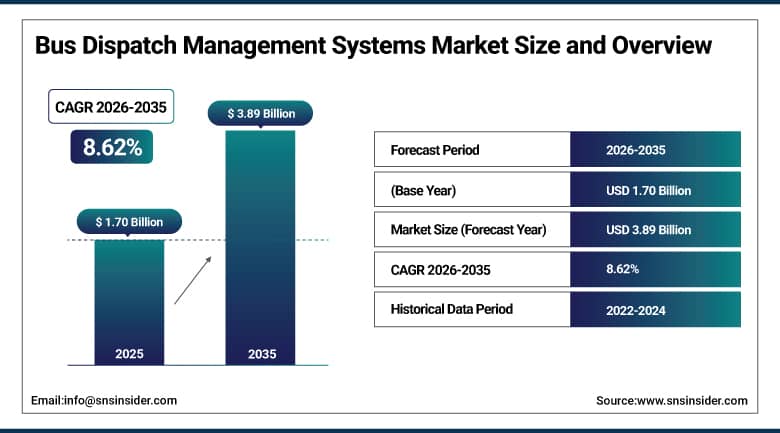
The Bus Dispatch Management Systems Market was valued at USD 1.70 billion in 2025 and is expected to reach USD 3.89 billion by 2035, growing at a CAGR of 8.62% from 2026–2035.
Market expansion in the global bus dispatch management systems is due to the growing use of intelligent transportation systems, smart cities, and digital fleet management systems. The increase in the adoption of fleet management systems to track the fleet in real time and optimize the route, along with investment in connected mobility and electric buses, is expected to compel transit authorities to adopt dispatch management systems. Increasing adoption of technologies like artificial intelligence, Internet of Things, cloud computing, and predictive analytics is another factor that is fuelling market growth.
Zonar launched a reimagined Bus Suite platform integrating dispatch, routing, GPS tracking, ridership management, and parent communication to improve K-12 school transportation operations.
Market Size and Forecast:
-
Market Size 2026E: USD 1.85 billion
-
Market Size 2035: USD 3.89 billion
-
CAGR: 8.62% from 2026 to 2035
-
Fastest Growing Region: Asia-Pacific
-
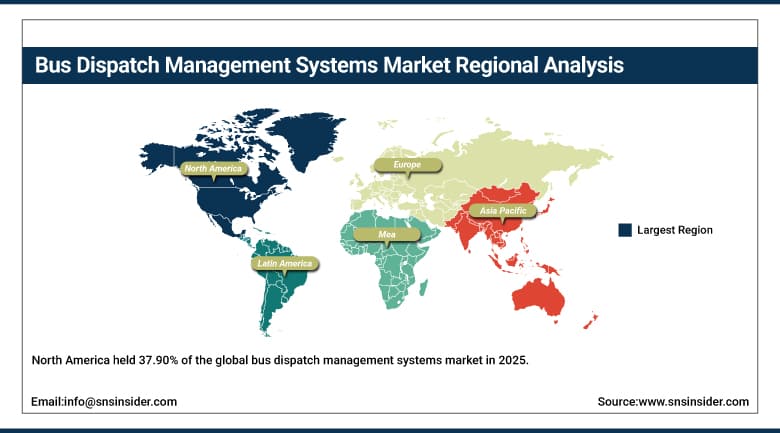
Largest Region: North America
To Get More Information On Bus Dispatch Management Systems Market - Request Free Sample Report
Bus Dispatch Management Systems Market Trends:
-
Increasing adoption of AI-powered route optimization and predictive analytics is enabling transit agencies to improve scheduling accuracy, fleet utilization, and operational efficiency.
-
Rising deployment of cloud-based dispatch management platforms is driving demand for scalable, real-time fleet monitoring and centralized transit operations.
-
Growing integration of IoT, GPS, and telematics technologies is strengthening real-time vehicle tracking, driver management, and passenger information services.
-
Increasing investments in smart city initiatives and intelligent transportation systems (ITS) are accelerating the adoption of digital bus dispatch and fleet management solutions.
-
Expansion of electric bus fleets and connected public transportation networks is fueling demand for advanced dispatch systems capable of managing charging schedules, route planning, and energy-efficient fleet operations.
U.S. Bus Dispatch Management Systems Market Outlook:
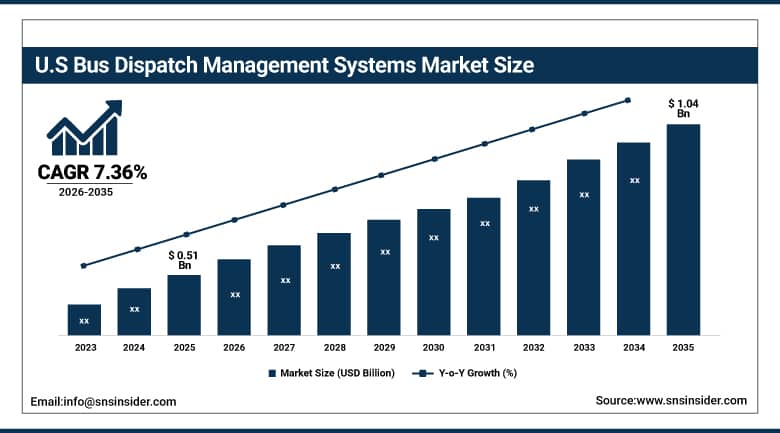
The U.S. Bus Dispatch Management Systems Market was valued at USD 0.51 billion in 2025 and is expected to reach around USD 1.04 billion by 2035, growing at a CAGR of 7.36% from 2026–2035.
The US market for bus dispatch management systems is growing rapidly owing to increased investments in intelligent transportation system solutions, smart cities, and modern public transport systems. Increased demands for real-time fleet management, artificial intelligence-assisted route optimization, and cloud computing platforms have led to increased use of advanced transit management systems. Transit authorities and fleet managers are adopting GPS technology, predictive analytics, passenger information systems, and automatic dispatch management systems in order to increase their operational efficiency and effectiveness. In addition, increasing investments in electric buses, connected vehicles, and intelligent traffic management solutions will further drive growth in the market for bus dispatch management systems in the US during the forecast period.
Brainerd & Crow Wing County Transit, U.S., launched a mobile app enabling passengers to book, plan, and pay for scheduled and on-demand bus services, improving convenience, real-time accessibility, and overall transit efficiency.
Bus Dispatch Management Systems Market Segment Analysis:
-
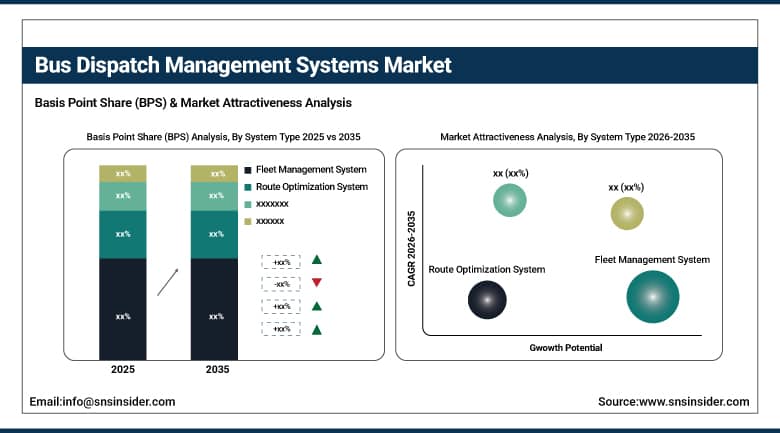
By System type, fleet management system dominated the bus dispatch management systems market with a 38.00% share in 2025; while route optimization system is the fastest-growing segment with a CAGR of 11.27% during 2026 to 2035.
-
By Bus type, conventional buses dominated the bus dispatch management systems market with a 82.00% share in 2025; while electric buses is the fastest-growing segment with a CAGR of 15.94% during 2026 to 2035.
-
By Application, public transport management dominated the bus dispatch management systems market with a 48.00% share in 2025; while school bus dispatch is the fastest-growing segment with a CAGR of 12.62% during 2026 to 2035.
-
By End user, government & municipal transit authorities dominated the bus dispatch management systems market with a 52.00% share in 2025; while corporate & industrial shuttle operators is the fastest-growing segment with a CAGR of 12.69% during 2026 to 2035.
By System Type, Fleet Management System dominated the bus dispatch management systems market, while the Route Optimization System segment is expected to grow fastest.
The fleet management system segment is likely to generate the highest revenue in 2025 as transit agencies and private bus operators increasingly adopt integrated fleet monitoring, vehicle scheduling, maintenance management, and real-time operational control solutions. Growing investments in intelligent transportation systems, GPS-enabled fleet tracking, and digital fleet optimization platforms are further driving the growth of this segment.
The route optimization system segment is estimated to grow at the highest CAGR during the forecast period owing to the increasing adoption of AI-powered route planning, predictive traffic analytics, and dynamic scheduling technologies. Rising demand for fuel-efficient operations, reduced travel time, improved fleet utilization, and real-time rerouting capabilities is accelerating the adoption of route optimization systems. Increasing deployment of smart city initiatives and electric bus fleets is expected to further support the segment's growth through 2035.
By Bus Type, conventional buses dominated the bus dispatch management systems market, while the electric buses segment is expected to grow fastest
The conventional buses segment occupied the highest market share in 2025 due to its widespread deployment across public transportation networks, school transportation, private fleet operations, and tour & charter services. Transit operators continue to rely on conventional buses because of their large installed fleet base, established infrastructure, and cost-effective operations, driving strong demand for dispatch management, route optimization, and fleet coordination solutions. The growing focus on improving operational efficiency, passenger service, and fleet utilization is further supporting the dominance of this segment.
The electric buses segment is expected to grow at the fastest pace over the forecast period due to increasing investments in sustainable public transportation, government incentives for zero-emission vehicles, and the rapid expansion of electric bus fleets worldwide. Rising adoption of intelligent fleet management systems, real-time dispatch platforms, AI-powered route optimization, and charging schedule management is further accelerating the demand for bus dispatch management systems for electric buses through 2035.
By Application, public transport management dominated the bus dispatch management systems market, while the private fleet management segment is expected to grow fastest
The public transport management segment accounted for the maximum market share in 2025 due to its extensive adoption by public transit authorities and municipal transportation agencies to manage large bus fleets, optimize routes, and improve service reliability. The growing demand for real-time fleet monitoring, efficient dispatching, and passenger information systems, along with increasing investments in smart transportation infrastructure, is supporting the dominance of this segment.
The private fleet management segment is expected to experience the fastest growth over the forecast period due to the rising adoption of bus dispatch management systems by corporate transportation providers, logistics companies, employee shuttle operators, and private mobility services. Increasing demand for AI-powered route optimization, GPS-enabled fleet tracking, fuel efficiency, and predictive maintenance solutions is expected to accelerate the growth of this segment through 2035.
Regional Analysis:
|
Region |
Major Country |
Share within Region, 2025(%) |
|---|---|---|
|
North America |
United States |
79.20% |
|
Europe |
Germany |
20.80% |
|
Asia Pacific |
China |
36.40% |
|
Middle East & Africa |
Saudi Arabia |
41.20% |
|
Latin America |
Brazil |
27.60% |
North America Bus Dispatch Management Systems Market Insights.
North America held 37.90% of the global bus dispatch management systems market in 2025, driven by the widespread adoption of intelligent transportation systems, advanced fleet management technologies, and increasing investments in smart public transit infrastructure. The United States accounted for approximately 79.20% of the North American bus dispatch management systems market in 2025, supported by its extensive public transportation networks, large school bus fleets, and growing deployment of AI-enabled dispatch, GPS tracking, and real-time fleet monitoring solutions.
Increasing investments in smart city initiatives, rising demand for efficient fleet operations, and the growing adoption of cloud-based dispatch platforms are accelerating market growth across the region. Furthermore, the integration of route optimization, predictive maintenance, passenger information systems, and connected vehicle technologies is expected to further strengthen the U.S. bus dispatch management systems market throughout the forecast period.
Get Customized Report as Per Your Business Requirement - Enquiry Now
Europe Bus Dispatch Management Systems Market Insights
Europe remains one of the leading regions in the bus dispatch management systems market, supported by increasing investments in intelligent transportation infrastructure, smart mobility initiatives, and the modernization of public transit networks. Germany is the major contributor within the region, driven by the strong adoption of advanced fleet management systems, AI-powered dispatch solutions, GPS-based vehicle tracking, and route optimization technologies across public and private transportation operators.
Market growth is being driven by increasing investments in sustainable public transportation, the expansion of electric bus fleets, and the growing demand for real-time fleet monitoring and operational efficiency. Rising adoption of connected transportation technologies, cloud-based dispatch platforms, and intelligent traffic management systems is further strengthening Europe's position in the global bus dispatch management systems market.
Asia Pacific Bus Dispatch Management Systems Market Insights
Asia Pacific is expected to grow at the fastest CAGR of 10.24% between 2025 and 2035, driven by rapid urbanization, expanding public transportation networks, and increasing investments in smart mobility and intelligent transportation systems. The region is witnessing significant adoption of AI-enabled dispatch platforms, GPS-based fleet tracking, and cloud-based fleet management solutions to improve operational efficiency and passenger services. China is the major contributor in the region, accounting for approximately 36.40% of the Asia Pacific bus dispatch management systems market in 2025, supported by large-scale investments in smart city projects, electric bus deployment, and digital transportation infrastructure.
Increasing government initiatives to modernize public transit systems, rising adoption of connected vehicle technologies, and growing demand for real-time fleet monitoring and route optimization are creating significant growth opportunities across the region. Continued investments in intelligent transportation infrastructure and sustainable mobility solutions are expected to further accelerate the growth of the bus dispatch management systems market in Asia Pacific.
Middle East & Africa and Latin America Insights
The Middle East & Africa bus dispatch management systems market is witnessing steady growth due to increasing investments in smart transportation infrastructure, public transit modernization, and digital mobility initiatives. Saudi Arabia plays a significant role in the market, accounting for an estimated 27.60% share of the Middle East & Africa market in 2025, supported by government investments in smart city projects, intelligent transportation systems, and the expansion of public bus networks under national development initiatives.
The Latin America bus dispatch management systems market is experiencing stable growth owing to increasing urbanization, expansion of public transportation services, and rising adoption of fleet management and real-time dispatch technologies. Brazil is the largest contributor in the region, accounting for approximately 41.20% of the Latin American market in 2025. The country's growth is driven by investments in smart mobility, modernization of urban bus fleets, increasing deployment of GPS-enabled fleet management systems, and growing demand for efficient public transportation operations.
Market Dynamics:
Growth Driver: Rising adoption of intelligent transportation systems, real-time fleet management, and AI-powered route optimization solutions
The rapid adoption of intelligent transportation systems, cloud-based fleet management platforms, and connected vehicle technologies has significantly increased the demand for bus dispatch management systems. Public transit agencies and private fleet operators are increasingly deploying real-time dispatch, GPS tracking, AI-powered route optimization, and predictive analytics solutions to improve fleet utilization, reduce operational costs, and enhance passenger services. As transportation networks continue to modernize, the need for efficient dispatching and centralized fleet management is accelerating market growth.
Increasing urbanization, government investments in smart city initiatives, and the expansion of electric and connected bus fleets are further driving demand for advanced dispatch management solutions. In addition, the growing focus on reducing traffic congestion, improving on-time performance, optimizing fuel consumption, and enhancing passenger safety is encouraging transportation operators to adopt intelligent dispatch platforms integrated with real-time monitoring, predictive maintenance, and automated scheduling capabilities.
Restraints: High implementation costs and integration complexity
The high cost of deploying bus dispatch management systems remains a major challenge, particularly for small and medium-sized fleet operators with limited IT budgets. Implementing advanced solutions such as real-time fleet tracking, AI-powered route optimization, GPS integration, predictive maintenance, and cloud-based dispatch platforms often requires significant investments in software, hardware, network infrastructure, and employee training. These costs can slow adoption, especially in developing regions.
In addition, integrating bus dispatch management systems with existing fleet management software, ticketing systems, telematics platforms, and legacy transportation infrastructure can be complex and time-consuming. Compatibility issues, data migration challenges, and the need for continuous system maintenance and updates further increase operational complexity, limiting market growth among organizations with constrained technical resources.
Opportunities: Increasing adoption of AI-powered fleet management and smart transportation solutions
The rapid adoption of artificial intelligence, cloud computing, Internet of Things (IoT), and connected vehicle technologies is creating significant growth opportunities for the bus dispatch management systems market. As public transit agencies and private fleet operators seek to improve operational efficiency, reduce costs, and enhance passenger experiences, demand for intelligent dispatch platforms capable of real-time fleet monitoring, automated scheduling, predictive maintenance, and AI-powered route optimization is increasing.
Growing investments in smart city projects, intelligent transportation systems, and electric bus infrastructure are enabling transportation providers to deploy advanced dispatch solutions with cloud-based fleet management, GPS tracking, and data-driven decision-making capabilities. In addition, increasing government support for sustainable mobility, expansion of connected transportation networks, and rising demand for real-time passenger information systems are creating new opportunities for vendors to deliver scalable, AI-enabled bus dispatch management solutions across public and private transportation sectors.
Recent Developments:
-
2025: Optibus Ltd. expanded its AI-powered scheduling and dispatch platform with enhanced real-time fleet optimization and electric bus planning capabilities, helping transit agencies improve operational efficiency.
-
2025: Trapeze Group introduced advanced cloud-based dispatch and fleet management enhancements, enabling public transit operators to improve real-time vehicle tracking, service reliability, and route optimization.
-
2024: Samsara Inc. enhanced its AI-powered Connected Operations Platform with new fleet intelligence and predictive maintenance capabilities, enabling bus operators to improve fleet utilization, driver safety, and operational efficiency.
-
2024: INIT GmbH expanded its intelligent transportation solutions by introducing advanced dispatch management and passenger information capabilities to support smart public transit operations and connected mobility initiatives.
Bus Dispatch Management Systems Market key players are:
-
Trapeze Group
-
GIRO Inc.
-
Optibus Ltd.
-
INIT GmbH
-
Clever Devices Ltd.
-
Ecolane USA, Inc.
-
Verizon Connect
-
Samsara Inc.
-
Swiftly, Inc.
-
Luminator Technology Group
-
Avail Technologies, Inc.
-
DoubleMap (Via Transportation, Inc.)
-
Syncromatics Corporation
-
Trakm8 Holdings PLC
-
GPS Insight
-
RouteMatch Software, Inc. (Uber Technologies, Inc.)
-
Teletrac Navman
-
Fleet Complete
-
Moovit (Intel Corporation)
-
IVU Traffic Technologies AG.
Bus Dispatch Management Systems Market Report Scope:
| Report Attributes | Details |
|---|---|
| Market Size in 2025 | USD 1.70 Billion |
| Market Size by 2035 | USD 3.89 Billion |
| CAGR | CAGR of 8.62% From 2026 to 2035 |
| Base Year | 2025 |
| Forecast Period | 2026-2035 |
| Historical Data | 2022-2024 |
| Report Scope & Coverage | Market Size, Segments Analysis, Competitive Landscape, Regional Analysis, DROC & SWOT Analysis, Forecast Outlook |
| Key Segments | • By System Type (Real-Time Dispatch System, Fleet Management System, Route Optimization System, Passenger Information System) • By Bus Type (Conventional Buses, Electric Buses) • By Application (Public Transport Management, School Bus Dispatch, Tour & Charter Bus Management, Private Fleet Management, Others) • By End User (Government & Municipal Transit Authorities, Private Bus Operators, Educational Institutions, Corporate & Industrial Shuttle Operators, Others) |
| Regional Analysis/Coverage | North America (US, Canada, Mexico), Europe (Eastern Europe [Poland, Romania, Hungary, Turkey, Rest of Eastern Europe] Western Europe] Germany, France, UK, Italy, Spain, Netherlands, Switzerland, Austria, Rest of Western Europe]), Asia Pacific (China, India, Japan, South Korea, Vietnam, Singapore, Australia, Rest of Asia Pacific), Middle East & Africa (Middle East [UAE, Egypt, Saudi Arabia, Qatar, Rest of Middle East], Africa [Nigeria, South Africa, Rest of Africa], Latin America (Brazil, Argentina, Colombia, Rest of Latin America) |
| Company Profiles | Trapeze Group; GIRO Inc.; Optibus Ltd.; INIT GmbH; Clever Devices Ltd.; Ecolane USA, Inc.; Verizon Connect; Samsara Inc.; Swiftly, Inc.; Luminator Technology Group; Avail Technologies, Inc.; DoubleMap (Via Transportation, Inc.); Syncromatics Corporation; Trakm8 Holdings PLC; GPS Insight; RouteMatch Software, Inc. (Uber Technologies, Inc.); Teletrac Navman; Fleet Complete; Moovit (Intel Corporation); IVU Traffic Technologies AG. |

Frequently Asked Questions
The fleet management system segment dominated the market in 2025 with a 38.00% share.
Growth is driven by the increasing adoption of intelligent transportation systems, real-time fleet management, AI-powered route optimization, and growing investments in smart mobility and public transportation infrastructure.
The bus dispatch management systems market was valued at USD 1.70 billion in 2025.
The bus dispatch management systems market is expected to grow at a CAGR of 8.62% from 2026 to 2035.
North America dominated the bus dispatch management systems market in 2025 with a 37.90% share.
