
Chemical Resistant Coating Market Report Scope & Overview:
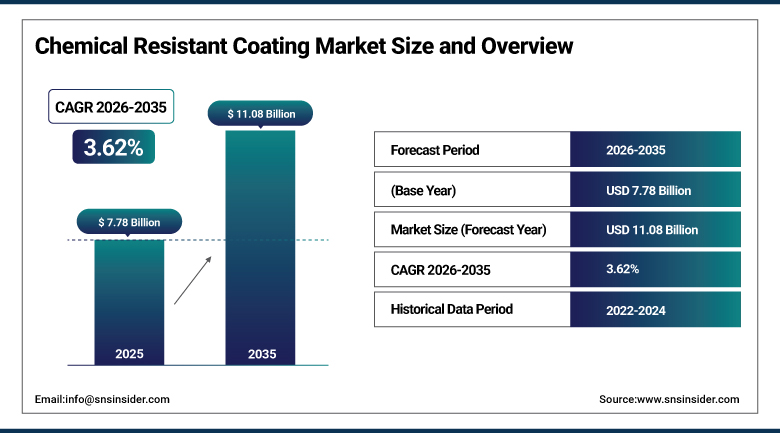
The Chemical Resistant Coating Market was valued at USD 7.78 Billion in 2025 and is expected to reach USD 11.08 Billion by 2035, growing at a CAGR of 3.62% from 2026–2035.
The chemical resistant coating Market is witnessing steady growth in the global market owing to rising demand from chemical processing industries. Increasing industrial corrosion issues are boosting adoption. Expanding oil & gas infrastructure is supporting market growth. Growing marine and offshore applications are strengthening demand. Manufacturers are focusing on high-performance protective formulations. Rising need for long-lasting anti-corrosion systems is driving innovation. Increasing construction and industrial expansion is further accelerating market adoption.
According to the U.S. Environmental Protection Agency Toxic Substances Control Act inventory and 2025 chemical safety reporting updates, more than 86% of industrial chemical substances in commerce have undergone baseline hazard screening, with coatings classified under corrosion and chemical resistance applications subject to strict VOC compliance thresholds. As per the European Chemicals Agency REACH, over 25,000 substances are registered with usage restrictions or safety evaluations affecting protective coatings used in industrial and marine environments.
To Get more information Chemical Resistant Coating Market - Request Free Sample Report
Chemical Resistant Coating Market Trends:
-
Growing Trend of Expanding Industrial Activities in Chemical and Energy Industry Creating Huge Demand for Corrosion Resistant Coating Systems Throughout the World.
-
Faster Growth in Oil & Gas Sector Infrastructure Development Creating Need for High Performance Protective Coating Applications in Difficult Conditions.
-
Increasing Construction of Chemical Processing Plants Leading to Increased Demand for Latest Epoxy Based and Fluoropolymer Based Coating Systems.
-
Urbanization And Industrialization in Emerging Countries Promoting Usage of Long Lasting Durable Protective Coating Applications in Various Sectors.
-
Latest Technological Developments in Coating Materials Improving Durable and Chemical Resistance Property of Industrial Protective Coatings.
-
Increasing Emphasis on Protection and Maintenance Reduction Promoting Application of High-Performance Coating Systems.
U.S. Chemical Resistant Coating Market Outlook:
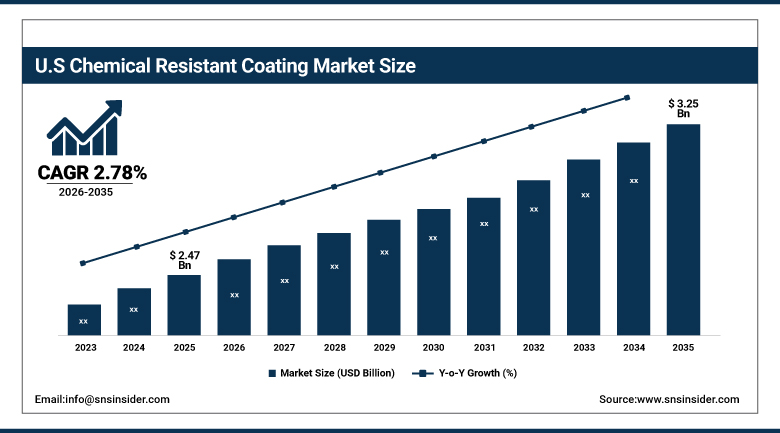
The U.S. Chemical Resistant Coating Market was valued at USD 2.47 Billion in 2025 and is expected to reach around USD 3.25 Billion by 2035, growing at a CAGR of 2.78% from 2026–2035.
The U.S. chemical resistant coating Market is expanding steadily owing to strong demand from chemical and industrial sectors. Increasing corrosion issues in harsh environments are supporting market growth. Rising investments in oil & gas infrastructure are driving adoption. Growth in marine and offshore applications is further accelerating demand. Manufacturers are focusing on advanced epoxy and fluoropolymer systems. Increasing need for durable protective coatings is strengthening market penetration.
According to the U.S. Environmental Protection Agency Toxics Release Inventory Program 2025 data framework, over 21,000 industrial facilities report chemical usage and emissions annually, with coatings and surface protection applications forming a significant share of regulated chemical processes.
As per the Occupational Safety and Health Administration standards, more than 20% of the U.S. manufacturing workers are exposed to hazardous chemicals requiring protective surface systems. The U.S. Department of Transportation Federal Highway Administration reports that over 600,000 bridges nationwide require corrosion protection maintenance, supporting widespread adoption of chemical resistant coatings in infrastructure, marine, and industrial applications.
Chemical Resistant Coating Market Segment Analysis:
-
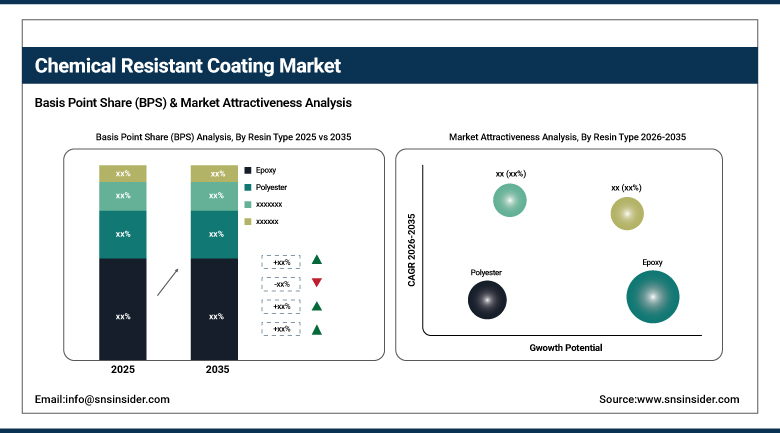
By Resin Type, epoxy dominated the market with 39.80% share in 2025; while fluoropolymers are the fastest growing segment with CAGR of 5.87% during 2026 to 2035.
-
By Technology, solvent-based dominated the market with 48.60% share in 2025; while water-based is the fastest growing segment with CAGR of 6.21% during 2026 to 2035.
-
By Film Thickness, heavy duty coatings dominated the market with 41.60% share in 2025; while ultra-heavy duty systems are the fastest growing segment with CAGR of 6.84% during 2026 to 2035.
-
By End-User, chemical dominated the market with 34.80% share in 2025; while oil & gas is the fastest growing segment with CAGR of 5.30% during 2026 to 2035.
By Resin Type, epoxy dominated the chemical resistant coating market, while fluoropolymers are the fastest growing segment.
The epoxy segment led the chemical resistant coating market by revenue share in 2025 owing to its good adhesion characteristics and chemical resistant performance. They provide effective protection from corrosion in tough industrial conditions. The epoxy coating is popular in chemical processing and oil and gas sectors. They are economically efficient and durable. The easy applicability and mechanical strength are other factors aiding their popularity among different industries.
The fluoropolymers segment is expected to register the fastest CAGR between 2026 and 2035. The growth will be due to their good resistance to highly aggressive chemicals and high temperatures. These coatings provide effective protection for the surfaces in harsh corrosive conditions. The growing demand from high-end performance sectors will help the adoption. They provide non-stick and low-maintenance property to the surfaces. The increasing use in the marine and advanced chemical applications will drive the growth of the market.
By Technology, solvent-based dominated the chemical resistant coating market, while water-based is the fastest growing segment.
Solvent-Based is dominating the global market for Chemical Resistant Coatings in terms of revenue share in 2025 due to high chemical resistance, durability, and excellent performance in severe conditions. It finds application in chemical processing, oil and gas processing, and marine industry. Its established compatibility with existing infrastructure and cost-effectiveness is other factors contributing to its adoption. They deliver excellent adhesion properties and protective performance in industrial conditions.
Water-Based segment is anticipated to exhibit fastest CAGR during 2026-2035 due to strict environmental regulations and sustainability trends. Increasing preference for low VOC and green coating solutions is encouraging their adoption. Advanced formulation technology is offering better performance and resistance against corrosion. There is a move towards setting up safer working conditions in industries. Their rising application in the construction, automotive, and industrial maintenance sector is boosting their demand globally.
By Film Thickness, heavy duty coatings dominated the chemical resistant coating market, while ultra-heavy duty systems are the fastest growing segment.
Heavy Duty Coatings held the dominated share of revenue in the chemical resistant coating market in 2025. This is because of high demand for coatings in chemical plants, oil & gas facilities, and maritime infrastructures. Heavy duty coatings have high acid, alkali, and corrosion resistance. Longevity and durability of these products help reduce maintenance costs. Industrial growth and safety standards further boost their demand in heavy duty applications.
Ultra-Heavy Duty Systems is predicted to hold the fastest growing CAGR during 2026-2035 owing to increasing demand for the same in extreme corrosion environments. Multi-layered protection and higher chemical resistance in these systems make them ideal for use in offshore, petrochemical, and wastewater facilities. Technological developments in high build formulations have further boosted growth prospects of the market globally.
By End-User, chemical dominated the chemical resistant coating market, while oil & gas is the fastest growing segment.
The Chemical segment held a major share of the chemical resistant coating market on account of its extensive use in harsh processing environments. The chemical industries require protection from corrosive elements such as acids, alkalis, and solvents at all times. Growing number of chemical manufacturing plants is increasing the requirement of advanced protective coatings. Safety and maintenance practices are driving the need for advanced coatings in these processes.
The Oil & Gas segment will grow at the fastest CAGR between 2026 and 2035. The growth is attributed to increasing offshore exploration activities under harsh conditions. Corrosion resistance needs in oil & gas applications such as pipelines, refineries, and drilling equipment are growing. Harsh environments characterized by extreme temperatures and corrosive chemical substances require durable coating systems. Increasing energy infrastructure worldwide is further aiding adoption.
Regional Analysis:
|
Region |
Major Country |
Share within Region, 2025(%) |
|---|---|---|
|
North America |
United States |
86.40% |
|
Europe |
Germany |
28.10% |
|
Asia Pacific |
China |
43.50% |
|
Middle East & Africa |
UAE |
19.20% |
|
Latin America |
Brazil |
46.30% |
North America Chemical Resistant Coating Market Insights.
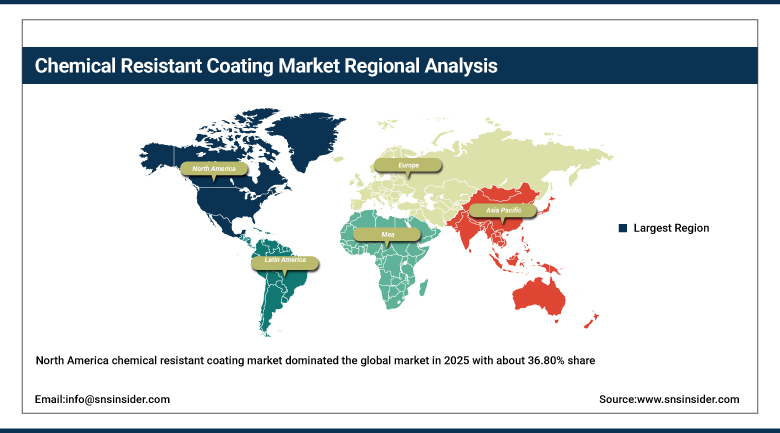
North America chemical resistant coating market dominated the global market in 2025 with about 36.80% share, owing to strong demand from oil & gas and industrial sectors. The region benefits from advanced industrial infrastructure and strict environmental regulations. Increasing corrosion protection requirements in chemical plants are improving product penetration. Expansion of refinery and petrochemical facilities is driving demand. Strong focus on high performance protective coatings is further supporting market growth.
As per the United States Environmental Protection Agency Safer Choice initiative and compliance regulations for North American industries, over 75% of industrial surface coating applications within the regulated industries, like oil & gas, chemical processing, and water infrastructure, involve performance requirements for either corrosion resistance or chemical resistance based on EPA environmental guidelines. Based on the corrosion-related materials failure studies from the Department of Energy, USA, around 3-4% of GDP-equivalent national infrastructural losses occur due to corrosion each year.
Get Customized Report as per Your Business Requirement - Enquiry Now
Europe Chemical Resistant Coating Market Insights.
Europe chemical resistant coating market is characterized by stable growth in 2025 owing to strong demand from chemical processing and marine industries. Key countries include Germany, France, United Kingdom, and Italy. Rising focus on industrial safety and corrosion prevention is driving adoption. Increasing investments in sustainable coating technologies are boosting market expansion. Growth in offshore wind and marine infrastructure is further supporting demand. Strict environmental regulations are encouraging advanced low emission coating systems.
The European Environment Agency and Eurostat industrial emissions monitoring reports have indicated that above 21% of value addition from manufacturing in the EU is from chemical and materials-based industries which need surface protection technologies in order to meet environmental regulations in 2025. According to implementation reports of the European Commission Industrial Emissions Directive, there are above 50,000 industrial plants in Europe which are strictly monitored for emissions and corrosion.
Asia Pacific Chemical Resistant Coating Market Insights.
Asia Pacific is the fastest growing region in the chemical resistant coating market, registering a CAGR of about 4.76% during 2026–2035. Rapid industrialization and infrastructure expansion are driving strong demand across China, India, Japan, South Korea, and Southeast Asia. Growth in chemical manufacturing and oil refining capacity is boosting market expansion. Increasing construction of industrial facilities is further accelerating adoption. Rising corrosion challenges in humid environments are supporting large scale coating usage.
According to the UNIDO industrial statistics and OECD Environmental Policy Outlook 2025, the Asia Pacific region contributes more than 50% of the world's industrial output, wherein China alone provides more than 28% of world industrial output. According to the IEA energy infrastructure database, the Asia Pacific region accounts for almost 45% of world total industrial energy use, particularly with the fast growth in the petrochemicals, maritime, and construction industries.
Middle East & Africa and Latin America Chemical Resistant Coating Market Insights.
The Middle East & Africa along with Latin America regions are witnessing steady growth due to expanding oil & gas and industrial sectors. Key contributing countries include UAE, Saudi Arabia, South Africa, Brazil, and Mexico. Increasing investment in petrochemical and refinery infrastructure is driving demand. Growth in marine and offshore projects is further supporting market expansion. Rising industrialization and harsh environmental conditions are boosting adoption of protective coatings.
As reported by the United Nations Industrial Development Organization industrial statistics database and the International Energy Agency refining and petrochemical capacity statistics, Middle Eastern nations produce more than 30% of world crude oil production, while Latin American nations produce about 8–9%, thus offering highly corrosive conditions. According to the World Bank infrastructure resiliency data and OECD materials durability standards, over 70% of infrastructure within coastal and petrochemical areas in these nations need corrosion prevention systems.
Market Dynamics:
Growth Drivers: Rapid Expansion of Oil & Gas and Chemical Processing Infrastructure Boosting High Performance Coating Adoption
Growing energy needs worldwide are fueling the growth of oil and gas exploration, production, and transportation activities. This sector is prone to high exposure to corrosion, temperature extremes, and chemicals. Protective coatings that resist chemicals are being increasingly deployed to safeguard pipelines, storage tanks, and offshore platforms. The rise in construction of chemical plants is also aiding in boosting the market. Investment in industrial upgrades and capacity additions is further promoting the adoption of these coatings.
According to the U.S. Energy Information Administration International Energy Statistics 2025, global petroleum and other liquid fuels production exceeded 100 million barrels per day, with OPEC countries accounting for over 35% of total output, driving extensive downstream infrastructure maintenance requirements. As per the International Energy Agency Oil 2025 analysis, global refinery throughput utilization rates remain above 80%, indicating sustained operational intensity in corrosive processing environments.
Restraints: Strict Environmental Regulations on VOC Emissions Limiting Adoption of Conventional Solvent-Based Coating Systems
Growing environmental concerns have led to strict regulations on volatile organic compound emissions in coatings. Governments across North America and Europe are enforcing limits on solvent-based formulations. Compliance with environmental safety standards increases production complexity and costs. Many traditional coating systems are being restricted or phased out. Manufacturers are required to invest in water-based and low-VOC technologies. Transition challenges and performance limitations in certain applications slow down adoption. Regulatory pressure significantly affects product formulation strategies and market expansion pace.
Opportunities:Increasing Demand from Emerging Economies Creating Strong Growth Potential for Advanced Coating Solutions
With the rise in industrialization across Asia Pacific, Latin America, and Middle East & Africa, there is an emergence of great opportunities in terms of growth in the market. There is increasing investment in the areas of chemicals, oil & gas, and infrastructure which in turn results in increased demand for corrosion protection systems. Urbanization along with industrial constructions is also playing a vital role in the development of the same. There are rising production facilities in developing nations resulting in growing consumption of protective coating materials.
As mentioned in the UNIDO Industrial Development Report and World Bank infrastructure indexes, the developing nations in Asia and Africa contribute more than 60% to the manufacturing value added growth around the world, with the industrial output growing at more than 5% per year in developing Asia. According to the International Energy Agency and the OECD infrastructure outlook, the chemical production capacity is rising in Asia Pacific, where there is more than 45% of the world chemical production.
Recent Developments:
-
2026: BASF SE No verified public 2026 coatings segment chemical resistant product launches or expansions disclosed in current reports.
-
2025: Akzo Nobel N.V. expanded sustainable powder coatings portfolio and upgraded European facilities to reduce carbon emissions.
-
2025: The Sherwin-Williams Company strengthened FIRETEX passive fire protection portfolio and expanded specialty protective coatings for marine and critical infrastructure application.
-
2024: PPG Industries, Inc. strengthened epoxy and protective coatings portfolio targeting corrosion resistance in industrial environments worldwide.
Chemical Resistant Coating Market Key Players are:
-
Akzo Nobel N.V.
-
Ppg Industries, Inc.
-
The Sherwin-Williams Company
-
Jotun A/S
-
Hempel A/S
-
Nippon Paint Holdings Co., Ltd.
-
Kansai Paint Co., Ltd.
-
Rpm International Inc.
-
Axalta Coating Systems Ltd.
-
Basf Se
-
Sika Ag
-
The Chemours Company
-
3M Company
-
Tnemec Company, Inc.
-
Carboline Company
-
Teknos Group Oy
-
Berger Paints India Limited
-
Asian Paints Limited
-
Weg S.A.
-
Advanced Polymer Coatings, Inc.
Chemical Resistant Coating Market Report Scope:
| Report Attributes | Details |
|---|---|
| Market Size in 2025 | USD 7.78 Billion |
| Market Size by 2035 | USD 11.08 Billion |
| CAGR | CAGR of 3.62% From 2026 to 2035 |
| Base Year | 2025 |
| Forecast Period | 2026-2035 |
| Historical Data | 2022-2024 |
| Report Scope & Coverage | Market Size, Segments Analysis, Competitive Landscape, Regional Analysis, DROC & SWOT Analysis, Forecast Outlook |
| Key Segments | • By Resin Type (Epoxy, Polyester, Fluoropolymers, Polyurethane, Other Resins) • By Technology (Solvent-based, Water-based, Powder Coating, Others) • By Film Thickness (Thin Film Coatings, Medium Build Coatings, Heavy Duty Coatings, Ultra-Heavy Duty Systems) • By End-User (Chemical, Oil & Gas, Marine, Construction & Infrastructural, Others) |
| Regional Analysis/Coverage | North America (US, Canada), Europe (Germany, UK, France, Italy, Spain, Russia, Poland, Rest of Europe), Asia Pacific (China, India, Japan, South Korea, Australia, ASEAN Countries, Rest of Asia Pacific), Middle East & Africa (UAE, Saudi Arabia, Qatar, South Africa, Rest of Middle East & Africa), Latin America (Brazil, Argentina, Mexico, Colombia, Rest of Latin America). |
| Company Profiles | Akzo Nobel N.V., Ppg Industries, Inc., The Sherwin-Williams Company, Jotun A/S, Hempel A/S, Nippon Paint Holdings Co., Ltd., Kansai Paint Co., Ltd., Rpm International Inc., Axalta Coating Systems Ltd., Basf Se, Sika Ag, The Chemours Company, 3M Company, Tnemec Company, Inc., Carboline Company, Teknos Group Oy, Berger Paints India Limited, Asian Paints Limited, Weg S.A., Advanced Polymer Coatings, Inc. |

Frequently Asked Questions
North America dominated the chemical resistant coating market in 2025 due to strong industrial infrastructure and high corrosion protection demand.
The Major growth factors include rising demand from chemical processing industries, increasing corrosion issues, expansion of oil & gas and marine infrastructure, growing chemical plants, and need for durable protective coating systems.
The chemical resistant coating market is expected to grow at a CAGR of 3.62% from 2026 to 2035.
The chemical resistant coating market was valued at USD 7.78 Billion in 2025.
The Epoxy segment dominated the market in 2025 due to strong adhesion, chemical resistance, durability, cost effectiveness, and industrial applications.
