
Flame Retardant Textile Market Report Scope & Overview:
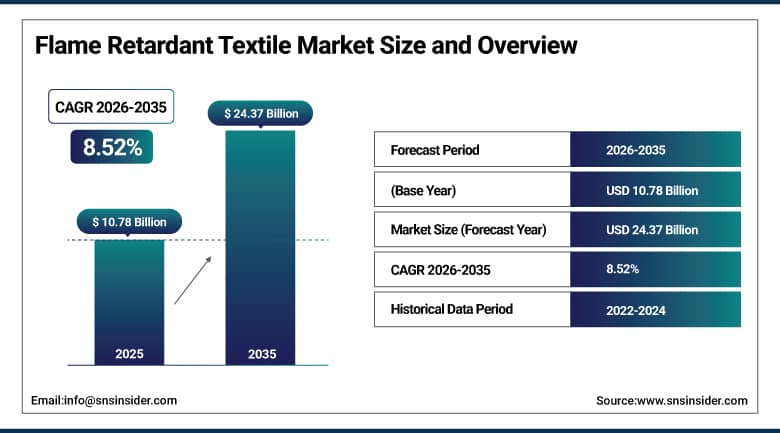
The Flame Retardant Textile Market was valued at USD 10.78 Billion in 2025 and is expected to reach USD 24.37 Billion by 2035, growing at a CAGR of 8.52% from 2026–2035.
The flame retardant textile market is witnessing strong growth in the global market owing to increasing demand for safety compliant fabrics across multiple industries. Rising adoption of protective clothing and transportation textiles is improving product utilization. Expanding industrial safety regulations are supporting market expansion. Manufacturers are focusing on advanced reactive and additive flame-retardant technologies. Growing emphasis on workplace safety and fire prevention is driving innovation. Increasing investments in automotive and aerospace sectors are further accelerating market adoption.
According to the United Nations Environment Programme and the International Labour Organization, over 2.7 million work-related deaths occur annually worldwide, with a significant share linked to fire and heat exposure risks in industrial environments, supporting increased use of protective flame-resistant textiles. As per the OECD environmental safety and industrial standards framework, more than 60% of OECD member countries enforce mandatory fire safety compliance standards in construction, transportation, and defense sectors.
To Get More Information On Flame Retardant Textile Market - Request Free Sample Report
Flame Retardant Textile Market Trends:
-
Widespread use of flame-retardant textiles in aerospace, automotive, railways, and public transportation safety applications worldwide.
-
Growing use of smart textiles that have temperature sensing ability and increased durability features in the industrial and defense sector.
-
Increase in demand for lightweight flame-resistant fabrics in electric vehicles and automotive manufacturing systems.
-
Modernization of militaries resulting in the high-performance protective clothing and textile innovation worldwide.
-
Emphasis on passenger safety and fire-resistant interior applications in the commercial transportation and aviation industry.
-
Growing industrial automation and hazardous work environments resulting in the increase in demand for intelligent safety and protective textile solutions.
U.S. Flame Retardant Textile Market Outlook:
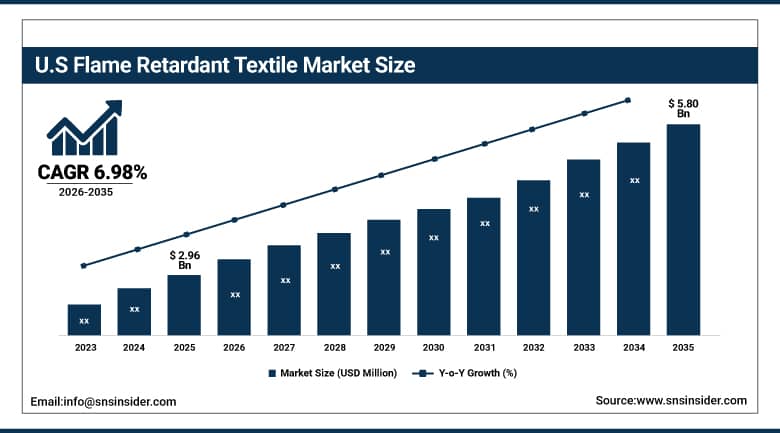
The U.S. Flame Retardant Textile Market was valued at USD 2.96 Billion in 2025 and is expected to reach around USD 5.80 Billion by 2035, growing at a CAGR of 6.98% from 2026–2035.
The U.S. flame retardant textile market is growing steadily owing to rising demand for safety compliant industrial textiles across sectors. Increasing adoption of protective clothing is improving workplace safety standards. Expansion of aerospace and automotive industries is supporting market growth across regions. Strong use of advanced additive and reactive flame retardants is enhancing performance efficiency. Growing investments in fire safety regulations are accelerating market development. Advancements in sustainable textile technologies are further driving adoption nationwide.
According to the U.S. Consumer Product Safety Commission and National Fire Protection Association 2025 fire safety statistics, residential structure fires account for approximately 27% of all reported fires in the United States, with upholstered furniture and bedding involved in nearly 50% of civilian fire deaths. The U.S. Bureau of Labor Statistics shows that over 35% of textile manufacturing output is associated with industrial and protective applications requiring compliance with flammability standards.
Flame Retardant Textile Market Segment Analysis:
-
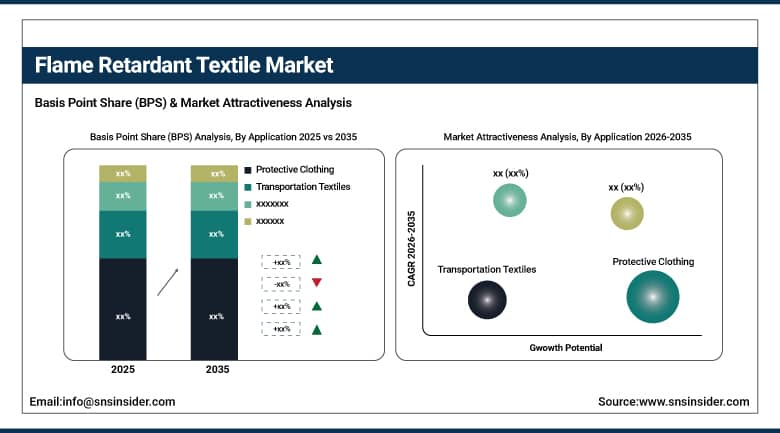
By Application, protective clothing dominated the market with 41.60% share in 2025; while transportation textiles are the fastest growing segment with CAGR of 12.82% during 2026 to 2035.
-
By Fiber Type, natural fibers dominated the market with 42.60% share in 2025; while synthetic fibers are the fastest growing segment with CAGR of 11.12% during 2026 to 2035.
-
By End Use, aerospace dominated the market with 38.50% share in 2025; while automotive are the fastest growing segment with CAGR of 11.29% during 2026 to 2035.
-
By Flame Retardant Type, additive dominated the market with 51.40% share in 2025; while reactive are the fastest growing segment with CAGR of 11.66% during 2026 to 2035.
By Application, protective clothing dominated the flame retardant textile market, while transportation textiles are the fastest growing segment.
Protective Clothing emerged as a dominant market segment with maximum revenue contribution in the global flame retardant textile market in 2025. This dominance can be attributed to strict occupational safety norms in oil and gas, construction, and manufacturing sectors. Growing demand for firefighter clothing, military attire, and safety wear in the industry is helping the segment in gaining significant traction. Increased awareness about worker safety and compliance requirements will continue to drive consumption of products in both developing and developed nations.
Transportation Textiles is anticipated to witness fastest CAGR during the forecast period, 2026 to 2035. Rising demand for fireproof textiles in the automotive, railway, and aviation sectors is driving growth of the segment. In addition, rising production of electric vehicles is augmenting demand for safer interiors. Increasing investments in public transportation system along with stringent safety norms are propelling adoption. Innovations in lightweight and durable flame-retardant textile materials are also contributing towards fast-paced growth of the market.
By Fiber Type, natural fibers dominated the flame retardant textile market, while synthetic fibers are the fastest growing segment.
The Natural Fibers segment holds the dominated revenue share in the flame retardant textile market in 2025. This is attributed to the wide use of natural fibers in protective clothing, residential textiles, and safety textiles for industries. Natural fibers like cotton are mostly used because they are comfortable, breathable, and can easily undergo flame retardant treatment. Also, stringent regulations of workplace safety and textile manufacturing capabilities drive their demand.
The Synthetic Fibers segment is projected to witness fastest growth during the forecast period from 2026 to 2035. This growth is fueled by the increasing use of performance-driven fibers like polyester, aramids, and nylon fibers. These fibers provide improved durability and thermal resistance along with durable flame-retardant features. Increasing demand from automotive, aerospace, and transport industry fuels the market growth.
By End Use, aerospace dominated the flame retardant textile market, while automotive are the fastest growing segment.
Aerospace Segment held a dominated market revenue share position in the flame retardant textile market in 2025. This is because of stringent regulations in aviation safety and increased demand for fire resistant interior cabin of the aircrafts. Certified flame-retardant textiles are required for seating, insulation, and flooring of aircrafts. The expansion in the fleet of the commercial aircrafts and modernization of military aircraft further support their adoption. Passenger safety and lightweight materials are other factors that help sustain this position of the aerospace segment in the market.
Automotive Segment is anticipated to exhibit fastest CAGR during the forecast period, i.e., 2026-2035 in the flame-retardant textile market. This is owing to the increasing production of the vehicles and safety regulations related to the interior parts of the vehicle. Further, electric vehicles increase the need for such fire-resistant materials. Flame retardant textiles can be used for seats, carpets, headliners, and insulation. Increasing passenger safety and lightweight materials adoption is contributing to the automotive industry.
By Flame Retardant Type, additive dominated the flame retardant textile market, while reactive are the fastest growing segment.
Additive segment held a dominated revenue share in the flame retardant textile market in 2025. The growth of additive segment is primarily attributed to its broad range of applications in various types of textile and low-cost processing features. Additive segment finds extensive use in industrial textiles, protective clothing, and home textiles. Compatibility with existing process operations and integration into fibers have helped it maintain its leadership position in the market.
Reactive segment is projected to experience the fastest CAGR during 2026 to 2035 on account of rising demand for more durable and long-lasting flame resistance characteristics. These chemicals form an integral part of the fiber structure and hence possess increased wash durability. Environmental norms and growing awareness of sustainable textiles have led to increased usage of reactive chemicals. Increasing usage in automobile, aerospace, and protective applications fuels its market growth.
Regional Analysis:
|
Region |
Major Country |
Share within Region, 2025(%) |
|---|---|---|
|
North America |
United States |
74.60% |
|
Europe |
Germany |
28.10% |
|
Asia Pacific |
China |
43.60% |
|
Middle East & Africa |
UAE |
18.40% |
|
Latin America |
Brazil |
48.20% |
North America Flame Retardant Textile Market Insights.
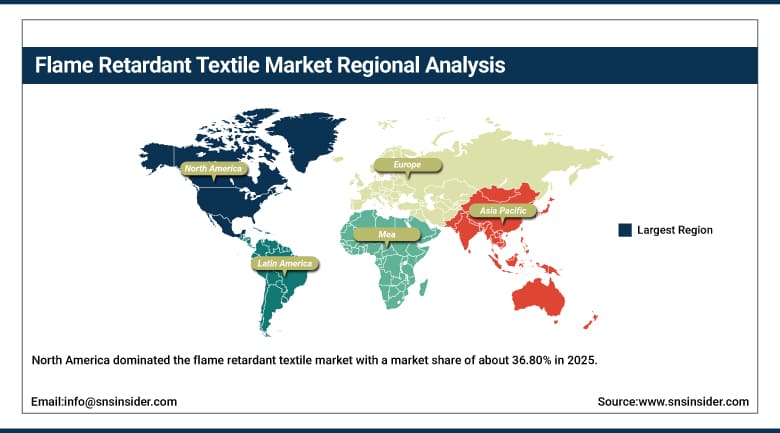
North America dominated the flame retardant textile market with a market share of about 36.80% in 2025 owing to rising demand for safety compliant industrial textiles across key sectors. The region benefits from strong regulatory frameworks and strict workplace fire safety standards across industries. Increasing use of protective clothing in oil and gas and manufacturing sectors is improving adoption rates. Expansion of aerospace and transportation industries is driving demand for advanced flame-retardant fabrics. Strong R&D investments in innovative textile materials are further supporting market growth.
According to the U.S. Fire Administration and National Fire Protection Association 2025 safety statistics, residential building fires account for approximately 74% of all fire-related deaths in the United States, with upholstered furniture and bedding contributing significantly to fire load. As per NFPA fire protection standards, flame-retardant textile requirements are mandated in multiple public occupancy categories, including transportation and healthcare sectors covering 100% compliance for regulated materials.
Get Customized Report as Per Your Business Requirement - Enquiry Now
Europe Flame Retardant Textile Market Insights.
Europe flame retardant textile market is characterized by steady growth in 2025 owing to strict safety regulations and sustainability focused textile standards. Key countries include Germany, France, United Kingdom, Italy, and Spain. Rising demand for high performance protective fabrics is driving adoption across industrial and transportation sectors. Increasing focus on reducing workplace hazards is boosting use of flame-resistant textiles. Expansion of aerospace and automotive manufacturing is further supporting market growth across the region.
According to the European Chemicals Agency REACH regulation enforcement framework and Eurostat industrial production data for 2025, over 90% of textile chemical substances used in the EU are now subject to registration, evaluation, and restriction controls, including flame retardant formulations.
As per the European Commission’s Circular Economy Action Plan monitoring indicators, the EU textile recycling rate remains below 15%, while more than 60% of technical textiles are used in transportation, construction, and protective applications requiring compliance with fire safety standards EN 13501 classification system, supporting sustained demand for flame retardant textile materials across Europe.
Asia Pacific Flame Retardant Textile Market Insights.
Asia Pacific is expected to register the fastest CAGR of about 10.36% during 2026 to 2035 in the flame retardant textile market, driven by rapid industrialization and expanding manufacturing sectors across key economies. Strong demand is emerging from China, India, Japan, South Korea, and Southeast Asia. Increasing workplace safety regulations are significantly boosting adoption of protective textiles. Growth in automotive and construction industries is further accelerating market expansion. Rising investments in industrial safety infrastructure are strengthening regional demand consistently.
According to the trade in value-added statistics and safety norms of the OECD, over 70% of the total industrial safety standards in the Asia Pacific region require fire resistant protective apparel in the oil and gas industry, construction, and manufacturing industries. Moreover, according to the World Bank’s industrial safety monitoring program, the workplace safety compliance programs related to flame retardant protective textile have reached more than 65% in 2025.
Middle East & Africa and Latin America Flame Retardant Textile Market Insights.
The Middle East & Africa along with Latin America regions are experiencing steady growth due to rising industrial safety awareness and infrastructure expansion. Key contributing countries include Brazil, Mexico, UAE, Saudi Arabia, and South Africa. Increasing demand for protective clothing in oil and gas and construction sectors is driving market growth. Expanding industrial development and safety regulations are supporting adoption of flame-resistant textiles. Growing investments in industrial workforce protection are further boosting demand.
According to the International Labour Organization and United Nations Economic Commission for Latin America and the Caribbean 2025 industrial safety and labor protection indicators, construction and manufacturing sectors account for over 20% of total employment in Latin America and more than 15% in parts of the Middle East and Africa. As per the International Energy Agency building safety and energy efficiency datasets, over 30% of global industrial fires originate in building and textile-related environments, while national fire safety regulations in more than 70% of OECD-adjacent and emerging economies mandate flame-retardant materials in public infrastructure and transportation textiles, supporting adoption of flame-retardant fabrics.
Market Dynamics:
Growth Drivers: Rising Demand from Aerospace Automotive and Transportation Safety Applications Worldwide
Increasing usage of fire-retardant textiles for aerospace, automobiles, railway and public transport system applications is fueling significant growth within the market. Emphasis on passenger safety and fire-resistant interiors is increasing adoption within vehicle manufacturing industry. Increased production of electric vehicles is adding to the demand for such advanced heat-resistant materials. Airlines and military sector applications are becoming more reliant on such lightweight, flame-resistant fabric materials. Growing infrastructure development within the transportation industry is fast increasing adoption of such textiles.
According to the International Civil Aviation Organization safety framework and the European Union Aviation Safety Agency cabin material compliance standards, over 95% of commercial aircraft interiors must meet stringent flame resistance requirements under standardized flammability tests such as FAR 25.853. As per the U.S. National Highway Traffic Safety Administration Federal Motor Vehicle Safety Standard 302, all passenger vehicle interior materials are required to self-extinguish within 60 seconds during burn testing.
Restraints: Environmental And Health Concerns Associated with Certain Flame Retardant Chemicals
The use of some flame-retardant chemicals during textile processing poses both environmental and health risks that affect the market growth. The regulations against the use of hazardous chemicals are rising in most regions. There is an environmental challenge when disposing and recycling of the treated textiles. The consumer’s interest is tilting towards eco-friendly products, thus posing a limitation to the chemical-based products demand. The need for manufacturers to come up with a safer formulation result in high research expenses.
Opportunities:Expansion Of Smart Protective Textiles in Emerging Industrial and Defense Applications
The combination of smart textiles and flame-retardant technology is increasingly opening up possibilities in various industries as well as the defense sector. Smart textiles that have temperature sensing and improved durability are becoming popular. With increased modernization of militaries across the globe, there is growing demand for high-quality protective wear. Increasing industrial automation as well as working conditions that involve hazards are also contributing to the adoption of intelligent safety textiles. Innovation of multi-functional textiles is set to increase the scope of applications dramatically in various industries.
According to the International Labour Organization and ISO 11612 occupational safety standards framework, more than 2.78 million work-related deaths occur annually worldwide, with thermal and fire hazards contributing significantly in high-risk sectors such as oil, gas, and defense manufacturing. As per the U.S. Bureau of Labor Statistics 2025 occupational safety data, protective clothing usage in hazardous industries exceeds 85% compliance in regulated workplaces.
Recent Developments:
-
2026: Milliken expanded flame resistant textile innovation programs focusing on PFAS-free protective fabrics and advanced firefighter safety solutions development.
-
2025: DuPont advanced aramid fiber and Kevlar solutions expansion focusing on sustainability, lightweight protection, and manufacturing optimization initiatives globally.
-
2025: Teijin launched Digital Product Passport compliant aramid and carbon fiber traceability system enhancing supply chain transparency and sustainability compliance.
-
2024: BASF expanded circular economy initiatives and chemical recycling technologies for polymer and textile-related applications across global manufacturing sites.
Flame Retardant Textile Market Key Players are:
-
DuPont
-
Teijin
-
Toray Industries
-
Huntsman Corporation
-
Milliken & Company
-
Solvay
-
BASF
-
Clariant
-
Arkema
-
Dow
-
Lenzing AG
-
W. L. Gore & Associates
-
Kaneka Corporation
-
Toyobo
-
Asahi Kasei
-
Indorama Ventures
-
Reliance Industries Limited
-
Hyosung Corporation
-
Kolon Industries
-
Sioen Industries
Flame Retardant Textile Market Report Scope:
| Report Attributes | Details |
|---|---|
| Market Size in 2025 | USD 10.78 Billion |
| Market Size by 2035 | USD 24.37 Billion |
| CAGR | CAGR of 8.52% From 2026 to 2035 |
| Base Year | 2025 |
| Forecast Period | 2026-2035 |
| Historical Data | 2022-2024 |
| Report Scope & Coverage | Market Size, Segments Analysis, Competitive Landscape, Regional Analysis, DROC & SWOT Analysis, Forecast Outlook |
| Key Segments | • By Application (Home Textiles, Protective Clothing, Transportation Textiles, Industrial Fabrics) • By Fiber Type (Natural Fibers, Synthetic Fibers, Blended Fibers) • By End Use (Aerospace, Automotive, Construction, Healthcare) • By Flame Retardant Type (Additive, Reactive, Coating) |
| Regional Analysis/Coverage | North America (US, Canada), Europe (Germany, UK, France, Italy, Spain, Russia, Poland, Rest of Europe), Asia Pacific (China, India, Japan, South Korea, Australia, ASEAN Countries, Rest of Asia Pacific), Middle East & Africa (UAE, Saudi Arabia, Qatar, South Africa, Rest of Middle East & Africa), Latin America (Brazil, Argentina, Mexico, Colombia, Rest of Latin America). |
| Company Profiles | DuPont, Teijin, Toray Industries, Huntsman Corporation, Milliken & Company, Solvay, BASF, Clariant, Arkema, Dow, Lenzing AG, W. L. Gore & Associates, Kaneka Corporation, Toyobo, Asahi Kasei, Indorama Ventures, Reliance Industries Limited, Hyosung Corporation, Kolon Industries, Sioen Industries |
Frequently Asked Questions
Major growth factors include rising safety compliant fabric demand, strict fire regulations, protective clothing adoption, aerospace automotive use, workplace safety expansion, and advancements in reactive and additive flame-retardant technologies.
The flame retardant textile market was valued at USD 10.78 Billion in 2025.
The flame retardant textile market is expected to grow at a CAGR of 8.52% from 2026 to 2035.
The Protective Clothing segment dominated the market in 2025 due to strict safety rules, industrial demand, and military firefighter applications.
North America dominated the flame retardant textile market in 2025 due to strict safety regulations, strong industries, and high protective textile demand.
