
Circulating Tumor DNA Testing Market Report Scope & Overview:
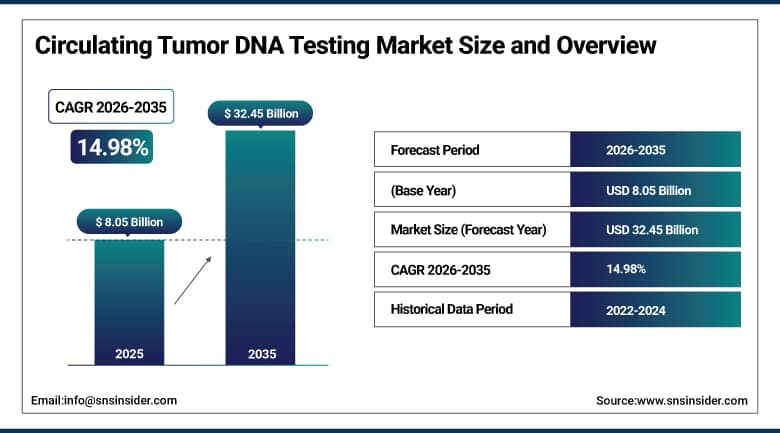
The Circulating Tumor DNA Testing Market was valued at USD 8.05 Billion in 2025 and is expected to reach USD 32.45 Billion by 2035, growing at a CAGR of 14.98% from 2026 to 2035.
A consistent expansion in the Circulating Tumor DNA Testing market exists due to an increasing number of cases of cancer worldwide, increasing application of liquid biopsy as a non-invasive tool for testing compared to tissue biopsy and technological advancements made in next-generation sequencing and digital PCR. Such improvements improve sensitivity and specificity in detecting ctDNA even at very low allele fraction. Circulating tumor DNA testing is increasingly becoming part of the routine process in oncology, helping with cancer detection, companion diagnostics and post-curative intent therapy monitoring for residual disease. This allows doctors to monitor the patient’s tumor genomics in a minimally invasive way.
In January 2025, Natera and Guardant Health upgraded their molecular residual disease testing laboratories to handle the rising demand for their tests – Signatera and Guardant Reveal ctDNA tests respectively. This is due to the increasing coverage for these indications from Medicare and private payers for colorectal, breast, and lung cancers.
To Get More Information On Circulating Tumor DNA Testing Market - Request Free Sample Report
Circulating Tumor DNA Testing Market Trends:
-
Rising adoption of ctDNA-based molecular residual disease testing is transforming post-treatment cancer surveillance across colorectal, breast, and lung cancer care.
-
Growing integration of ctDNA assays into companion diagnostics is expanding their role in guiding targeted therapy and immunotherapy selection.
-
Increasing use of multi-cancer early detection blood tests is broadening ctDNA testing beyond diagnosed patients into average-risk screening populations.
-
Expanding pharmaceutical industry adoption of ctDNA endpoints in clinical trials is accelerating drug development and patient stratification.
-
Strategic collaborations between diagnostics companies, hospitals, and biopharma firms are driving development of next-generation, tumor-informed ctDNA assays.
U.S. Circulating Tumor DNA Testing Market Outlook:
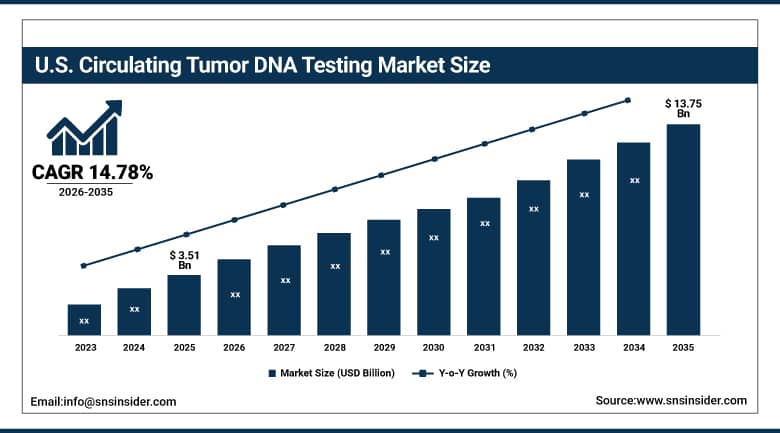
The U.S. Circulating Tumor DNA Testing Market was valued at USD 3.51 Billion in 2025 and is projected to reach USD 13.75 Billion by 2035, growing at a CAGR of 14.78% during 2026-2035.
Top companies in precision oncology from the United States have been increasing their ctDNA testing capabilities due to growing insurance coverage by Medicare and other payers for molecular residual disease tests, use of liquid biopsy in community oncology settings, and applications of surveillance in colon, breast, lung, and bladder cancers. There is growing demand in the country for next-generation circulating tumor DNA testing because there are increasing numbers of CLIA-certified labs in the United States providing both tumor-informed and tumor-naive ctDNA tests and clinical trial evidence from top cancer research institutions.
In February 2026, Exact Sciences increased the high-throughput sequencing capacity in the United States to handle the increasing number of test orders of Oncodetect and Cancerguard ctDNA tests from oncologists in the country.
Circulating Tumor DNA Testing Market Segment Analysis:
-
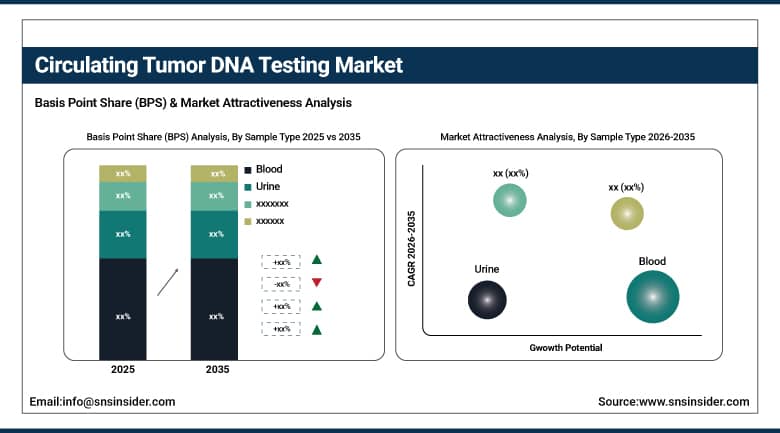
By Sample Type, Blood dominated the Circulating Tumor DNA Testing Market with an 81.60% share in 2025, while Urine is the fastest-growing sample type segment with a CAGR of 16.90% from 2026-2035.
-
By Technology, Next-Generation Sequencing dominated the Circulating Tumor DNA Testing Market with a 46.50% share in 2025, while PCR-Based Assays is the fastest-growing technology segment with a CAGR of 17.20% from 2026-2035.
-
By Application, Cancer Screening & Early Detection dominated the Circulating Tumor DNA Testing Market with a 34.80% share in 2025, while Molecular Residual Disease Monitoring is the fastest-growing application segment with a CAGR of 18.60% from 2026-2035.
-
By End User, Hospitals & Diagnostic Centers dominated the Circulating Tumor DNA Testing Market with a 42.30% share in 2025, while Biopharmaceutical & Biotech Companies is the fastest-growing end-user segment with a CAGR of 17.80% from 2026-2035.
By Sample Type, Blood dominated the market, while Urine is the fastest-growing segment.
Among segments of the Circulating Tumor DNA Testing Market, the Blood segment continued to hold a leading market position in terms of market revenue in 2025. The most popular sample is blood because of the minimal invasiveness of blood sampling, its wide availability, and the ability to obtain circulating cell-free DNA of the appropriate volume for genetic testing. In addition, an extensive network of phlebotomy centers, standard blood collection tubes, and optimized protocols for plasma preparation contribute to making the default workflow blood-based. Increased physician awareness about liquid biopsy technology and improvement of pre-analytical stability of samples are expected to ensure Blood segment domination during the forecast period.
The Urine segment is estimated to be the fastest-growing one among all segments from 2026 to 2035. The growing popularity of ctDNA urine testing for genitourinary cancers, such as bladder cancer and prostate cancer, will fuel the growth of this non-invasive sample collection procedure. Specifically, ctDNA urine testing for recurrent bladder cancer after surgery provides the possibility to perform serial tests without any venipuncture or invasive procedures. Improved sensitivity and clinical utility of urine ctDNA testing in the course of ongoing validations will increase its popularity.
By Technology, Next-Generation Sequencing led the market, while PCR-Based Assays is the fastest-growing segment.
The Next-Generation Sequencing segment led the Circulating Tumor DNA Testing Market in 2025. Among others, the key characteristic that makes next-generation sequencing advantageous is the ability to analyze multiple cancer-associated genes and structural variants from one blood sample at once. The growing popularity of NGS in the field of companion diagnostics, tumor mutational burden measurement, and mutation resistance identification is contributing to its wide implementation. In combination with the decreasing sequencing price, time, FDA approvals, and bioinformatics and assay sensitivity improvements, next-generation sequencing seems to be capable of retaining dominance in hospitals, reference laboratories, and cancer clinics.
PCR-based assays are anticipated to register the highest compound annual growth rate between 2026 and 2035. Highly sensitive detection of known tumor-specific mutations is possible by means of using digital PCR and droplet digital PCR technologies. Lower prices, simplicity of procedure, and rapidity make PCR-based tests popular among community oncology practices and smaller laboratories. Tumor-informed PCR tests for monitoring changes after surgery or chemotherapy become increasingly common; therefore, PCR becomes a good addition to NGS-based genomic testing.
By Application, Cancer Screening & Early Detection dominated the market, while Molecular Residual Disease Monitoring is the fastest-growing segment.
The Cancer Screening & Early Detection segment dominated the Circulating Tumor DNA Testing Market in 2025. This segment is driven by the increasing uptake of blood-based non-invasive multi-cancer early detection tests that detect tumor DNA prior to detecting diseases through imaging technology. The rise in awareness about blood-based testing, pilot programs among employers and health systems, increasing regulatory approval activity, and an increasing amount of clinical evidence have contributed to its momentum. This segment will stay ahead of the competition throughout 2035 as ctDNA-based technologies continue to supplement other screening approaches.
The Molecular Residual Disease (MRD) Monitoring segment will be the fastest-growing for 2026 - 2035. Evidence showing that ctDNA positivity following surgery can predict cancer recurrence is driving the adoption of tumor-informed MRD testing in various types of cancers such as colorectal, breast, bladder, and lung cancers. Increasing payer coverage, serial ctDNA testing for making treatment decisions, and the utilization of MRD as an endpoint in clinical trials among pharmaceutical companies are other drivers of this market. As the clinical validation expands to more cancer types, this type of test will significantly surpass the market overall.
By End User, Hospitals & Diagnostic Centers dominated the market, while Biopharmaceutical & Biotech Companies is the fastest-growing segment.
The Hospitals & Diagnostic Centers segment dominated the Circulating Tumor DNA Testing Market in 2025. Hospitals and Diagnostic Centers remain key channels for ctDNA testing, with oncologists becoming increasingly dependent on liquid biopsy test results when making treatment decisions. With ctDNA testing being incorporated in electronic health records and increased molecular pathology capabilities at hospitals, there is improved ctDNA testing at hospitals. Through collaboration with reference laboratories and developers of ctDNA tests, there is improvement in logistics and time taken to report results to enable hospitals to remain leaders until 2035.
Biopharmaceutical & Biotech Companies is projected to have the highest compound annual growth rate during the forecast period of 2026 to 2035. Developers of drugs are increasingly using ctDNA tests to stratify patients involved in clinical trials, monitor response to treatment, and develop companion diagnostics for targeted therapy and immuno-oncology drugs. Increased use of ctDNA-based minimal residual disease endpoints, coupled with collaborations by diagnostic companies with pharmaceutical companies, is fueling growth. Adoption will increase in the coming years with acceptance by regulators of ctDNA biomarkers in oncology clinical trials.
Regional Analysis:
|
Region |
Major Country |
Share within Region, 2025 (%) |
|---|---|---|
|
North America |
United States |
84.50% |
|
Europe |
Germany |
24.80% |
|
Asia Pacific |
China |
38.60% |
|
Middle East & Africa |
UAE |
24.40% |
|
Latin America |
Brazil |
36.50% |
North America Circulating Tumor DNA Testing Market Insights
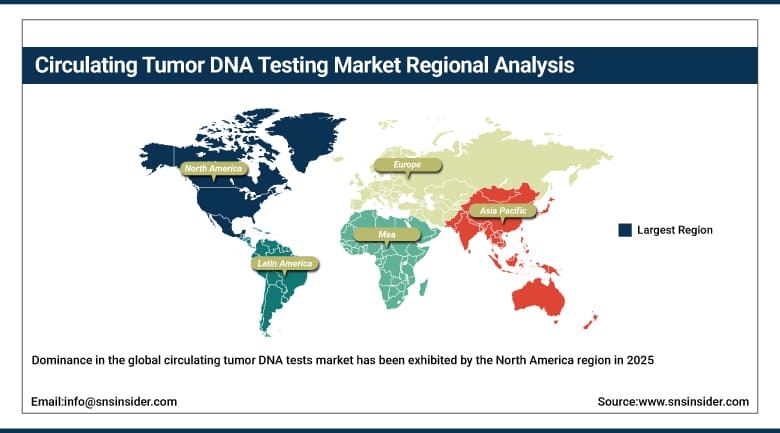
Dominance in the global circulating tumor DNA tests market has been exhibited by the North America region in 2025, which was 51.20% due to the advanced precision oncology infrastructure, the high number of CLIA-certified molecular diagnostic laboratories in the region, as well as doctors' familiarity with ordering liquid biopsies both in academia and community-based oncology clinics. Expansion in the Medicare as well as commercial payers' reimbursement of companion diagnostics and molecular residual disease circulating tumor DNA tests has been a major contributing factor to increased adoption in the region. Also noteworthy is the high number of precision oncology firms in the region, and their innovations and advancements in test sensitivities and clinical validation of circulating tumor DNA tests. Additionally, academic medical centers in the region have been actively publishing peer-reviewed studies of clinical utility of circulating tumor DNA tests.
The US was the leading country within the North America Circulating Tumor DNA Testing Market in 2025 with a market share of 84.50% of the regional market, driven by extensive domestic laboratory infrastructure, rapid Medicare coverage expansion for molecular residual disease testing, and the concentrated presence of leading ctDNA test developers headquartered within the country. Canada is contributing to regional growth through its own expanding precision oncology adoption, growing public health system integration of liquid biopsy testing, and increasing collaboration between Canadian cancer centers and US-based diagnostic companies to broaden ctDNA test accessibility across provincial healthcare systems.
Get Customized Report as Per Your Business Requirement - Enquiry Now
Europe Circulating Tumor DNA Testing Market Insights
The Europe region was a significant contributor to the Circulating Tumor DNA Testing Market in 2025, expected to register comparatively higher growth for companion diagnostic and molecular residual disease ctDNA assays during the forecast period. This is attributed to the region's well-established oncology treatment infrastructure, growing national health system pilot programs evaluating liquid biopsy cost-effectiveness, and increasing pan-European regulatory harmonization efforts supporting broader clinical adoption of ctDNA-based companion diagnostics across member states pursuing more personalized cancer care pathways.
Germany is one of the major markets in Europe owing to its strong academic oncology research base, well-developed molecular pathology laboratory network, and presence of leading diagnostics and pharmaceutical companies actively investing in liquid biopsy research and development. Other countries such as the United Kingdom, France, and Italy, home to large national cancer screening programs and growing genomic medicine initiatives, are also contributing to market growth through expanding public and private sector investment in ctDNA testing infrastructure and clinical validation research.
Asia Pacific Circulating Tumor DNA Testing Market Insights
The Asia Pacific Circulating Tumor DNA Testing Market is expected to witness the fastest growth rate during the forecast period 2026-2035, registering a CAGR of 17.40%. The market growth is driven by rapidly rising cancer incidence across the region's large population base, expanding hospital and diagnostic laboratory infrastructure, and growing government investment in genomic medicine and cancer screening initiatives across both established and emerging regional economies pursuing broader precision oncology adoption.
China is one of the main growth drivers in the Asia Pacific Circulating Tumor DNA Testing Market, owing to its large patient population, rapidly expanding domestic molecular diagnostics industry, and growing government support for genomic cancer research and early screening programs. India and Japan, both witnessing rising cancer diagnosis rates and expanding private healthcare infrastructure, are also contributing to regional growth through increasing adoption of liquid biopsy testing among urban hospital networks and growing collaboration with international diagnostics companies.
Middle East & Africa and Latin America Circulating Tumor DNA Testing Market Insights
Middle East & Africa and Latin American regions are gradually expanding circulating tumor DNA testing adoption as healthcare infrastructure investment grows across both regions, supported by increasing government focus on cancer screening programs and growing private hospital network expansion offering advanced oncology diagnostic services.
Brazil is set to be a prominent Latin American market fueled by its expanding private oncology care sector and growing physician awareness of liquid biopsy applications in treatment planning and recurrence monitoring. The Middle East & Africa region has the UAE and Saudi Arabia investing in modern precision medicine infrastructure that is gradually increasing demand for circulating tumor DNA testing across their expanding network of specialized cancer treatment centers.
Market Dynamics:
Growth Drivers: Rising cancer prevalence and expanding precision oncology adoption driving market growth
The rising global prevalence of cancer, combined with growing clinical and payer acceptance of liquid biopsy as a minimally invasive alternative to repeated tissue biopsy, is among the primary drivers of the Circulating Tumor DNA Testing Market. Circulating tumor DNA testing provides oncologists with a non-invasive, real-time window into tumor genomics and treatment response, improving clinical decision-making across virtually every stage of the cancer care continuum, from initial diagnosis and companion diagnostic-guided therapy selection through post-treatment molecular residual disease surveillance and recurrence monitoring.
The development of next-generation sequencing and digital PCR technologies has helped greatly increase the sensitivity of the test, and new developments have made it possible to identify tumor DNA even at lower fractions of alleles in blood plasma. With the expansion of payment from Medicare and other commercial payers for the test of residual molecular disease, and the adoption by the pharmaceutical industry of the ctDNA endpoints in its clinical trials, the demand gets even more stimulated. Ongoing investments in the biotech sector increase laboratory capacities and drive growth in the forecast period.
Restraints: High testing costs and limited reimbursement in emerging markets limiting market expansion
One of the most critical obstacles to market growth is the high cost associated with comprehensive next-generation sequencing-based ctDNA assays, which can limit accessibility for patients in markets without robust insurance coverage or public health system reimbursement. This comes down to the fact that assay development, clinical validation, and regulatory approval require substantial investment, and these costs are often passed through to payers and patients, constraining broader adoption particularly across price-sensitive emerging markets.
Moreover, inconsistent reimbursement policies across different countries and even across payers within the same country create uncertainty for both diagnostic companies and healthcare providers, complicating long-term commercial planning. Besides, the technical complexity of developing and validating tumor-informed assays that require initial tissue sequencing before serial blood monitoring can begin adds workflow complexity and turnaround time, which may limit adoption among smaller oncology practices lacking integrated molecular pathology support.
Opportunities: Expansion of multi-cancer early detection and biopharma partnerships creating new growth avenues
The increasing development of multi-cancer early detection blood tests capable of screening for numerous cancer types from a single blood draw, combined with growing biopharmaceutical industry demand for ctDNA-based clinical trial endpoints, will provide ample growth opportunities in the Circulating Tumor DNA Testing Market. The need for earlier cancer detection tools that can meaningfully improve survival outcomes will ensure future growth as national screening guidelines increasingly incorporate blood-based testing alongside conventional modalities.
There is immense potential for growth in the area of urine and other non-blood sample types that further reduce testing invasiveness, alongside continued expansion of ctDNA testing into emerging economies of Asia Pacific and Latin America as healthcare infrastructure and government cancer screening investment expand. Growing strategic collaborations between diagnostics companies, hospital systems, and pharmaceutical developers focused on companion diagnostic co-development will further drive demand across the forecast period.
Recent Developments:
-
2025: GRAIL, Inc. launched an expanded Galleri multi-cancer early detection test update improving sensitivity for stage I cancers, broadening clinical utility for oncologists ordering ctDNA-based screening panels.
-
2025: Foundation Medicine, Inc. launched FoundationOne Tracker, a personalized ctDNA-based molecular residual disease monitoring assay developed in collaboration with Natera for solid tumor recurrence surveillance.
-
2026: Guardant Health, Inc. received FDA approval for its Guardant Reveal test expansion into triple-negative breast cancer molecular residual disease monitoring, strengthening its solid-tumor MRD portfolio.
-
2026: Exact Sciences Corporation launched Cancerguard, a multi-cancer early detection blood test incorporating ctDNA methylation analysis for average-risk screening populations.
Circulating Tumor DNA Testing Market Key Players Are:
-
Guardant Health, Inc
-
Natera, Inc.
-
Illumina, Inc.
-
F. Hoffmann-La Roche Ltd. (Foundation Medicine)
-
Exact Sciences Corporation
-
QIAGEN N.V.
-
Thermo Fisher Scientific Inc.
-
Bio-Rad Laboratories, Inc.
-
Myriad Genetics, Inc.
-
Sysmex Corporation
-
GRAIL, Inc.
-
NeoGenomics, Inc.
-
Tempus AI, Inc.
-
Caris Life Sciences
-
Adaptive Biotechnologies Corporation
-
Freenome Holdings, Inc.
-
Biodesix, Inc.
-
Menarini Silicon Biosystems
-
Laboratory Corporation of America Holdings (LabCorp)
-
CellMax Life
Circulating Tumor DNA Testing Market Report Scope:
| Report Attributes | Details |
|---|---|
| Market Size in 2025 | USD 8.05 Billion |
| Market Size by 2035 | USD 32.45 Billion |
| CAGR | CAGR of 14.98% From 2026 to 2035 |
| Base Year | 2025 |
| Forecast Period | 2026-2035 |
| Historical Data | 2022-2024 |
| Report Scope & Coverage | Market Size, Segments Analysis, Competitive Landscape, Regional Analysis, DROC & SWOT Analysis, Forecast Outlook |
| Key Segments | • By Technology (Next-Generation Sequencing (NGS), PCR-Based Assays, Digital PCR, Others) • By Application (Cancer Screening & Early Detection, Therapy Selection / Companion Diagnostics, Molecular Residual Disease (MRD) Monitoring, Recurrence Monitoring) • By Sample Type (Blood, Urine, Others) • By End User (Hospitals & Diagnostic Centers, Clinical & Reference Laboratories, Academic & Research Institutes, Biopharmaceutical & Biotech Companies) |
| Regional Analysis/Coverage | North America (US, Canada), Europe (Germany, France, UK, Italy, Spain, Russia, Poland, Rest of Europe]), Asia Pacific (China, India, Japan, South Korea, Australia, ASEAN Countries, Rest of Asia Pacific), Latin America (Brazil, Argentina, Mexico, Colombia, Rest of Latin America), Middle East & Africa (UAE, Saudi Arabia, Qatar, South Africa, Rest of Middle East & Africa) |
| Company Profiles | Guardant Health Inc, Natera Inc., Illumina Inc., F. Hoffmann-La Roche Ltd. (Foundation Medicine), Exact Sciences Corporation, QIAGEN N.V., Thermo Fisher Scientific Inc., Bio-Rad Laboratories Inc., Myriad Genetics Inc., Sysmex Corporation, GRAIL Inc., NeoGenomics Inc., Tempus AI Inc., Caris Life Sciences, Adaptive Biotechnologies Corporation, Freenome Holdings Inc., Biodesix Inc., Menarini Silicon Biosystems, Laboratory Corporation of America Holdings (LabCorp), CellMax Life. |

Frequently Asked Questions
Key players include Guardant Health Inc, Natera Inc., Illumina Inc., F. Hoffmann-La Roche Ltd. (Foundation Medicine), and Exact Sciences Corporation, among others.
Key opportunities include expanding liquid biopsy adoption, increasing early cancer detection, growing applications in treatment monitoring, rising demand for minimal residual disease testing, and advances in sequencing technologies.
The market is driven by rising global cancer prevalence, growing clinical adoption of liquid biopsy as a non-invasive alternative to tissue biopsy, and continued advancements in next-generation sequencing and digital PCR technologies.
The Cancer Screening & Early Detection segment dominated the Circulating Tumor DNA Testing Market in 2025, accounting for approximately 34.80% market share.
The North America region dominated the Circulating Tumor DNA Testing Market in 2025 with a 51.20% market share, driven by advanced precision oncology infrastructure and strong reimbursement support for liquid biopsy testing.
