
Combi Ovens Market Report Scope & Overview:
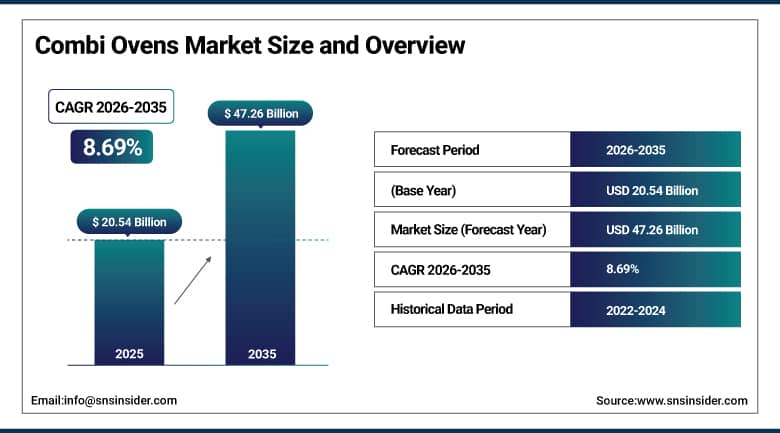
The Combi Ovens Market was valued at USD 20.54 Billion in 2025 and is expected to reach USD 47.26 Billion by 2035, growing at a CAGR of 8.69% from 2026 to 2035.
Combi Ovens Market is growing with the adoption of multi-cooking appliances that provide combined capabilities like convection, steam, and a mixture of both cooking processes into a single unit which can produce faster and more efficient output. Restaurants, hotels, and other commercial kitchens are relying more on this kitchen equipment as the chains of quick service are growing and there is an increasing need to reduce the time consumed for cooking without affecting the quality of food. The incorporation of smart control and monitoring systems in the modern day combi ovens is getting popular, whereas the pressure of sustainability is favoring electrical ovens over gas-fired ovens.
In the year 2025, Marriott International stated that they have implemented smart combi ovens at more than 200 of their hotels globally, while in 2024, Rational AG launched their iHexagon combi oven with microwave integration with steam and convection to cater the needs of cooking according to the moisture of the food.
To Get More Information On Combi Ovens Market - Request Free Sample Report
Combi Ovens Market Trends
-
Rising adoption of energy-efficient and multifunctional combi ovens is expanding across commercial kitchens of every size.
-
Growing integration of smart controls, IoT, and automation is improving cooking efficiency and consistency.
-
Restaurants, QSRs, hotels, and institutional kitchens keep demanding more consistent, higher-quality food output.
-
Foodservice and hospitality sectors are expanding quickly across emerging economies as urbanization and incomes both rise.
-
Compact, AI-enabled combi ovens tailored to small-to-medium enterprises are gaining traction for their operational efficiency.
United States Combi Ovens Market Outlook
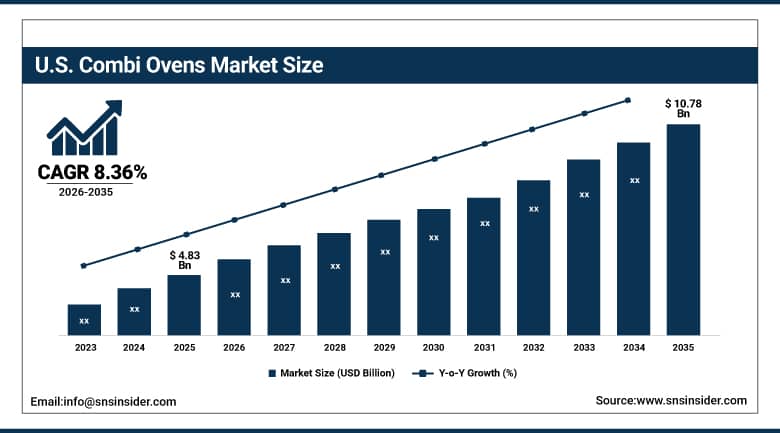
The United States Combi Ovens Market was valued at USD 4.83 Billion in 2025 and is expected to reach USD 10.78 Billion by 2035, growing at a CAGR of 8.36% from 2026 to 2035.
The US Combis Ovens Market saw growth due to the increasing demand in various restaurants, hotels, and institutional kitchens for energy-efficient and versatile cooking appliances. Innovations in technology, preference of electric over gas models due to sustainability considerations, and continuous growth of quick service restaurant and hospitality industries helped fuel the demand, and combi ovens started to be viewed by American commercial kitchen managers as a perfect solution for saving time and reducing labor costs.
In April 2024, Electrolux Professional launched SkyLine Combi Oven, which comes with digital controls, adjustable settings, and self-cleaning functions for efficient energy consumption and precise cooking processes in American and worldwide commercial kitchens.
Combi Ovens Market Segment Analysis
-
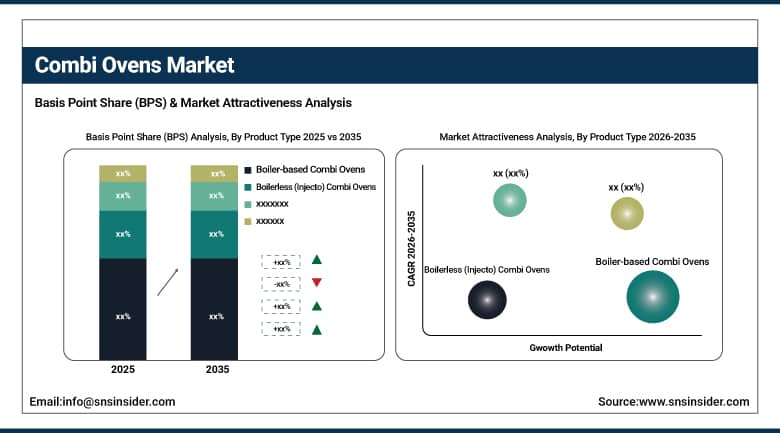
By Product Type, the boiler-based combi ovens segment dominated the Combi Ovens Market with a 57.31% share in 2025, while the boilerless (injecto) combi ovens segment is the fastest growing.
-
By Power Source, the electric combi ovens segment dominated the Combi Ovens Market with a 45.72% share in 2025 and is also the fastest growing.
-
By Capacity, the medium capacity segment dominated the Combi Ovens Market with a 42.58% share in 2025 and is also the fastest growing.
-
By End User, the restaurants & QSRs segment dominated the Combi Ovens Market with a 37.35% share in 2025 and is also the fastest growing.
By Product Type, boiler-based led the market, boilerless grew fastest
The Boiler-Based Combi Ovens was the largest segment of the Combi Ovens Market in 2025, with around 57.31% market share. The high reliability, high steam generation capacity, and ability to perform large scale cooking for hotels, institutional kitchens, and even large restaurants made this type of combi oven dominant in the market since it was the first choice of well-established commercial kitchens that had to feed a large number of customers.
The Boilerless (Injecto) Combi Ovens segment is expected to register the highest CAGR in the forecast period. Its compact size, low water and power requirements and easy to maintain nature compared to boiler-based combi ovens have resulted in their increased popularity among small and medium businesses and quick service restaurants.
By Power Source, electric led the market and grew fastest
Electric combi ovens held the dominant share in the Combi Ovens Market with about 45.72% of the market share in 2025, and were also the most rapidly growing power source segment due to their energy efficiency, reduced environmental effects, and suitability for modern kitchen design. As the need to address sustainability issues increases, alongside strict environmental regulations, the adoption of more efficient and environmentally friendly commercial kitchen equipment has grown.
Smart technology improvements have led to even more efficient and versatile electric combi ovens with features such as remote control capability. With increasing costs of setting up the gas infrastructure network, and advances in electric oven technology, the combination of these factors is expected to lead to further dominance of electric combi ovens over the forecast period.
By Capacity, medium capacity led the market and grew fastest
Medium capacity held a dominant position in the Combi Ovens Market in 2025, accounting for an estimated market share of 42.58%, and it was also the fastest-growing capacity segment. The unique nature of the medium capacity which enables high-capacity cooking at the same time being able to fit seamlessly in commercial kitchen space made it the most suitable one for hotels, quick service restaurants, and institutions which need versatile and reliable performance.
Increasing demand for effective and multi-functional cooking systems as well as expansion of the food service industry worldwide is further cementing the dominance of the medium capacity segment in its role of both the leader and the fastest-growing capacity category in the global market.
By End User, restaurants & QSRs led the market and grew fastest
The restaurants & QSRs segment dominated the Combi Ovens Market in 2025 with approximately 37.35% market share and was also the fastest-growing end user category. Rising demand for quick, consistent, high-quality food preparation continued to drive this dual leadership position, and the growth of global QSR chains, changing consumer lifestyles, and rising urbanization all continued to reinforce demand for combi ovens across expanding foodservice operations worldwide.
Adoption of combi ovens in restaurants and QSRs specifically enhances kitchen efficiency, reduces cooking time, and ensures menu consistency across multiple locations, qualities that matter enormously for chains trying to deliver the same product quality whether a customer visits one location or another halfway across the country. That consistency requirement keeps restaurants and QSRs firmly ahead of every other end-user category on both current share and forward growth.
Regional Analysis
|
Region |
Major Country |
Share within Region, 2025 (%) |
|---|---|---|
|
Europe |
Germany |
29.0% |
|
North America |
United States |
75.0% |
|
Asia Pacific |
China |
37.0% |
|
Middle East & Africa |
UAE |
28.0% |
|
Latin America |
Brazil |
40.0% |
Europe Combi Ovens Market Insights
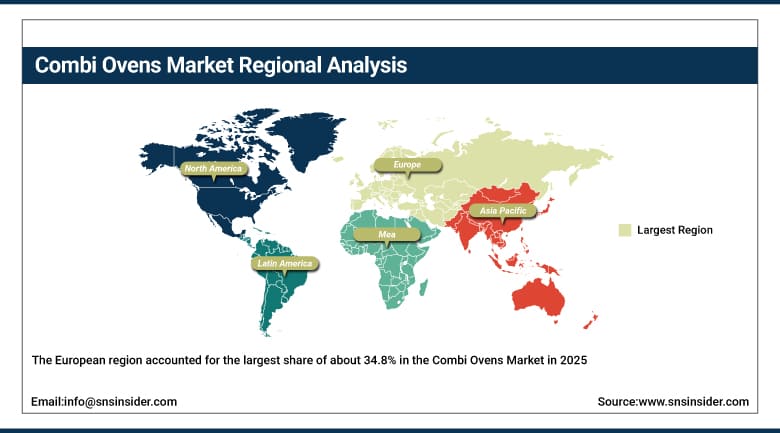
The European region accounted for the largest share of about 34.8% in the Combi Ovens Market in 2025, backed by an established foodservice industry and wide use of technologically advanced kitchen appliances in Europe. The high need for energy-efficient and multipurpose cooking solutions along with environmental regulation was boosting the growth, while the hospitality and institutional segments of the region, which value precise cooking, were sustaining the region's dominance.
The leading country in the region in 2025 was Germany, which captured about 29% of revenues in Europe, backed by its developed hospitality industry, technologically advanced foodservice industry, and early adoption of technologically advanced kitchen appliances. The adoption of IoT-enabled and advanced cooking systems was increasing, while the environmental regulations and high need for precise cooking solutions maintained the dominance of the country.
Get Customized Report as Per Your Business Requirement - Enquiry Now
North America Combi Ovens Market Insights
North America held approximately 31.53% of the global Combi Ovens Market in 2025, driven by a mature foodservice industry and high adoption of advanced kitchen technologies across the region. Strong demand from restaurants, hotels, and institutional kitchens for energy-efficient, multifunctional cooking solutions continued to support growth, and increasing focus on sustainability and compliance with environmental regulation boosted electric combi oven adoption across the region's commercial kitchen base.
The United States led North America, accounting for roughly 75% of regional revenue, driven by its large and diverse foodservice industry, high technological adoption in commercial kitchens, and strong emphasis on energy efficiency. Growing demand for multifunctional cooking solutions across restaurants and hospitality sectors continued to reinforce U.S. market leadership, and Canada contributed a smaller but steadily growing share as its own foodservice sector continued to modernize.
Asia Pacific Combi Ovens Market Insights
Asia Pacific proved to be the fastest-growing market in the Combi Ovens Market due to rapid urbanization, high levels of disposable income, and rapid growth in the foodservice industry across the region. Increased demand for convenience foods, growth in quick service restaurants, and increased adoption of advanced cooking technologies acted as the driving forces. Increased growth in tourism and hospitality, along with changes in the lifestyle of consumers, further spurred the need for efficient cooking equipment.
China remained the largest consumer in the region, contributing nearly 37% of Asia Pacific’s revenues in the market owing to growth in its foodservice industry, rapid urbanization, and increasing disposable income. High demand for efficient and advanced cooking equipment among restaurants, hotels, and institutional kitchens acted as the driving factor behind the adoption of combi ovens across the country.
MEA & Latin America Combi Ovens Market Insights
The Combi Ovens Market in Latin America and the Middle East & Africa expanded due to growing foodservice and hospitality sectors, rising urbanization, and increasing demand for efficient cooking solutions across both regions. Adoption was driven by the need for consistent food quality, reduced cooking time, and energy efficiency, and tourism growth combined with expanding quick-service restaurant chains continued to support demand, with the UAE accounting for roughly 28% of MEA revenue.
Latin America followed a similar growth pattern, with Brazil accounting for roughly 40% of regional revenue as its own hospitality and foodservice sectors continued to expand. Infrastructure limitations and skilled labor shortages in certain areas may impact growth in both regions, though opportunities exist in emerging urban markets where rising incomes and expanding restaurant chains continue to widen the addressable customer base for combi oven manufacturers.
Market Dynamics
Growth Drivers: Growing demand for versatile, energy-efficient combi ovens
The main drivers behind the growth of the Combi Ovens Market include the rising demand for efficient and flexible cooking solutions among commercial kitchen operators. The adoption of combi ovens in restaurants, quick service restaurants, hotels, and institutional kitchens is being influenced by the increasing need for fast cooking, high food quality standards, and decreased cost of labor. Sustainability practices are also driving the demand towards electric combi ovens and are backed up by government regulations and environmental initiatives globally.
As an example of how many large hotels have already adopted combi ovens in their kitchens, one can use the case of Marriott International, which rolled out smart combi ovens into 200 hotels across the globe. Following the example of other big hotel chains, we may expect the demand for combi ovens capable of ensuring both high quality and sustainability to increase throughout the entire forecast period.
Restraints: Operational complexity and skilled labor shortages
Key restraints for the Combi Ovens Market include the complexity of operation, which requires skilled labor that is not always readily available, particularly in smaller foodservice businesses that may lack dedicated kitchen technology staff. Limited awareness of advanced combi oven benefits among smaller operators, combined with genuine space constraints in compact kitchens, continues to slow adoption even where the underlying value proposition of faster, more consistent cooking is well understood.
Inconsistent electricity supply in certain regions poses a further obstacle, particularly for electric combi ovens that depend on stable power to deliver their full efficiency benefits, and maintenance challenges for high-tech models can also slow adoption despite otherwise growing demand globally. Smaller operators in particular may find it hard to justify the technical support and training investment that getting full value from a modern combi oven genuinely requires.
Opportunities: Expanding foodservice sectors and AI-driven innovation
Market opportunities come from growth in foodservices and hospitality industries within developing economies such as China, India, and Southeast Asia, driven by increasing levels of urbanization and disposable incomes resulting in higher demands for commercial kitchen equipment. Manufacturing firms may benefit from innovations related to development of efficient, multi-purpose ovens designed for small and medium-size businesses that do not require as much equipment as large companies.
Application of artificial intelligence and data analytics in combi ovens provides additional opportunities for achieving high accuracy of cooking and improving operational efficiency using products such as Rational AG's iHexagon combi oven with integrated microwave, convection, and steam cooking technologies tailored to particular food features. Combis ovens with smart cooking options are increasingly becoming popular, and manufacturers prepared to offer advanced cooking technology solutions are likely to meet rising demand up until 2035.
Recent Developments:
-
2024: Unox unveiled its X-Generation ovens in the UK market, the most powerful series of products the brand had created, alongside plans to launch its OPTIC.Cooking accessory, which uses an optical sensor and adaptive AI to automatically recognize food and start the corresponding cooking program.
-
2024: Fagor Professional announced plans to launch its new iKORE Kompact range along with a matching set of accessories, expanding its compact combi oven lineup for smaller commercial kitchens and space-constrained foodservice operations.
-
2024: Convotherm advanced its ConvoSense fully automatic cooking technology, combining artificial intelligence and cutting-edge sensor technology to open new possibilities in automated food preparation across its combi oven product line.
Combi Ovens Market key players are:
-
Rational AG
-
Electrolux Professional
-
Alto-Shaam, Inc.
-
Middleby Corporation
-
UNOX S.p.A
-
Henny Penny Corporation
-
Convotherm Elektrogeräte GmbH
-
Fagor Industrial
-
LAINOX Ali Group S.r.l.
-
MKN Maschinenfabrik
-
Vulcan
-
G.S. Blodgett Oven Company
-
Angelo Po Grandi Cucine S.p.A.
-
Eloma GmbH
-
Hounö
-
Prince Engineering
-
Öztiryakiler
-
Retigo s.r.o.
-
TurboChef Technologies, Inc.
-
Giorik S.p.A.
Combi Ovens Market Report Scope:
| Report Attributes | Details |
|---|---|
| Market Size in 2025 | USD 20.54 Billion |
| Market Size by 2035 | USD 47.26 Billion |
| CAGR | CAGR of 8.69% From 2026 to 2035 |
| Base Year | 2025 |
| Forecast Period | 2026-2035 |
| Historical Data | 2022-2024 |
| Report Scope & Coverage | Market Size, Segments Analysis, Competitive Landscape, Regional Analysis, DROC & SWOT Analysis, Forecast Outlook |
| Key Segments | • by Product Type (Boiler-based Combi Ovens and Boilerless (Injecto) Combi Ovens) • by Power Source (Electric Combi Ovens and Gas Combi Ovens) • by Capacity (Low Capacity, Medium Capacity, and High Capacity) • by End User (Restaurants & Quick-Service Restaurants (QSRs), Hotels & Hospitality, Bakeries & Confectioneries, and Institutional Kitchens) |
| Regional Analysis/Coverage | North America (US, Canada, Mexico), Europe (Eastern Europe [Poland, Romania, Hungary, Turkey, Rest of Eastern Europe] Western Europe] Germany, France, UK, Italy, Spain, Netherlands, Switzerland, Austria, Rest of Western Europe]), Asia Pacific (China, India, Japan, South Korea, Vietnam, Singapore, Australia, Rest of Asia Pacific), Middle East & Africa (Middle East [UAE, Egypt, Saudi Arabia, Qatar, Rest of Middle East], Africa [Nigeria, South Africa, Rest of Africa], Latin America (Brazil, Argentina, Colombia, Rest of Latin America) |
| Company Profiles | Rational AG, Electrolux Professional, Alto-Shaam, Inc., Middleby Corporation, UNOX S.p.A, Henny Penny Corporation, Convotherm Elektrogeräte GmbH, Fagor Industrial, LAINOX Ali Group S.r.l., MKN Maschinenfabrik, Vulcan, G.S. Blodgett Oven Company, Angelo Po, Grandi Cucine S.p.A., Eloma GmbH, Hounö, Prince Engineering], Öztiryakiler, Retigo s.r.o., TurboChef Technologies, Inc., Giorik S.p.A. |
Frequently Asked Questions
The key drivers are rising demand for energy-efficient, multifunctional cooking solutions in the expanding foodservice and hospitality sectors globally.
The Combi Ovens Market was valued at USD 20.54 Billion in 2025 and is expected to reach USD 47.26 Billion by 2035.
Europe dominated the Combi Ovens Market in 2025.
The Combi Ovens Market is expected to grow at a CAGR of 8.69% from 2026 to 2035.
