
Continuous Integration Tools Market Report Scope & Overview:
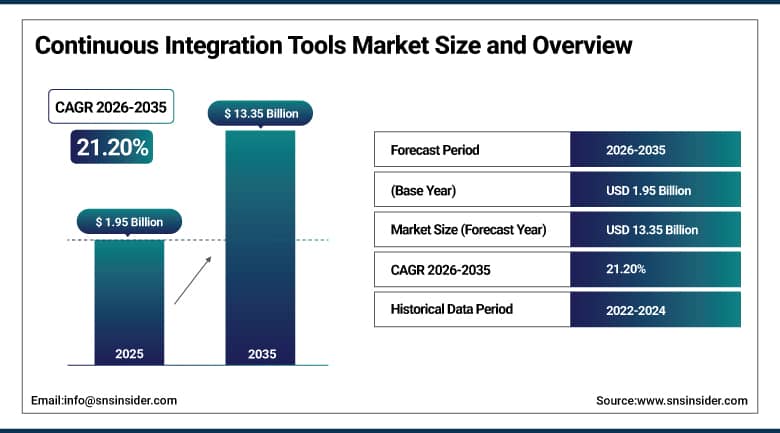
The Continuous Integration Tools Market was valued at USD 1.95 Billion in 2025 and is expected to reach USD 13.35 Billion by 2035, growing at a CAGR of 21.20% from 2026 to 2035.
The Continuous Integration Tools Market is seeing an exponential increase because organizations from almost all industries are rapidly embracing agile and DevOps development methodologies so that they can minimize their release cycles and enhance software quality. Continuous integration tools automate the process of integration of the source code into a common repository where automated builds are performed followed by running tests, thereby helping organizations to find out defects early and deliver their software products with much more confidence. There is increased interest in cloud-native applications, microservices, and applications developed using containers such as Docker and Kubernetes, and hence the need for CI solutions that can scale automatically in a multi-cloud environment is high.
In 2026, CircleCI introduced its Chunk AI agent alongside Model Context Protocol (MCP) server integration, enabling AI coding assistants such as Claude Desktop and Cursor to trigger builds, diagnose pipeline failures, and validate configurations directly through natural-language commands.
To Get More Information On Continuous Integration Tools Market - Request Free Sample Report
Continuous Integration Tools Market Trends:
-
Rising integration of generative AI for automated pipeline configuration, log analysis, and root-cause diagnosis of build failures.
-
Growing adoption of DevSecOps practices that embed security scanning and compliance checks directly within CI pipelines.
-
Expanding use of hybrid deployment models that balance cloud-native scalability with on-premises data-sovereignty requirements.
-
Increasing consolidation among CI/CD vendors through platform expansion, native version-control integrations, and acquisitions.
-
Rising demand for CI tooling tailored to containerized, Kubernetes-based, and microservices-driven application architectures.
U.S. Continuous Integration Tools Market Outlook:
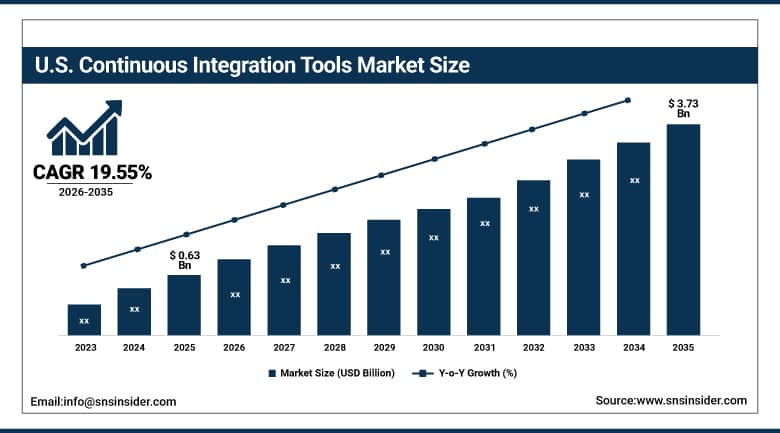
The U.S. Continuous Integration Tools Market was valued at USD 0.63 Billion in 2025 and is projected to reach USD 3.73 Billion by 2035, growing at a CAGR of 19.55% during 2026–2035.
The presence of a large number of hyperscale cloud companies, enterprise software players, and innovative businesses in the country continues to support its dominance in the region. The growing use of DevOps and agile practices among enterprises along with huge investments in cloud technologies and application development using containers will continue to propel the demand for CI platforms in sectors such as BFSI, healthcare, and IT services. In the United States, enterprises are preferring CI solutions that offer native integration with AI-powered development platforms where developers can troubleshoot problems and initiate builds through conversation rather than setting up the build pipeline manually.
In March 2025, GitLab released GitLab 17.10, extending Root Cause Analysis to GitLab Duo Self-Hosted deployments and enabling U.S. enterprises with strict data-sovereignty requirements to troubleshoot failed CI/CD pipeline jobs using self-hosted large language models.
Continuous Integration Tools Market Segment Analysis:
-
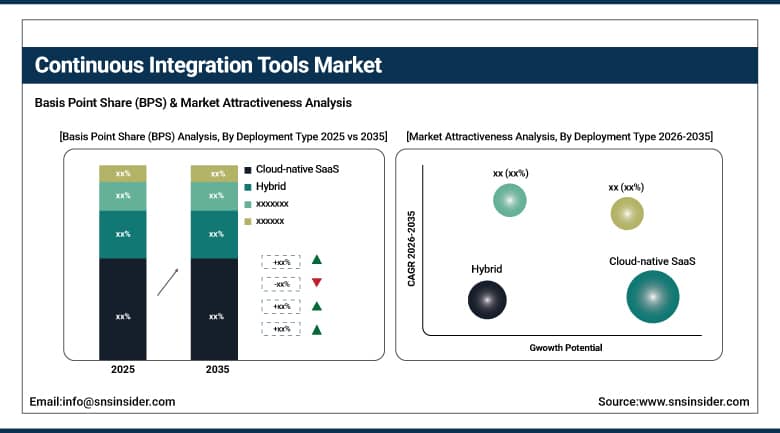
By Deployment Type, Cloud-native SaaS dominated the Continuous Integration Tools Market with a 52.30% share in 2025, while Hybrid is the fastest-growing deployment segment with a CAGR of 24.60% from 2026–2035.
-
By Organization Size, Large Enterprises dominated the Continuous Integration Tools Market with a 59.80% share in 2025, while Small & Medium Enterprises is the fastest-growing organization-size segment with a CAGR of 23.10% from 2026–2035.
-
By Application, Build Automation dominated the Continuous Integration Tools Market with a 28.40% share in 2025, while Testing Automation is the fastest-growing application segment with a CAGR of 24.90% from 2026–2035.
-
By End-User Industry, IT & Telecommunications dominated the Continuous Integration Tools Market with a 25.70% share in 2025, while Healthcare & Life Sciences is the fastest-growing end-user segment with a CAGR of 23.40% from 2026–2035.
By Deployment Type, Cloud-native SaaS leads while Hybrid grows fastest.
Cloud-native SaaS held the leading position with a 52.30% revenue share in the Continuous Integration Tools Market in 2025. The Cloud-native platforms bring together the benefits of automated builds of continuous integration and scalability offered by cloud computing into one single platform, allowing teams to perform parallel builds and testing in container-based dynamic environment without handling any infrastructure. Their easy adoption and pricing model have kept their dominance intact even in large enterprises and growing development teams.
Hybrid deployment is expected to register the fastest CAGR of 24.60% during 2026-2035. The industries such as BFSI, Healthcare, and Government are testing out hybrid models of development where critical source codes and build artifact remain in on-premise servers while less critical components make use of cloud infrastructure for scalability.
By Organization Size, Large Enterprises lead while SMEs grow fastest.
Large Enterprises accounted for a 59.80% share of the Continuous Integration Tools Market in 2025. Organizations need a CI system that can handle parallel pipelines, plugin compatibility, and enterprise-level governance due to their complexity and multiple teams in handling software projects, which makes them the main target of license fees from CI tool vendors.
Small & Medium Enterprises are expected to grow at the fastest rate of 23.10% during 2026-2035. As the cost-effective cloud-based CI tools become available to small teams, the adoption of DevOps becomes easier for them to compete in release velocity and software quality.
By Application, Build Automation leads while Testing Automation grows fastest.
Build Automation accounted for a market share of 28.40% in the Continuous Integration Tools Market for the year 2025. As the primary element of the CI process, build automation is still the most widely used tool among the development teams of all sizes and represents the starting point for implementing continuous integration into the organization’s processes.
The Testing Automation segment is estimated to have the highest CAGR of 24.90% during the forecast period till 2035. Increased code complexity and the emergence of AI code generation require more frequent test runs to ensure high-quality code, resulting in higher investments in the field of testing automation and detection of flaky tests assisted by AI.
By End-User Industry, IT & Telecommunications leads while Healthcare & Life Sciences grows fastest.
The IT & Telecommunication category held a share of 25.70% of the Continuous Integration Tools Market in 2025. Software vendors and telecommunication companies having huge and regularly evolving software portfolios will still remain the biggest and the most experienced adopters of continuous integration solutions, as they have to sustain fast release cycles for their geographically dispersed engineering teams.
The Healthcare & Life Sciences segment is predicted to witness the highest CAGR of 23.40%. The increasing digitization of healthcare software along with the increasing software validation regulatory requirements is pushing healthcare providers to implement CI solutions with embedded automation and quality control.
Regional Analysis:
|
Region |
Major Country |
Share within Region, 2025 (%) |
|---|---|---|
|
North America |
United States |
83.40% |
|
Europe |
United Kingdom |
24.10% |
|
Asia Pacific |
China |
33.60% |
|
Middle East & Africa |
UAE |
26.80% |
|
Latin America |
Brazil |
29.70% |
North America Continuous Integration Tools Market Insights
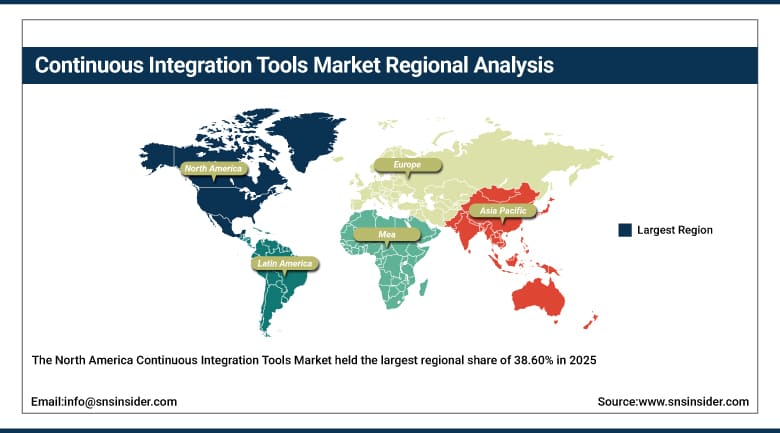
The North America Continuous Integration Tools Market held the largest regional share of 38.60% in 2025, owing to the presence of a considerable number of hyperscale cloud companies, enterprise software companies, and technology firms that have an advanced DevOps environment. The demand is supplemented due to high investments made in cloud infrastructure along with the adoption of AI-based development and automation pipelines.
The United States accounted for 83.40% of the North America Continuous Integration Tools Market in 2025, due to the high presence of technology companies in the country and heavy investments made by them in cloud infrastructure, as well as the early adoption of CI systems integrated with AI.
Get Customized Report as Per Your Business Requirement - Enquiry Now
Europe Continuous Integration Tools Market Insights
The Europe Continuous Integration Tools Market remained a significant contributor to global revenue in 2025 and is expected to maintain steady growth through the forecast period, supported by a large base of financial services, manufacturing, and technology enterprises undergoing digital transformation. Strict data-protection and software-compliance regulations across the European Union are encouraging organizations to adopt hybrid and self-hosted CI architectures.
The United Kingdom led the Europe Continuous Integration Tools Market with a 24.10% share in 2025, reflecting its position as a hub for financial technology and enterprise software development. Germany, France, and the Nordics, each home to substantial manufacturing and technology sectors, are also contributing meaningfully to regional demand through expanding DevOps and cloud-migration initiatives.
Asia Pacific Continuous Integration Tools Market Insights
The Asia Pacific Continuous Integration Tools Market is expected to grow at the fastest pace of 24.80% during 2026-2035 due to rapid expansion of the software-developers' base in the region, increasing investments in cloud infrastructure, and adoption of DevOps approach in enterprises in China, India, and Southeast Asia. Growth in local technology industry and digitization initiatives backed by the governments are fueling the adoption of CI tools.
China accounted for 33.60% of the Asia Pacific Continuous Integration Tools Market share in 2025, owing to its strong local technology industry and continued investments in modernizing enterprise software. India and Japan, both being leading centers of software development and IT services, are adding on to the growth of the region due to their increasing outsourced software development activities.
Middle East & Africa and Latin America Continuous Integration Tools Market Insights
Continuous integration solutions have been gaining traction within both the Middle East & Africa and Latin America markets as regional companies push for digital transformation efforts and develop their software development capabilities amid growing government spending on technology infrastructure in both markets.
The UAE accounted for 26.80% of the Middle East & Africa Continuous Integration Tools Market in 2025, driven by its position as a regional technology and financial hub with strong cloud-infrastructure investment. Brazil accounted for 29.70% of the Latin American Continuous Integration Tools Market due to its large domestic software-development industry and growing enterprise DevOps adoption.
Market Dynamics:
Growth Drivers: Rapid DevOps adoption and compressed release cycles driving market growth
Enterprises across nearly every industry are pushing out new software builds from weeks down to mere hours through investment in CI tools that automate code development and validation. In addition, the adoption of microservices and containerization systems like Docker and Kubernetes continues to create the need for CI systems that are able to coordinate complex, distributed build processes in cloud infrastructure.
Moreover, the introduction of generative AI in pipeline creation, problem detection, and test generation is reducing the technical barrier that comes with CI implementation, making it easier for smaller development teams to attain release velocity that was earlier possible only in resource-rich engineering teams. Increased importance of DevSecOps by enterprises as they look to integrate compliance and security checks within build pipelines has made CI more valuable.
Restraints: Pipeline security concerns and integration complexity limiting market expansion
Increasing issues related to CI pipeline security, such as risk of secret exposure, vulnerability due to dependencies and supply chain risk due to third-party plugins used, are making it harder for security-minded companies to adopt CI pipelines. The use of CI tools in an already fragmented environment of version control tools, cloud-based solutions, and legacy on-premises solutions makes the problem even more challenging for enterprises.
Moreover, the cost and specialized expertise required to configure and maintain complex, multi-stage pipelines can be prohibitive for smaller organizations, particularly those operating legacy monolithic applications that are difficult to adapt to modern CI workflows. Regulatory requirements around software validation in industries such as healthcare and financial services also add compliance overhead to pipeline design.
Opportunities: AI-assisted pipeline automation and DevSecOps convergence creating new growth avenues
The emergence of fast-growing technologies related to artificial intelligence-based pipeline construction, debugging pipelines via natural language processing, and automatic test creation is an interesting opportunity for continuous integration service providers, since these features might allow saving the knowledge needed for developing CI systems.
There is also considerable opportunity in the convergence of continuous integration with DevSecOps as organizations look to integrate their continuous integration platforms with build automation and security scanning features. Digital transformation spending in emerging markets such as those found in the Asia-Pacific, Latin American and Middle Eastern regions continues to expand the market for CI platforms.
Recent Developments:
-
2026: CircleCI launched native GitLab integration, enabling GitLab SaaS and self-managed users to build, test and deploy directly on the CircleCI platform.
-
2026: CircleCI introduced its Chunk AI agent and Model Context Protocol (MCP) server integration allowing AI coding tools to trigger builds and diagnose pipeline failures using natural language.
-
2025: GitLab released GitLab 17.10, extending Duo Root Cause Analysis to self-hosted deployments and introducing Duo Code Review Beta for enterprise CI/CD pipelines.
-
2025: JFrog introduced advanced contextual analysis security capabilities within JFrog Xray, strengthening its DevSecOps platform's ability to detect and prioritize vulnerabilities across CI/CD pipelines.
Continuous Integration Tools Market key players are:
-
Microsoft Corporation
-
GitHub, Inc.
-
GitLab Inc.
-
Atlassian Corporation
-
CloudBees, Inc.
-
JetBrains s.r.o.
-
CircleCI, Inc.
-
JFrog Ltd.
-
Harness, Inc.
-
Broadcom Inc.
-
IBM Corporation
-
Red Hat, Inc.
-
Oracle Corporation
-
Amazon Web Services, Inc.
-
Google LLC
-
Perforce Software, Inc.
-
SmartBear Software, Inc.
-
Travis CI GmbH
-
SonarSource SA
-
Digital.ai Software, Inc.
Continuous Integration Tools Market Report Scope:
| Report Attributes | Details |
|---|---|
| Market Size in 2025 | USD 1.95 Billion |
| Market Size by 2035 | USD 13.35 Billion |
| CAGR | CAGR of 21.20% From 2026 to 2035 |
| Base Year | 2025 |
| Forecast Period | 2026-2035 |
| Historical Data | 2022-2024 |
| Report Scope & Coverage | Market Size, Segments Analysis, Competitive Landscape, Regional Analysis, DROC & SWOT Analysis, Forecast Outlook |
| Key Segments | • By Deployment Type (Cloud-native SaaS, On-Premise, Hybrid) • By Organization Size (Large Enterprises, Small & Medium Enterprises (SMEs)) • By Application (Build Automation, Testing Automation, Deployment Automation, Monitoring & Reporting) • By End-User Industry (IT & Telecommunications, BFSI, Healthcare & Life Sciences, Retail & E-commerce, Others) |
| Regional Analysis/Coverage | North America (US, Canada), Europe (Germany, UK, France, Italy, Spain, Russia, Poland, Rest of Europe), Asia Pacific (China, India, Japan, South Korea, Australia, ASEAN Countries, Rest of Asia Pacific), Middle East & Africa (UAE, Saudi Arabia, Qatar, South Africa, Rest of Middle East & Africa), Latin America (Brazil, Argentina, Mexico, Colombia, Rest of Latin America). |
| Company Profiles | Microsoft Corporation, GitHub, Inc., GitLab Inc., Atlassian Corporation, CloudBees, Inc., JetBrains s.r.o., CircleCI, Inc., JFrog Ltd., Harness, Inc., Broadcom Inc., IBM Corporation, Red Hat, Inc., Oracle Corporation, Amazon Web Services, Inc., Google LLC, Perforce Software, Inc., SmartBear Software, Inc., Travis CI GmbH, SonarSource SA, Digital.ai Software, Inc. |

Frequently Asked Questions
Key players in the Continuous Integration Tools Market include Microsoft, GitHub, GitLab, Atlassian, CloudBees, JetBrains, CircleCI, JFrog, and Harness, among other providers.
Key opportunities include AI-assisted pipeline configuration, automated failure analysis, DevSecOps integration within pipelines, and rising hybrid-cloud adoption across regulated, compliance-driven industries.
The market is driven by rapid DevOps adoption, compressed release cycles, multi-cloud adoption, and rising integration of AI-assisted testing and security automation.
The Cloud-native SaaS segment dominated the Continuous Integration Tools Market, accounting for 52.30% share in 2025, driven by scalability and DevOps adoption.
The North America region dominated the Continuous Integration Tools Market in 2025 with a 38.60% share, backed by DevOps and cloud adoption.
