
Application Integration Market Report Scope and Overview:
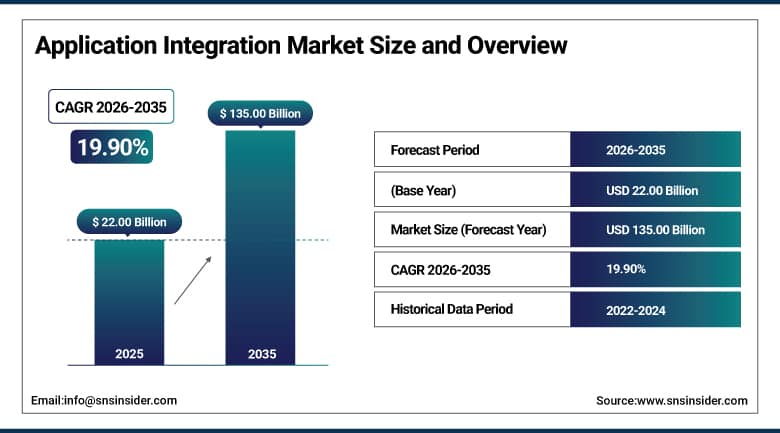
The Application Integration Market was valued at USD 22.00 Billion in 2025 and is projected to reach USD 135.00 Billion by 2035, registering a CAGR of 19.90% from 2026 to 2035.
The Application Integration Market encompasses all the software and services that help integrate and coordinate different enterprise applications, systems, and databases to ensure smooth communication and interaction among them. The market is largely dominated by companies operating in different industries like BFSI, IT & Telecom, Healthcare, Retail, Manufacturing, Government, and others, and it helps to reduce the cost of integration and data management. This market is characterized by rapid cloud adoption, accelerating digital transformation initiatives, rising demand for real-time and event-driven data sharing, and growing expansion of AI-driven and low-code integration platforms that reduce the complexity traditionally associated with connecting diverse legacy and modern enterprise systems across on-premises, hybrid, and multi-cloud environments worldwide.
API-led connectivity, partnerships between platform vendors and cloud hyperscalers, and expansion of generative AI-powered integration assistants have followed heavy investment from large enterprises, small and medium businesses, and system integrators pursuing faster, more resilient application connectivity.
To Get More Information On Application Integration Market - Request Free Sample Report
Application Integration Market Trends
-
Rising adoption of event-driven architectures continues accelerating real-time integration platform deployment.
-
Growing expansion of AI-driven and low-code platforms continues lowering barriers to enterprise integration adoption.
-
Expanding API-led connectivity is broadening demand for microservices-based integration architectures.
-
Increasing enterprise shift toward cloud and SaaS platforms continues driving iPaaS solution adoption.
-
Growing focus on data governance and security continues shaping enterprise integration platform selection.
U.S. Application Integration Market Outlook
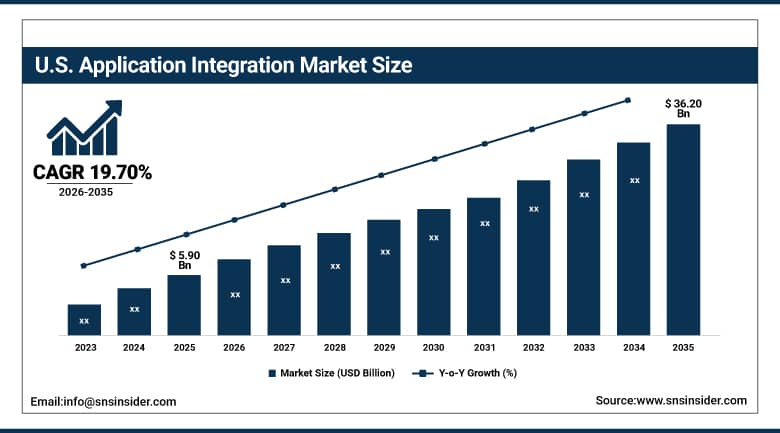
The U.S. Application Integration Market was valued at approximately USD 5.90 Billion in 2025 and is projected to reach approximately USD 36.20 Billion by 2035, registering a CAGR of approximately 19.70% from 2026 to 2035.
Demand in the United States has been driven by a high concentration of large enterprises, advanced IT infrastructure, and early adoption of cloud and API-based integration solutions. Strong presence of leading platform vendors and high digital transformation spending continue reinforcing U.S. leadership, while growing enterprise investment in AI-powered and event-driven integration architectures has further accelerated platform adoption across BFSI, healthcare, and technology sectors.
The use of AI-powered data management and integration platforms was highly important for consolidating the leadership of the U.S. application integration market. In addition, growing deployment of low-code and no-code integration tools among small and medium enterprises drove further demand for the product across the domestic market.
Application Integration Market Segment Analysis
-
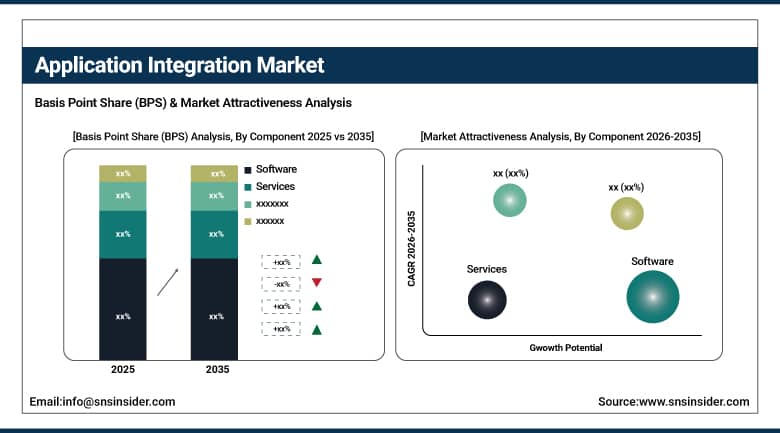
By Component, Software segment dominated the Market in 2025 with 58.60% share; Services segment is the fastest growing segment, registering a CAGR of approximately 22.40%.
-
By Integration Type, Application to Application (A2A) segment dominated the market in 2025 with 28.70% share; API Integration segment is the fastest growing segment, registering a CAGR of approximately 24.60%.
-
By Deployment, On-Premise segment dominated the market in 2025 with 52.80% share; Cloud segment is the fastest growing segment, registering a CAGR of approximately 25.20%.
-
By Enterprise Type, Large Enterprises segment dominated the market in 2025 with 64.50% share; Small & Medium Enterprises segment is the fastest growing segment, registering a CAGR of approximately 23.80%.
-
By Industry, BFSI segment dominated the market in 2025 with 24.60% share; Healthcare segment is the fastest growing segment, registering a CAGR of approximately 25.80%.
By Component, Software Dominates the Application Integration Market While Services Grows Fastest
Software commanded the leading share of the Application Integration Market in 2025 at approximately 58.60%, considering companies tend to make huge investments in integration platforms, middleware and iPaaS, which essentially serve as the core integration layer. Launch of Informatica's IDMC platform, providing enhanced data management solutions powered by AI, explains why companies prefer purchasing software rather than services in the process of integration solutions implementation.
Services are projected to expand at a CAGR of approximately 22.40%, due to increased need for consulting, customizing and managed services in order to overcome complex hybrid landscapes and skills shortages. Growth is further stimulated by growing demand for customized implementation assistance in view of the shortage of skilled integration professionals globally.
By Integration Type, A2A Dominates the Application Integration Market While API Integration Grows Fastest
Application to Application (A2A) integration held the largest share in 2025 at approximately 28.70%, due to the high number of legacy or enterprise applications that require constant connection through point-to-point or hub-and-spoke networking. Such an integration paradigm is deeply entrenched within the mature IT environment of an enterprise, thereby emphasizing its dominance within such enterprises.
API Integration is projected to expand at a CAGR of approximately 24.60%, the fastest pace among integration type categories, as businesses rapidly modernize toward microservices, open APIs, and ecosystem connectivity for real-time digital services. Platforms such as MuleSoft's Anypoint Platform, incorporating agentic AI capabilities alongside API-led connectivity, exemplify the growing shift toward flexible, developer-friendly integration architectures.
By Deployment, On-Premise Leads the Application Integration Market While Cloud Grows Fastest
The On-Premise deployment segment held the highest market share in 2025 at approximately 52.80%, as there still exists a lot of mission-critical integrations dependent on legacy systems, data locality needs and investments made in middleware on-premise. This type of deployment is still the foundation for enterprise-level deployments that have strong needs for compliance and control.
The fastest growing deployment type is expected to be Cloud deployment, which is expected to see a CAGR of 25.20% as companies migrate their workloads to SaaS and public clouds in order to find scalable and subscription-based integration capabilities. The development of cloud iPaaS capabilities by vendors supports this trend.
By Enterprise Type, Large Enterprises Lead the Application Integration Market While SMEs Grow Fastest
Large Enterprises emerged as the leading segment in 2025, accounting for approximately 64.50% of total revenue due to their highly complex landscape of application integration across multiple regions and business units, which makes them spend much more on the process of integration. Their huge budgets in the field of IT and integration make large enterprises a natural anchor segment.
Small & Medium Enterprises are projected to grow at the fastest pace, registering a CAGR of approximately 23.80%, due to affordable cloud-based and low-code integration technologies that decrease entry barriers and make sophisticated integration possible and affordable for small and medium enterprises. Subscription pricing of iPaaS solutions has made SMEs an increasingly significant customer segment.
By Industry, BFSI Dominates the Application Integration Market While Healthcare Grows Fastest
The BFSI industry had the highest market share in 2025 at about 24.60%, due to its high reliance on integration which helps link core banking applications, payment systems, risk management systems and regulatory systems. Compliance issues and the need for security have strengthened the BFSI industry’s position within all industry verticals' integration spend.
The healthcare industry is forecasted to grow at a CAGR of 25.80% which is faster than other industry verticals. This will be achieved through increased interoperability efforts, connectivity of EHR systems and data sharing aimed at enhancing patient outcomes. The growing importance of data interoperability regulations within the healthcare industry will continue to drive this growth.
Regional Analysis:
|
Region |
Major Country |
Share within Region, 2025 (%) |
|---|---|---|
|
North America |
United States |
80.00% |
|
Europe |
Germany |
24.00% |
|
Asia Pacific |
China |
32.00% |
|
Middle East and Africa |
GCC |
28.00% |
|
Latin America |
Brazil |
50.00% |
North America Application Integration Market Insights
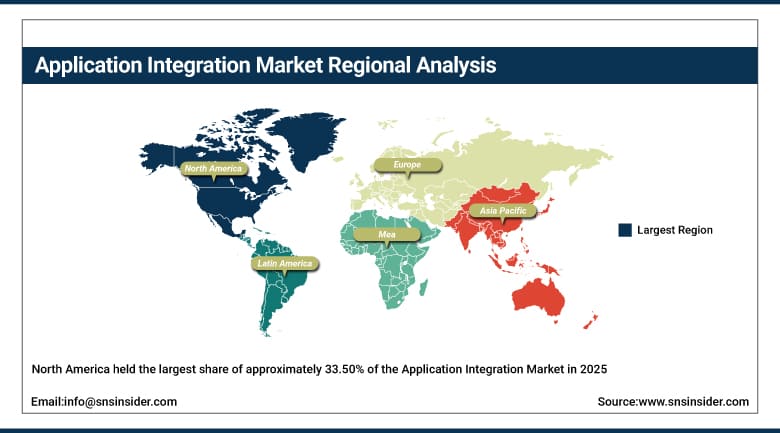
North America held the largest share of approximately 33.50% of the Application Integration Market in 2025, driven by a high concentration of large enterprises, advanced IT infrastructure, and early adoption of cloud and API-based integration solutions. Strong presence of leading platform vendors and high digital transformation spending continue reinforcing the region's dominant position across the forecast period.
The U.S. accounted for approximately 80.00% of the overall North American revenue share, primarily because of its mature technology ecosystem, concentration of leading integration platform vendors, and rising enterprise investment in AI-powered and event-driven integration architectures across BFSI, healthcare, and technology sectors.
Get Customized Report as Per Your Business Requirement - Enquiry Now
Europe Application Integration Market Insights
Europe held a substantial share of the Application Integration Market, as organizations across BFSI, manufacturing, and the public sector invest heavily in integration to meet regulatory requirements and support complex cross-border operations. Ongoing modernization of legacy systems and emphasis on data governance continue sustaining robust demand for integration platforms across the region.
Germany led the European market in revenue terms, accounting for approximately 24.00% of regional share, driven by growing adoption of AIoT and data analytics boosting digital transformation across manufacturing and financial services. The United Kingdom and France remained important contributors to regional demand owing to strong digital transformation initiatives and increased government spending on integration infrastructure.
Asia Pacific Application Integration Market Insights
Asia Pacific is forecast to be the fastest-growing region, expanding at an approximate CAGR of 22.80% from 2026 to 2035. This growth has been majorly fueled by enterprises in China, India, and Southeast Asia rapidly adopting cloud services, SaaS applications, and digital platforms, supported by growing investments in IT modernization and expanding small and medium enterprise activity across the region.
China accounted for the majority share of Asia Pacific revenue at approximately 32.00%, attributed to the spread of IoT and big data technology boosting growth of application integration adoption. Rising investment in latest technologies across India and rapid technological advancements in Japan were similarly responsible for accelerating Asia Pacific's overall growth trajectory across the forecast period.
MEA and Latin America Application Integration Market Insights
The Middle East & Africa and Latin America witnessed steady growth as governments and enterprises ramp up digital transformation programs and smart infrastructure projects. Increasing cloud adoption and rising focus on improving connectivity across financial, telecom, and public services have positioned both regions as increasingly important markets for application integration platforms over the coming decade.
In the Middle East & Africa, the GCC led regional demand, accounting for approximately 28.00% of regional share, driven by increasing demand for digital transformation amid a changing network ecosystem. In Latin America, Brazil remained the largest market, accounting for approximately 50.00% of regional share, owing to growing adoption of IT solutions and rising enterprise investment in integration infrastructure.
Growth Drivers: Rising Need for Seamless Real-Time Data Exchange
The market progresses owing to the increasing demand for real-time data synchronization which is becoming increasingly important in light of the way businesses are operating within complex and interconnected ecosystems of applications, where instant data transfer is essential for making decisions and sustaining operations. The importance of real-time data integration has been augmented by the rise of cloud solutions and SaaS products, making this capability essential for business success around the world.
Further proof includes the increasing demand for getting rid of inefficient data silos and boosting productivity, along with the demand for automating business processes which are critical to the operations of BFSI, healthcare and manufacturing industries. The ongoing trend in improving interoperability and digital performance around the world will be a contributing factor to this effect.
Restraints: High Complexity and Cost of Integration
High cost and complexity of the integration process, as well as issues of security and privacy of the data involved, are still restraining wider market adoption due to difficulties experienced by companies in terms of integrating legacy systems with new cloud-based software. In fact, many firms still use legacy systems that make it difficult for companies to integrate applications, especially taking into account the increasing problems with API management and secure connection of applications and systems.
Application integration is a quite costly and complex process that involves a lot of expenses related to the need for special technical expertise and high level of customization. This becomes an additional obstacle in the way of widespread adoption of such tools among smaller companies.
Opportunities: Expansion of AI-Driven and Low-Code Integration Platforms
The growth of AI-integration and low-code integration platforms is a huge chance for the industry, as the use of these solutions allows for the simplification of the integration process that used to be very complex. For example, integration platform solutions from Boomi and Workato are a good illustration of how vendors leverage this growing trend in order to make a difference on the market for enterprise and SME clients.
Integration platforms automate a great number of integration activities and allow for non-technical users to manage integrations on their own, taking the burden off the shoulders of organizations due to a severe shortage of professional integrators worldwide. The success of the vendors in this process will be determined by the speed with which they help their clients transform digitally.
Recent Developments:
-
2025: Informatica unveiled AI-powered data management enhancements within its IDMC platform, aimed at providing more reliable and AI-ready data across the enterprise.
-
2025: HID launched its Integration Service to unify physical security, cybersecurity, and digital identity management, simplifying complex security infrastructure management.
-
2025: Boomi expanded its AI-powered integration platform with new low-code capabilities targeting enterprise customers managing hybrid application environments.
-
2025: Workato introduced an enhanced enterprise automation platform featuring expanded AI agent orchestration for complex, multi-system workflows.
-
2025: SAP integrated new API management capabilities into its Integration Suite, strengthening connectivity between cloud and on-premises enterprise applications.
-
2025: MuleSoft expanded its Anypoint Platform with new agentic AI integration capabilities, enabling automated workflow orchestration across connected systems.
-
2026: Software AG launched an enhanced webMethods integration platform featuring expanded hybrid cloud connectivity for enterprise digital transformation initiatives.
-
2026: SnapLogic introduced a new generative AI-powered integration assistant designed to accelerate enterprise integration design and deployment.
Application Integration Market key players are:
-
Salesforce, Inc.
-
IBM Corporation
-
SAP SE
-
Microsoft Corporation
-
Informatica Inc.
-
MuleSoft, LLC
-
Boomi, LP
-
Software AG
-
TIBCO Software Inc.
-
Workato, Inc.
-
Talend
-
Celigo, Inc.
-
WSO2 LLC
-
InterSystems Corporation
-
SEEBURGER AG
-
Magic Software Enterprises Ltd.
-
Jitterbit, Inc.
-
Zapier Inc.
Application Integration Market Report Scope:
| Report Attributes | Details |
|---|---|
| Market Size in 2025 | USD 22.00 Billion |
| Market Size by 2035 | USD 135.00 Billion |
| CAGR | CAGR of 19.90% From 2026 to 2035 |
| Base Year | 2025 |
| Forecast Period | 2026-2035 |
| Historical Data | 2022-2024 |
| Report Scope & Coverage | Market Size, Segments Analysis, Competitive Landscape, Regional Analysis, DROC & SWOT Analysis, Forecast Outlook |
| Key Segments | • By Component (Software, Services) • By Integration Type (Application to Application (A2A), Data Integration, Process Integration, API Integration, B2B Integration) • By Deployment (On-Premise, Cloud) • By Enterprise Type (Large Enterprises, Small & Medium Enterprises) • By Industry (BFSI, IT & Telecom, Healthcare, Retail, Manufacturing, Government, Others) |
| Regional Analysis/Coverage | North America (US, Canada), Europe (Germany, UK, France, Italy, Spain, Russia, Poland, Rest of Europe), Asia Pacific (China, India, Japan, South Korea, Australia, ASEAN Countries, Rest of Asia Pacific), Middle East & Africa (UAE, Saudi Arabia, Qatar, South Africa, Rest of Middle East & Africa), Latin America (Brazil, Argentina, Mexico, Colombia, Rest of Latin America). |
| Company Profiles | Salesforce, Inc., IBM Corporation, SAP SE, Oracle Corporation, Microsoft Corporation, Informatica Inc., MuleSoft, LLC, Boomi, LP, Software AG, TIBCO Software Inc., SnapLogic, Inc., Workato, Inc., Talend, Celigo, Inc., WSO2 LLC, InterSystems Corporation, SEEBURGER AG, Magic Software Enterprises Ltd., Jitterbit, Inc., Zapier Inc. |

Frequently Asked Questions
Key players in the Application Integration Market include Salesforce, Inc., IBM Corporation, SAP SE, Oracle Corporation, and Microsoft Corporation, among others.
Key opportunities in the Application Integration Market include rapid expansion of AI-driven and low-code integration platforms, alongside growing enterprise demand for event-driven, real-time integration architectures across cloud and hybrid environments.
The market is driven by the rising need for seamless real-time data exchange, growing need to eliminate costly data silos, and accelerating digital transformation initiatives across enterprises worldwide.
The Software segment dominated the Application Integration Market, accounting for approximately 58.60% market share.
The North America region dominated the Application Integration Market in 2025 with a 33.50% share, driven by a high concentration of large enterprises and early adoption of cloud and API-based integration solutions.
