
Dental Consumables Market Report Scope & Overview:
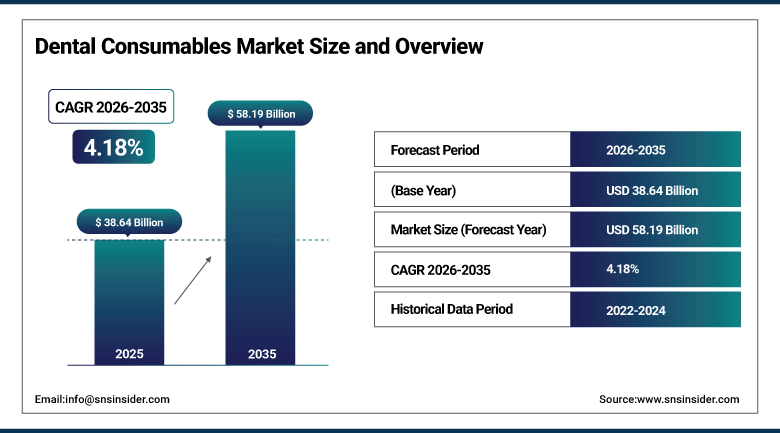
The Dental consumables Market was valued at USD 38.64 Billion in 2025 and is expected to reach USD 58.19 Billion by 2035, growing at a CAGR of 4.18% from 2026-2035.
Dental consumables market covers single-use and frequently replaced products used in dental care, such as filling and bonding materials, impression materials, burs, endodontic files, anesthetics, aligners, gloves, masks and disinfectants. Dentists, laboratories and dental groups buy them continuously, often through dealers. Growth is supported by oral disease, cosmetic dentistry, aligner use and aging populations, while price sensitivity, tariffs and weak patient spending in some markets shape demand.
⮞In August 5, 2026, Envista Holdings reported second-quarter sales of USD 731.00 million, up 7.1%, with dental equipment and consumables at USD 260.00 million, up 9.5%, and its Spark aligners growing at a double-digit rate. The company raised its full-year core growth guidance to 3.50%-4.50%.
To Get more information Global Dental Consumables Market - Request Free Sample Report
Dental Consumables Market Trends
- Rapid growth of clear aligners and related consumables
- Bioactive and aesthetic restorative materials with easier handling
- Growth of dental service organizations that buy in bulk
- Online ordering and direct-to-clinic delivery from manufacturers
- Shift to digital workflows that use printing resins and milling blanks
- Stronger infection control and single-use products in clinics
U.S. Dental Consumables Market Outlook
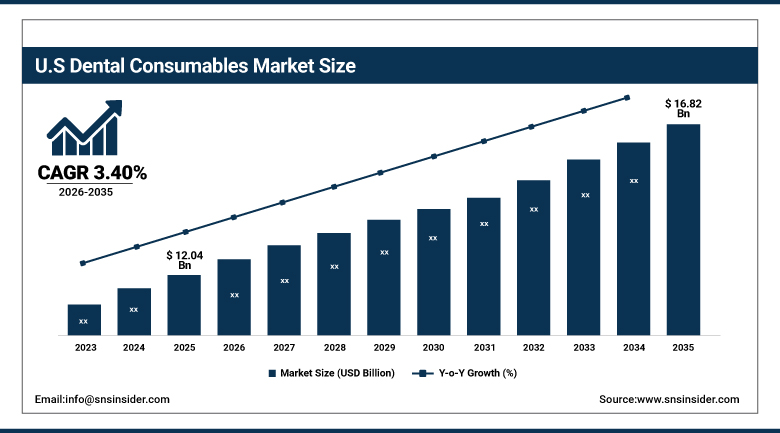
The U.S. Dental Consumables Market was valued at USD 12.04 Billion in 2025 and is expected to reach USD 16.82 Billion by 2035, growing at a CAGR of 3.40% from 2026-2035.
The U.S. Dental Consumables Market is the largest market among the region's national markets, due to the extensive presence of dental practices, heavy spending on cosmetic and orthodontic treatments, and the emergence of dental service organizations. The market is financed through private insurance for basic treatments, and practices purchase through major distributors. Growth is restricted due to competitive pricing, duties, and reduced patient flow in certain seasons.
⮞In the second quarter of 2026, Align Technology reported record revenue of USD 1.06 billion, up 4.3%, with aligner revenue of USD 871.00 million and shipments of 691,785 cases. The company said North America was stable, with lower retail demand offset by growth from dental service organizations.
Dental Consumables Market Segment Analysis
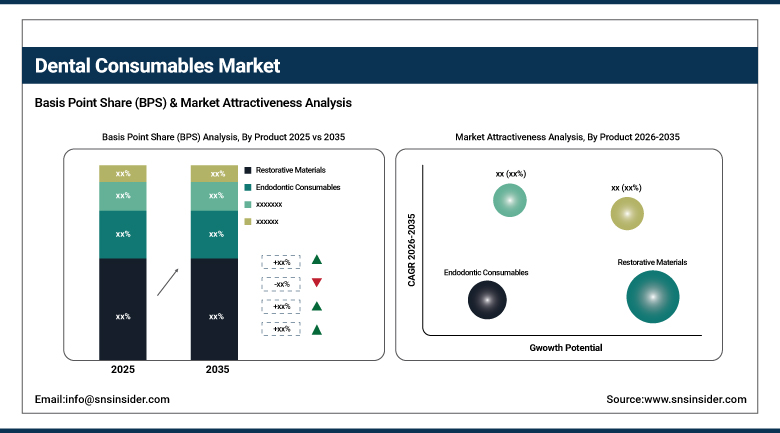
- By Product, restorative materials segment dominated the Dental Consumables Market in 2025 with an estimated 33.00% share; orthodontic consumables segment is the fastest-growing segment, with an estimated CAGR of 7.40% during 2026–2035.
- By End User, dental clinics segment dominated the Dental Consumables Market in 2025 with an estimated 66.00% share; dental service organizations segment is the fastest-growing segment, with an estimated CAGR of 7.00% during 2026–2035.
- By Distribution Channel, indirect dealers segment dominated the Dental Consumables Market in 2025 with an estimated 62.00% share; online channels segment is the fastest-growing segment, with an estimated CAGR of 10.50% during 2026–2035.
By Product, Restorative Materials Dominates Dental Consumables Market; Orthodontic Consumables to Register Fastest Growth.
Restorative materials dominate the Dental Consumables Market because tooth decay and tooth wear are common worldwide, and fillings, bonding agents, cements, composites and crowns are used in the highest number of procedures. Dentists reorder these items frequently, and new materials that cure faster or look more natural encourage upgrades. Composite resins, glass ionomers and universal adhesives are the main categories, and manufacturers compete on shade matching, shrinkage, strength and ease of use. Bulk-fill and bioactive materials save chair time, which gives dentists a reason to switch brands. Strong brand reputation is important because dentists put products in patients' mouths.
Orthodontic consumables are projected to register the fastest growth as clear aligners, brackets, wires, attachments and retainers are adopted by adults and teenagers. Aligner makers sell trays on a per-case basis, which creates recurring consumable revenue, and digital planning makes treatment easier for general dentists to offer. Digital design tools have also made it easier for general practitioners to plan aligner cases, and attachments, elastics and retainers add recurring items. Competition from direct-to-consumer providers is shaping pricing and service models.
By End User, Dental Clinics Dominates Dental Consumables Market; Dental Service Organizations to Register Fastest Growth.
Dental clinics dominate the Dental Consumables Market because most dental treatment is provided in independent and small group practices that use consumables in every patient visit. Gloves, masks, anesthetics, burs, impression materials and restorative products are stocked and reordered continuously, so clinics are the main buyers across all regions. Dentists value product consistency, training and technical support, and loyalty to familiar brands is strong. Seasonal patterns, insurance benefit cycles and patient recalls shape order timing across the year. Single-use items also help clinics follow infection control rules.
Dental service organizations are projected to register the fastest growth as private equity and corporate groups buy and open practices, centralize purchasing and negotiate volume contracts. They standardize product lists and push suppliers on price, yet they also add volume and open new accounts for manufacturers that offer broad portfolios. Corporate buying teams track utilization, and manufacturers offer rebates, bundles and education programs to win and keep contracts. Larger groups also run private-label lines for basic consumables to protect margins.
By Distribution Channel, Indirect Dealers Dominates Dental Consumables Market; Online Channels to Register Fastest Growth.
Indirect dealers dominate the Dental Consumables Market because large distributors such as Henry Schein, Patterson and Benco carry thousands of products, deliver quickly and give credit to practices. Dentists value one-stop ordering and sales representatives who advise on new products, and manufacturers rely on dealer networks to reach small clinics. Distributors also provide equipment financing, practice management software and training, which deepens relationships with clinics. Consolidation among dealers has created a few large national groups with strong purchasing power. Credit terms and bundled promotions help dealers win orders from small clinics.
Online channels are projected to register the fastest growth as practices order routine items through web portals and apps, compare prices and use subscription deliveries. Manufacturers are also building direct-to-clinic platforms, and younger dentists are comfortable with e-commerce, which supports growth even as dealers add their own digital tools. Marketplaces and manufacturer websites are used for repeat purchases, while complex or new items still rely on sales visits. Digital catalogues, automated reorder lists and fast delivery are important features for adoption.
Regional Analysis
|
Region |
Major Country |
Share within Region, 2025 (%) |
|
North America |
United States |
89.00 |
|
Asia Pacific |
China |
30.00 |
|
Europe |
Germany |
24.00 |
|
MEA & Latin America |
Brazil |
45.00 |
North America Dental Consumables Market Insights
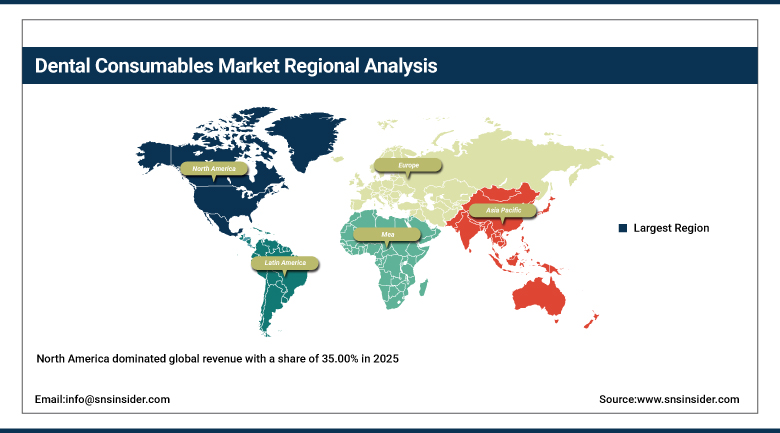
North America dominated revenue with a share of 35.00% in 2025. The United States accounts for major share of regional demand, with Canada adding volume. Dentsply Sirona, Envista, Align, Solventum, Henry Schein, Patterson, Ultradent, Kerr and Benco serve the region. Insurance plans pay for preventive and basic restorative care, and demand for whitening, veneers and aligners is mainly out of pocket. Large dealers, group purchasing organizations and corporate dental groups shape buying decisions across the region. Continuing education events and trade shows are important for new product launches.
High spending on cosmetic and orthodontic care, wide private insurance and a large base of dental practices support demand. Dental service organizations are growing and buy in volume. Price pressure, tariffs and cautious patient spending moderate growth, though aligners and restorative materials continue to expand. Dentist numbers are stable, and practice ownership is moving toward group models. Manufacturers invest in clinician education and digital tools to drive product adoption, and tariffs on imported goods are being managed through pricing and local sourcing.
⮞In the second quarter of 2026, Dentsply Sirona reported revenue of USD 898.00 million, down 4.1%, with Americas sales down 10.7%. CEO Daniel Scavilla said the company is six months into a 24-month plan to return to growth, centered on U.S. commercial restructuring, and expects positive U.S. growth by year-end.
Get Customized Report as per Your Business Requirement - Enquiry Now
Asia Pacific Dental Consumables Market Insights
Asia Pacific is projected to be the fastest-growing region, at a CAGR of 5.50% during 2026-2035. China, Japan, India, South Korea and Australia lead regional demand. GC Corporation, Osstem, Dentium, Nakanishi, Shofu, Morita, Straumann, Envista and local manufacturers serve the region. China accounts for about 30.00% of regional demand. Japan has an aging population and high implant and prosthetic use, while South Korea is a hub for implant makers. India is adding dentists and clinics quickly, and China is expanding dental service chains and local producers. Consumer interest in whitening and straight teeth is rising among younger adults.
Rising incomes, awareness of oral health and cosmetic dentistry, and growing numbers of dentists lift demand, with India and China adding volume. Volume-based procurement for implants and orthodontics in China affects pricing and timing. Uneven reimbursement and price sensitivity moderate growth, but local production is expanding. Government programs for oral health, rising dental tourism in Thailand, India and Malaysia, and growing online retail support demand. Price-focused local brands compete strongly in basic items such as gloves, masks and burs. Rising numbers of dental colleges are also raising the supply of new dentists.
Europe Dental Consumables Market Insights
In Europe, Germany, France, the United Kingdom, Italy and Spain lead regional demand. Straumann, Ivoclar, Kulzer, Coltene, Septodont, VOCO, Dentsply Sirona and 3M-linked Solventum serve the region. Central European countries host leading manufacturers, and export trade is large. Public health systems and statutory insurance cover basic dental care in many countries, which maintains steady volumes. Strict hygiene rules also drive demand for disposable infection control items.
Established oral health systems, high patient awareness and a strong base of dental manufacturers support demand. Public and insurance coverage differs by country, shaping spending on restorative and prosthetic work. Aging populations raise needs for implants and prosthetics, while price controls and the cost of regulation moderate growth. Rules on medical devices and mercury use under European regulations are shaping product choices, with a move away from amalgam to composite and glass ionomer materials. Sustainability goals are encouraging recyclable packaging and lower-waste products.
⮞In the second quarter of 2026, Straumann Group reported revenue up 5.9%, with EMEA sales of up 5.4% and led by implantology. The company also announced that CEO Guillaume Daniellot will step down, with Christopher Norbye succeeding him in December.
MEA & Latin America Dental Consumables Market Insights
In Latin America, Brazil is leading, with Mexico, Argentina, Colombia and Chile following. The presence of many dentists, increased demands on aesthetics, and increased spending by the middle classes drives sales. Currency fluctuations and the cost of importing determine pricing. Brazil is home to one of the highest populations of dentists in the world, and cosmetic dentistry is very popular. Local producers provide a lot of basic products whereas foreign brands dominate advanced materials and implants. In public clinics in some countries, tenders determine supplies.
In the Middle East and Africa, Saudi Arabia, the United Arab Emirates, Turkey, Egypt and South Africa dominate in terms of demand. Dental tourism, private clinics and health services provided by the government help boost consumable use, while lack of dentist access in most parts of Africa curtails growth. Gulf countries have been investing in private clinics and dental tourism, and in addition, governments in some selected markets are expanding access through their health schemes. Distributors are key in accessing clinics, and importation requires registration and duties.
Market Dynamics
Growth Drivers: Oral Disease, Aesthetic Demand and Aligner Adoption
Tooth decay, gum disease and tooth loss remain common, and aging populations need more restorative and prosthetic work. Awareness campaigns and school screening programs raise early detection, which increases demand for preventive and restorative products. Growing numbers of older adults keep their natural teeth longer, which raises demand for restorative, endodontic and periodontal treatments. Awareness of the link between oral health and overall health, including diabetes and heart disease, also encourages regular dental visits, and preventive programs run by governments and insurers add to routine product use across clinics. Growth of cosmetic bonding and veneers among younger adults, helped by social media, also increases use of premium composite and ceramic products in private practices.
Growing interest in straight teeth and whiter smiles drives aligner, whitening and bonding product use among adults. Social media and celebrity influence also increase interest in smile design, whitening and orthodontic care. Expanded dental insurance and public coverage in several emerging markets increase the number of people who can afford routine care. Technology such as intraoral scanners and chairside printing raises the number of same-day procedures, which in turn uses more consumable materials per visit. Growth in dental tourism in Asia and Eastern Europe adds volume in clinics that serve international patients. Government campaigns to reduce sugar intake and promote fluoride use support prevention, which, over time, shifts spending toward routine care.
Restraints: Price Pressure, Tariffs and Weak Patient Spending
Price pressure from dental groups and dealers results in lower margins for suppliers on commodity supplies. Buyer consolidation allows large groups of buyers to negotiate terms that would undermine brand premium on mature products. Disruptions in the supply chain, increased prices of raw materials including resins and metals, will lead to higher cost structure and shipping delays. Reduced consumer confidence and rising inflation result in fewer elective dental services. The latter leads to decreased purchases of whitening services and veneers and aligners. Price competition through heavy discounts in the distribution channels leads to poor price discipline in the marketplace. Limited reimbursement growth constrains budget available for premium supplies in some markets.
Customs duties, inflation, and prudent consumer behavior lead to treatment deferrals and reduced volume. Increased costs related to compliance with medical device regulations and sterilization requirements negatively impact small suppliers. Dentist and dental assistant shortages limit procedure capacity in some markets. Duties on imported dental products increase costs in the market and fluctuations in exchange rates bring additional pricing risks for distributors and clinics. Consumer preference for less expensive alternatives such as at-home whitening and mail-order aligners diverts expenditures from clinics.
Opportunities: Digital Workflows, Emerging Markets and Direct Online Sales
Printing resins, milling blanks and digital impression products are growing as clinics adopt chairside workflows. Bioactive, self-healing and regenerative materials may allow premium pricing and reduce repeat visits. Training programs, webinars and clinical partnerships can increase use of premium products and lock in loyalty among younger dentists. Training dentists on digital workflows and new materials can lift per-patient spending, and manufacturers that bundle software with consumables can build recurring revenue. Local production in emerging markets can bring lower-cost products to price-sensitive buyers. Wider adoption of teledentistry and digital monitoring may increase the number of treatments started and support recurring use of retainers, aligners and related materials. Dealers and manufacturers can also offer practice analytics that help clinics control supply costs.
Rising dental care access in India, Southeast Asia and the Middle East, and direct online ordering, open new channels for manufacturers. Sustainable, recyclable and low-waste products offer a way for brands to stand out with clinics that have environmental goals. Mergers and acquisitions among manufacturers can create broader portfolios that serve dental groups from a single contract. Partnerships with insurers, dental schools and public health programs can open new patient groups and support wider adoption of preventive products. Eco-friendly, mercury-free and lower-plastic products meet new rules and attract clinics with sustainability goals, giving brands a way to differentiate.
Recent Developments:
- On August 5, 2026, Envista Holdings reported second-quarter sales of USD 731.00 million and raised its full-year core growth outlook to 3.50%-4.50%.
- In 2026, Align Technology reported record revenue of USD 1.06 billion and aligner shipments of 691,785 cases.
- In 2026, Dentsply Sirona reported revenue of USD 898.00 million and said it is executing a 24-month plan to return to growth.
Dental Consumables Market Key Players are:
- Dentsply Sirona Inc.
- Envista Holdings Corporation
- Straumann Group
- Solventum Corporation
- Align Technology, Inc.
- Henry Schein, Inc.
- Patterson Companies, Inc.
- Ivoclar Vivadent AG
- GC Corporation
- Kulzer GmbH
- Septodont Holding
- Ultradent Products, Inc.
- Coltene Holding AG
- VOCO GmbH
- Osstem Implant Co., Ltd.
- Nakanishi Inc.
- Shofu Inc.
- Colgate-Palmolive Company
- Zimmer Biomet Holdings, Inc.
- Hu-Friedy Mfg. Co., LLC
Dental Consumables Market Report Scope:
| Report Attributes | Details |
|---|---|
| Market Size in 2025 | USD 38.64 Billion |
| Market Size by 2035 | USD 58.19 Billion |
| CAGR | CAGR of 4.18% From 2026 to 2035 |
| Base Year | 2025 |
| Forecast Period | 2026-2035 |
| Historical Data | 2022-2024 |
| Report Scope & Coverage | Market Size, Segments Analysis, Competitive Landscape, Regional Analysis, DROC & SWOT Analysis, Forecast Outlook |
| Key Segments | • By Product (Restorative Materials, Endodontic Consumables, Orthodontic Consumables, Infection Control Products, and Others) • By End User (Dental Clinics, Dental Service Organizations, and Dental Laboratories) • By Distribution Channel (Indirect Dealers, Direct Sales, and Online Channels) |
| Regional Analysis/Coverage | North America (US, Canada), Europe (Germany, UK, France, Italy, Spain, Russia, Poland, Rest of Europe), Asia Pacific (China, India, Japan, South Korea, Australia, ASEAN Countries, Rest of Asia Pacific), Middle East & Africa (UAE, Saudi Arabia, Qatar, South Africa, Rest of Middle East & Africa), Latin America (Brazil, Argentina, Mexico, Colombia, Rest of Latin America). |
| Company Profiles | Dentsply Sirona Inc., Envista Holdings Corporation, Straumann Group, Solventum Corporation, Align Technology, Inc., Henry Schein, Inc., Patterson Companies, Inc., Ivoclar Vivadent AG, GC Corporation, Kulzer GmbH, Septodont Holding, Ultradent Products, Inc., Coltene Holding AG, VOCO GmbH, Osstem Implant Co., Ltd., Nakanishi Inc., Shofu Inc., Colgate-Palmolive Company, Zimmer Biomet Holdings, Inc., Hu-Friedy Mfg. Co., LLC |

Frequently Asked Questions
Key players include Dentsply Sirona Inc., Envista Holdings Corporation, Straumann Group, Solventum Corporation, Align Technology, Inc., Henry Schein, Inc., Ivoclar Vivadent AG and GC Corporation.
Key opportunities include digital workflows, emerging markets and direct online sales.
The major growth factor is the high prevalence of oral disease, along with rising aesthetic demand and aligner adoption.
By Product, the Restorative Materials segment dominated the market in 2025 with an estimated 33.00% share, as fillings and bonding products are used in the highest number of procedures.
North America dominated the market with a share of 35.00% in 2025, driven by high spending on cosmetic and orthodontic care and a large base of dental practices.
