
Molecular Cytogenetics Market Report Scope & Overview:
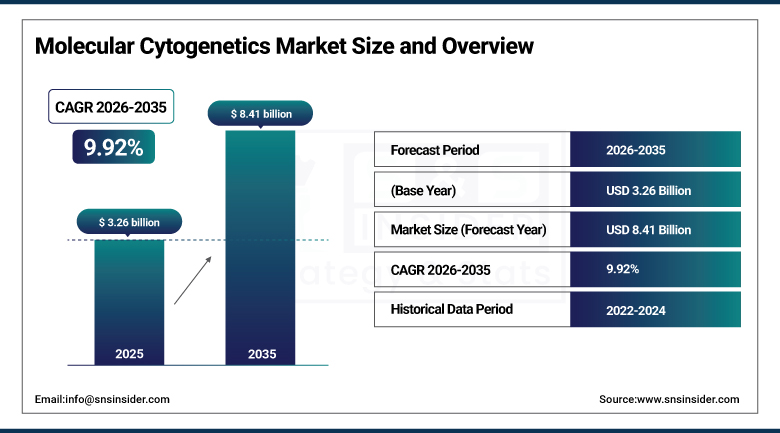
The Molecular Cytogenetics Market was valued at USD 3.26 Billion in 2025 and is expected to reach USD 8.41 Billion by 2035, growing at a CAGR of 9.92% from 2026–2035.
Molecular cytogenetics is a scientific area that integrates both molecular biology techniques and cytogenetics methods for examining chromosomal abnormalities using high-resolution compared with conventional karyotyping. It is extensively employed in detecting gene amplification, deletions, translocation, copy number variation, and other genomic anomalies related to cancers, genetic diseases, and prenatal issues. Advanced techniques, including FISH, CGH, and chromosomal microarray analysis, play an important role in determining genetic mutations for further diagnosing, prognosing, and managing patients' conditions. Increasing demand for precision medicine and genetic tests, along with the development of oncological diagnostics, stimulates the use of molecular cytogenetics worldwide.
In January 2025, Roche obtained 510(k) clearance from the U.S. FDA for the VENTANA Kappa and Lambda Dual ISH mRNA Probe Cocktail, marking the first clinically approved in situ hybridisation assay capable of sensitively assessing the full spectrum of B-cell lymphoma subtypes by simultaneously visualising kappa and lambda immunoglobulin light chain mRNA expression in tissue sections.
To Get more information on Molecular Cytogenetics Market - Request Free Sample Report
Molecular Cytogenetics Market Trends
-
Optical genome mapping is emerging as an advanced molecular cytogenetics technology capable of detecting complex chromosomal abnormalities with higher resolution than conventional methods
-
Integration of spatial transcriptomics with molecular cytogenetics is enabling comprehensive analysis of gene expression and chromosomal alterations within tissue samples
-
Next-generation sequencing-based cytogenomics is gaining adoption as a comprehensive alternative to array CGH for genome-wide chromosomal and genetic analysis
-
Artificial intelligence-powered image analysis is improving the speed, accuracy, and efficiency of FISH interpretation, karyotyping, and chromosomal abnormality detection
-
Liquid biopsy-based molecular cytogenetics is expanding non-invasive prenatal testing and cancer monitoring through chromosomal analysis of cell-free DNA samples
U.S. Molecular Cytogenetics Market Outlook
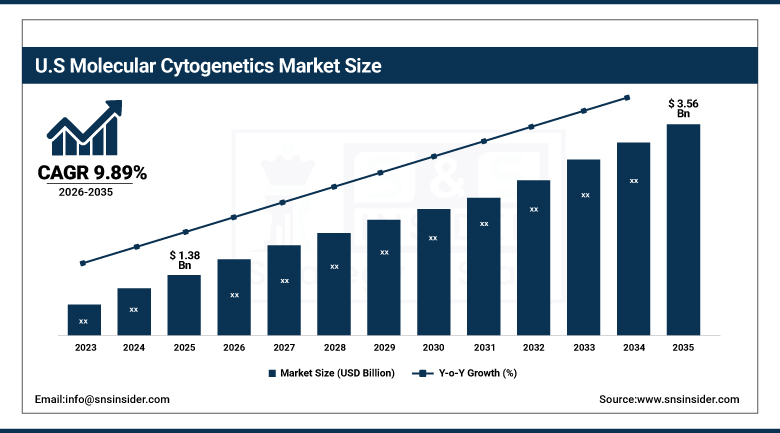
The U.S. Molecular Cytogenetics Market was valued at approximately USD 1.38 Billion in 2025 and is expected to reach approximately USD 3.56 Billion by 2035, growing at a CAGR of approximately 9.89%.
The United States is considered one of the key markets for molecular cytogenetics owing to the advanced healthcare sector, cancer diagnostic facilities, and the prevalence of precision medicine. Various technologies like FISH, chromosomal microarray analysis, and comparative genomic hybridization are widely used in hospitals, cancer centers, and diagnostic labs for cancer diagnosis, prognosis, and treatment. The increase in the use of genomic-based diagnosis in oncology and personalized medicine will fuel the demand for molecular cytogenetic services in the coming years.
In April 2024, Dartmouth Health launched optical genome mapping technology to improve cancer diagnosis by capturing detailed chromosome images and utilising specialised software for structural variant analysis, demonstrating the clinical translation of this emerging molecular cytogenetics technique from research settings into routine pathology workflow.
Molecular Cytogenetics Market Segment Analysis
-
By Product, the Kits & Reagents segment dominated the Molecular Cytogenetics Market with approximately 55% share in 2025, while the Software & Services segment is the fastest growing.
-
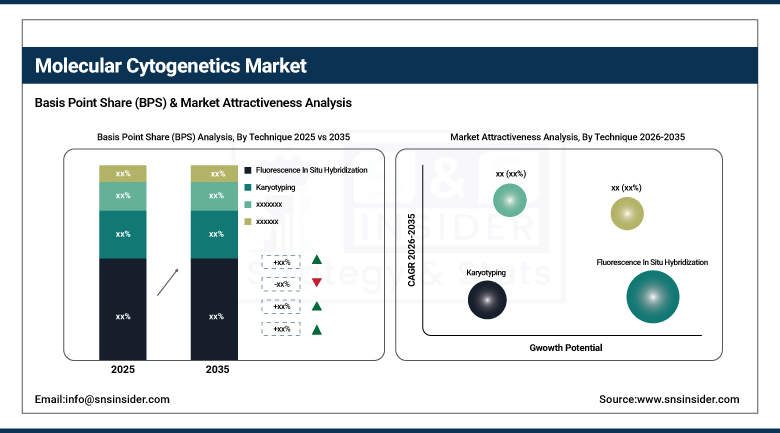
By Technique, the Fluorescence In Situ Hybridisation segment dominated the Molecular Cytogenetics Market with approximately 58% share in 2025, while the Array Comparative Genomic Hybridisation segment is the fastest growing.
-
By Application, the Cancer Testing segment dominated the Molecular Cytogenetics Market with approximately 58% share in 2025, while the Prenatal Testing segment is among the fastest growing.
-
By End User, the Clinical & Research Laboratories segment dominated the Molecular Cytogenetics Market with approximately 46% share in 2025,while the Pharmaceutical & Biotechnology Companies segment is the fastest growing.
By Technique, FISH dominates, array CGH grows fastest
Fluorescence In Situ Hybridisation (FISH) was the leading type in the molecular cytogenetics market with around 58% share in 2025 because of its wide usage in cancer diagnosis, hematological malignancies detection, prenatal testing, and in companions diagnostics. It is regarded as an established method in clinics because of its high sensitivity, large amount of validation and availability of disease-specific probes. The method has become essential in gene amplification, chromosomal rearrangements and fusion gene detection for selecting appropriate treatment, which increases demand of this type.
Array CGH is the fast-growing method in the market because of its capability to perform full genome copy number test. More popularity of this type because of increasing use in developmental disorders testing, prenatal testings, oncology testings and reproductive health applications drives the market growth. Favorable guidelines on the usage of this testing methods in some genetic conditions as well as development of new integrated SNP-CGH test increase the application spectrum of the method.
By Application, cancer testing dominates, prenatal testing grows fastest
The Cancer Testing segment held a dominant position in the molecular cytogenetics market, accounting for around 58% market share in 2025. This was attributed to the rising significance of genetic and chromosomal profiling in the diagnosis, prognosis, treatment, and monitoring of various types of cancers. Several molecular cytogenetics approaches, including fluorescence in-situ hybridization (FISH) and chromosomal microarray analysis, are currently being used to analyze genetic material for detecting gene amplification, chromosomal translocation, and other genetic defects to facilitate precision medicine approaches.
The Prenatal Testing application segment accounted for one of the fastest-growing segments within the molecular cytogenetics market owing to rising demand for early and accurate diagnosis of chromosomal abnormalities in pregnancies. Advancements in genetic testing technology are providing better ways of detecting genetic abnormalities and disorders with higher precision and lower risk. Increasing knowledge about prenatal tests and improving access to maternal healthcare services are further boosting the growth of this segment in the market.
Regional Analysis
|
Region |
Major Country |
Share within Region, 2025 (%) |
|---|---|---|
|
North America |
United States |
82.5% |
|
Europe |
Germany |
28.5% |
|
Asia Pacific |
China |
38.5% |
|
Middle East & Africa |
UAE |
22.8% |
|
Latin America |
Brazil |
43.8% |
North America Molecular Cytogenetics Market Insights
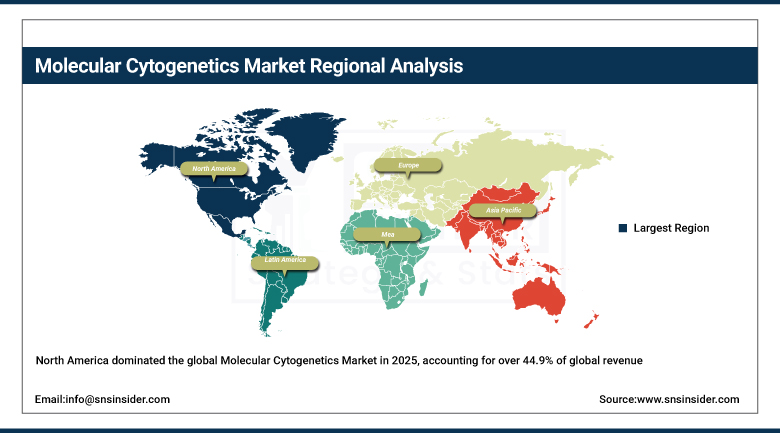
North America dominated the global Molecular Cytogenetics Market in 2025, accounting for over 44.9% of global revenue. The United States accounts for approximately 82.5% of North American revenues through the world's most extensive cancer genomics and clinical genetics infrastructure, the highest NIPT adoption rate among major economies, and the regulatory environment whose FDA companion diagnostic approval requirements create mandatory oncology molecular cytogenetics test volumes.
Canada contributes supplementary demand through its clinical genetics infrastructure, growing NIPT adoption across provincial healthcare systems, and academic cancer genomics centres whose research programmes create demand for advanced molecular cytogenetics instrumentation and reagent supply.
Get Customized Report as per Your Business Requirement - Enquiry Now
Europe Molecular Cytogenetics Market Insights
Europe held a significant share of the global Molecular Cytogenetics Market in 2025. Germany, France, the United Kingdom, the Netherlands, and Italy are the leading national markets whose comprehensive clinical genetics services, academic cancer genomics research infrastructure, and progressive regulatory pathways for companion diagnostics create consistent and growing molecular cytogenetics demand.
Germany accounts for approximately 28.5% of European revenues through the commercial presence of Roche Diagnostics and Siemens Healthineers whose European headquarters sustain regional market development, the large academic medical centre sector whose clinical genetics and haematology oncology programmes are among Europe's most active molecular cytogenetics adopters.
The United Kingdom's NHS Genomics Medicine Service, whose integration of genomic medicine into standard clinical care creates systematic adoption of advanced molecular cytogenetic testing across cancer and rare disease pathways, represents the most commercially significant single national clinical genomics programme in Europe. France's Plan France Médecine Génomique 2025 and the European Reference Networks for rare diseases collectively create regulatory and clinical frameworks that sustain European molecular cytogenetics market development above the level that commercial adoption alone would generate.
Asia Pacific Molecular Cytogenetics Market Insights
Asia Pacific is the fastest-growing regional Molecular Cytogenetics Market, driven by the rapid expansion of cancer genomics infrastructure, growing NIPT adoption across the region's large obstetric care population, and progressive pharmaceutical and biotechnology sector investment in companion diagnostic development.
China accounts for approximately 38.5% of Asia Pacific revenues through its rapidly growing comprehensive cancer centre network, the world's largest obstetric population creating demand for prenatal molecular cytogenetics testing, and domestic molecular diagnostics company development whose BGI Genomics, Berry Genomics, and CapitalBio represent significant Chinese molecular cytogenetics commercial activity.
Japan, South Korea, and Taiwan contribute premium regional demand through their advanced clinical genomics infrastructure, high NIPT adoption in the obstetric population whose awareness of chromosomal anomaly risk is creating voluntary prenatal testing demand, and the pharmaceutical and biotechnology sectors whose clinical trial companion diagnostic requirements create specialised molecular cytogenetics test demand.
MEA & Latin America Molecular Cytogenetics Market Insights
The UAE leads MEA revenues at approximately 22.8% of the regional total through its world-class hospital infrastructure, the growing clinical genetics services at major Dubai and Abu Dhabi teaching hospitals whose comprehensive cancer care and rare disease diagnosis programmes create molecular cytogenetics demand, and the medical tourism sector's genetic testing component.
Saudi Arabia contributes growing demand through its national cancer strategy's genomics component and the growing prenatal diagnosis awareness among its population of high consanguinity marriage rate whose associated recessive genetic disorder risk creates clinical motivation for chromosomal analysis.
Brazil leads Latin American revenues at approximately 43.8% of the regional total through its growing oncology infrastructure, the clinical genetics services at major academic medical centres including Hospital das Clínicas in São Paulo, and the expanding NIPT commercial availability whose adoption is growing with private health insurance penetration among the Brazilian middle class.
Market Dynamics
Growth Drivers: Rising cancer incidence creating companion diagnostic demand and expanding prenatal molecular cytogenetics testing adoption driving market growth globally
The molecular cytogenetics market is experiencing strong growth due to the rising global burden of cancer and the increasing importance of genomic analysis in modern oncology. Molecular cytogenetic techniques are widely used for cancer diagnosis, prognosis, treatment selection, and disease monitoring, making them essential tools in precision medicine. As cancer incidence continues to increase worldwide, demand for technologies such as FISH, chromosomal microarrays, and other advanced cytogenetic methods is expanding across hospitals, cancer centers, and diagnostic laboratories.
Another major growth driver is the growing adoption of prenatal genetic testing and precision oncology. Increasing use of companion diagnostics for targeted therapies requires accurate identification of chromosomal abnormalities, gene amplifications, and genetic rearrangements. In addition, expanding utilization of non-invasive prenatal testing and advanced prenatal screening technologies is creating substantial demand for molecular cytogenetic solutions, further supporting long-term market growth.
Restraints: High cost of advanced molecular cytogenetics instrumentation and the highly specialised technical expertise required for assay performance and interpretation constraining adoption in resource-limited settings
Molecular cytogenetics market growth is hampered by the huge investment needed to buy sophisticated diagnostic tools and technologies such as next generation sequencing technologies, array CGH technologies, and optical genome mapping solutions. The costly process of purchasing, operating, and maintaining sophisticated instruments limits the usage of molecular cytogenetic technologies only to big hospitals, academic research organizations, and specialty laboratories that have adequate financial capabilities. In addition, the high expenses may limit the use of molecular cytogenetic testing especially in underdeveloped markets.
Highly qualified staff who are skilled in performing and interpreting molecular cytogenetics testing poses another key restraint in the market. Molecular cytogenetics testing processes like fluorescence in situ hybridization tests, chromosomal microarray analysis, and genomic variants evaluation need skilled personnel. Inadequate availability of trained laboratory specialists could limit the testing process.
Opportunities: AI-powered automated image analysis and next-generation sequencing integration represent transformative frontiers expanding molecular cytogenetics capacity and clinical utility
The application of artificial intelligence to image analysis can be an important opportunity for the molecular cytogenetics market since this technology allows performing tedious tasks, like interpreting FISH signals, karyotyping, and chromosome analysis. Such systems dramatically shorten the process time, optimize workflows, and boost productivity without sacrificing the quality and reliability of the diagnostic procedure. In addition, the shortage of personnel and manual processing of the results can be mitigated with AI technologies.
Yet another opportunity for the market development comes from the implementation of NGS cytogenomics that uses one platform for detecting CNVs, chromosomal abnormalities, and single-nucleotide alterations in a patient's genome at once. This solution provides much more detailed information about a person's genotype in one run, unlike multiple cytogenetic tests. Moreover, the cost of sequencing continues to fall and the clinical value of the technique rises.
Recent Developments:
-
2025: Roche obtained FDA 510(k) clearance for the VENTANA Kappa and Lambda Dual ISH mRNA Probe Cocktail, the first clinically approved ISH assay for comprehensive B-cell lymphoma subtype assessment enabling pathologists to perform clonality analysis with spatial tissue context advantages over flow cytometry alternatives.
-
2025: Bio-Techne and Oxford Nanopore extended their alliance to 2032, integrating RNAscope spatial transcriptomics with nanopore long-read sequencing for tissue-context structural variant analysis, enabling simultaneous gene expression and chromosomal structural assessment from the same tissue section.
-
2024: Dartmouth Health launched optical genome mapping for cancer diagnosis, capturing high-resolution chromosome images with specialised analysis software to identify complex structural variants including balanced translocations and inversions that conventional FISH and array CGH cannot comprehensively detect.
Molecular Cytogenetics Market Key Players
-
Illumina Inc.
-
Thermo Fisher Scientific Inc.
-
Agilent Technologies Inc.
-
F. Hoffmann-La Roche Ltd.
-
Abbott Laboratories
-
Danaher Corporation (Beckman Coulter)
-
Bio-Rad Laboratories Inc.
-
Oxford Gene Technology (OGT)
-
PerkinElmer Inc. (Revvity)
-
Bio-Techne Corporation
-
Applied Spectral Imaging Inc.
-
Cytotest Inc.
-
MetaSystems Group GmbH
-
Leica Biosystems (Danaher)
-
NovaBay Pharmaceuticals Inc.
-
Bioview Ltd.
-
GeneDx Inc.
-
Pacific Biosciences of California Inc.
-
Bionano Genomics Inc.
-
Hologic Inc.
Molecular Cytogenetics Market Report Scope:
| Report Attributes | Details |
|---|---|
| Market Size in 2025 | USD 3.26 Billion |
| Market Size by 2035 | USD 8.41 Billion |
| CAGR | CAGR of 9.92% From 2026 to 2035 |
| Base Year | 2025 |
| Forecast Period | 2026-2035 |
| Historical Data | 2022-2024 |
| Report Scope & Coverage | Market Size, Segments Analysis, Competitive Landscape, Regional Analysis, DROC & SWOT Analysis, Forecast Outlook |
| Key Segments | • by Product (Kits & Reagents, Instruments, Consumables, Software & Services) • by Technique (Fluorescence In Situ Hybridization, Comparative Genomic Hybridization/Array CGH, Chromogenic In Situ Hybridization, Karyotyping, Others) • by Application (Cancer Testing, Prenatal Testing, Genetic Disorders, Drug Development & Research, Others) • by End User (Clinical & Research Laboratories, Academic Research Institutes, Pharmaceutical & Biotechnology Companies, Others) |
| Regional Analysis/Coverage | North America (US, Canada, Mexico), Europe (Eastern Europe [Poland, Romania, Hungary, Turkey, Rest of Eastern Europe] Western Europe] Germany, France, UK, Italy, Spain, Netherlands, Switzerland, Austria, Rest of Western Europe]), Asia Pacific (China, India, Japan, South Korea, Vietnam, Singapore, Australia, Rest of Asia Pacific), Middle East & Africa (Middle East [UAE, Egypt, Saudi Arabia, Qatar, Rest of Middle East], Africa [Nigeria, South Africa, Rest of Africa], Latin America (Brazil, Argentina, Colombia, Rest of Latin America) |
| Company Profiles | Illumina Inc., Thermo Fisher Scientific Inc., Agilent Technologies Inc., F. Hoffmann-La Roche Ltd., Abbott Laboratories, Danaher Corporation (Beckman Coulter), Bio-Rad Laboratories Inc., Oxford Gene Technology (OGT), PerkinElmer Inc. (Revvity), Bio-Techne Corporation, Applied Spectral Imaging Inc., Cytotest Inc., MetaSystems Group GmbH, Leica Biosystems (Danaher), NovaBay Pharmaceuticals Inc., Bioview Ltd., GeneDx Inc., Pacific Biosciences of California Inc., Bionano Genomics Inc., Hologic Inc. |
Frequently Asked Questions
The Molecular Cytogenetics Market is expected to grow at a CAGR of 9.92% from 2026 to 2035.
Rising global cancer incidence creating non-discretionary companion diagnostic molecular cytogenetics test demand, expanding NIPT and prenatal chromosomal microarray adoption creating high-volume consumer accessible testing.
The Fluorescence In Situ Hybridisation segment dominated the Molecular Cytogenetics Market with approximately 58% share in 2025.
North America dominated the Molecular Cytogenetics Market in 2025, accounting for over 44.9% of global revenue.
