
Solid State Cooling Market Report Scope & Overview:
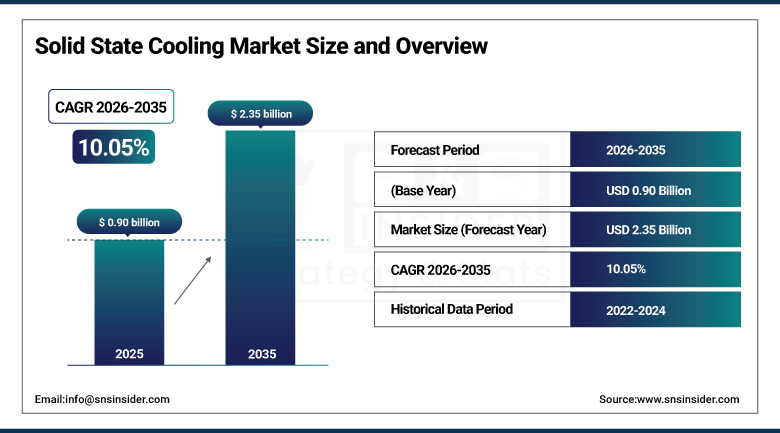
The Solid State Cooling Market size was valued at USD 0.90 Billion in 2025 and is expected to reach USD 2.35 Billion by 2035, growing at a CAGR of 10.05% from 2026–2035.
Solid state cooling covers a family of technologies, thermoelectric, electrocaloric, and magnetocaloric among them, that move heat without any of the moving parts, compressors, or refrigerants that define conventional cooling systems. That absence of mechanical components turns out to matter a great deal in practice: these systems run silently, require essentially no maintenance, and sidestep the environmental liability that comes with hydrofluorocarbon refrigerants entirely. Demand is climbing fastest where compact, precise, reliable cooling matters more than raw capacity, medical devices, consumer electronics, and increasingly electric vehicles, all of which benefit from a cooling approach that can be miniaturized without sacrificing temperature control. Continued innovation across all three underlying technologies keeps improving performance and efficiency, and that improvement curve is what's letting solid state cooling expand into applications that would have been out of reach just a few years ago.
Researchers at the Hong Kong University of Science and Technology have developed the world's first kilowatt-scale elastocaloric cooling device, capable of stabilizing indoor temperatures at 21°C to 22°C within 15 minutes, even when outdoor temperatures reach 30°C to 31°C. That kind of demonstrated performance at meaningful scale is exactly the sort of proof point that tends to accelerate commercial investment in an emerging cooling technology.
To Get more information on Solid State Cooling Market - Request Free Sample Report
Solid State Cooling Market Trends
-
Electrocaloric cooling technology is advancing quickly, with lead scandium tantalate multilayer capacitor devices demonstrating meaningful temperature spans that hint at genuine large-scale refrigeration potential.
-
Refrigeration systems are gaining ground on standalone cooling systems as solid state technology matures enough to complement, rather than just supplement, conventional refrigerant-based equipment.
-
Multi-stage cooling architectures are seeing rising demand in high-performance computing and automotive applications that require more precise thermal control than single-stage systems can deliver.
-
Consumer electronics miniaturization keeps pushing demand for smaller, quieter, more energy-efficient cooling solutions, a trend that plays directly to solid state cooling's core strengths.
-
Government-backed phase-out of hydrofluorocarbon refrigerants, paired with green technology incentive programs, continues to create favorable regulatory tailwinds for solid state cooling adoption.
U.S. Solid State Cooling Market Size Outlook:
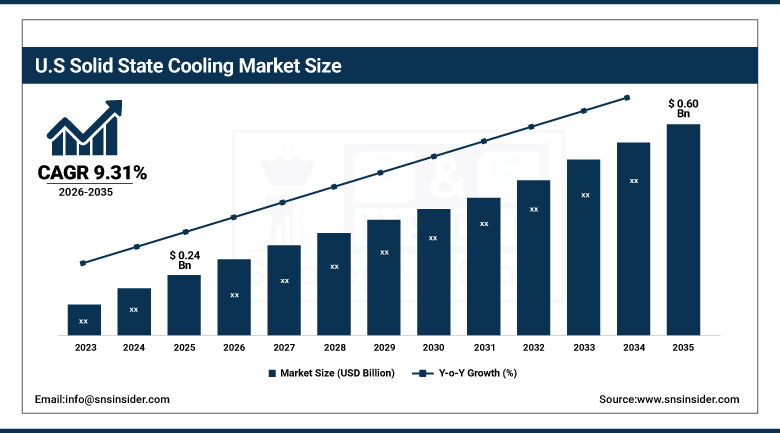
The U.S. Solid State Cooling Market was valued at approximately USD 0.24 Billion in 2025 and is expected to reach approximately USD 0.60 Billion by 2035, growing at a CAGR of approximately 9.31%.
Growth of the market in the United States is largely being driven by the move of the nation away from traditional cooling systems powered by refrigerant, primarily as a result of tough environmental regulations that have made the use of such refrigerant less and less justifiable. Continuous development in the area of semiconductor manufacturing, growing implementation of precision cooling in defense and healthcare, as well as the increasing use of intelligent and silent thermal management technologies is only enhancing this trend, turning the United States into a true hub of innovation and early adopters of the technology.
Laird Thermal Systems released the SuperCool X Series in June 2024, introducing the latest generation of thermoelectric coolers, improving their performance by up to 10%. The environmentally friendly products provide up to 400 watts of cooling power and are optimized for tight space applications, demonstrating the trend of continuous improvement of solid state cooling performance.
Solid State Cooling Market Segment Analysis
-
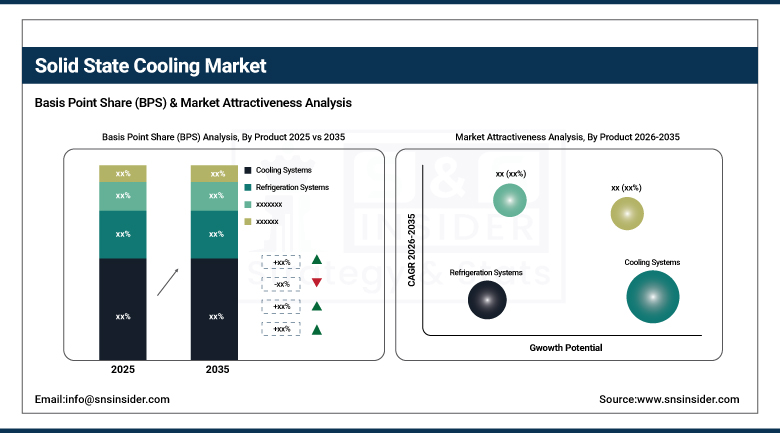
By Product, the Cooling Systems segment dominated the Solid State Cooling Market with a 63.6% revenue share in 2025, while the Refrigeration Systems segment is expected to register the fastest growth.
-
By Type, the Single Stage segment dominated the Solid State Cooling Market with a 47.1% revenue share in 2025, while the Multi-Stage segment is expected to register the fastest growth.
-
By Technology, the Thermoelectric Cooling segment dominated the Solid State Cooling Market with a 70.4% revenue share in 2025, while the Electrocaloric Cooling segment is expected to register the fastest growth.
-
By End Use, the Healthcare segment dominated the Solid State Cooling Market with a 47.3% revenue share in 2025, while the Consumer Electronics segment is expected to register the fastest growth.
By Product, cooling systems dominate, refrigeration systems grow fastest
Cooling systems accounted for 63.6% of the market in 2025, the dominant product category, driven by growing need for advanced thermal management technology in consumer electronics, high-performance computing, and automotive applications. Thermoelectric coolers in particular deliver compact size, maintenance-free operation, and silent running, characteristics that continue to make them well suited across exactly these industries.
Refrigeration systems are expected to register the highest CAGR through the forecast period, fueled by increasing demand for green, energy-efficient cooling solutions across healthcare, food processing, and industrial applications. Adoption of solid state refrigeration systems is climbing as these technologies increasingly complement existing refrigerant-based systems while helping operators meet worldwide sustainability targets.
By Type, single stage dominates, multi-stage grows fastest
The single-stage system occupied 47.1% of the total market share in 2025 and was praised for its simplistic nature, cost-effectiveness, and good performance irrespective of the applications including consumer electronics and smaller refrigeration equipment. The system provides efficient cooling in instances where very accurate results are not needed, hence making it popular in various applications.
Multi-stage systems are expected to post the highest CAGR owing to the increasing demand for improved cooling efficiency in handling larger loads of heat especially in high-performance computing, automotive, and industries. Multi-staging cooling allows for accuracy in temperature regulation in such applications.
By Technology, thermoelectric cooling dominates, electrocaloric cooling grows fastest
Thermoelectric cooling represented the largest technology share at 70.4% in 2025, relying on the Peltier effect to transfer heat between the two sides of a device, an approach widely applied across consumer electronics, automotive systems, and portable cooling devices. Its small footprint, high reliability, low maintenance requirement, and ability to operate without harmful vapor-compression refrigerants continue to make it the preferred solid state cooling technology across size- and environmentally-constrained applications.
Electrocaloric cooling is projected to register the highest CAGR through the forecast period, attributable to continued advancement in electrocaloric materials that change temperature in response to an applied electric field. These systems offer highly efficient, energy-saving performance with genuine potential in more demanding applications, including large-scale refrigeration and precision thermal management for high-performance electronics.
By End Use, healthcare dominates, consumer electronics grows fastest
Healthcare held 47.3% of the market in 2025, driven by the strict temperature control requirements for portable refrigerators, vaccine storage, and diagnostic equipment. Solid state cooling technologies, thermoelectric coolers chief among them, deliver reliable, efficient, compact temperature control for sensitive materials while avoiding environmentally problematic refrigerants entirely, a combination that's made them essential across healthcare cooling applications.
Consumer electronics is expected to grow at the highest CAGR through the forecast period, as devices including smartphones, laptops, and wearables continue getting smaller while demanding more efficient cooling. Solid state cooling is gaining popularity in this space precisely because it can be made smaller, quieter, and more energy-efficient than conventional cooling solutions, capabilities that matter more with every new generation of increasingly powerful, increasingly compact devices.
Regional Insights
|
Region |
Major Country |
Share within Region, 2025 (%) |
|---|---|---|
|
North America |
United States |
78.0% |
|
Europe |
Germany |
24.0% |
|
Asia Pacific |
China |
39.0% |
|
Latin America |
Brazil |
36.0% |
|
Middle East & Africa |
UAE |
27.0% |
North America Solid State Cooling Market Insights
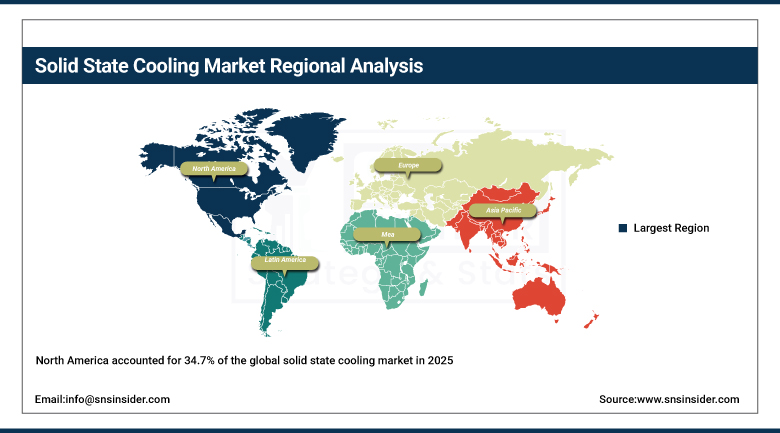
North America accounted for 34.7% of the global solid state cooling market in 2025, driven by a strong presence of advanced industries, healthcare, aerospace and defense, and consumer electronics, that increasingly require energy-efficient, compact, and reliable thermal management solutions. The region's leadership reflects deep integration between solid state cooling technology and the sectors most eager to adopt it early.
The United States dominates the North American market, owing to well-established healthcare, electronics, and aerospace sectors, growing R&D infrastructure, early adoption of green technologies, and substantial capital investment in developing innovative thermal management solutions. That combination of sector depth and sustained investment keeps the U.S. at the center of North American solid state cooling innovation.
Get Customized Report as per Your Business Requirement - Enquiry Now
Asia Pacific Solid State Cooling Market Insights
Asia Pacific is anticipated to be the fastest-growing region through the forecast period, with China, Japan, South Korea, and India leading this growth owing to rapid industrialization, expanding electronics manufacturing hubs, and increasing investment in electric vehicles and smart healthcare infrastructure. Government initiatives encouraging green technology and a broader transition toward sustainable cooling solutions are expected to further accelerate regional adoption.
China dominates the Asia Pacific market, owing to its enormous electronics manufacturing industry, fast-paced industrialization, government initiatives promoting green technologies, substantial investment in electric vehicles, and high-end healthcare infrastructure that requires efficient thermal management solutions across a wide range of applications.
Europe Solid State Cooling Market Insights
Europe's solid state cooling market is characterized by strict environmental regulation, a strong regional emphasis on sustainability, and significant advancement in material science. The region actively supports and implements research into thermoelectric and electrocaloric technology, and that support is gaining traction fastest across the automotive, healthcare, and electronics sectors specifically.
Germany is the largest contributor to the European solid state cooling market, propelled by its automotive and electronics industries, highly developed R&D capability, and proactive adoption of sustainable, energy-efficient cooling technologies. France and the United Kingdom follow as significant secondary markets, each contributing meaningfully to the region's overall growth trajectory.
MEA & Latin America Solid State Cooling Market Insights
Latin America and the Middle East and Africa are emerging markets within the global solid state cooling industry, gradually adopting these technologies as demand for sustainable, energy-efficient cooling continues to grow. In Latin America specifically, growth is driven by rising healthcare and consumer electronics investment across the region's largest economies.
Across the Middle East and Africa, urbanization and improving medical infrastructure are creating meaningful new interest in solid state cooling technology. Despite currently limited market size, driven by uneven technology awareness and infrastructure development, continued investment initiatives and a broadly supportive policy climate are expected to help propel demand across both regions over the coming years.
Market Dynamics
Growth Drivers: Demand for eco-friendly, energy-efficient cooling sustains market expansion
The major factor contributing to solid state cooling market growth is the increasing requirement for eco-friendly, energy-efficient cooling solutions across healthcare, automotive, and electronics applications. Solid state systems, whether based on thermoelectric, electrocaloric, or magnetocaloric technology, offer compact size, low maintenance, noise-free operation, and elimination of harmful refrigerants, characteristics that make them genuinely useful across an expanding range of sustainability-focused applications.
As electronic devices continue miniaturizing and electric vehicles keep proliferating, demand for cutting-edge thermal management solutions capable of meeting both size and efficiency requirements keeps growing correspondingly. Laird Thermal Systems' introduction of the OptoTEC MSX Series in June 2023, featuring compact thermoelectric coolers with a 10% increase in cooling capacity within a micro footprint for high-performance image-sensing applications, illustrates the kind of continued product innovation that's sustaining this growth driver across the industry.
Restraints: Material limitations constrain large-scale application performance
The inability of some solid-state cooling systems to cool effectively, especially when one considers traditional cooling systems that work more effectively at larger scales, has made it difficult to adopt these cooling technologies widely in large-scale applications. The non-availability of traditional materials and components that work well for solid-state cooling is another problem that makes it difficult to adopt these cooling technologies.
The inability of some solid-state cooling systems to remain operational over a longer period of time due to issues such as material degradation and thermal stability has made it difficult for the engineers working on solid-state cooling systems to adopt these technologies for demanding operations. Until material science catches up with traditional systems in terms of performance, this limitation will make it impossible for solid-state cooling to displace traditional cooling technologies at an industrial level.
Opportunities: Green technology push and expanding applications unlock substantial growth
The future potential of solid state cooling lies substantially in consumer electronics, wearables, and high-performance computing systems, areas where the technology's core advantages, compactness, silence, and efficiency, align closely with what these industries actually need. Government regulation phasing out hydrofluorocarbon refrigerants, combined with incentive structures promoting green technology, continues to support market growth from the policy side as well.
Growing industrialization and improving healthcare infrastructure in emerging economies have similarly driven adoption of related precision technologies in these regions, a trend that bodes well for solid state cooling's own expansion. Continuous R&D in material science is likely to keep improving performance and cost-effectiveness, opening new application areas worldwide as the technology matures beyond its current niche use cases.
Recent Developments:
-
2023: In June 2023, Laird Thermal Systems introduced the OptoTEC MSX Series, featuring compact thermoelectric coolers that offer a 10% increase in cooling capacity within a micro footprint, catering to high-performance image-sensing applications.
-
2024: In June 2024, Laird Thermal Systems launched the SuperCool X Series, featuring next-generation thermoelectric coolers that improve performance by up to 10% while offering up to 400 watts of cooling capacity for tight-space applications.
-
2024: In October 2024, Cooler Master introduced next-generation cooling solutions for Intel Core Ultra 200S CPUs, compatible with the new LGA1851 socket and RL-ILM standard, including the MasterLiquid Ion, Atmos, and Core Series.
Solid State Cooling Companies are:
-
Cooler Master
-
II-VI Incorporated
-
Alphabet Energy
-
RTP Company
-
Laird Thermal Systems
-
MicroCool
-
Calyos
-
Ouroboros Technologies
-
Ferrotec Holdings Corporation
-
TE Technology, Inc.
-
European Thermodynamics Ltd.
-
Marlow Industries, Inc.
-
KELK Ltd.
-
Crystal Ltd.
-
Phononic, Inc.
-
Coherent Corp. (II-VI)
-
Kryotherm Industrial Coolers
-
Global Component Sourcing
Solid State Cooling Market Report Scope:
| Report Attributes | Details |
|---|---|
| Market Size in 2025 | USD 0.90 Billion |
| Market Size by 2035 | USD 2.35 Billion |
| CAGR | CAGR of 10.05% From 2026 to 2035 |
| Base Year | 2025 |
| Forecast Period | 2026-2035 |
| Historical Data | 2022-2024 |
| Report Scope & Coverage | Market Size, Segments Analysis, Competitive Landscape, Regional Analysis, DROC & SWOT Analysis, Forecast Outlook |
| Key Segments | • by Product (Refrigeration Systems, Cooling Systems) • by Type (Single Stage, Multi-Stage, Thermocycler) • by Technology (Electrocaloric Cooling, Magnetocaloric Cooling, Thermoelectric Cooling) • by End Use (Consumer Electronics, Healthcare, Automotive, Others) |
| Regional Analysis/Coverage | North America (US, Canada, Mexico), Europe (Eastern Europe [Poland, Romania, Hungary, Turkey, Rest of Eastern Europe] Western Europe] Germany, France, UK, Italy, Spain, Netherlands, Switzerland, Austria, Rest of Western Europe]), Asia Pacific (China, India, Japan, South Korea, Vietnam, Singapore, Australia, Rest of Asia Pacific), Middle East & Africa (Middle East [UAE, Egypt, Saudi Arabia, Qatar, Rest of Middle East], Africa [Nigeria, South Africa, Rest of Africa], Latin America (Brazil, Argentina, Colombia, Rest of Latin America) |
| Company Profiles | Thermoelectric Cooling America, Cooler Master, II-VI Incorporated, Alphabet Energy, RTP Company, Laird Thermal Systems, Kryotherm, MicroCool, Calyos, Ouroboros Technologies, Ferrotec Holdings Corporation, TE Technology, Inc., European Thermodynamics Ltd., Marlow Industries, Inc., KELK Ltd., Crystal Ltd., Phononic, Inc., Coherent Corp. (II-VI), Kryotherm Industrial Coolers, Global Component Sourcing. |

Frequently Asked Questions
Rising demand for eco-friendly, energy-efficient cooling solutions across healthcare, consumer electronics, and electric vehicle applications.
North America dominated the Solid State Cooling Market in 2025 with a 34.7% market share, while Asia Pacific is the fastest-growing region.
Cooling Systems dominated with a 63.6% revenue share in 2025, while Refrigeration Systems is expected to register the fastest growth.
The Solid State Cooling Market is expected to grow at a CAGR of 10.05% from 2026 to 2035.
The Solid State Cooling Market was valued at USD 0.90 Billion in 2025.
Rising demand for eco-friendly, energy-efficient cooling solutions across healthcare, consumer electronics, and electric vehicle applications.
