
Diesel Market Report Scope & Overview:
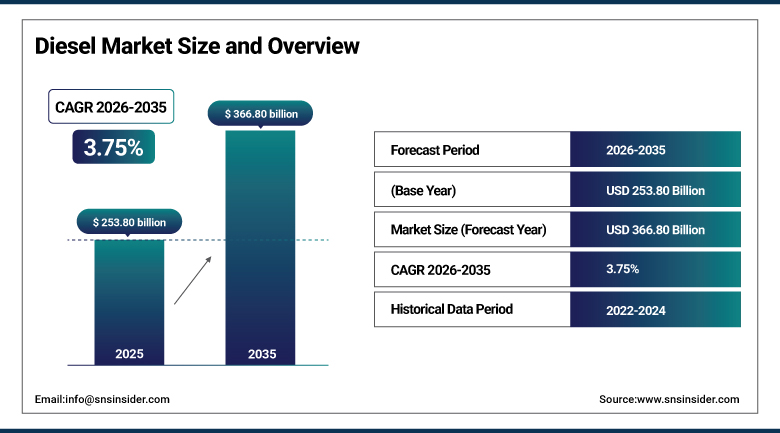
The Diesel Market was valued at USD 253.80 Billion in 2025 and is projected to reach USD 366.80 Billion by 2035, expanding at a CAGR of 3.75% during the forecast period 2026–2035.
The global market for diesel is expected to retain its importance for the industries of energy and transport through its usage in commercial transport, industrial applications, mining, agriculture, construction, maritime shipping, and standby power generation purposes. Despite the increasing efforts towards moving towards cleaner sources of energy, diesel still plays an important role owing to its energy density, efficiency as well as the existing infrastructure of distribution around the world.
Investment in clean diesel technology, ultra-low sulfur diesel, renewable diesel blending, refineries upgrading, and emission reduction techniques are changing the dynamics of competition. The demand for freight transport, infrastructure development, industrial development, and energy security policies keep contributing to market growth, while the environmental regulations push for lower emission diesel fuels.
To Get more information Diesel Market - Request Free Sample Report
Diesel Market Trends
-
Increasing adoption of ultra-low sulfur diesel (ULSD) to comply with tightening global emission regulations.
-
Rising investments in renewable diesel production and refinery conversion projects worldwide.
-
Growing freight transportation and logistics activities continue supporting commercial diesel consumption.
-
Expansion of mining, construction, and industrial infrastructure projects driving off-road diesel demand.
-
Increasing deployment of digital fuel management, predictive fleet monitoring, and fuel efficiency technologies.
The U.S. Diesel Market Size Outlook
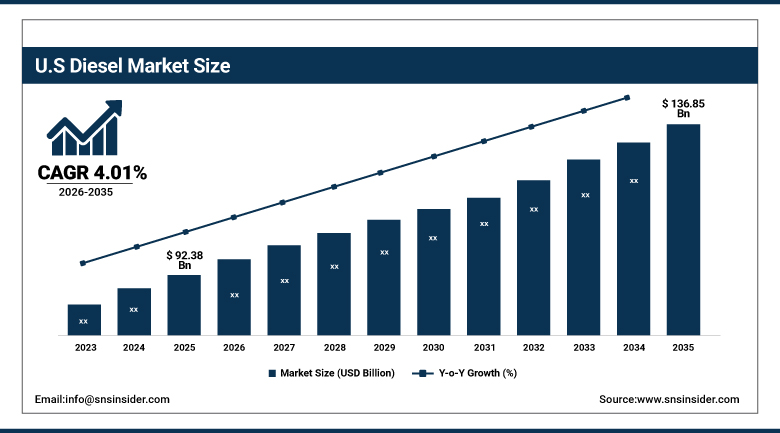
The U.S. Diesel Market was valued at USD 92.38 billion in 2025 and is expected to reach approximately USD 136.85 billion by 2035, expanding at a CAGR of 4.01% during 2026–2035.
The United States remains dominant within the region because of the prevalence of smartphone use, good digital connectivity, growing installations of public charging, and investments in customer experience in business spaces. Airports, shopping malls, hospitals, colleges, entertainment complexes, and corporate campuses keep expanding their network of charging stations to ensure visitors' satisfaction while enabling digital living for customers. Growing use of fast charging, contactless payments, and cloud-based fleet management systems contributes positively to the expansion of the market. Investments in smart cities and upgrading of public infrastructure will drive deployment in the coming years.
In the year 2026, a few leading charging infrastructure firms from the United States launched charging management solutions for their clients that featured AI-based remote diagnostics, maintenance, digital advertising, and real-time operations.
Diesel Market Segment Analysis
-
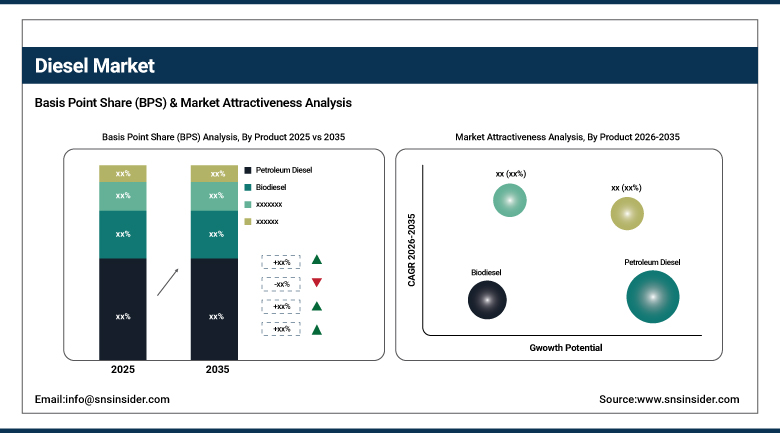
By Product, petroleum diesel dominated the market with 86.00% share in 2025, while renewable diesel is projected to witness the fastest growth with 17.93% CAGR during the forecast period.
-
By Sulfur Content, ultra-low sulfur diesel (ULSD) dominated the market with 74.00% share in 2025, while low sulfur diesel (LSD) is projected to witness the fastest growth with 4.41% CAGR during the forecast period.
-
By Application, transportation dominated the market with 48.00% share in 2025, while marine is projected to witness the fastest growth with 7.00% CAGR during the forecast period.
-
By End User, automotive dominated the market with 45.00% share in 2025, while marine is projected to witness the fastest growth with 7.00% CAGR during the forecast period.
By Product, petroleum diesel dominated, while renewable diesel is the fastest-growing.
The petroleum diesel segment holds the highest revenue share of 86.00% in 2025 due to its availability, efficient refining process, extensive fueling network and dependency in applications such as heavy duty transportation, industries, agriculture, construction and power generation. Commercial trucks and railway fleet, mining machineries and marine vehicles still depend on petroleum diesel since it is highly efficient, reliable and cost-effective fuel. Even with other fuels available, petroleum diesel continues to be widely used since it is the most effective fuel in powering freight transportations, industries and infrastructural activities in both emerging and developed countries.
The renewable diesel segment will have the highest CAGR of 17.93% during the forecast period due to increased decarburization programs in the world, stringent emission regulations and increasing production capacities of renewable fuels. Energy companies are developing renewable diesel refineries using waste oils, vegetable oils and bio-fuels to ensure lower carbon life cycle emissions yet remaining compatible with conventional diesel engines and networks. Increased government incentives and low-carbon fuel standards coupled with the demand from commercial transportation fleet for clean alternative fuels are expected to drive rapid growth of renewable diesel segment during the forecast period.
By Sulfur Content, ultra-low sulfur diesel (ULSD) dominated, while low sulfur diesel (LSD) is the fastest-growing.
The ultra-low sulfur diesel (ULSD) category dominated the market share with 74.00% in 2025 because of the extensive deployment of stringent emission norms across the transportation, industry, and commercial sectors. The ULSD helps in efficient operation of advanced technologies for emission reduction such as diesel particulate filter and selective catalytic reduction along with significant decrease in the levels of sulfur oxide emission. Strict cleaner fuel norms enforced by the authorities worldwide prompt the refiners to expand their ULSD production capacity. Increasing replacement of traditional diesel fuel varieties with the cleaner variety will further help to maintain the dominance of ULSD in the global diesel fuel market.
The low sulfur diesel (LSD) category is anticipated to witness the highest CAGR of 4.41% during 2026-2035 as a result of gradual shift towards cleaner fuel specifications in the emerging countries where ULSD penetration has not yet been completed. Many industries, commercial fleets, and transportation services continue using the LSD as a bridge fuel until the complete transition to the ULSD fuel. The increasing up gradation of refineries, growing environmental compliance standards, and better fuel quality specifications across the emerging nations will help in consistent demand for low sulfur diesel.
By Application, transportation dominated, while marine is the fastest-growing.
Transportation was the most prominent end-user application in 2025 with the largest revenue share of 48.00%, owing to the extensive use of diesel in commercial trucks, buses, freight logistics, rail transportations, and long haul vehicles. Diesel engines have been used in heavy-duty transports because of the high fuel efficiency, higher torque output, and longevity of operations in difficult conditions. Increasing freight movement, logistics network expansion, international business transactions, and infrastructural developments are likely to continue providing strong support to steady consumption of diesel from transportation applications despite increased investment in alternative power sources.
The marine industry segment is expected to grow at the highest CAGR of 7.00% during the forecast period on account of the increasing maritime traffic globally, modernization efforts of the fleet of ships, and adoption of clean diesel fuel in marine vessels. Shipping companies are continuously investing in emissions-friendly marine engines, improved fuel management solutions, and cleaner formulations of diesel fuel in order to meet the environmental norms laid down by International Maritime Organization. Expansion of international shipping activities and offshore energy activities would provide strong growth prospects for diesel consumption in marine applications.
Regional Analysis
|
Region |
Major Country |
Share within Region, 2025 (%) |
|---|---|---|
|
North America |
United States |
91.00% |
|
Europe |
Germany |
19.00% |
|
Asia Pacific |
China |
21.00% |
|
Middle East & Africa |
UAE |
9.00% |
|
Latin America |
Brazil |
11.00% |
North America Diesel Market Insights
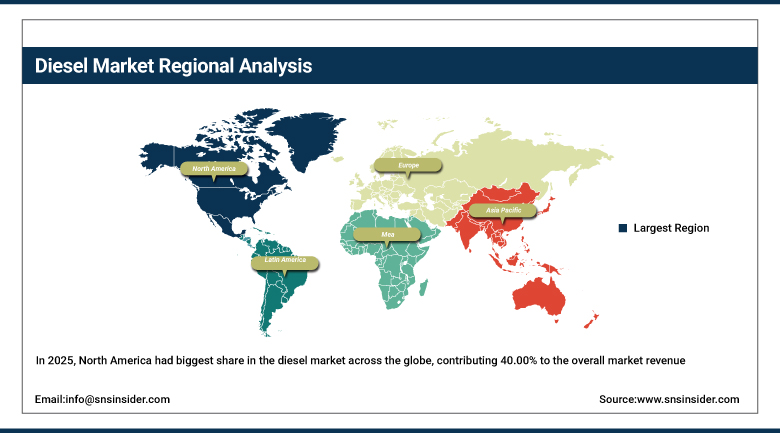
In 2025, North America is estimated to have held the biggest share in the diesel market across the globe, contributing 40.00% to the overall market revenue. The region is set to continue dominating due to well-developed commercial freight transportation system, sophisticated refining facilities, huge fleet of heavy duty trucks and diesel usage in various industries such as construction, agriculture, industrial sector, and mining sector. The U.S. is the biggest contributor due to investments in refining facilities, production of ultra-low sulfur diesel fuel, renewable diesel blending and fuel distribution system.
The growth in infrastructure development, logistics industry, and diesel-powered commercial trucks is expected to retain the dominance of North America throughout the forecast period despite increasing investments in alternative fuels. According to U.S. Energy Information Administration (EIA), there was continuous investment in refineries in North America to produce cleaner diesel fuel and steady distillate fuel supply.
Get Customized Report as per Your Business Requirement - Enquiry Now
Europe Diesel Market Insights
The continent had its back supported through the demand generated from commercial vehicles, industrial machines, agricultural equipment, and maritime use. Europe keeps moving towards sustainable diesel through the extensive use of ultra-low sulfur diesel, renewable diesel, and emission reduction technology. Countries such as Germany, France, Italy, Spain, and Netherlands keep upgrading their refineries and producing sustainable fuel while ensuring that diesel is still an important fuel in the movement of freight and industrial activities.
While there have been efforts towards electrification, diesel will always be an important fuel in heavy haulage and industries needing high-energy fuel. The Renewable Energy Directive and FuelEU Maritime by the European Commission were implemented further in order to promote the use of renewable fuel and low-emission transport fuels.
Asia Pacific Diesel Market Insights
The Asia-Pacific region is estimated to have the highest CAGR of 4.86% over the forecasted period due to its fast-paced industrialization, construction work, increased freight transport, and infrastructural developments in China, India, Indonesia, Vietnam, and Southeast Asia. Increasing mining activities, mechanization of agriculture, manufacturing industries, and commercial vehicles are responsible for high demand for diesel.
At the same time, countries are making efforts to develop their refineries, produce cleaner diesel fuel, and improve fuel quality standards in order to help economies grow without harming the environment. Urbanization and industrialization are likely to drive the markets of the region for many years to come. In India, refinery up gradation and clean transport fuel programs are being continuously expanded through the Bharat Stage VI fuel quality regulations.
Middle East & Africa and Latin America Diesel Market Insights
The Middle East & Africa due to the growing oil and gas extraction, industry, power plants, mining operations, and construction activities. Countries such as Saudi Arabia, UAE, and South Africa will be increasing their investment in the development of refining capacities and clean fuels to enhance their energy security and competitiveness. The growth of industrialization and infrastructure will contribute to the steady demand for diesel in the region. Saudi Aramco will continue developing its refinery integration and the production of clean fuels to improve fuel quality and meet growing demand in domestic and export markets.
Latin America because of the high level of demand for diesel in mining, agriculture, commercial transportation, and oil and gas industry in Brazil, Mexico, Chile, and Argentina. Growing infrastructure spending, logistics activity, and increased agricultural exports will continue driving diesel consumption in the region. The development of refineries and improved fuel quality initiatives will also contribute to market development in several countries.
Market Dynamics
Growth Drivers: Growth in freight transportation, industrial activity continues to fuel the global consumption of diesel.
Growing freight movement via road transport, railway logistics, sea transportation, mining, and construction activities continues to be the main growth factor in the global market for diesel fuel. Diesel engines have shown greater fuel efficiency, higher torque, longevity, and robustness in performing under heavy duty conditions and continue to be critical in all commercial industries. Investments are being made in developing countries to develop highways, port terminals, industrial facilities, mines, and urban infrastructure development, thus driving the demand for diesel.
At the same time, advancements in refineries, clean diesel production, and logistics support market growth by providing adequate fuel supplies to the transportation and industrial sector. According to U.S. Energy Information Administration (EIA), growing demand for distillate fuel on the back of commercial transportation and industrial activities along with investments in clean diesel production at refineries continues.
Restraints: Strict environmental regulations and the ongoing electrification of cars will slow down future demand growth for diesel fuel.
Despite the importance of this fuel for the industry and for heavy-duty transport, the diesel fuel market faces more and more pressure due to stricter environmental regulations, carbon emission reductions, and the fast electrification. Environmental regulations and stricter emissions are being introduced by governments from North America, Europe, and Asia through tighter fuel-quality regulations, emission standards, and policies to adopt electric vehicles, hydrogen energy, and other alternative low-carbon fuels. Adherence to such strict environmental regulations involves high costs for upgrading refineries and adopting technologies that provide clean fuel.
Moreover, sustainability goals and zero-emission transport strategies adopted by companies lead to additional future threats to traditional diesel fuel usage in different industries. The European Union continued to implement FuelEU Maritime and Fit for 55 programs designed to reduce greenhouse gas emissions from the transport sector.
Opportunities: Increased production capacity provide considerable future market opportunities.
Increased commercialization of renewable diesel, sustainable raw materials, and new innovations in refining provides considerable opportunities for the future development of the diesel market. Energy companies are actively investing into conversions of refineries that can produce renewable diesel out of waste oil, used cooking oil, animal fat, and other sustainable raw materials using the existing fuel distribution network. Increased implementation of the standards related to low-carbon fuels, government subsidies, and decarburization of corporations' activities is driving investments into the clean diesel innovations.
Constant innovations in fuel processing, carbon reduction, and production of bio-fuel are going to increase the competitiveness of the market and contribute to energy security of the world and emission reduction targets. Neste continued developing renewable diesel production capacity and sustainable fuel supply for global transportation decarburization and rising demand for low-carbon diesel alternatives.
Recent Developments
-
2026: Neste Oyj expanded its global renewable diesel production and distribution network to meet increasing demand for low-carbon transportation fuels across North America and Europe, strengthening supply for commercial transportation and industrial customers.
-
2026: Chevron Corporation continued expanding renewable fuel production through its renewable diesel initiatives and refinery optimization projects to support lower-carbon fuel availability for commercial transportation markets.
-
2025: Valero Energy Corporation, through the Diamond Green Diesel joint venture, announced continued expansion of renewable diesel production capabilities to support growing demand for sustainable transportation fuels in North America.
-
2025: ExxonMobil announced continued investments in advanced refinery technologies and cleaner transportation fuel production to improve operational efficiency and reduce lifecycle emissions across its downstream operations.
Diesel Market Key Players are:
-
Exxon Mobil Corporation
-
Shell plc
-
BP plc
-
Chevron Corporation
-
TotalEnergies SE
-
Saudi Aramco
-
China Petroleum & Chemical Corporation
-
PetroChina Company Limited
-
Indian Oil Corporation Limited
-
Bharat Petroleum Corporation Limited
-
Hindustan Petroleum Corporation Limited
-
Marathon Petroleum Corporation
-
Valero Energy Corporation
-
Phillips 66
-
Neste Oyj
-
Repsol S.A.
-
Eni S.p.A.
-
OMV AG
-
HF Sinclair Corporation
-
PBF Energy Inc
Diesel Market Report Scope:
| Report Attributes | Details |
|---|---|
| Market Size in 2025 | USD 253.80 Billion |
| Market Size by 2035 | USD 366.80 Billion |
| CAGR | CAGR of 3.75% From 2026 to 2035 |
| Base Year | 2025 |
| Forecast Period | 2026-2035 |
| Historical Data | 2022-2024 |
| Report Scope & Coverage | Market Size, Segments Analysis, Competitive Landscape, Regional Analysis, DROC & SWOT Analysis, Forecast Outlook |
| Key Segments | • By Product (Petroleum Diesel, Biodiesel, Renewable Diesel, Synthetic Diesel) • By Sulfur Content (Ultra-Low Sulfur Diesel (ULSD), Low Sulfur Diesel (LSD), High Sulfur Diesel (HSD)) • By Application (Transportation, Power Generation, Construction Equipment, Marine, Mining Equipment, Others) • By End User (Automotive, Industrial, Marine, Oil & Gas, Power Generation, Others) |
| Regional Analysis/Coverage | North America (US, Canada), Europe (Germany, UK, France, Italy, Spain, Russia, Poland, Rest of Europe), Asia Pacific (China, India, Japan, South Korea, Australia, ASEAN Countries, Rest of Asia Pacific), Middle East & Africa (UAE, Saudi Arabia, Qatar, South Africa, Rest of Middle East & Africa), Latin America (Brazil, Argentina, Mexico, Colombia, Rest of Latin America). |
| Company Profiles | Exxon Mobil Corporation, Shell plc, BP plc, Chevron Corporation, TotalEnergies SE, Saudi Aramco, China Petroleum & Chemical Corporation, PetroChina Company Limited, Indian Oil Corporation Limited, Bharat Petroleum Corporation Limited, Hindustan Petroleum Corporation Limited, Marathon Petroleum Corporation, Valero Energy Corporation, Phillips 66, Neste Oyj, Repsol S.A., Eni S.p.A., OMV AG, HF Sinclair Corporation, PBF Energy Inc. |

Frequently Asked Questions
The Diesel Market was valued at USD 283.36 Billion in 2025.
The market is expected to expand at a CAGR of 3.75% during the forecast period.
The market is projected to reach USD 366.80 Billion by 2035.
Petroleum Diesel accounted for the largest market share of 86.00% in 2025.
North America dominated the global Diesel Market in 2025.
