
Digital Wound Care Management System Market Report Scope & Overview:
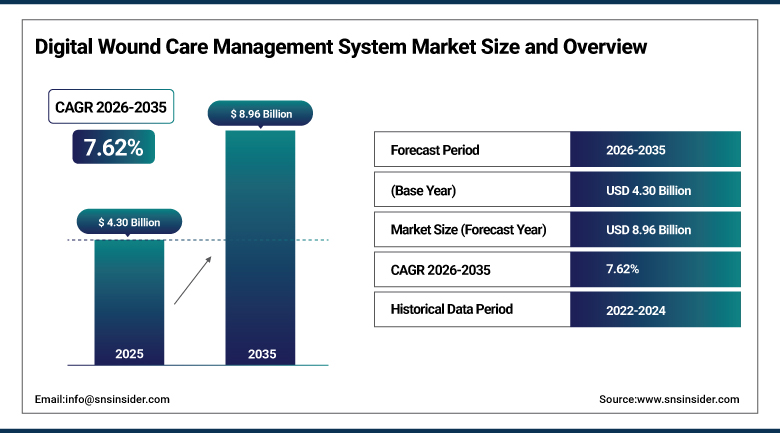
The Digital Wound Care Management System Market was valued at USD 4.30 Billion in 2025 and is expected to reach USD 8.96 Billion by 2035, growing at a CAGR of 7.62% from 2026-2035.
The Digital Wound Care Management System Market is advancing at a steady pace as clinicians replace paper charts and rulers with software, imaging, and analytics that track healing across care settings. Rising numbers of diabetic foot ulcers, pressure injuries, and venous leg ulcers are increasing pressure on hospitals and community teams to document and measure wounds consistently. Artificial intelligence based measurement, telehealth consultations, and integration with electronic health records are shifting the competitive focus toward interoperable platforms. Payers and quality programs are also rewarding documented outcomes, which supports wider adoption across hospitals, clinics, and home care.
⮞In April 2025, the International Diabetes Federation reported in its Diabetes Atlas 11th edition that 589 million adults were living with diabetes. A patient base of this scale sustains demand for systems that monitor diabetic foot ulcers.
To Get more information Digital Wound Care Management System Market - Request Free Sample Report
Digital Wound Care Management System Market Trends
- Smartphone-based wound measurement and artificial intelligence tissue classification
- Integration of wound documentation with electronic health records
- Remote wound monitoring through telehealth and home nursing programs
- Fluorescence and multispectral imaging for infection and healing assessment
- Cloud platforms supporting multi-site wound care networks
U.S. Digital Wound Care Management System Market Outlook
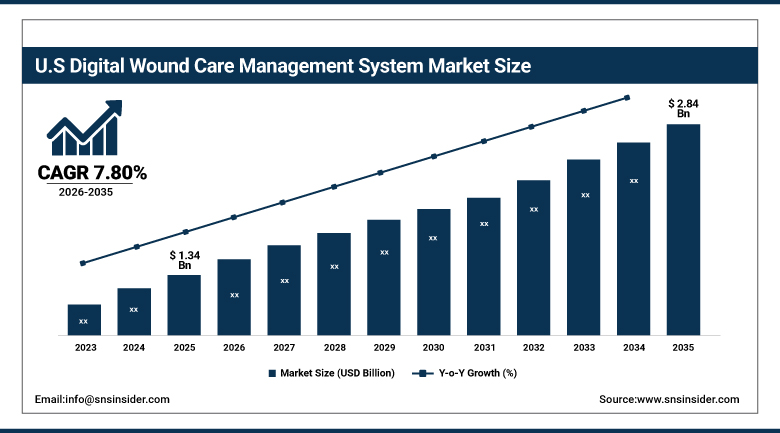
The U.S. Digital Wound Care Management System Market was valued at USD 1.34 Billion in 2025 and is expected to reach USD 2.84 Billion by 2035, growing at a CAGR of 7.80% from 2026-2035.
The U.S. Digital Wound Care Management System Market is anchored by a large Medicare population, a high prevalence of diabetes, and a dense network of hospital based wound centers and outpatient clinics. Hospitals adopt digital documentation to satisfy quality reporting, reduce hospital-acquired pressure injuries, and defend reimbursement. Skilled nursing and home health agencies are expanding use of smartphone applications for measurement and photographs. Vendors compete on EHR integration, regulatory clearances, and analytics, while health systems standardize platforms across sites to compare outcomes and support value-based contracts.
⮞In November 2025, the Centers for Medicare & Medicaid Services finalized a flat Medicare Part B payment rate of USD 127.14 per square centimeter for skin substitutes, effective 1 January 2026. Payment reform of this kind increases scrutiny of wound documentation.
Digital Wound Care Management System Market Segment Analysis
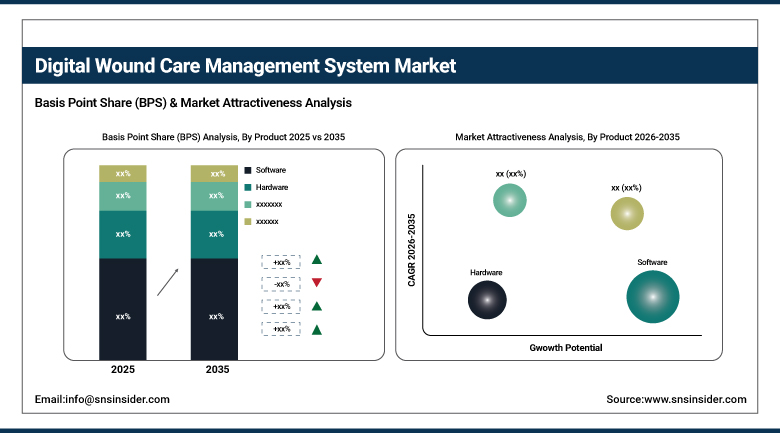
- By Product, the Software segment dominated the Digital Wound Care Management System Market with approximately 65.91% share in 2025, and is also the fastest growing with a CAGR of approximately 8.31%.
- By Wound Type, the Chronic Wounds segment dominated the Digital Wound Care Management System Market with approximately 58.79% share in 2025, and is also the fastest growing with a CAGR of approximately 8.44%.
- By End Use, the Hospitals segment dominated the Digital Wound Care Management System Market with approximately 52.07% share in 2025, while the Wound Care Clinics segment is the fastest growing with a CAGR of approximately 8.95%.
- By Deployment, the Cloud-Based segment dominated the Digital Wound Care Management System Market with approximately 52.40% share in 2025, while the Mobile-Based segment is the fastest growing with a CAGR of approximately 9.62%.
By Product, Software Dominates Digital Wound Care Management System Market and Also Registers Fastest Growth
Software leads the product landscape because documentation, measurement, and analytics tools deliver value without large equipment purchases. Wound assessment modules, image management, and care planning applications sit inside hospital workflows and are licensed on subscription terms. Interoperability with electronic health records, structured data capture, and reporting dashboards make the software indispensable for quality programs. Hardware such as imaging devices and sensors remains a complementary category that supports data capture. Vendors also bundle training and support services for hospital customers.
The software sector is growing the fastest with regard to measurement, classification, and wound-healing prediction due to artificial intelligence. The software is being updated by vendors from time to time with the inclusion of automated area calculations, infection detection, and remote reviews. The smartphone camera helps reduce dependence on specific equipment, making it more accessible in community nursing and extended care facilities. Cloud computing helps organizations benchmark their results against other organizations and detect patients who may have a problem with healing in advance.
⮞In December 2025, Sheffield Teaching Hospitals NHS Foundation Trust began piloting an artificial intelligence wound measurement app with three community district nursing teams. Clinicians photograph the wound with a calibration sticker and the software calculates its size.
By Wound Type, Chronic Wounds Dominates Digital Wound Care Management System Market and Also Registers Fastest Growth
Chronic wounds account for most system use because diabetic foot ulcers, pressure injuries, and venous leg ulcers require weeks or months of monitoring. Repeated measurement, photography, and treatment documentation generate the longitudinal records that digital platforms handle well. Clinics running dedicated programs for these patients rely on structured tools to follow healing curves and justify continued therapy. Rising diabetes and an ageing population enlarge the cohort of patients who need this long-term attention. Specialist programs also report fewer missed assessments.
Chronic wounds are also the fastest growing application, supported by the shift of care toward homes and community settings where objective tracking is essential. Remote monitoring programs use photographs and sensor data to detect stalled healing early, reducing avoidable amputations and admissions. Payers increasingly link coverage to documented progress, which strengthens demand for compliant records. Acute wounds, including surgical and traumatic injuries, form a smaller group that uses digital tools mostly for inpatient documentation and follow-up. Education improves adherence.
⮞The National Pressure Injury Advisory Panel estimates that 2.5 million patients per year develop a pressure injury in the United States. Prevalence of that size makes systematic tracking a priority for hospitals and nursing facilities.
By End Use, Hospitals Dominates Digital Wound Care Management System Market; Wound Care Clinics to Register Fastest Growth
Hospital settings constitute the largest end use segment due to their ability to manage high acuity wounds, conduct inpatient pressure injury prevention programs, and budget for enterprise solutions. Information technology departments in centralized hospitals can implement solutions in various wards and integrate these into electronic medical records. Accreditation and regulation reporting further provide an additional incentive for wound documentation. In addition, large-scale hospital systems operate outpatient wound care centers that function as referral centers from primary care practices and surgeries. The wound teams in tertiary hospitals drive standardization through IT solutions.
Wound care clinics represent the rapidly growing end use segment, with outpatient specialty clinics rising in popularity especially in diabetic foot ulcers and chronic wound management. These wound care clinics make use of measurement reproducibility and documentation in order to enable reimbursement of advanced wound treatment procedures. Cloud-based IT solutions that require minimal onsite infrastructure are increasingly popular among such clinics. Home health and long-term care organizations are the other two segments of end users with the growth driven by telemedicine regulations and hospital at home programs.
⮞In March 2026, the American Medical Association reported that Congress extended the Acute Hospital Care at Home waiver through 2030, with 366 programs across 139 health systems in 37 states approved. Growth of home-based acute care widens the use of remote wound monitoring.
By Deployment, Cloud-Based Dominates Digital Wound Care Management System Market; Mobile-Based to Register Fastest Growth
Cloud-based deployment leads because it reduces upfront cost, simplifies updates, and allows images and records to be shared across sites. Health systems, clinic groups, and home health agencies value central data storage and remote access for specialists. Vendors maintain security certifications and handle backups, which eases the burden on small organizations. Subscription pricing aligns costs with patient volumes, and integration with electronic health records is usually delivered through standard application programming interfaces. Automatic upgrades keep clinical content current everywhere.
Mobile-based deployment is the fastest growing option as clinicians use phones and tablets to capture wound images, measurements, and notes at the bedside or in the home. Apps built around the device camera, calibration markers, and artificial intelligence require no specialized hardware, lowering the barrier to adoption. Patient-facing versions let individuals share photographs with nurses between visits. On-premise systems persist in organizations with strict data residency rules, but their share is gradually declining. Offline capture suits remote rural homes.
⮞In 2026, the American Podiatric Medical Association noted that the Consolidated Appropriations Act restored Medicare telehealth flexibilities retroactively, with availability through 31 January 2027. Telehealth continuity supports remote wound review on mobile platforms.
Regional Analysis
|
Region |
Major Country |
Share within Region, 2025 (%) |
|---|---|---|
|
North America |
United States |
88.00% |
|
Europe |
Germany |
28.17% |
|
Asia Pacific |
China |
35.42% |
|
Latin America |
Brazil |
49.38% |
|
Middle East & Africa |
Saudi Arabia |
31.76% |
North America Digital Wound Care Management System Market Insights
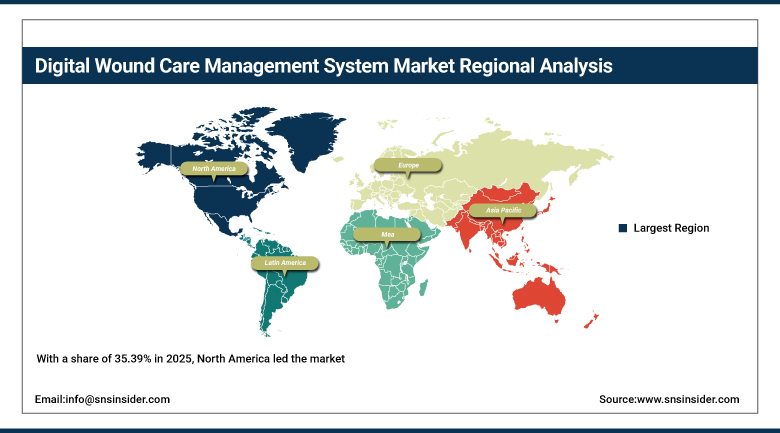
With a share of 35.39% in 2025, North America led the market, supported by a large population of Medicare beneficiaries, widespread diabetes, and early adoption of electronic health record based workflows. The United States generates most regional demand through hospital wound centers, skilled nursing groups, and specialist clinics, while Canada contributes through provincial initiatives to standardize wound documentation. Vendors headquartered in the region run clinical studies with health systems and secure regulatory clearances for imaging and artificial intelligence tools. Private payers add further momentum.
Reimbursement policy strongly influences purchasing. Payment reform for skin substitutes, hospital quality programs, and penalties for hospital-acquired pressure injuries all raise the value of consistent documentation. Telehealth flexibilities and hospital-at-home programs create new settings in which digital wound assessment is useful. Consolidation among wound care service providers is producing larger buyers that standardize platforms across many sites. Cybersecurity expectations are high, so vendors invest in compliance, audit logging, and secure image storage. Large integrated delivery networks also pilot new tools within a few facilities before wider rollout, which gives vendors a repeatable path to enterprise contracts and long term service agreements.
⮞Researchers writing in the International Wound Journal in December 2023 modeled that wound care represents about 3.5% of Canadian health spending. A share of that size gives provinces an incentive to improve the efficiency of wound management.
Get Customized Report as per Your Business Requirement - Enquiry Now
Europe Digital Wound Care Management System Market Insights
Europe ranks second, supported by national health systems that manage large wound populations and increasingly fund digital pathways. Germany, the United Kingdom, France, Italy, and the Nordic countries lead adoption, with community nursing and specialized wound clinics as the main users. Health authorities favor tools that reduce nurse travel and improve consistency of assessment. Medical device regulation requires clinical evidence for measurement and artificial intelligence software, which raises entry barriers but strengthens confidence among buyers. National digital health strategies encourage standard data formats.
Procurement is often regional or national, so suppliers need to demonstrate integration with a variety of record systems and compliance with data protection law. Pilot programs in community care are testing smartphone based measurement and remote review, particularly in the United Kingdom. Ageing populations and the growing burden of diabetes sustain long term demand. Reimbursement for digital wound tools is limited in several countries, so adoption depends on funding from trusts, regional authorities, and innovation programs. Cross-border research collaborations also help validate measurement algorithms across diverse populations.
⮞A BMJ Open study published in December 2020 estimated that 3.8 million patients with a wound were managed by the NHS in 2017 and 2018. Volumes of this size explain the interest in scalable digital assessment.
Asia Pacific Digital Wound Care Management System Market Insights
Asia Pacific is the fastest growing region with an expected CAGR of 9.52% from 2026 to 2035, led by China, Japan, India, Australia, and South Korea. Ageing societies, rapid growth in diabetes, and investment in digital health infrastructure are widening the user base. Japan combines a high proportion of older adults with advanced home nursing services, while China is building hospital information systems at scale. India offers a large patient population and rising private hospital investment. Government screening drives further expand early detection.
Local technology firms are entering the field with applications tailored to regional languages and workflows, and global vendors partner with hospital groups for pilots. Telemedicine adoption accelerated after the pandemic and now supports remote wound review in rural areas. Reimbursement for digital tools is still limited, so private hospitals and clinic chains are the early adopters. Training of nurses in standardized assessment is an important enabler, and government programs for diabetic foot care are creating additional demand. Investment from regional venture funds also supports development.
⮞In June 2025, the Chinese Center for Disease Control and Prevention reported an estimated 233 million people with diabetes in China in 2023, up 163% from 2005. The scale of the disease increases the need for diabetic foot ulcer monitoring.
MEA & Latin America Digital Wound Care Management System Market Insights
Latin America is developing as private hospital groups in Brazil, Mexico, Argentina, and Colombia adopt electronic records and wound documentation tools. Mexico belongs to this region in market estimates, and its large diabetic population creates clear clinical need. Public systems face budget limits, so adoption is concentrated in major cities and private networks. Telehealth programs are gradually enabling specialist review of wounds in remote areas, and local software companies are emerging to serve the market. Academic hospitals in the region also collaborate on clinical validation studies for imaging tools.
The Middle East and Africa region is led by Gulf countries, where national digital health programs and new specialist hospitals support investment in wound documentation and telemedicine. Saudi Arabia and the United Arab Emirates are expanding health information exchanges and virtual care networks. In Africa, adoption is limited by infrastructure and cost, though mobile applications offer a path for community clinics. International vendors rely on distributors and partnerships with academic hospitals to enter the region. Sovereign health investment funds also back digital pilots at flagship hospitals.
⮞In August 2026, the Saudi Ministry of Health reported that the Seha Virtual Hospital was connected to 241 hospitals and more than 1,400 health centers. Virtual care networks of this scale offer a platform for remote wound consultation.
Market Dynamics
Growth Drivers: Rising Chronic Wound Prevalence and Quality-Based Reimbursement Drive Growth in the Digital Wound Care Management System Market
Chronic wound prevalence is rising with diabetes, obesity, vascular disease, and population ageing. Treatment is lengthy and costly, so providers seek tools that shorten healing time and prevent complications. Digital measurement and photography establish objective baselines, allow clinicians to detect stalled healing quickly, and give managers visibility into outcomes across programs. These capabilities align closely with the priorities of hospitals and health plans seeking to reduce avoidable admissions, amputations, and readmissions. Employers and insurers are also paying closer attention to the long-term cost of untreated ulcers, which adds executive-level support for digital programs and encourages investment in standardized training across clinical teams. Early wins in reduced visit counts help justify wider rollouts.
Quality-based reimbursement is a second driver. Payers increasingly require documentation of wound size, treatment, and progress before approving advanced therapies, and hospitals face penalties for hospital-acquired pressure injuries. Digital systems create the audit trails needed to meet these requirements. Integration with electronic records reduces duplicate entry for nurses and improves compliance. As value-based contracts spread, organizations are likely to treat wound software as a core part of their clinical and financial infrastructure. Accrediting bodies and public reporting programs also publish pressure injury rates, which makes hospitals more attentive to the quality of nursing documentation and creates a natural opening for software that standardizes photographs, measurements, and risk scores. Dashboards further help managers coach staff.
Restraints: Data Security Concerns, Interoperability Gaps, and Limited Reimbursement Restrain Growth in the Digital Wound Care Management System Market
Security of data is an important issue since the wound pictures and documentation have personal health details. The healthcare companies undergo many cyber-attacks and there are many security checks, which take time to complete, thus slowing down the process and costing money. Smaller hospitals do not have information technology knowledge to be able to scrutinize the supplier. It is also hard to integrate with different electronic documentation and proprietary documentation makes it even harder. All these factors make the sales cycle longer and costlier. The vendor should be able to withstand security tests, certifications, and good incident management plan. This makes the process costlier and takes more time.
Limited reimbursement and clinician adoption challenges form a second set of constraints. Few payers directly cover digital wound assessment software, so purchases come from operating budgets. Busy nurses may resist new workflows, and training takes time. Evidence of improved outcomes is growing but is not yet conclusive for many tools. Variation in wound care practice between organizations further complicates standardization. These issues suggest that growth will remain steady rather than rapid, with the strongest uptake in organizations that have formal wound programs. Budget holders also hesitate when return on investment is hard to measure in the short term, since benefits such as fewer amputations appear gradually. Pilot projects with clear metrics are therefore a common prerequisite.
⮞In its report to Congress for 2024, the U.S. Department of Health and Human Services Office for Civil Rights recorded 663 breaches affecting 500 or more individuals, with hacking and IT incidents accounting for 534 of them. Threat levels of this kind explain the scrutiny applied to cloud based health software.
Opportunities: Artificial Intelligence and Home-Based Care Create Opportunities in the Digital Wound Care Management System Market
Artificial intelligence technology has great potential in automating image analysis for the purposes of classifying tissues and prediction of wound healing process. Studies conducted on a clinical level have revealed good correlation between results of such algorithms and the judgment of professionals that confirm suitability for use by nurses who do not specialize in treating wounds. Prediction models have the ability to identify those patients who are prone to deterioration. The companies that will be able to obtain certification for their products in terms of these functions will definitely get an advantage over other competitors. Continuous learning models can become even better as a result of additional images being added.
Home care presents another chance for growth as hospital at home services, home health agencies, and telehealth services increase in popularity. Patients and their caregivers are able to take photographs with the use of mobile phones, whereas nurses are able to check on their development and fine-tune treatment from afar. This will eliminate the need for travel, as well as reduce time to intervention and costs. Collaboration between software vendors, home health organizations, and payers is possible for bundled service provision. There is also an emerging market, provided that low cost mobile solutions are combined with training of community health workers. Another potential collaborator could be pharmacies and durable medical equipment providers by supplying dressings with software access as a bundle.
⮞A non-randomized clinical trial of 150 patients reported in the Journal of Wound Care found that an artificial intelligence device reached 97% accuracy against physician assessment in wound bed classification and tissue segmentation. Results like these support clinical confidence in automated tools.
Recent Developments:
- In May 2026, Spectral AI received FDA De Novo classification for its DeepView System for burn care, which combines multispectral imaging with an artificial intelligence algorithm. The system captures an image in 0.2 seconds and classifies areas unlikely to heal within 21 days, extending objective imaging into acute wound assessment.
- In February 2026, Swift Medical received an FDA decision of substantial equivalence for its Swift Ray 1 autofluorescence imaging adjunct tool for wounds. The clearance expands the company's smartphone based portfolio with fluorescence imaging to support detection of bacterial burden in clinical settings.
- In November 2025, Solventum announced an agreement to acquire Acera Surgical, maker of the Restrata synthetic tissue matrix for hard-to-heal wounds, for USD 725 million in cash plus up to USD 125 million in contingent payments. The transaction broadens the company's wound care portfolio.
- In December 2025, Net Health integrated the MolecuLightDX fluorescence imaging device into its Tissue Analytics platform, with interoperability for WoundExpert and compatible electronic health records. The integration supports a single standards-based documentation flow for imaging results and cloud archiving.
Digital Wound Care Management System Market Key Players are:
- WoundZoom
- WoundMatrix
- Swift Medical
- eKare
- Net Health Systems
- Healthy.io
- MolecuLight
- Joerns Healthcare
- Healogics
- Entec Health
- Spectral AI
Digital Wound Care Management System Market Report Scope:
| Report Attributes | Details |
|---|---|
| Market Size in 2025 | USD 4.30 Billion |
| Market Size by 2035 | USD 8.96 Billion |
| CAGR | CAGR of 7.62% From 2026 to 2035 |
| Base Year | 2025 |
| Forecast Period | 2026-2035 |
| Historical Data | 2022-2024 |
| Report Scope & Coverage | Market Size, Segments Analysis, Competitive Landscape, Regional Analysis, DROC & SWOT Analysis, Forecast Outlook |
| Key Segments | • By Product (Software and Hardware) • By Wound Type (Chronic Wounds and Acute Wounds) • By End Use (Hospitals, Wound Care Clinics, and Others) • By Deployment (Cloud-Based, On-Premise, and Mobile-Based) |
| Regional Analysis/Coverage | North America (US, Canada), Europe (Germany, UK, France, Italy, Spain, Russia, Poland, Rest of Europe), Asia Pacific (China, India, Japan, South Korea, Australia, ASEAN Countries, Rest of Asia Pacific), Middle East & Africa (UAE, Saudi Arabia, Qatar, South Africa, Rest of Middle East & Africa), Latin America (Brazil, Argentina, Mexico, Colombia, Rest of Latin America). |
| Company Profiles | WoundZoom, WoundMatrix, Swift Medical, eKare, Net Health Systems, Healthy.io, MolecuLight, Joerns Healthcare, Healogics, Entec Health, Spectral AI |

Frequently Asked Questions
Key players in the market include WoundZoom, WoundMatrix, Swift Medical, eKare, Net Health Systems, and Healthy.io, among others.
Key opportunities include artificial intelligence for automated measurement and healing prediction, and home-based care supported by telehealth and mobile applications.
Rising chronic wound prevalence and quality-based reimbursement are the major growth factors, as they increase the need for objective measurement and documented outcomes.
The Software segment dominated the market in 2025 with approximately 65.91% share, as documentation, measurement, and analytics tools deliver value without large equipment purchases.
North America dominated the market in 2025 with approximately 35.39% share, supported by a large Medicare population, widespread diabetes, and early adoption of electronic health record based workflows.
