
Wound Cleanser Products Market Report Scope & Overview:
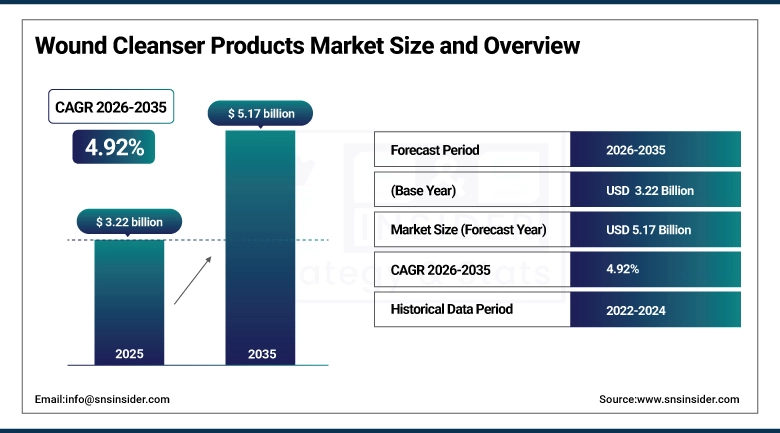
The Wound Cleanser Products Market size is valued at USD 3.22 Billion in 2025 and is projected to reach USD 5.17 Billion by 2035, growing at a CAGR of 4.92% during the forecast period 2026–2035.
The market research report on the Wound Cleanser Products Market analyzes key industry trends, product innovations, clinical advancements, and adoption expansion across hospitals, clinics, and home healthcare settings. The increasing prevalence of chronic wounds such as diabetic foot ulcers and pressure injuries, rising number of surgical procedures and burn cases, growing demand for antimicrobial and advanced wound cleansing solutions, and expanding awareness regarding infection prevention and wound hygiene are driving steady market growth from 2026 to 2035.
Usage of wound cleanser products is estimated to surpass 1.5 billion wound cleansing procedures globally in 2025.
Market Size and Forecast:
-
Market Size in 2025: USD 3.22 Billion
-
Market Size by 2035: USD 5.17 Billion
-
CAGR: 4.92% from 2026 to 2035
-
Base Year: 2025
-
Forecast Period: 2026–2035
-
Historical Data: 2022–2024
To Get more information on Wound Cleanser Products Market - Request Free Sample Report
Wound Cleanser Products Market Trends:
-
Rising prevalence of chronic wounds such as diabetic foot ulcers, pressure ulcers, and venous leg ulcers is significantly accelerating demand for advanced wound cleansing solutions globally.
-
Expanding shift toward antimicrobial and surfactant-based wound cleansers is improving infection control outcomes and driving clinical preference over traditional saline solutions.
-
Increasing adoption of home healthcare and outpatient wound management is boosting demand for easy-to-use spray and foam-based cleansing formulations.
-
Growing emphasis on surgical site infection (SSI) prevention in hospitals is fueling higher usage of advanced wound cleansing protocols in post-operative care settings.
-
Rapid expansion of aging population and diabetes burden is increasing long-term dependency on chronic wound care management solutions across developed and emerging economies.
-
Advancements in bioactive, pH-balanced, and non-cytotoxic cleansing formulations are enhancing wound healing efficiency and accelerating product innovation pipelines.
U.S. Wound Cleanser Products Market Insights:
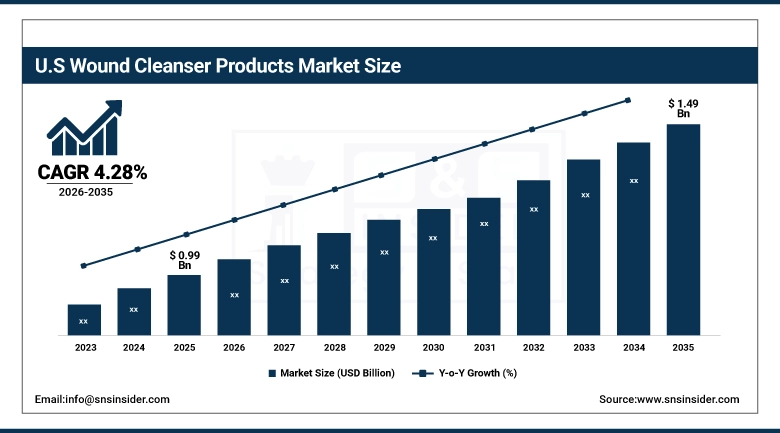
The Wound Cleanser Market is projected to grow from USD 0.99 Billion in 2025 to USD 1.49 Billion by 2035, at a CAGR of 4.28%. Some of the main factors fueling the growth of the market are the rising number of chronic wounds, including diabetic foot ulcers, pressure ulcers, and venous leg ulcers; the increasing use of high-tech antimicrobial and surfactant cleansers for wound care; and the need for infection control and fast wound healing.
Wound Cleanser Products Market Growth Drivers:
-
Rising burden of chronic and acute wound cases across hospitals, surgical centers, and homecare settings is driving strong global demand for advanced wound cleansing solutions.
The increasing necessity for infection control, faster healing, and better results after surgeries is one of the critical drivers behind the fast-paced adoption of advanced wound cleansers in clinical and ambulatory settings. The swift change towards antiseptic, surfactant-based, and bioactive formulations for wound cleaning is rising owing to the requirement for efficient microbial control, lower rates of infections at surgical sites, and greater efficiency in the treatment of chronic wounds such as diabetic foot ulcers, pressure ulcers, and traumatic wounds.
More than 55% of chronic wound care treatment protocols in 2025 are estimated to involve advanced antimicrobial or surfactant-based wound cleansing solutions across hospital and specialized wound care settings.
Wound Cleanser Products Market Restraints:
-
High cost associated with advanced wound cleansing solutions and limited reimbursement coverage remain a key restraint for the Wound Cleanser Market.
In some cases, healthcare institutions, more specifically in cost-conscious and developing areas, struggle with the implementation of innovative antimicrobial, surfactant, and bioactive wound cleansers owing to their relatively high price point compared to traditional saline cleansers. Furthermore, erratic coverage for advanced wound products poses significant financial strain for healthcare facilities, which consequently inhibits universal adoption. The demand for recurrent administration when dealing with chronic wounds also results in higher expenditure, thus posing another challenge for affordable healthcare delivery systems that cannot afford high-end wound cleanser solutions.
Wound Cleanser Products Market Opportunities:
-
Rapid expansion of precision-driven digital healthcare and value-based wound management systems presents a significant growth opportunity for the Wound Cleanser Market.
The growing use of innovative wound cleansing products within chronic wound care protocols, out-of-hospital clinics, and even home-based care through telemedicine has created new avenues of adoption for these products across mature and developing healthcare markets. Providers and insurers have become highly interested in implementing wound care programs based on fast-healing capabilities, infection recurrences, and hospital admission expenses.
Nearly 40% of next-generation wound care programs globally are expected to incorporate advanced wound cleansing solutions as a core component of standardized treatment pathways by 2025–2026.
Wound Cleanser Products Market Segmentation Analysis:
-
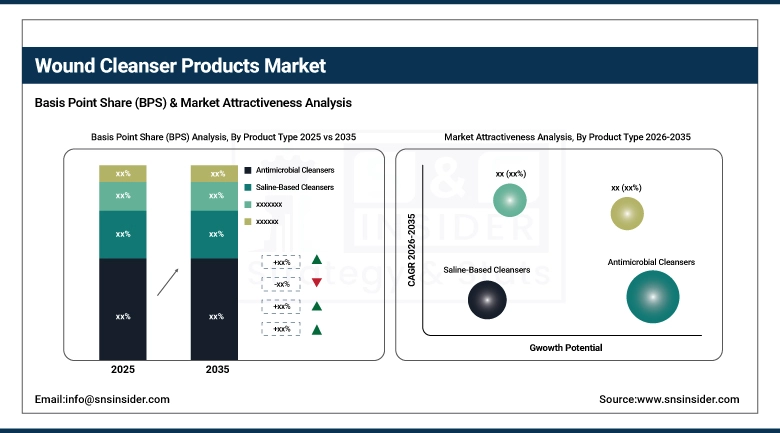
Saline-Based Cleansers dominate the largest market share of 37.55% in 2025, while Antimicrobial Cleansers are expected to grow at the fastest CAGR of 6.18% during 2026–2035.
-
Solution/Liquid formulations hold the largest market share of 42.45% in 2025, while Foam-based wound cleansers are expected to grow at the fastest CAGR of 7.14%.
-
Chronic Wounds segment dominates the largest market share of 42.85% in 2025, while it is also expected to grow at the fastest CAGR of 5.64% during 2026–2035.
-
Hospitals dominate the largest end-user share of 46.21% in 2025, while Long-Term Care Facilities are expected to grow at the fastest CAGR of 6.14% during 2026–2035.
By Product Type, Antimicrobial Cleansers Dominate While Surfactant-Based Cleansers Grow Rapidly:
Antimicrobial Cleansers was the dominating market segment because of high clinical preference in terms of infection prevention, specifically for chronic wound care, including diabetic foot ulcers, pressure ulcers, and venous leg ulcers. The benefits offered by Antimicrobial Cleansers in lowering bioburden, preventing surgical site infections, and accelerating wound healing make them more favorable choices for hospital wound care programs.
The Surfactant-Based Cleansers market segment is Fastest Growing growth because of the rising need for wound cleansers that promote mild debridement and wound bed preparation without compromising cytotoxicity.
By Formulation Type, Solution/Liquid Dominates While Foam-Based Cleansers Grow Rapidly:
The Solution/Liquid segment had dominated the market share as a result of its extensive clinical use, economical prices, and ease of application in hospitals, clinics, and homecare applications. It continues to be the most common type of wound cleansers used in regular wound irrigation treatments.
The Foam-Based Cleansers segment is fastest growing segment because of the rising inclination towards cleansers that can be easily applied to patients without having to rinse them off. They are gaining popularity in chronic wound treatment and home healthcare applications because of their higher absorption levels.
By Application, Chronic Wounds Dominate While Also Growing Rapidly:
Chronic Wounds segment held the largest market share due to the high global burden of diabetic foot ulcers, pressure ulcers, and venous leg ulcers requiring long-term wound management and repeated cleansing interventions. The need for sustained infection control and advanced wound bed preparation makes this segment the primary demand driver for wound cleansing products.
Chronic Wounds segment is also witnessing the highest growth owing to rising prevalence of diabetes, aging population, and increasing incidence of non-healing wounds that require continuous and specialized care.
By End-User, Hospitals & Cardiac Centers Dominate While Homecare Settings Grow Rapidly:
The Hospitals & Cardiac Centers segment dominates the market owing to their importance in advanced cardiac diagnostics, monitoring of patients during acute illness, and use of multilead ECG devices. The Hospitals & Cardiac Centers are still considered the main source of care where patients need ongoing monitoring for their cardiac status and post-operative follow-up.
Homecare Settings segment is the fastest-growing owing to the increasing trend of delivering healthcare services beyond hospitals through remote monitoring of patients' cardiovascular status. Wearable ECG devices and smartphone apps coupled with AI algorithms are helping patients monitor their health at home through remote access to clinical professionals.
Wound Cleanser Products Market Regional Analysis:
North America Wound Cleanser Products Market Insights:
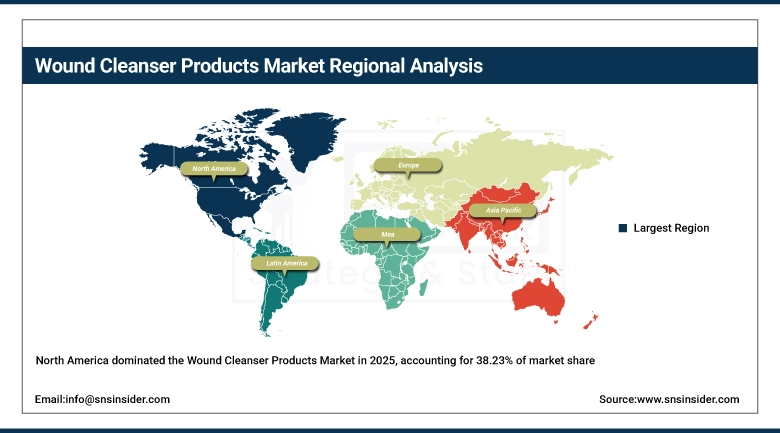
The North America Wound Cleanser Products Market is a dominant region, holding approximately 38.23% share in 2025. The market receives strong support from highly advanced clinical care infrastructure, the wide adoption of standardized wound management protocols, and the high penetration of advanced infection control solutions across healthcare facilities. Advanced wound cleansers are being constantly used in hospitals, outpatient clinics, and home healthcare facilities in the United States and Canada for managing acute and chronic wounds. The increasing prevalence of complications caused by diabetes, surgical wound cases, and an elderly population base is fueling the demand for effective wound cleansing solutions.
Get Customized Report as per Your Business Requirement - Enquiry Now
United States Wound Cleanser Products Market Insights:
The United States Wound Cleanser Products Market is characterized by a highly sophisticated healthcare ecosystem, high volume of surgical procedures, and strong focus on evidence-based wound care practices. Rising incidence of diabetic ulcers, pressure injuries, and post-operative wound complications is driving steady adoption of antimicrobial, surfactant-based, and foam cleansing formulations. Hospitals and ambulatory care centers are increasingly integrating advanced wound cleansing products into standard treatment protocols to reduce infection risks and improve healing outcomes.
Asia-Pacific Wound Cleanser Products Market Insights:
The Asia-Pacific Wound Cleanser Products Market is the fastest-growing region, projected to expand at a 5.91% CAGR during 2026–2035. Growth is fueled by rising burden of chronic wounds, increasing surgical interventions, and improving access to modern healthcare services across emerging economies. Countries such as China, India, Japan, and Southeast Asia are experiencing rapid healthcare infrastructure development, leading to wider adoption of advanced wound cleansing solutions. Expanding hospital networks, increasing healthcare spending, and growing awareness regarding infection prevention and wound hygiene practices are significantly supporting market expansion across both urban and semi-urban regions.
China Wound Cleanser Products Market Insights:
The China Wound Cleanser Products Market is expanding rapidly due to large-scale healthcare modernization, rising prevalence of chronic diseases, and increasing incidence of trauma and surgical wounds. Strong demand for advanced wound care solutions is emerging across tertiary hospitals, specialty clinics, and expanding healthcare networks. Government-led healthcare reforms, hospital capacity expansion, and investments in medical infrastructure are improving access to modern wound management products.
Europe Wound Cleanser Products Market Insights:
The Europe Wound Cleanser Products Market is driven by strong clinical standards for infection control, widespread adoption of advanced wound care protocols, and a highly structured healthcare reimbursement system. Countries such as Germany, the United Kingdom, France, and Italy are leading in the use of advanced wound cleansing formulations for chronic wound management, post-operative care, and hospital-based treatment protocols. Rising incidence of diabetic foot ulcers, pressure injuries, and aging population-related wound complications is further accelerating demand for antimicrobial and surfactant-based cleansers. Additionally, strict regulatory frameworks and emphasis on evidence-based wound care practices are encouraging adoption of high-efficacy, clinically validated cleansing solutions across hospitals and specialty wound care centers.
Germany Wound Cleanser Products Market Insights:
Germany represents a key European market due to its highly advanced hospital infrastructure, strong focus on clinical innovation, and large elderly population requiring long-term wound management. The adoption of wound cleanser products is increasing in surgical care, orthopedic recovery, and chronic wound treatment applications. Hospitals and specialized wound care clinics are integrating antimicrobial and surfactant-based cleansers into standardized treatment pathways to reduce infection risks and improve healing outcomes. Germany’s strong pharmaceutical and medical device ecosystem, combined with robust R&D investment in advanced wound care technologies, is further supporting market expansion and product innovation in the country.
Latin America Wound Cleanser Products Market Insights:
The Latin America Wound Cleanser Products Market is growing steadily owing to rising incidences of diabetes, trauma cases, and surgery in Brazil, Mexico, and Argentina. The demand for more economical wound cleansing products is fueling the use of saline and surfactant-based cleansers in public as well as private health care facilities. The expansion of primary health care services and improvement in hospital infrastructure is contributing towards market growth.
Middle East & Africa Wound Cleanser Products Market Insights:
The Middle East & Africa Wound Cleanser Products Market is expanding because of increased health care spending, increase in surgical interventions, and an upsurge in cases of chronic wounds like diabetic ulcers and burns. The major countries responsible for leading the market are Saudi Arabia, UAE, and South Africa. This has been possible due to advancements made in hospitals, including building dedicated wound care centers.
Wound Cleanser Products Market Competitive Landscape:
Smith & Nephew plc
Smith & Nephew plc is a leading global player in the Wound Cleanser Products Market, strongly positioned in advanced wound care solutions including cleansing, debridement, and infection management products. The company benefits from a broad clinical portfolio used across hospitals, outpatient wound care centers, and home healthcare settings. Its strength lies in integrating wound cleansing solutions with advanced dressing technologies, supporting faster healing in chronic and acute wound cases such as diabetic ulcers, surgical wounds, and trauma injuries. Continuous innovation in antimicrobial wound care formulations and strong global distribution networks further reinforce its competitive position.
-
In September 2025, Smith & Nephew expanded its advanced wound care portfolio by enhancing its wound cleansing and biofilm management solutions, aimed at improving chronic wound healing efficiency and infection control outcomes in hospital and outpatient settings.
3M Company
3M Company is a key innovator in the wound care segment of the Wound Cleanser Products Market, offering a wide range of cleansing solutions, barrier products, and skin protection technologies. The company is recognized for its antiseptic and skin-friendly wound cleansing systems that support infection prevention and skin integrity. Its strong R&D capabilities and material science expertise enable high-performance solutions for both clinical and homecare applications. 3M continues to focus on reducing healthcare-associated infections and improving wound management efficiency across healthcare systems.
-
In August 2025, 3M enhanced its advanced wound care portfolio with upgraded skin-safe cleansing and antimicrobial protection technologies, improving infection prevention performance in surgical and chronic wound care environments.
Johnson & Johnson
Johnson & Johnson Services, Inc. holds a strong position in the Wound Cleanser Products Market through its Ethicon division and wound care solutions supporting surgical and post-operative applications. The company benefits from strong clinical credibility and global healthcare penetration. Its wound care offerings are widely used in hospitals, surgical centers, and acute care settings, particularly for infection prevention and post-surgical recovery management. Johnson & Johnson continues to focus on improving patient outcomes through advanced wound hygiene and surgical site infection reduction strategies.
-
In July 2025, Johnson & Johnson enhanced its surgical wound care portfolio with improved cleansing and infection control solutions designed to reduce surgical site infections and support faster post-operative recovery in hospital environments.
Wound Cleanser Products Market Key Players:
Some of the Wound Cleanser Products Market Companies are:
-
Smith & Nephew plc
-
3M Company
-
Johnson & Johnson Services Inc.
-
Coloplast A/S
-
ConvaTec Group plc
-
B. Braun Melsungen AG
-
Mölnlycke Health Care AB
-
Medline Industries, Inc.
-
Cardinal Health, Inc.
-
Integra LifeSciences Corporation
-
Stryker Corporation
-
Hollister Incorporated
-
Zimmer Biomet Holdings, Inc.
-
DermaRite Industries, LLC
-
DeRoyal Industries, Inc.
-
NovaBay Pharmaceuticals, Inc.
-
Angelini Pharma S.p.A.
-
Winner Medical Group Inc.
-
HR HealthCare
-
Paul Hartmann AG
| Report Attributes | Details |
|---|---|
| Market Size in 2025 | USD 3.22 Billion |
| Market Size by 2035 | USD 5.17 Billion |
| CAGR | CAGR of 4.92% From 2026 to 2035 |
| Base Year | 2025 |
| Forecast Period | 2026-2035 |
| Historical Data | 2022-2024 |
| Report Scope & Coverage | Market Size, Segments Analysis, Competitive Landscape, Regional Analysis, DROC & SWOT Analysis, Forecast Outlook |
| Key Segments | • By Product Type (Saline-Based Cleansers, Surfactant-Based Cleansers, Antimicrobial Cleansers, Wetting Agents, Others) • By Formulation Type( Solution/Liquid,Spray Foam, Gel, Others) • By Application (Chronic Wounds (diabetic foot ulcers,Acute Wounds (surgical wounds, traumatic wounds), pressure ulcers, venous leg ulcers), Burns, Post-Operative Wound Care, Others) • By End-User (Hospitals, Clinics, Ambulatory Surgical Centers (ASCs), Home Healthcare Settings, Long-Term Care Facilities, Others) |
| Regional Analysis/Coverage | North America (US, Canada), Europe (Germany, UK, France, Italy, Spain, Russia, Poland, Rest of Europe), Asia Pacific (China, India, Japan, South Korea, Australia, ASEAN Countries, Rest of Asia Pacific), Middle East & Africa (UAE, Saudi Arabia, Qatar, South Africa, Rest of Middle East & Africa), Latin America (Brazil, Argentina, Mexico, Colombia, Rest of Latin America). |
| Company Profiles | Smith & Nephew plc, 3M Company, Johnson & Johnson Services Inc., Coloplast A/S, ConvaTec Group plc, B. Braun Melsungen AG, Mölnlycke Health Care AB, Medline Industries, Inc., Cardinal Health, Inc., Integra LifeSciences Corporation, Stryker Corporation, Hollister Incorporated, Zimmer Biomet Holdings, Inc., DermaRite Industries, LLC, DeRoyal Industries, Inc., NovaBay Pharmaceuticals, Inc., Angelini Pharma S.p.A., Winner Medical Group Inc., HR HealthCare, Paul Hartmann AG. |
Frequently Asked Questions
North America dominated with a 38.23% share in 2025, while Asia-Pacific is the fastest-growing region, expected to expand at a CAGR of 5.91% during 2026–2035.
Solution/Liquid dominated with a 42.45% share in 2025, while Foam is projected to grow at the fastest CAGR of 7.14% during 2026–2035.
Growth is driven by rising prevalence of chronic and acute wounds such as diabetic ulcers and surgical wounds, increasing demand for advanced infection control and evidence-based wound care solutions across hospitals, clinics, and home healthcare settings.
The market is valued at USD 3.22 Billion in 2025 and is projected to reach USD 5.17 Billion by 2035.
The Wound Cleanser Products Market is projected to grow at a CAGR of 4.92% during 2026–2035.
