
Direct Air Capture Market Report Scope & Overview:
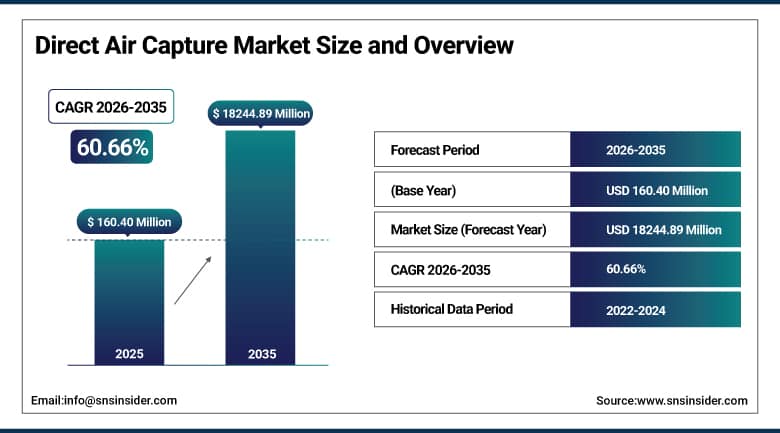
The Direct Air Capture Market size was valued at USD 160.40 million in 2025 and is expected to reach USD 18244.89 million by 2035, growing at a CAGR of 60.66% from 2026-2035.
The demand for direct air capture is influenced by an increase in demand for technologies that remove carbon from the atmosphere, with countries and corporations setting zero net emission goals and seeking solutions for reducing hard-to-abate emissions. The increasing number of governments providing their backing to the industry along with carbon pricing initiatives and investments into DAC facilities also fuels market expansion. Policies, tax benefits, and investments into carbon capture technologies drive technology development and commercialization.
According to the U.S. Department of Energy (DOE), the United States has committed up to $3.5 billion to develop four regional Direct Air Capture hubs. Additionally, the 45Q tax credit provides up to $180 per metric ton of CO₂ permanently stored from eligible DAC projects, strengthening investment and commercialization.
Market Size and Forecast:
-
Market Size in 2026E: USD 255.90 Million
-
Market Size by 2035: USD 18244.89 Million
-
CAGR: 60.66% from 2026 to 2035
-
Fastest Growing Region: Asia Pacific
-
Largest Region: North America
To Get More Information On Direct Air Capture Market - Request Free Sample Report
Direct Air Capture Market Trends:
-
Expansion of large-scale DAC facilities is accelerating as companies move from pilot projects toward commercial-scale carbon removal operations.
-
Growing government funding and tax incentives are improving project economics and encouraging private investment in DAC technologies.
-
Integration with renewable energy sources is increasing to reduce operational emissions and enhance net carbon removal.
-
Advancements in solid sorbent materials are improving CO₂ capture efficiency while lowering energy requirements for regeneration.
-
Development of modular DAC systems is enabling flexible deployment, faster scaling, and reduced infrastructure requirements for projects.
U.S. Direct Air Capture Market Size Outlook:
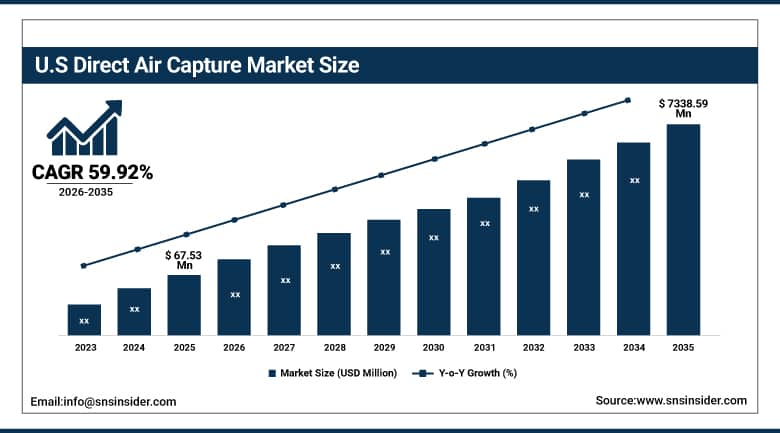
The U.S. Direct Air Capture Market was valued at USD 67.53 million in 2025 and is expected to reach USD 7338.59 million by 2035, growing at a CAGR of 59.92% from 2026-2035.
The U.S. direct air capture market is driven by increasing federal support for carbon removal technologies, including funding for large-scale DAC demonstration hubs and research initiatives. Growing corporate demand for high-quality carbon removal credits is also encouraging investment in DAC projects. In addition, ambitious net-zero commitments from businesses and government agencies are increasing the need for scalable carbon dioxide removal solutions to address hard-to-abate emissions and achieve long-term decarbonization goals.
The U.S. direct air capture market is supported by the development of four regional DAC hubs, each targeting at least 1 million metric tons of annual CO₂ capture capacity, while federal tax incentives provide eligible DAC facilities with credits of up to $180 per metric ton, improving project economics and encouraging commercial deployment.
Direct Air Capture Market Segment Analysis:
-
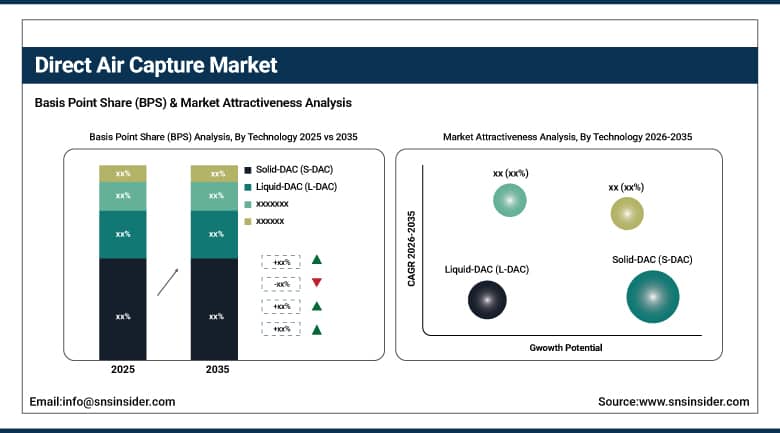
By Technology, solid-DAC (S-DAC) dominated the direct air capture market in 2025 with 55.46% share; liquid-DAC (L-DAC) is the fastest-growing segment with a 44.54% CAGR.
-
By Source, renewable energy dominated the market in 2025 with 42.56% share and is also the fastest-growing segment with a 62.14% CAGR.
-
By Application, carbon capture and storage (CCS) dominated the market in 2025 with 65.35% share; carbon capture utilization and storage (CCUS) is fastest-growing segment with a 61.65% CAGR.
-
By End Use, oil & gas dominated the market in 2025 with 32.45% share; construction is the fastest-growing segment with a 64.42% CAGR
By Technology, solid-DAC (S-DAC) segment dominates the direct air capture market, liquid-DAC (L-DAC) segment expected to grow fastest
Solid-DAC technology holds the majority share in the Direct Air Capture market owing to its comparatively low regeneration temperature along with the capability of operating at lower energy levels than liquid-based systems. It allows selective capture of CO2 from atmospheric air and is being enhanced continually by developing the materials used in it. The technology is also applicable for modular and scalable plants.
The most rapid growth of the technology can be seen in Liquid-DAC technology due to the immense possibility of scaling up the CO2 capturing capacity and large-scale application in industry. The solvents in the system have the capacity of processing large quantities of air and are easily compatible with existing chemical processing facilities. Energy consumption and cost-effectiveness are being improved continually through advancements in this technology.
By Source, renewable energy segment dominates the direct air capture market and is also expected to show fastest growth
Renewable energy dominates the Direct Air Capture market because DAC systems require substantial energy for air movement, CO₂ separation, and sorbent or solvent regeneration. Using renewable electricity and heat helps reduce the overall carbon footprint of DAC operations and increases the amount of CO₂ removed on a net basis. Declining renewable energy costs, increasing clean-power availability, and corporate decarbonization commitments are further supporting renewable-powered DAC project development.
Renewable energy is also expected to be the fastest-growing energy source for DAC as developers increasingly prioritize low-carbon and energy-efficient operations. The expansion of solar, wind, and other renewable generation is improving access to clean electricity for DAC facilities. Additionally, growing demand for high-quality carbon removal credits is encouraging developers to use low-carbon energy sources, enabling projects to achieve greater net atmospheric CO₂ removal and stronger environmental benefits.
By Application, carbon capture and storage (CCS) segment dominates the direct air capture market, carbon capture utilization and storage (CCUS) segment shows fastest growth
Carbon Capture and Storage (CCS) is the leading technology that drives the DAC industry since its geological storage allows finding a sustainable way to take CO₂ out of the atmosphere. The captured carbon dioxide may be transported and stored underground in a safe place that ensures carbon removal. The presence of already developed infrastructure for carbon dioxide transportation and storage, together with government incentives and demand for permanent carbon removal, enables the use of CCS DAC.
Carbon Capture Utilization and Storage (CCUS) will have the highest rate of development since companies will find more and more ways to utilize the captured CO₂ besides storage. CO₂ captured from DAC may be used in the synthesis of fuels, chemicals, construction materials, and other industrial processes. New investments in circular carbon economy, development of technologies of CO₂ conversion, and increasing demand for low-carbon products create more possibilities for carbon utilization.
By End Use, oil & gas segment dominates the direct air capture market, construction segment expected to grow fastest
The oil & gas industry leads the DAC industry due to its wealth of experience in handling, transporting, injecting and storing CO₂. The current pipeline infrastructure and geology know-how may contribute to the development of integrated DAC operations and carbon handling infrastructure. Moreover, the oil & gas industry is actively working on the development of carbon storage solutions for the sake of emissions reduction, portfolio diversification, meeting climate-related pledges and utilizing its expertise.
The construction industry will show the highest growth rate owing to the rising interest in capturing CO₂ and its utilization in the creation of low-carbon construction materials. CO₂ can be used to create such construction materials as concrete and others, thus enabling the permanent storage of captured carbon. The growing demand for sustainable infrastructure, stringent building standards, decarbonization efforts and innovations in the field of CO₂-based construction materials drive the growth of the industry.
Regional Analysis:
|
Region |
Major Country |
Share within Region, 2025 (%) |
|---|---|---|
|
North America |
United States |
90.10% |
|
Europe |
Germany |
25.45% |
|
Asia Pacific |
China |
35.62% |
|
Middle East & Africa |
UAE |
30.54% |
|
Latin America |
Brazil |
45.15% |
North America Direct Air Capture Market Insights
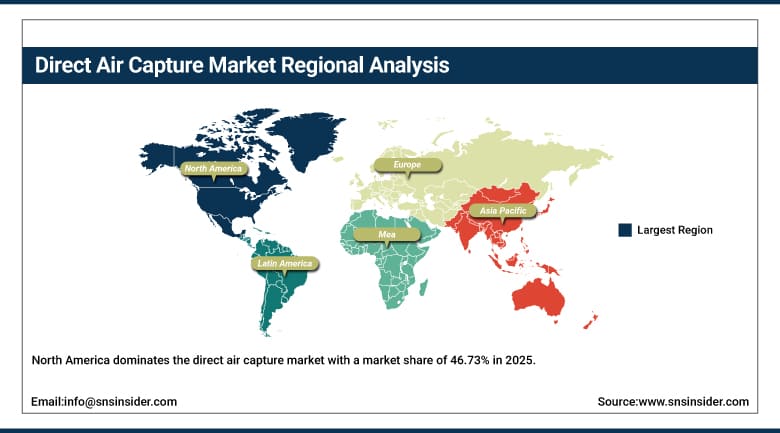
North America dominates the direct air capture market with a market share of 46.73% in 2025. Government initiatives have played a key role in fueling the North American direct air capture market, especially in the USA. The government is investing money into technology research and development via increased funding and incentives. The US Department of Energy has invested a considerable amount of resources towards regional DAC hubs, while Section 45Q tax credits are helping with the economic feasibility of carbon removal. All this is leading to investments in the technology and the transition from pilot to commercialization of the technology.
Corporate initiatives of going carbon-neutral along with the need for high-quality carbon removal certificates are driving the adoption of DAC technology in North America. Companies that want to achieve their net-zero goals and remove carbon from the atmosphere have started investing in DAC technology. There are many opportunities in North America in terms of energy infrastructure, availability of renewable energy, geological storage capacity, and venture capital.
Get Customized Report as Per Your Business Requirement - Enquiry Now
Europe Direct Air Capture Market Insights
The European Direct Air Capture market is motivated by stringent climate policies and the region’s pursuit of reaching climate neutrality. Governments and institutions in Europe have started understanding the importance of carbon dioxide removal in addressing residual emissions from hard-to-abate sectors. The development of supportive carbon management structures, emission reduction goals, and the rise of certification frameworks has motivated investments in DACs and enhanced the credibility and marketability of carbon removal credits within the European market.
The need for durable carbon removal solutions among corporations is fueling the uptake of DACs within Europe. The increase in corporate demands for carbon removal credits is a motivation for companies looking to solve their unavoidable emissions. The favorable renewable energy ecosystem in Europe further enables the development of DAC systems owing to their provision of affordable electricity. Technology advancements, research capacity, and cooperation with energy companies and industrial sectors have been useful in improving efficiency and scaling up of DACs.
Asia Pacific Direct Air Capture Market Insights
Asia Pacific shows fastest growth in the direct air capture market with a CAGR of 65.60% in 2025. Growing investments in decarbonization and carbon management technologies are propelling the Asia Pacific Direct Air Capture market forward. Countries like China, Japan, Australia, and South Korea are developing their climate policies and investigating technologies that would help to address industrial emissions. Increasing investments in clean energy, carbon capture, and storage, as well as low-carbon infrastructures, create favorable conditions for development of DAC, whereas rising industrialization creates a need for scalable technologies that would allow reducing emissions in the long term.
The vast industrial sector and growing energy consumption in the region provide ample opportunity for DAC technologies. Industries such as chemicals, manufacturing, energy production, and construction industries are seeking for ways to remove carbon dioxide and utilize it in order to reach their sustainability goals. Moreover, ongoing R&D activities and innovation initiatives from governments along with collaboration with DAC providers from other countries will help to advance the technology.
Middle East & Africa and Latin America Direct Air Capture Market Insights
The Middle East, Africa and Latin America Direct Air Capture market growth is propelled by an abundance of renewable resources and carbon management efforts. Various countries from this region are working on installing solar, wind power and other types of clean energy generation which will provide the low-carbon electricity necessary for DAC operations. Moreover, there is oil and gas infrastructure in some Middle East countries, and also geological storage potential in various countries which will enable the combination of DAC with carbon capture, transport and storage facilities.
Growing government interest in decarbonization and sustainable development is pushing forward the use of Direct Air Capture technologies in these countries. There is a growing number of cleantech and carbon management projects in countries like UAE, Saudi Arabia and Brazil, also the participation of international companies in these projects is providing technology and funding for developing countries. There is also high corporate demand for carbon removal credits in conjunction with the availability of land and renewable resources in these regions.
Market Dynamics:
Growth Drivers: Government Support and Corporate Demand Accelerate Direct Air Capture Market Growth
Government support through funding, incentives on taxes, carbon pricing systems, and favorable climate policies is driving innovations and investments in Direct Air Capture. The governments are now realizing that carbon removal is necessary for reaching net-zero objectives and handling residual emissions in hard-to-abate sectors. Financial incentives lower the cost of projects and increase their profitability, thus motivating the developers of the technology and industrial firms to set up pilot and commercial Direct Air Capture plants. These policies boost investor confidence and commercialization processes.
Increased commitment by corporations towards net-zero and carbon-neutral objectives is leading to increased need for long-term carbon dioxide removal solutions. Direct Air Capture enables verified carbon dioxide removal since the CO₂ can be permanently stored in underground locations. Technology firms are now engaging in long-term contracts on carbon dioxide removal with corporations requiring such solution. This increased demand for verified carbon dioxide removal credits is spurring investments and developing commercial DAC installations.
Restraints: High Costs and Limited Infrastructure Restrict Large-Scale Direct Air Capture Deployment
Direct Air Capture plants are energy-intensive because they need plenty of energy for moving huge quantities of air and regenerating sorbents or solvents. The use of much energy increases operational costs and can lower the advantages of the net carbon capture in cases where there is no low-carbon energy available. Moreover, expensive equipment and high capital investments represent considerable financial hurdles. All of these factors may prevent projects from being scalable, especially when regions do not have access to renewable energy.
A lack of appropriate geological storage sites, carbon dioxide transportation infrastructure, and favorable regulations represents another problem which can be observed in many regions. Direct Air Capture plants need proper infrastructure for the transportation and permanent storage of carbon dioxide. Besides that, complex permitting processes, long periods for the environmental approval of projects, and vague regulations may increase costs and project development times. The lack of standard carbon accounting and certification framework is also an issue here.
Opportunities: Technological Innovation and Carbon Utilization Create New Opportunities for Direct Air Capture Expansion
New developments in sorbent and solvent chemistry provide considerable possibilities for improving Direct Air Capture efficiency and economic feasibility. The industry is working on the creation of new sorbents and solvents with better CO2 selectivity, enhanced sustainability, and reduced energy demands for the material regeneration process. Design improvements in modular systems, automation, and integration of heat can make the technology more economical and scalable. Further research and development could help to build more efficient DAC systems, thereby making it a more competitive solution.
CO2 captured through DAC can be utilized in the production of synthetic fuels, chemicals, construction materials, and other industrial products to provide extra sources of income for the DAC providers. This approach would help to cut the reliance on the revenues from the credits for carbon removal and support circular carbon economy principles. Cooperation between DAC businesses and the industries that use low-carbon CO2 will contribute to the further commercialization of the technology. There is considerable potential for DAC expansion into sustainable aviation fuel production, construction materials, and carbon-derived products.
Recent Developments:
-
2022: Climeworks broke ground on Mammoth, its second commercial direct air capture and storage facility in Iceland. The plant, designed with a nameplate capture capacity of up to 36,000 tonnes of CO₂ annually, was switched on in May 2024. Mammoth represents a major scale-up from Orca and is designed to provide operational experience for future larger DAC facilities.
-
2025: Mission Zero Technologies opened a new direct air capture plant in Norfolk, UK, marking the world’s first fully integrated DAC-to-building-materials demonstration. Developed with O.C.O Technology and the UK Department for Energy Security and Net Zero, the facility can capture up to 250 tonnes of CO₂ annually and convert it into manufactured limestone for carbon-negative construction products.
-
2025: Dutch carbon capture company Carbyon unveiled Carbyon GO, a direct air capture machine designed to improve carbon removal speed, scalability, and affordability. The system uses only 1 kg of sorbent material to capture approximately 3 tonnes of CO₂ annually, equivalent to the carbon removal potential of around 150 trees, demonstrating the company's technology's scalability potential.
Direct Air Capture Companies are:
-
Climeworks
-
Carbon Engineering ULC.
-
Global Thermostat
-
Heirloom Carbon Technologies
-
CarbonCapture Inc.
-
Avnos, Inc.
-
Noya PBC
-
Skytree
-
RepAir
-
MISSION ZERO TECHNOLOGIES
-
Octavia Carbon
-
Capture6
-
Sustaera Inc.
-
Spiritus
-
Infinitree LLC
-
Mosaic Materials Inc.
-
Carbon Collect Limited
-
Southern Green Gas Limited.
Direct Air Capture Market Report Scope:
| Report Attributes | Details |
|---|---|
| Market Size in 2025 | USD 160.40 Million |
| Market Size by 2035 | USD 18244.89 Million |
| CAGR | 60.66% |
| Base Year | 2025 |
| Forecast Period | 2026-2035 |
| Historical Data | 2022-2024 |
| Report Scope & Coverage | Market Size, Segments Analysis, Competitive Landscape, Regional Analysis, DROC & SWOT Analysis, Forecast Outlook |
| Key Segments | • By Technology (Solid-DAC (S-DAC), Liquid-DAC (L-DAC)) • By Source (Natural Gas, Renewable Energy, Nuclear Energy, Other Energy Sources) • By Application (Carbon Capture and Storage (CCS), Carbon Capture Utilization and Storage (CCUS)) • By End Use (Oil & Gas, Food & Beverages, Automotive, Chemicals, Construction, Agriculture, Others) |
| Regional Analysis/Coverage | North America (US, Canada), Europe (Germany, UK, France, Italy, Spain, Russia, Poland, Rest of Europe), Asia Pacific (China, India, Japan, South Korea, Australia, ASEAN Countries, Rest of Asia Pacific), Middle East & Africa (UAE, Saudi Arabia, Qatar, South Africa, Rest of Middle East & Africa), Latin America (Brazil, Argentina, Mexico, Colombia, Rest of Latin America). |
| Company Profiles | Climeworks, Carbon Engineering ULC., Global Thermostat, Heirloom Carbon Technologies, Soletair Power, CarbonCapture Inc., Avnos, Inc., Noya PBC, Skytree, RepAir, MISSION ZERO TECHNOLOGIES, Carbyon, Octavia Carbon, Capture6, Sustaera Inc., Spiritus, Infinitree LLC, Mosaic Materials Inc., Carbon Collect Limited, Southern Green Gas Limited |
Frequently Asked Questions
The Direct Air Capture Market is expected to grow at a CAGR of 60.66% from 2026 to 2035.
The major growth factor is increasing government support, carbon removal investments, and corporate net-zero commitments driving demand for scalable Direct Air Capture technologies.
North America dominated the Direct Air Capture Market in 2025.
The solid-DAC (S-DAC) dominated the Direct Air Capture Market in 2025.
The Direct Air Capture Market was valued at USD 160.40 million in 2025.
