
Domain-Specific Large Language Models Market Report Scope & Overview:
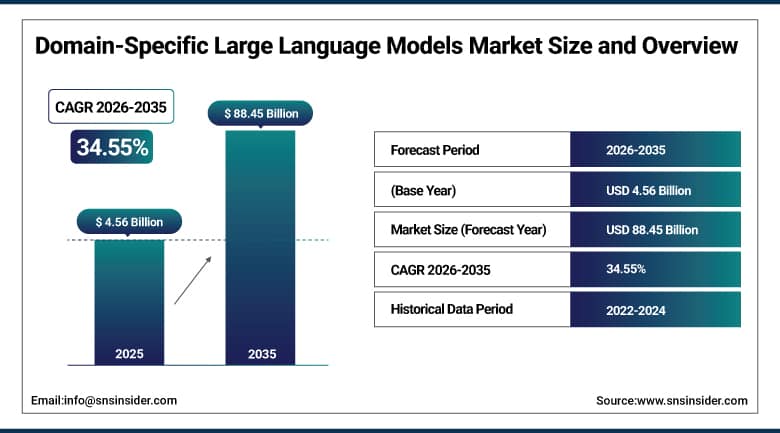
The Domain-Specific Large Language Models Market was valued at USD 4.56 Billion in 2025 and is expected to reach USD 88.45 Billion by 2035, growing at a CAGR of 34.55% from 2026–2035.
The domain-specific large language models witnessed steady growth in the market because of the rising need for AI solutions that cater to specific industries. There is an increase in investments made in advanced AI, which includes the use of domain-specific LLMs and retrieval-augmented generation, which ensures accurate, reliable, and relevant AI applications within the industry. Growing demand for custom-made AI solutions and enterprise automation is resulting in technological innovations within the sector. Firms are concentrating on customized models, domain knowledge incorporation, and application performance. Additionally, multimodal integration, cloud-based solutions, and AI automation are some of the key factors driving market growth.
In February 2025, researchers published a study evaluating domain-specific large language models, highlighting the importance of specialized datasets, domain adaptation, and standardized evaluation methods for improving model accuracy and reliability. The research supports the development of optimized fine-tuning and retrieval-augmented generation approaches for improving domain-specific AI performance.
To Get More Information On Domain-Specific Large Language Models Market - Request Free Sample Report
Domain-Specific Large Language Models Market Trends
-
Growing adoption of domain-specific artificial intelligence is driving demand for specialized large language models capable of delivering accurate and context-aware outputs across industry-specific applications.
-
Rising deployment of generative AI across enterprises is increasing demand for domain-specific LLMs that support automation, decision-making, content generation, and specialized business workflows.
-
Increasing demand for industry-specific AI applications across BFSI, healthcare, manufacturing, retail, telecom, and government is supporting the growth of customized large language model solutions.
-
Growing focus on improving model accuracy, relevance, data security, customization, and operational efficiency is creating opportunities for domain-specific LLM providers.
-
Advancements in fine-tuning, retrieval-augmented generation, multimodal AI, model optimization, and domain-specific training techniques are improving performance and supporting market adoption.
The U.S. Domain-Specific Large Language Models Market Outlook
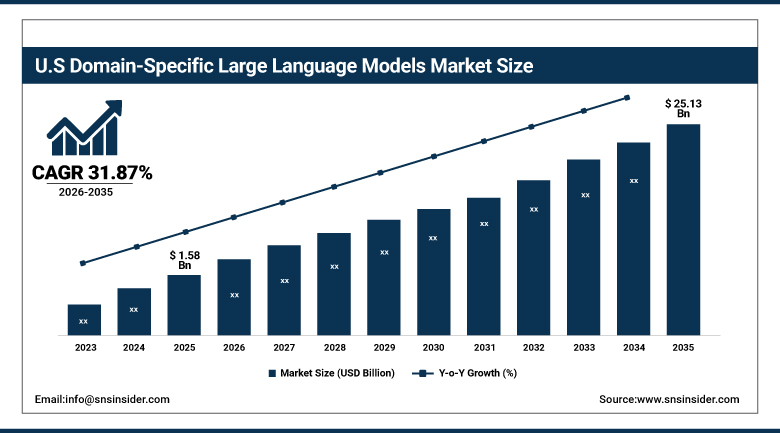
The U.S. Domain-Specific Large Language Models Market was valued at USD 1.58 Billion in 2025 and is expected to reach around USD 25.13 Billion by 2035, growing at a CAGR of 31.87% from 2026–2035.
The market growth rate of domain-specific large language models in the United States is at a steady pace due to the high demand for specialized AI solutions within the business community. The rising use of generative AI for enterprise purposes such as customer services, software development, content creation, healthcare, finance services, and automation is fueling the demand for domain-specific LLMs. Investments in AI model development, model training, and AI infrastructure are leading to improvements in model accuracy and relevance. The adoption of AI within US enterprises and technology vendors will fuel the demand for domain-specific large language models. The model development vendors are focusing on domain-specific LLMs, retrieval-augmented generation, multimodality, and data security features among others.
In August 2026, Google expanded its Gemini Enterprise platform with a legal-focused offering, Gemini Enterprise for Legal, providing AI agents and tools tailored to legal workflows, including document analysis, contract review, and regulatory tasks.
Domain-Specific Large Language Models Market Segment Analysis
-
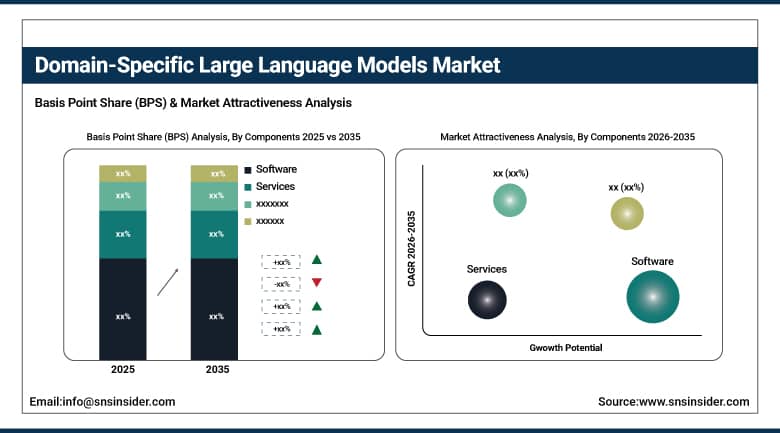
By Component, software dominated the domain-specific large language models market with a 67.26% share in 2025, while services are projected to be the fastest-growing segment, registering a 38.05% CAGR during 2026–2035.
-
By Deployment, cloud-based dominated the domain-specific large language models market with a 81.12% share in 2025, while on-premise is projected to be the fastest-growing segment, registering a 46.90% CAGR during 2026–2035.
-
By Model Type, text-based dominated the domain-specific large language models market with a 72.50% share in 2025, while multimodal is projected to be the fastest-growing segment, registering a 39.76% CAGR during 2026–2035.
-
By Model Customization, fine-tuned domain-specific LLMs dominated the domain-specific large language models market with a 58.60% share in 2025, while retrieval-augmented generation-based LLMs are projected to be the fastest-growing segment, registering a 40.04% CAGR during 2026–2035.
-
By Application, customer service automation dominated the domain-specific large language models market with a 22.32% share in 2025, while code generation and review are projected to be the fastest-growing segment, registering a 40.75% CAGR during 2026–2035.
-
By Enterprise Size, large enterprises dominated the domain-specific large language models market with a 68.50% share in 2025, while small & medium enterprises are projected to be the fastest-growing segment, registering a 38.34% CAGR during 2026–2035.
By Component, software dominated the domain-specific large language models market, while services are expected to grow fastest.
Software was the dominant segment in the market in 2025, owing to the rising use of LLM-based platforms, applications, and AI solutions in enterprises for industry-specific applications. With the help of software, organizations are able to deploy dedicated models to perform various industry-specific tasks such as content creation, automation of customer services, coding, knowledge management, decision-making, etc. The rising availability of pre-trained and fine-tuned LLM platforms, integration of enterprise applications, and the improved performance of models are some of the factors which are fuelling the growth of this segment. Growing investments in generative AI infrastructure and growing demand for scalable AI solutions are further bolstering the growth of the software segment.
The services segment is expected to witness the highest CAGR during the forecast period from 2026 to 2035. The increasing complexity involved in the development, customization, integration, deployment, and maintenance of domain-specific LLMs is resulting in an increase in demand for specialized services. Organizations are looking forward to services including consulting, implementation, model fine-tuning, data preparation, integration, monitoring, and optimization in order to make their LLMs suitable for their particular needs.
By Deployment, cloud-based dominated the domain-specific large language models market, while on-premise is expected to grow fastest.
The cloud-based deployment was the key market player owing to its scalability, accessibility, computing resources, and cost efficiency. Cloud-based platforms help businesses leverage AI infrastructures without making any huge investments in dedicated hardware. Increasing adoption of cloud-based generative AI platforms, scalable computing resources, and integration with enterprise applications is boosting the growth of cloud-based domain-specific LLM deployments. Cloud deployment helps organizations to easily scale up model training and inference as per workload needs.
The on-premise deployment is expected to grow at the highest CAGR in the forecast period 2026-2035. Increasing worries about data privacy, security, regulatory compliance, intellectual property, and control over sensitive industry-related data are compelling companies to deploy their LLM infrastructure in-house. On-premise deployment is also enabling organizations to get complete control over model access, data governance, customization, and integration with in-house systems. Increasing adoption by highly regulated industries and enterprises handling sensitive data will drive the growth of this segment.
By Model Type, text-based dominated the domain-specific large language models market, while multimodal is expected to grow fastest.
The text-based models were leading the market because of their increased use in text generation, chatbots, document processing, knowledge management, enterprise search and workflow automation in 2025. They can be trained on large amount of text data that can help them generate responses and automate knowledge intensive processes. Their advanced technology, wider compatibility with enterprise software solutions, and suitability for applications like customer service, coding, writing and translation continue to contribute towards their popularity. Availability of industry specific training datasets and integration of text-based LLMs in enterprise applications is adding to the demand of the segment.
The multimodal models are expected to register the fastest CAGR during the forecast period from 2026 to 2035. The multimodal domain specific LLMs can analyze different types of data like text, images, audio, video and structured data and hence have wide scope in industry specific AI applications. They are increasingly being used in healthcare imaging, industrial inspection, retail, financial documents processing, technical support and various other complex work flows. Improvement in the architectures, training, data integration and inferencing is expected to increase their adoption.
Regional Analysis
|
Region |
Major Country |
Share within Region, 2025(%) |
|---|---|---|
|
North America |
United States |
87.83% |
|
Europe |
Germany |
34.30% |
|
Asia Pacific |
China |
48.54% |
|
Middle East & Africa |
Saudi Arabia |
23.50% |
|
Latin America |
Brazil |
23.00% |
North America domain-specific large language models market insights
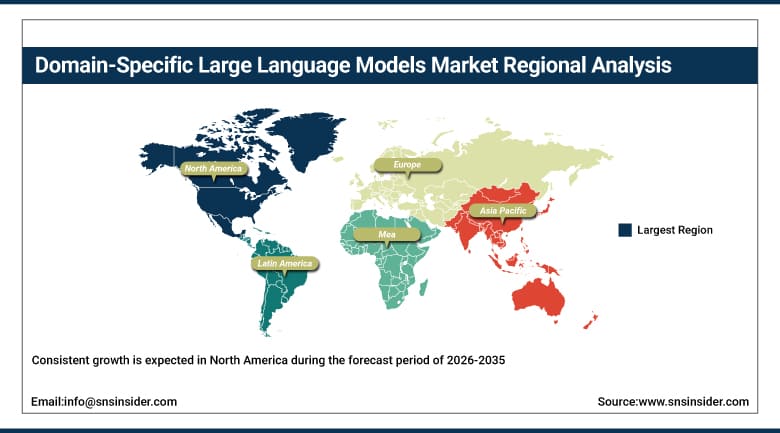
North America held major share of around 39.42%, on account of rising adoption of generative AI, enterprise AI, AI infrastructure spending, and the need for language models. There are some other factors behind the growth of the North American region, such as spending on AI platform, models, fine-tuning, retrieval augmented generation, and enterprise AI, which are used in various applications, such as financial services, healthcare, manufacturing, retail, telecom, and government.
United States is going to lead the market in North America and is estimated to take up 87.83% of the regional market share in 2025. United States' dominance in the regional market is attributed to the presence of robust AI ecosystem, presence of major technology companies, adoption of enterprise AI and generative AI, and increasing demand for domain-specific large language models.
Get Customized Report as Per Your Business Requirement - Enquiry Now
Europe domain-specific large language models market insights
The market for domain-specific large language models in Europe is projected to maintain steady growth through the forecast period on account of the increasing uptake of enterprise AI, rising demand for specialized AI tools, regulatory considerations, and investments in AI infrastructure and models. Growing focus on data privacy, responsible AI, specialization for particular industries, and secure deployment is generating demand for high-end domain-specific LLMs.
Germany is expected to be among the leading national markets in Europe on account of its well-developed manufacturing base, rising uptake of enterprise AI, industrial automation, and investment in specialized AI technologies. Along with Germany, nations such as the UK, France, Italy, and others will generate regional demand.
Asia Pacific domain-specific large language models market insights
Rapid growth of the domain-specific large language models market is anticipated to be experienced in the Asia Pacific region through 2026-2035 due to the rising use of generative AI, growth of digital economy, enterprise automation, artificial intelligence infrastructure investments, and demand for industry-specific artificial intelligence solutions. Asia Pacific is forecast to lead in terms of regional CAGR of approximately 39.40%.
The major reasons that will drive China as a leader in the Asia Pacific region will include the presence of a large technology ecosystem, growth in AI infrastructure, increasing enterprise AI adoption, and investments in large language model development. Similarly, Japan and South Korea will continue to perform well due to their existing technology, automobile, electronics, and industrial sectors, whereas India will see increasing demand due to the rise of digital transformation, enterprise automation, and AI adoption.
Middle East & Africa and Latin America domain-specific large language models market insights
Consistent growth is expected within the domain-specific large language models markets in Middle East & Africa and Latin America between 2026 and 2035, attributed to digital transformation, increased enterprise adoption of AI, cloud infrastructure development, and investment in artificial intelligence and automation. Specialized LLM application opportunities will become more prevalent in these regions in financial services, healthcare, retail, telecommunication, government, and other industries.
The Middle East & Africa will remain a key market for Saudi Arabia owing to investments in digital transformation, artificial intelligence, cloud infrastructure, and technology modernization. In Latin America, Brazil will remain a key country-level market owing to the huge digital economy, enterprise adoption of technology, financial services industry, and the adoption of AI-based solutions for businesses. Latin American nations will also drive regional growth through the expansion of digitalization and adoption of AI technologies.
Market Dynamics
Growth Driver: Increasing demand for specialized AI solutions is driving market growth
One of the key factors contributing to the growth of the global domain-specific large language models market is the ever-increasing requirement for domain-specific artificial intelligence solutions capable of providing precise, relevant, and context-specific results. The rising adoption of generative artificial intelligence, enterprise automation, and intelligent solutions in BFSI, healthcare, manufacturing, retail, telecom, and government is creating a high demand for domain-specific models to meet the needs of particular enterprises.
Furthermore, advancements in fine-tuning, retrieval augmented generation, multimodal artificial intelligence, optimization of models, and domain-specific training are fueling market growth. In addition to that, investments in artificial intelligence infrastructure, enterprise artificial intelligence platforms, and domain-specific model creation are motivating companies to use advanced domain-specific LLM solutions.
Restraint: Complex model customization and data requirements can limit market adoption
Domain-specific LLMs' development and customization become major barriers to their adoption by businesses. It is necessary to have good-quality industry-related data sets, appropriate hardware, and experts to develop, fine-tune, and deploy them. Terminology used in different industries, data formats, business practices, as well as industry regulations, may impact their effectiveness.
Furthermore, it takes many efforts to maintain the quality of data, minimize hallucinations of models, guarantee their security, and update domain-specific knowledge. This may lead to difficulties because of the high cost of model development, computing infrastructure, qualified employees, and monitoring.
Opportunity: Growing enterprise AI adoption and demand for customized models creates new market opportunities
The increasing number of uses of generative AI in enterprises brings about many opportunities for those who provide domain-specific large language models. Due to the fact that businesses need AI systems which will understand their industry-specific terminology, processes, regulatory requirements, and other specific factors, there is a growing need for custom LLMs. There may be used fine-tuned models and retrieval-augmented generation for developing customer service automation, code generation, document analysis, content creation, and other industry-specific decision-making tools.
Moreover, there are many opportunities for creating advanced domain-specific large language models because of the increasing use of multimodal AI, cloud AI platforms, and enterprise automation. Also, there are many investment opportunities for LLM developers due to increasing investment in AI infrastructure, special datasets, and other aspects.
Recent Developments
-
2026: OpenAI expanded its enterprise AI capabilities, supporting the development and deployment of specialized large language models for industry-specific applications and business workflows.
-
2026: Microsoft continued expanding its enterprise AI offerings, strengthening access to customized AI models and industry-focused solutions through its cloud and AI ecosystem.
-
2026: Google advanced its Gemini AI capabilities and enterprise-focused solutions, supporting the adoption of specialized language models for business applications and domain-specific workflows.
-
2026: IBM continued expanding its watsonx AI platform and industry-focused generative AI solutions, supporting enterprises in developing and deploying customized AI models for specialized business requirements.
-
2026: Anthropic continued advancing its Claude enterprise AI capabilities, supporting specialized applications through improved model performance, customization, security, and integration with enterprise workflows.
Domain-Specific Large Language Models Market key players are:
-
OpenAI, LLC
-
Microsoft Corporation
-
Google LLC
-
Amazon Web Services, Inc.
-
Anthropic PBC
-
IBM Corporation
-
Meta Platforms, Inc.
-
NVIDIA Corporation
-
Cohere Inc.
-
Databricks Inc.
-
Mistral AI
-
AI21 Labs
-
Hugging Face, Inc.
-
Oracle Corporation
-
Salesforce, Inc.
-
SAP SE
-
Alibaba Cloud
-
Baidu, Inc.
-
Stability AI
-
xAI Corp.
Domain-Specific Large Language Models Market Report Scope:
| Report Attributes | Details |
|---|---|
| Market Size in 2025 | USD 4.56 Billion |
| Market Size by 2035 | USD 88.45 Billion |
| CAGR | CAGR of 34.55% From 2026 to 2035 |
| Base Year | 2025 |
| Forecast Period | 2026-2035 |
| Historical Data | 2022-2024 |
| Report Scope & Coverage | Market Size, Segments Analysis, Competitive Landscape, Regional Analysis, DROC & SWOT Analysis, Forecast Outlook |
| Key Segments | • By Component (Software, Services) • By Deployment (Cloud-based, On-premise, Hybrid) • By Model Type (Text-Based, Multimodal) • By Model Customization (Fine-Tuned Domain-Specific LLMs, Retrieval-Augmented Generation-Based LLMs, Other Customization Levels) • By Application (Chatbots and Virtual Assistants, Code Generation and Review, Content and Media Generation, Customer Service Automation, Language Translation and Localization, Other Applications) • By Enterprise Size (Large Enterprises, Small & Medium Enterprises) • By Industry Vertical (BFSI, Healthcare & Life Sciences, Manufacturing & Industrial, Retail & E-commerce, Telecom & IT Services, Government & Defense, Other Industries) |
| Regional Analysis/Coverage | North America (US, Canada), Europe (Germany, UK, France, Italy, Spain, Russia, Poland, Rest of Europe), Asia Pacific (China, India, Japan, South Korea, Australia, ASEAN Countries, Rest of Asia Pacific), Middle East & Africa (UAE, Saudi Arabia, Qatar, South Africa, Rest of Middle East & Africa), Latin America (Brazil, Argentina, Mexico, Colombia, Rest of Latin America) |
| Company Profiles | OpenAI, LLC, Microsoft Corporation, Google LLC, Amazon Web Services, Inc., Anthropic PBC, IBM Corporation, Meta Platforms, Inc., NVIDIA Corporation, Cohere Inc., Databricks Inc., Mistral AI, AI21 Labs, Hugging Face, Inc., Oracle Corporation, Salesforce, Inc., SAP SE, Alibaba Cloud, Baidu, Inc., Stability AI, xAI Corp. |

Frequently Asked Questions
The Domain-Specific Large Language Models Market is expected to grow at a CAGR of 34.55% from 2026 to 2035.
The Domain-Specific Large Language Models Market was valued at approximately USD 4.56 billion in 2025.
The market is primarily driven by the increasing adoption of generative AI, growing demand for industry-specific AI solutions, enterprise automation, and advancements in model customization.
Software dominated the Domain-Specific Large Language Models Market in 2025, accounting for a 67.26% share.
North America dominated the Domain-Specific Large Language Models Market in 2025, accounting for a 41.55% share.
