
Dynamic Transformer Rating Market Report Scope and Overview:
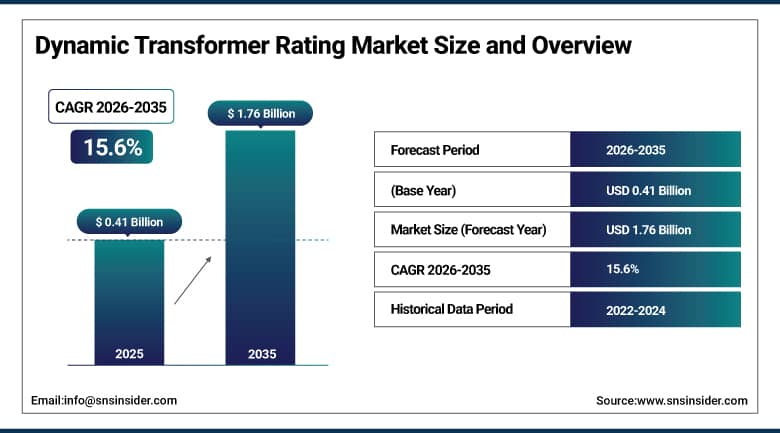
The Dynamic Transformer Rating Market was valued at USD 0.41 Billion in 2025 and is projected to reach USD 1.76 Billion by 2035, registering a CAGR of 15.6% from 2026 to 2035.
The Dynamic Transformer Rating Market is creating changes in the usage of transformer assets using fiber optic and RTD temperature sensors for winding temperature, real-time thermal analysis software, and load current analysis for safe operation of the transformer above its rated capacity. The market is marked by increased demands for renewable interconnection capacity without any new equipment by utilities, higher installations of winding hotspot and oil temperature monitoring system, increased adoption of IEC 60076-7 and IEEE C57.91 loading algorithm, and application in wind and solar hosting capacity, grid congestion alleviation, and transformer life extension.
In February 2026, Camlin Group showcased its transformer monitoring system that provides dynamic ratings by continuous measuring of winding temperature, oil temperature, loading, and cooling performance. This solution will allow utilities to optimize the use of transformers, operate under overload conditions, and delay investments in new transformers.
To Get More Information On Dynamic Transformer Rating Market - Request Free Sample Report
Dynamic Transformer Rating Market Trends
-
Expanding deployment of fiber optic winding hotspot sensors continues improving real-time thermal headroom visibility for utilities.
-
Growing integration of dynamic thermal analytics with SCADA and DERMS platforms continues accelerating renewable interconnection approvals.
-
Rising utility investment in distribution transformer monitoring continues expanding the addressable base beyond transmission-class assets.
-
Increasing wind and solar hosting capacity studies continue strengthening demand for load-and-ambient-responsive rating algorithms.
-
Growing adoption of cloud-hosted transformer fleet analytics continues accelerating cross-substation loss-of-life benchmarking.
U.S. Dynamic Transformer Rating Market Outlook
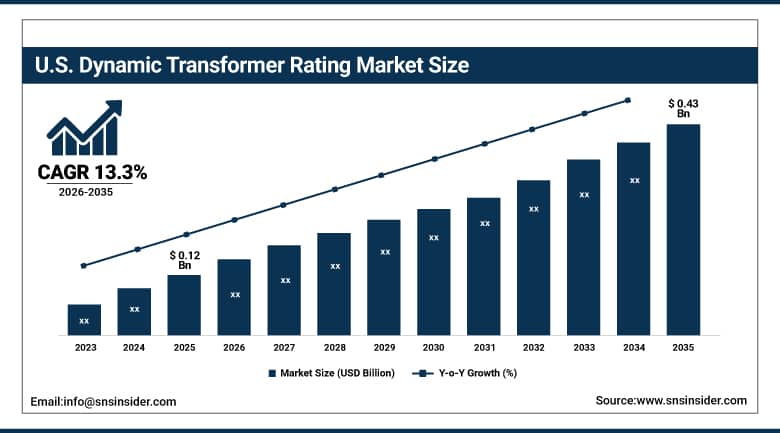
The U.S. Dynamic Transformer Rating Market was valued at approximately USD 0.12 Billion in 2025 and is projected to reach approximately USD 0.43 Billion by 2035, registering a CAGR of approximately 13.3% from 2026 to 2035.
In the U.S., the market growth is driven by substantial utility investments in interconnection queue management for renewables, extensive installation of winding temperature and load current sensors on aging transmission and distribution transformer fleets, and significant requirement for life expectancy analytics software from utilities looking to extend their transformer replacement cycle. Fiber optic hotspot detection and cloud-based thermal analytics of the transformer fleet used by major investor-owned utilities helped in elevating the position of the United States. Besides, the use of dynamic rating technology in wind and solar hosting capacity assessment and grid congestion management was adding to the significant domestic requirement.
In July 2026, Trench Group launched its first factory in the United States for the production of high-voltage bushings, which had been built on the investment exceeding USD 60 million. This 170,000 square feet factory will be responsible for producing transformer bushings ranging from 25 kV to 765 kV.
Dynamic Transformer Rating Market Segment Analysis
-
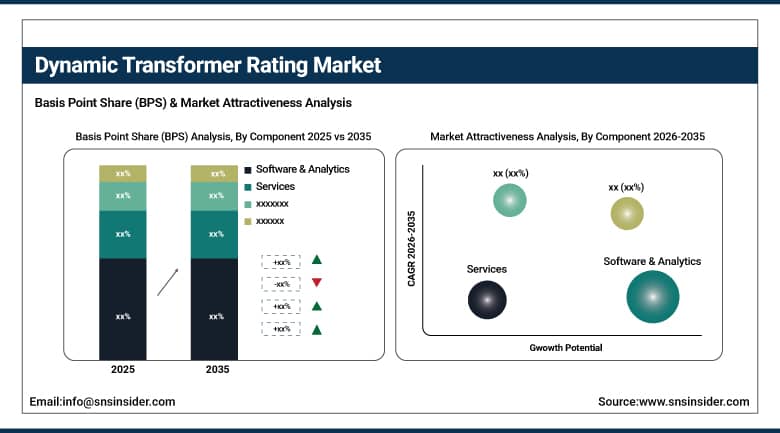
By Component, Software & Analytics segment dominated the Dynamic Transformer Rating Market in 2025 with 44% share; Services segment is the fastest growing segment, registering a CAGR of 17.8% from 2026 to 2035.
-
By Sensor Type, Fiber Optic Temperature Sensors segment dominated the market in 2025 with 38% share; Current & Load Sensors segment is the fastest growing segment, registering a CAGR of 18.1% from 2026 to 2035.
-
By Transformer Type, Power Transformers segment dominated the market in 2025 with 63% share; Distribution Transformers segment is the fastest growing segment, registering a CAGR of 17.5% from 2026 to 2035.
-
By Application, Grid Capacity Optimization segment dominated the market in 2025 with 34% share; Renewable Energy Integration segment is the fastest growing segment, registering a CAGR of 18.4% from 2026 to 2035.
-
By End User, Utilities segment dominated the market in 2025 with 69% share; Renewable Energy Developers segment is the fastest growing segment, registering a CAGR of 18.0% from 2026 to 2035.
By Component, Software & Analytics Leads, While Services Grows Fastest
Software & Analytics held the biggest share of the market, owing to its critical involvement in the conversion of sensor data into real-time thermal headroom and loss-of-life calculations. The condition monitoring platform from Dynamic Ratings that integrates dynamic loading analytics over winding hotspot and oil temperature is an example of how the utilities leverage software to interpret the sensor data into IEC 60076-7 loading decisions. With continuous improvement in algorithms and SCADA capability integration, the software has remained the most lucrative segment of the value chain.
Services segment is anticipated to witness highest CAGR over the forecast period, as more and more utilities prefer to utilize services in order to commission and calibrate their dynamic rating programs in their existing substations. The increasing field engineering services offered by Qualitrol for fiber optic sensors installation shows the trend in the increasing demand for turnkey installation of vendor-based dynamic rating systems. In light of the growing interest among utilities to implement dynamic rating systems fleet-wide due to renewable energy integration, the services are expected to experience even greater demand than hardware or software.
By Sensor Type, Fiber Optic Sensors Lead, While Current & Load Sensors Grow Fastest
Fiber Optic Temperature Sensors were the Dominant Segment in the Dynamic Transformer Rating Market during 2025 owing to their capability of sensing winding hotspot temperature without interference from electromagnetic sources that affects traditional RTD probe sensors. The OPTOCON fiber-optic temperature measurement systems developed by Weidmann Electrical Technology, bolstered following their acquisitions in 2025, have gained prominence in the market as an effective sensing device in case of utilities needing hotspot temperature without interference in a high voltage environment. Fiber optics temperature sensing has established itself as the dominant segment due to this reason.
Current & Load Sensors are anticipated to post the fastest growth owing to utilities extending their dynamic ratings of transformers down to distribution-class transformers in which complete retrofit with fiber optic sensing would be prohibitively expensive. Cost-effective load current sensors coupled with ambient temperature readings can allow utilities to estimate the dynamic thermal capacity of their assets. Increasing rooftop solar and other distributed energy generation installations are fueling the trend.
By Transformer Type, Power Transformers Dominate, Distribution Transformers Grow Fastest
Power Transformers accounted for the dominant share of the Dynamic Transformer Rating Market in 2025 due to their high replacement cost as they are large transformers used in transmission and therefore require an early investment in dynamic ratings systems. For instance, many utilities, such as Unison Networks have employed dynamic rating systems on several power transformers based on the IEC 60076-7 algorithms which convert data from the sensors to dynamic loading ratings to support the role of this segment in providing revenue to vendors of monitoring systems.
Distribution Transformers are expected to be the fastest-growing transformer type due to the challenge of meeting the increasing demands from distributed solar generation and electric vehicles charging. Research findings on dynamic ratings that show the hosting capacity of distribution transformers can be boosted up to 60% without any replacement has influenced pilot projects in distribution utilities aiming for alternative solutions other than transformer replacement.
By Application, Grid Capacity Optimization Leads, Renewable Energy Integration Grows Fastest
The Grid Capacity Optimization segment held the largest share of the Dynamic Transformer Rating Market in 2025, with utilities leveraging dynamic rating technology to defer transformer replacement through the optimization of thermal headroom in the existing transformers. The application gains advantage of the solid economic justification based on the avoidance of capital costs, which makes it the most well-funded of all dynamic rating initiatives within utility asset management schemes aimed at extending the lifespan of equipment without sacrificing reliability.
The Renewable Energy Integration application segment is expected to witness the fastest growth due to the growing use of dynamic transformer rating studies by renewable energy project developers to speed up interconnection approvals and reduce costs associated with it. For instance, both Reactive Technologies and Gridspertise introduced grid analytics solutions that include the ability to leverage dynamic rating to manage interconnection queues, which reflects the way renewable energy developers use dynamic rating to avoid transformer replacement costs related to new generation projects.
By End User, Utilities Dominate, Renewable Energy Developers Gain Fastest Traction
Utilities represented the dominant end-user segment of the Dynamic Transformer Rating Market in 2025 as grid companies have the main task of managing transformers, their reliability and interconnection approvals. Wide adoption of dynamic ratings by large power utility companies of North America and Europe such as fleet-wide installations of fiber optic sensors and fleet analysis on the cloud will show how dynamic rating investments are made an integral part of capital deferral and grid capacity planning.
Renewable Energy Developers are expected to emerge as the fastest-growing end-user segment as sponsors of wind and solar projects start hiring third party dynamic rating studies in order to cut down interconnection periods and save from network upgrades. Cooperation of renewable energy sponsors with grid analytics providers in terms of hosting capacity assessment will demonstrate how dynamic transformer ratings are now becoming an integral part of project financing and interconnection process.
Regional Analysis:
|
Region |
Major Country |
Share within Region, 2025 (%) |
|---|---|---|
|
North America |
United States |
81.00% |
|
Europe |
Germany |
23.50% |
|
Asia Pacific |
China |
34.20% |
|
Middle East and Africa |
Saudi Arabia |
28.00% |
|
Latin America |
Brazil |
31.50% |
North America Dynamic Transformer Rating Market Insights
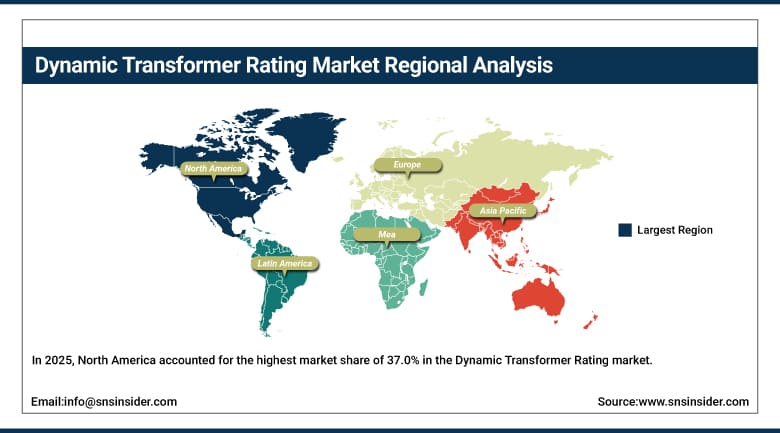
In 2025, North America accounted for the highest market share of 37.0% in the Dynamic Transformer Rating market. This development was influenced by huge investments made by utilities in the management of the renewable interconnection queue, stringent regulations for deferring transformer capital replacements, and the presence of major companies manufacturing transformers with monitoring capabilities and fiber optic sensors in the region. Further, close cooperation between utility asset management and domestic dynamic rating analytics software companies played an important role in maintaining North America's dominance in the market.
The U.S. held the largest revenue share of the total North American market, primarily because of increasing adoption of Qualitrol's dynamic ratings of winding hot spot and dynamic loading analytics solution, growing demand among transmission utilities due to FERC Order 881 for dynamic thermal rating compliance, and implementation of fiber optic sensor retrofit programs. Renewal interconnection studies in Canada helped the region contribute to North America's overall market dominance.
Get Customized Report as Per Your Business Requirement - Enquiry Now
Europe Dynamic Transformer Rating Market Insights
The sustainable share of Europe in the global Dynamic Transformer Rating market was enabled by the strong regulatory drive towards grid capacity optimization, the massive deployment of digitalization of transformer fleets, and increasing installations of winding temperature monitoring systems in transmission and distribution grids. The increased use of loading standards based on IEC 60076-7 has also been a driving force behind the investments into vendor-neutral dynamic rating systems by European utilities, which allowed Europe to become the regulatory leader in managing transformer temperature.
Germany was the largest European market for Dynamic Transformer Rating due to mass deployment of winding hot spot monitoring systems related to expansion of Germany's grid capacity for offshore wind generation. The UK also played an important role in the regional demand for dynamic transformer rating with consulting and pilot deployment services provided by EA Technology. Europe is forecast to have sustainable demand for dynamic transformer rating amid ongoing renewable interconnection development.
Asia Pacific Dynamic Transformer Rating Market Insights
Asia Pacific is experiencing the fastest-growing rate of any region considered in the market, registering a CAGR of 18.5%, attributed to significant investments in grid modernization projects in China and India, increasing mandate from governments to increase renewable hosting without having to purchase new transformers, and increased awareness of the concept of dynamic thermal rating among utility companies as a cheaper option than equipment replacement. The combination of fast-growing renewable energy capacity, along with the growing demand for sensor-driven analysis, is what makes this region the fastest-growing in terms of dynamic transformer rating market.
China was the leading nation in the region due to the large investments made in optimizing grid capacity and expanding sensor manufacturing capacities in the country. Other notable countries include India with state-owned transmission utilities conducting pilot projects related to dynamic rating to accommodate the fast-growing capacity of solar energy in the country, and South Korea with KEPCO KPS conducting transformer condition monitoring throughout its grid.
MEA and Latin America Dynamic Transformer Rating Market Insights
The Middle East and Africa and Latin America both showed steady growth in the Dynamic Transformer Rating Market driven by rising investments towards modernization of grid infrastructure, renewable energy diversity policies adopted by the government, and increasing cooperation between regional utility companies and foreign suppliers of sensors and analytical systems. Thermal visibility of transformers in real-time is becoming an increasing need in these regions owing to rising renewable capacity installation outpacing transformer procurement processes.
In ME&A, Saudi Arabia was the biggest country-level market owing to capacity optimization efforts by Saudi Electricity Company within its solar energy generation projects. The ME&A region also included grid modernization initiatives currently being implemented in the UAE. In LATAM, the country that generated the highest revenues was Brazil thanks to its well-developed transmission grid network and high demand for renewable capacity integration without investment in transformers.
Market Dynamics:
Growth Drivers: Rising Renewable Interconnection Demand and Expanding Sensor Retrofit Programs
Market growth is driven by increased utility requirements for renewable hosting capacity without any additional investments, growing installations of fiber optic and RTD-based winding temperature sensors, regulatory requirements, such as FERC Order 881 to implement dynamic thermal ratings, and widening applications from alleviating grid congestion to prolonging transformer life and managing interconnection queues. With increasing interest of utilities and renewable developers in dynamic rating studies in relation to interconnection scheduling, demand for accurate and timely sensor and analytics solutions is predicted to stay strong throughout the value chain.
Increased integrations of sensor vendors and grid analytics providers and increased utility interest in implementing integrated thermal management solutions before interconnection queue reform takes place add more weight to this prediction. Funding by venture and utility investors of dynamic rating pilot projects is also contributing to growing baseline deployment capabilities, and altogether these factors lead to consistent growth throughout the forecast period.
Restraints: Legacy Sensor Retrofit Costs and Data Integration Complexity
The cost and complexity of retrofitting fiber optic and RTD-based sensors onto aging transformer fleets continues to be an actual constraint on faster market development due to their age; some of these older transformers actually need to be opened up to get access to their windings before fitting in these sensors, which takes more time and effort. Because of the high costs involved, the more sophisticated deployments of dynamic rating technology have only been seen at large transmission utilities with good financial capacity.
Integration of data remains a challenge as dynamic rating systems need to integrate data from their sensors with the legacy SCADA, outage management, and asset management systems that did not account for dynamic rating in their designs. Resolving this problem involves coming up with standard communication protocols and verified thermal models.
Opportunities: Distribution-Class Deployment and Interconnection Reform Investment
Dynamic rating technology’s application to distribution-class transformers is a key opportunity in light of the movement by utilities to utilize low-cost solutions to sense load currents and ambient temperatures, rather than installing fiber optic systems. Vendors capable of providing scalable and cost-effective solutions to monitor distribution transformers, including load and current sensors for mass installation, are expected to take a large portion of the market as utilities move from individual projects in the transmission sector to fleets of distribution transformers.
Additionally, another key opportunity is provided by the interconnection reform trend, with the need for dynamic thermal ratings studies for fastening the project queues in the absence of additional transformers. Suppliers able to provide quick and standardized hosting capacity studies, as exemplified by Reactive Technologies and Gridspertise’s expanding grid analytics solution sets, are expected to take a disproportional share of the total interconnection reform market.
Recent Developments:
-
2026: Weidmann Electrical Technology expanded deployment of its OPTOCON fiber-optic temperature measurement platform across European transmission utilities for real-time transformer winding hotspot monitoring, building on its 2025 acquisition integration.
-
2026: Dynamic Ratings launched an enhanced dynamic loading analytics module within its transformer condition monitoring platform, enabling utilities to calculate real-time thermal headroom for renewable interconnection requests.
-
2026: Hitachi Energy announced a huge investment in a new power transformer manufacturing facility in Vadodara, India. This new facility will cater to the increased demand in transmission systems, HVDC systems, AI data centers, and industrial usage of transformers.
Dynamic Transformer Rating Market key players are:
-
Dynamic Ratings, Inc.
-
Qualitrol Company LLC
-
GE Vernova Inc.
-
Siemens AG
-
ABB Ltd
-
Schneider Electric SE
-
Doble Engineering Company
-
EA Technology Ltd.
-
Camlin Group Ltd.
-
Kalki Communication Technologies Pvt. Ltd. (Kalkitech)
-
Weidmann Electrical Technology AG
-
Arteche Group
-
Trench Group
-
Vaisala Oyj
-
Reactive Technologies Ltd.
-
Gridspertise S.r.l.
-
Mitsubishi Electric Corporation
-
Hitachi Energy Ltd.
-
Eaton Corporation plc
-
Megger Group Limited
Dynamic Transformer Rating Market Report Scope:
| Report Attributes | Details |
|---|---|
| Market Size in 2025 | USD 0.41 Billion |
| Market Size by 2035 | USD 1.76 Billion |
| CAGR | 15.6% from 2026 to 2035 |
| Base Year | 2025 |
| Forecast Period | 2026-2035 |
| Historical Data | 2022-2024 |
| Report Scope & Coverage | Market Size, Segments Analysis, Competitive Landscape, Regional Analysis, DROC & SWOT Analysis, Forecast Outlook |
| Key Segments |
•By Component (Software & Analytics, Services, Hardware) •By Sensor Type (Fiber Optic Temperature Sensors, Current & Load Sensors, RTD & Thermal Sensors, Others) •By Transformer Type (Power Transformers, Distribution Transformers) •By Application (Grid Capacity Optimization, Renewable Energy Integration, Asset Life Extension & Predictive Maintenance, Load Management) •By End User (Utilities, Renewable Energy Developers, Industrial) |
| Regional Analysis/Coverage | North America (US, Canada), Europe (Germany, UK, France, Italy, Spain, Russia, Poland, Rest of Europe), Asia Pacific (China, India, Japan, South Korea, Australia, ASEAN Countries, Rest of Asia Pacific), Middle East & Africa (UAE, Saudi Arabia, Qatar, South Africa, Rest of Middle East & Africa), Latin America (Brazil, Argentina, Mexico, Colombia, Rest of Latin America). |
| Company Profiles | Dynamic Ratings, Inc., Qualitrol Company LLC, GE Vernova Inc., Siemens AG, ABB Ltd, Schneider Electric SE, Doble Engineering, Company, EA Technology Ltd., Camlin Group Ltd., Kalki Communication Technologies Pvt. Ltd. (Kalkitech), Weidmann Electrical, Technology AG, Arteche Group, Trench Group, Vaisala Oyj, Reactive Technologies Ltd., Gridspertise S.r.l., Mitsubishi Electric Corporation, Hitachi Energy Ltd., Eaton Corporation plc, and Megger Group Limited. |

Frequently Asked Questions
Key players include Dynamic Ratings, Inc., Qualitrol Company LLC, GE Vernova Inc., and Siemens AG, ABB Ltd, among others.
Key opportunities include rising grid modernization, increasing renewable energy integration, transformer capacity optimization, real-time monitoring adoption, and growing demand for reliable and efficient power transmission.
The major growth factor is rising utility demand for renewable interconnection capacity without new equipment investment, expanding fiber optic and RTD sensor deployment, and growing regulatory pressure such as FERC Order 881 to adopt dynamic thermal rating practices.
The Software & Analytics segment dominated the Dynamic Transformer Rating Market by component, representing the largest share of revenue in 2025.
North America accounted for the highest market share of 37.0% in the Dynamic Transformer Rating market in 2025.
