
Photodynamic Therapy Market Report Scope & Overview:
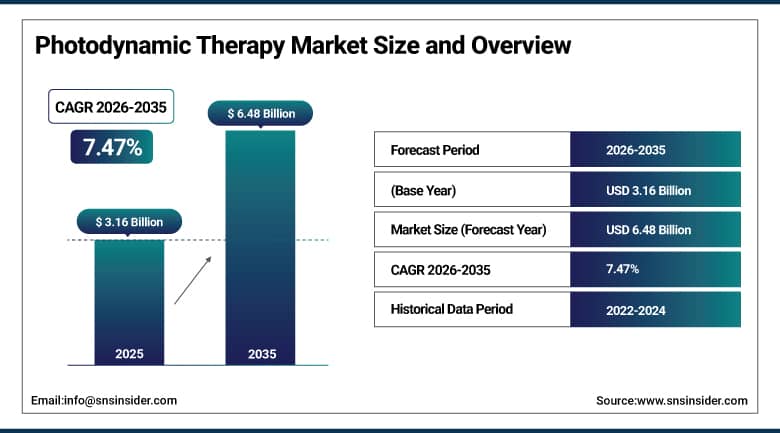
The Photodynamic Therapy Market was valued at USD 3.16 Billion in 2025 and is projected to reach USD 6.48 Billion by 2035, expanding at a CAGR of 7.47% during the forecast period 2026–2035.
The photodynamic therapy market is experiencing continued growth in demand driven by surging numbers of skin cancers, actinic keratosis, Barrett's esophagus, and multiple solid tumors that need a less invasive treatment option. Photodynamic therapy involves low doses of a photosensitizing agent whose application together with illuminating light is used to specifically target the diseased tissue, without affecting the targeted healthy tissue. This approach provides the unsaid as a feasible alternative to traditional surgery and radiotherapy. Increased awareness of the cosmetic results, decreased hospitalization time and minimized systemic toxicity has bolstered usage of photodynamic therapy among numerous medical disciplines which include dentistry, and ophthalmology.
Market also includes growing investment in precision oncology, AI-aided treatment planning, sophisticated dosimeter software, LED-based next generation illumination technology, all to enhance the treatment precision and workflow efficiency. In 2025, the U.S. Food and Drug Administration (FDA) maintained its support for advances in oncology and dermatology by providing reviews and other regulatory attention to new PDT technologies, just as various U.S. Academic cancer institutions added to existing published research in human 'proof-of-concept' trials using PDT plus immunotherapy combinations in difficult-to-treat cancers, reflecting the obvious strength of the U.S. Translational photo medicine backbone.
To Get More Information On Photodynamic Therapy Market - Request Free Sample Report
Photodynamic Therapy Market Trends
-
Increasing adoption of minimally invasive photodynamic cancer treatment procedures.
-
Growing development of AI-enabled photodynamic treatment planning platforms.
-
Rising commercialization of advanced LED-based photodynamic therapy systems.
-
Expanding research on next-generation targeted photosensitizing agents globally.
-
Increasing outpatient dermatology procedures supporting photodynamic therapy adoption.
The U.S. Photodynamic Therapy Market Size Outlook
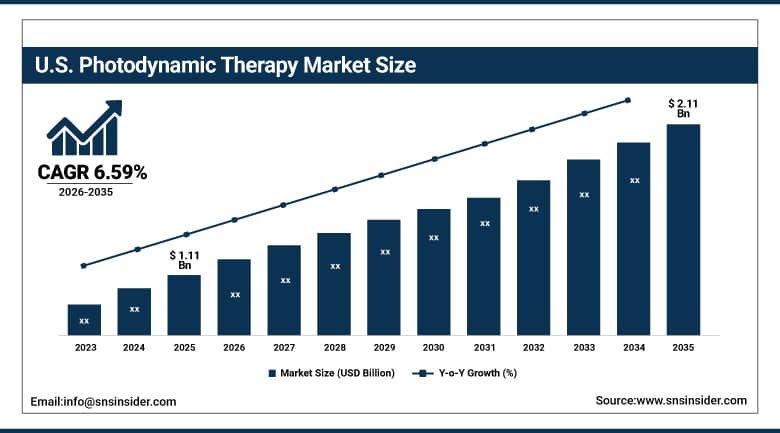
The U.S. Photodynamic Therapy Market was valued at USD 1.11 billion in 2025 and is expected to reach approximately USD 2.11 billion by 2035, expanding at a CAGR of 6.59% during 2026–2035.
The United States continues to be the leading North American photodynamic therapy market, benefiting from sophisticated oncology and dermatology infrastructure, increasing adoption rates of minimally invasive treatment procedures, and established clinical research platforms. The rising incidence of actinic keratosis, non-melanoma skin cancers, Barrett’s esophagus, and age-related ophthalmic diseases has dramatically fueled the demand of photodynamic therapy within hospitals and specialty clinics. Hospitals and specialty clinics are augmenting investments in modern laser systems, LED illumination platforms, digital treatment planning software, and advanced photosensitizing agents to boost procedural accuracy, patient outcomes, and operational efficiency.
The United States continues to pioneer the advancement of photomedicine through the active participation of biotechnology firms and academic cancer centers/medical centers with significant investment in targeted photosensitizers, artificial intelligence-powered dosimeter platforms, and hybrid therapy combinations which combines immunotherapy and photodynamic therapy to better patient outcomes. The clinical research efforts toward combining photodynamic therapy and immune checkpoint inhibitors for various solid tumors has continue to broaden throughout major U.S. Cancer centers with research in 2025, underscoring the mounting enthusiasm for achieving enhanced sustained therapy benefits with the implementation of multimodality cancer treatment.
Photodynamic Therapy Market Segment Analysis
-
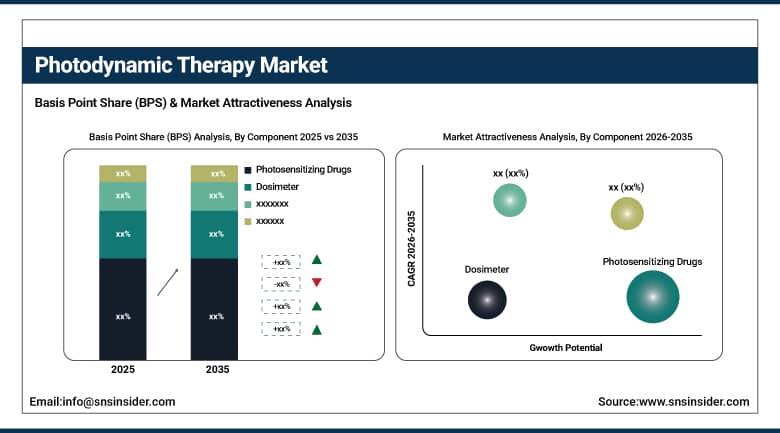
By Component, photosensitizing drugs dominated the market with 38.00% share in 2025, while dosimeter, planning software & accessories are projected to witness the fastest growth with 10.20% CAGR during the forecast period.
-
By Light Source, laser-based systems dominated the market with 43.00% share in 2025, while led-based systems are projected to witness the fastest growth with 9.50% CAGR during the forecast period.
-
By Application, actinic keratosis & precancerous skin lesions dominated the market with 32.00% share in 2025, while oncology applications are projected to witness the fastest growth with 10.74% CAGR during the forecast period.
-
By End User, dermatology clinics dominated the market with 35.00% share in 2025, while specialty oncology centers are projected to witness the fastest growth with 9.57% CAGR during the forecast period.
By Component, photosensitizing drugs dominated, while dosimeter, planning software & accessories grows fastest.
Photosensitizing drugs generated a global market share of 38.00% of the photodynamic therapy market in 2025 owing to its integral role in disease targeting with precise activation using the photodynamic therapy’s light. Continuous evolution and upgradation of second and third generation photosensitizers to higher tissue specificity, minimum systemic toxicity, maximum therapeutic efficacy in oncology and dermatology and the number of approvals of these revised formulations and their increasing confident application in outpatient procedures also increased this product type segment value. Extensive funding poured into drug development for precise treatments has also been one major reason to boost segment value.
Dosimeter, planning software & accessories to exhibit a rapid growing CAGR 10.20% from 2026-2035, the market for dosimeter devices are seeing a growth through innovation like artificial intelligence, real time optical imaging in the photodynamic therapy treatment delivery, software simulating treatment patterns, automated dosimeters etc., contributing towards better accuracy, reproducible clinical treatments, efficient workflows and digital health advancements. In 2025, development in the artificial intelligence based dosimeters continued by few research groups offering assistance to the optimal treatment conditions during photodynamic therapy applications thereby producing optimal outcome.
By Light Source, laser-based systems dominated, while LED-based systems grows fastest.
In the year 2025, laser-based systems contributed to largest share of over 43.00% and is the dominant photodynamic therapy market due to: Superior energy precision and delivery at defined wavelength; Better tissue penetration, thereby facilitating effective treatment deeper to specific target areas; Proven track record across oncology and dermatological applications, hospital & specialty clinics use these systems due to assured light output consistency; increased ability for targeting; compatibly with wider spectrum of approved photosensitizers.
LED-Based Systems segment would gain momentum with the CAGR of over 9.50% in during the review period due to: Cost-effective devices; energy efficient systems; more compact devices suitable for both in and outpatient care; easy operation suitable in private settings or treatment clinics; rising advancements in LED with improved high output intensity light sources, mobile systems with light sources, Wearable illumination device (WID), home-based PDT. Several medical device developers introduced their high-output and multi wavelength based LED illumination devices by 2025 which are gaining popularity, due to enabling treatment flexibility and improving light output efficiency, patient comforts on dermatology-specific PDT procedures. data for interoperable health information management and AI-enabled clinical innovations.
By End User, dermatology clinics dominated, while specialty oncology centers grows fastest.
Dermatology clinics held a 35.00% market share of the global photodynamic therapy market in 2025 due to a greater number of patients receiving treatments for conditions such as actinic keratosis, acne, non-melanoma skin cancers and other chronic skin diseases. Patients are increasingly turning to photodynamic therapy at clinics since it requires a minimally invasive approach, has better cosmetic results than surgical approaches, requires lesser downtime, and provides higher patient satisfaction. The increasing funding by several organizations toward innovative laser technologies, LED therapy devices, digital photography systems, and dedicated dermatology facilities has escalated procedural volumes for dermatology clinics.
Specialty oncology centers are projected to be the fastest-growing category, expanding at a CAGR of 9.57% over the forecast period owing to the rising application of photodynamic therapy for adjunctive treatment of varied solid tumors in combination with chemotherapy, surgery, radiation therapy and immunotherapy. By 2025, premier cancer research centers have initiated an increase in the implementation of clinical programs aimed at exploring the uses of photodynamic therapy for the treatment of chronic diseases, including lung, gastrointestinal and head and neck cancers.
Regional Analysis
|
Region |
Major Country |
Share within Region, 2025 (%) |
|---|---|---|
|
North America |
United States |
93.00% |
|
Europe |
Germany |
30.00% |
|
Asia Pacific |
China |
24.00% |
|
Middle East & Africa |
UAE |
4.00% |
|
Latin America |
Brazil |
4.00% |
North America Photodynamic Therapy Market Insights
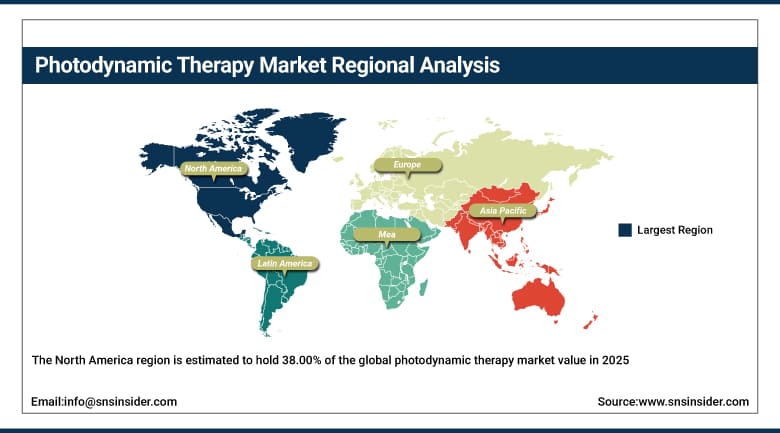
The North America region is estimated to hold 38.00% of the global photodynamic therapy market value in 2025, leading owing to robust healthcare infrastructure, the well-established use of minimally invasive treatments and high funding toward dermatology and oncology innovation. The high prevalence rate of skin condition such as actinic keratosis and non- melanoma skin cancers, along with age- related eye conditions like age- related macular degeneration (AMD), thus ensuring consistent demand for photo dynamic therapy across dermatology practices, tertiary healthcare settings and specialized cancer hospitals.
Continuous technological developments in next-generation photosensitizer agents, advanced laser based devices, A I powered automated light dosimeters, and targeted imaging solutions help improve efficiency in therapy delivery procedures. Reimbursement policies and the quick market proliferation of advanced photodynamic treatment plans also give an edge to these North American countries.
Get Customized Report as Per Your Business Requirement - Enquiry Now
Europe Photodynamic Therapy Market Insights
Europe remains one of the most mature regional markets for photodynamic therapy, propelled by advanced healthcare systems, favorable treatment guidelines for skin disease management, and an uptrend in minimal-invasive cancer treatment procedures. In nations such as Germany, the UK, France, Italy, and Spain, photodynamic therapy usage expanded in the dermatology, oncology, and ophthalmology sectors attributed to a higher incidence rate of skin cancer forms like actinic keratosis and age related ocular problems.
Moreover, ongoing innovations in photomedicine research, laser technological devices and improved photosensitizer agents, coupled with robust ties between academic and health organizations contribute to region's robust advancements. Early diagnosis and adoption of outpatient model along with a paradigm of medical personalized treatment to support regional healthy growth of market. In 2025, The Biofrontera AG added expanding training for physicians and more medical education around the use of photodynamic therapy in treating actinic keratosis throughout the Europe.
Asia Pacific Photodynamic Therapy Market Insights
Fastest growth is expected from Asia-Pacific Photodynamic Therapy market with CAGR 9.89 during the forecast period. Urban development along with increased spending on health care, rising need for early detection of cancer and availability of sophisticated dermatology treatments across China, Japan, South Korea, India and Southeast Asia region is contributing to the growth of this market. In terms of healthcare infrastructure for cancer therapies, specialized dermatology units, optical imaging systems and least invasive treatment platform, investment from governments and private players is significantly raised in the developed and developing healthcare regions.
Use of AI based treatment planning, locally designed medical devices and development of highly portable LED based systems are expected to make photodynamic therapy more viable and cost-effective in the region. Galderma continued its focus in the advancement of dermatology portfolio and commercial initiatives in the Asia Pacific region which supported expanding the access to sophisticated dermatological treatment solutions in 2025.
Middle East & Africa and Latin America Photodynamic Therapy Market Insights
The Middle East & Africa photodynamic therapy market is slowly developing with improved healthcare infrastructure and rising government investment into specific oncology and dermatology centers. Countries like the UAE, South Africa and Saudi Arabia are strengthening their cancer treatment facilities and encouraging the use of minimally invasive treatment technologies. The overall market is developing at a slow pace due to increasing private investment by the healthcare providers, opening of specialty clinics, increasing physician awareness and the availability of premium laser systems.
Market growth is stable in the Latin Americas market, driven by the rise in healthcare spending and sustains increased biopsies for earlier diagnosis, as well as improving access to advanced dermatological treatments in emerging economies such as Brazil, Mexico, Argentina, and Chile. Growing outpatient treatment capacity, as a result of increased investment into oncology infrastructure, and increasing adoption of leading photodynamic technology, are expanding region-wide treatment capabilities. In 2025, the company launched its overseas dermatology education programs in Latin America and the Middle East to promote the adoption of new dermatological treatment procedures involving high tech equipment.
Market Dynamics
Growth Drivers: Increase in the incidences of skin cancer; Preference for less invasive therapeutic methods.
Increase in number of incidences of actinic keratosis, non-melanoma skin cancer, Barrett’s esophagus, and certain solid tumors is one of the factors that boosts the usage of photodynamic therapy globally. PD Therapy is increasingly being prescribed by medical practitioners due to its targeted killing of affected tissues while leaving healthy tissues unaffected; thereby leading to lesser scarring, rapid recovery and less or no systemic side effects in contrast to conventional methods of skin treatment. Innovation with respect to photosensitive agents, and laser/light based source devices, are improving the method's efficacy. The Biofrontera AG actively supported physician training programs on PDT for actinic keratosis with continuing increase in the number of healthcare practitioners accepting minimally-invasive treatments by year 2025.
Restraints: High prices and unavailability of photodynamic specialized apparatus.
The treatment of diseases by PDT has produced positive clinical results, but on the medical device market it is impeded by the relatively high cost of expensive photosensitizing agents, laser platform used for treatment application, imaging systems, as well as advanced accessories used for effective optical delivery. The expenses for professional development of clinical professionals, planning system, as well as maintenance of complex medical equipment hinder the wider application of PDTs.
In many of the developed and developing economies, as well as several countries in regions such as the Far East and Eastern Europe, many physicians lack awareness of the potential benefits, while insufficient access to cutting-edge photomedicine infrastructure hampers further advancement. In the calendar year of 2025 several medical facilities started the further development of personnel training programs emphasizing the established treatment protocols for standard photodynamic therapy and aiming at increased use in clinic.
Opportunities: Increasing in Precision Oncology and Next Generation PDTs.
Significant growth opportunities for the photodynamic therapy market are expected with the continued progress in precision medicine. The use of artificial intelligence (AI), optical molecular imaging, nanoparticle-based photosensitizers, smart dosimeter software and individual treatment plans, has improved not only treatment accuracy but also an increase in treatable diseases. Current studies of photodynamic therapy combined with immunotherapy, targeted treatment therapies and gene-based treatment therapies are anticipated to elevate long term survival, while concurrently increasing the market opportunities for manufacturers. In 2026 the Galderma maintained focus on innovation in dermatology and technology co-operations to expand on light-based treatments for dermatological conditions.
Recent Developments
-
2026: Biofrontera AG reported continued expansion of its U.S. commercialization strategy for photodynamic therapy, focusing on physician engagement, treatment accessibility, and broader adoption of its Ameluz®-based PDT platform across dermatology clinics.
-
2025: Galderma highlighted continued investments in its dermatology innovation pipeline, including light-based treatment technologies and physician education initiatives supporting advanced management of precancerous and chronic skin disorders.
-
2025: Thorlabs, Inc. expanded its portfolio of medical laser, optical imaging, and photonics technologies supporting research and clinical development of next-generation photodynamic therapy systems for oncology and biomedical applications.
-
2025: Modulight Corporation continued advancing its medical laser platforms designed for precision oncology and photodynamic therapy applications, strengthening collaborations with healthcare and life science organizations.
Photodynamic Therapy Market Key Players are:
-
Biofrontera AG
-
Galderma S.A.
-
Sun Pharmaceutical Industries Ltd.
-
Modulight Corporation
-
Thorlabs, Inc.
-
Lumibird Medical
-
Quest PharmaTech Inc.
-
SUS Advancing Technology Co., Ltd.
-
Pinnacle Biologics, Inc.
-
Photocure ASA
-
Steba Biotech S.A.
-
Excel Lasers
-
Boston Scientific Corporation
-
biolitec AG
-
Candela Corporation
-
Coherent Corp.
-
Cutera Inc.
-
IRIDEX Corporation
-
Karl Storz SE & Co. KG
-
Apollo Medical Laser
Photodynamic Therapy Market Report Scope:
| Report Attributes | Details |
|---|---|
| Market Size in 2025 | USD 3.16 Billion |
| Market Size by 2035 | USD 6.48 Billion |
| CAGR | CAGR of 7.47% From 2026 to 2035 |
| Base Year | 2025 |
| Forecast Period | 2026-2035 |
| Historical Data | 2022-2024 |
| Report Scope & Coverage | Market Size, Segments Analysis, Competitive Landscape, Regional Analysis, DROC & SWOT Analysis, Forecast Outlook |
| Key Segments | • By Component (Photosensitizing Drugs, Light-Delivery Devices, Dosimeter, Planning Software & Accessories, Treatment & Maintenance Services, Others) • By Light Source (Laser-Based Systems, LED-Based Systems, Daylight Photodynamic Therapy, Others) • By Application (Actinic Keratosis & Precancerous Skin Lesions, Non-Melanoma Skin Cancer, Oncology Applications, Acne & Other Dermatological Conditions, Ophthalmology) • By End User (Dermatology Clinics, Hospitals & Cancer Centers, Specialty Oncology Centers, Ambulatory & Outpatient Centers, Others) |
| Regional Analysis/Coverage | North America (US, Canada), Europe (Germany, UK, France, Italy, Spain, Russia, Poland, Rest of Europe), Asia Pacific (China, India, Japan, South Korea, Australia, ASEAN Countries, Rest of Asia Pacific), Middle East & Africa (UAE, Saudi Arabia, Qatar, South Africa, Rest of Middle East & Africa), Latin America (Brazil, Argentina, Mexico, Colombia, Rest of Latin America). |
| Company Profiles | Biofrontera AG, Galderma S.A., Sun Pharmaceutical Industries Ltd., Modulight Corporation, Thorlabs, Inc., Lumibird Medical, Quest PharmaTech Inc., SUS Advancing Technology Co., Ltd., Pinnacle Biologics, Inc., Photocure ASA, Steba Biotech S.A., Excel Lasers, Boston Scientific Corporation, biolitec AG, Candela Corporation, Coherent Corp., Cutera Inc., IRIDEX Corporation, Karl Storz SE & Co. KG, Apollo Medical Laser |
Frequently Asked Questions
The Photodynamic Therapy Market was valued at USD 3.16 Billion in 2025.
The market is anticipated to expand at a CAGR of 7.47% during the forecast period.
Photosensitizing Drugs accounted for the largest revenue share of 38.00% in 2025.
