
Location Data as a Service Market Report Scope & Overview:
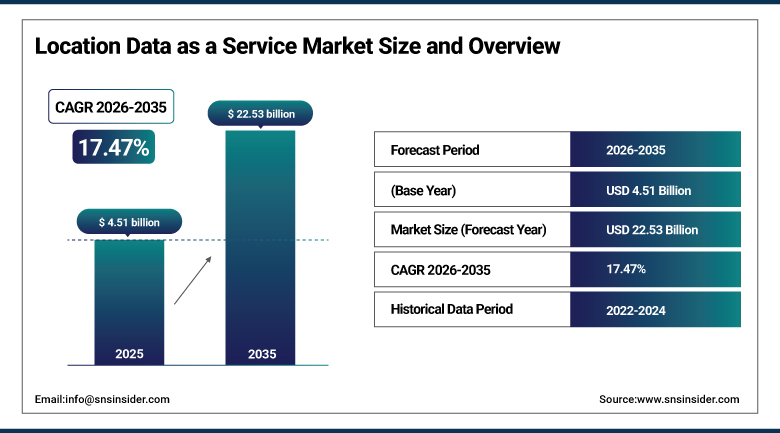
The Location Data as a Service Market was valued at USD 4.51 Billion in 2025 and is expected to reach USD 22.53 Billion by 2035, growing at a CAGR of 17.47% from 2026–2035.
Various factors including rising adoption of location-based technologies, increasing demand for real-time location intelligence, rising use of geospatial analytics, and the growing requirement for location data that are accurate and scalable are driving the growth of the Location Data as a Service Market. Location Data as a Service platform allow enterprises to leverage real-time and historical location data by accessing, integrating, managing, and analyzing them with the help of cloud-based services, and therefore, there will be little need for organizations to create location-data infrastructure internally.
Increasing use of connected devices, smartphones, GPS-enabled technology, IoT devices, connected cars, and location-aware applications has resulted in generation of huge amount of location data and rising need for scalable location data services. In addition to this, businesses belonging to various verticals like retail, transportation & logistics, BFSI, healthcare, government, and others are increasingly making use of location intelligence for mapping and navigation, marketing and advertising, asset tracking, risk management, and decision making. The growing need to gain real-time location insights, optimize operations, improve customer targeting, visibility of assets, and facilitate decision-making is likely to drive the adoption of Location Data as a Service solution.
In February 2025, Esri made ArcGIS Location Platform’s Batch Geocoding and Last Mile Delivery services generally available, expanding access to scalable geocoding, routing, and location-data capabilities. For the location data as a service market, the updates support growing demand for cloud-based location intelligence across mapping, navigation, and transportation applications.
To Get more information Location Data as a Service Market - Request Free Sample Report
Location Data as a Service Market Trends
-
Growing adoption of cloud-based location intelligence is driving demand for scalable location data services.
-
Rising use of GPS-enabled devices, IoT, smartphones, and connected vehicles is increasing location data generation.
-
Increasing demand for mapping, navigation, asset tracking, advertising, and geospatial analytics is supporting market growth.
-
Growing focus on operational efficiency, customer engagement, and data-driven decision-making is creating opportunities for LDaaS providers.
-
Advancements in AI, machine learning, and geospatial analytics are improving location data processing and real-time insights.
U.S. Location Data as a Service Market Outlook
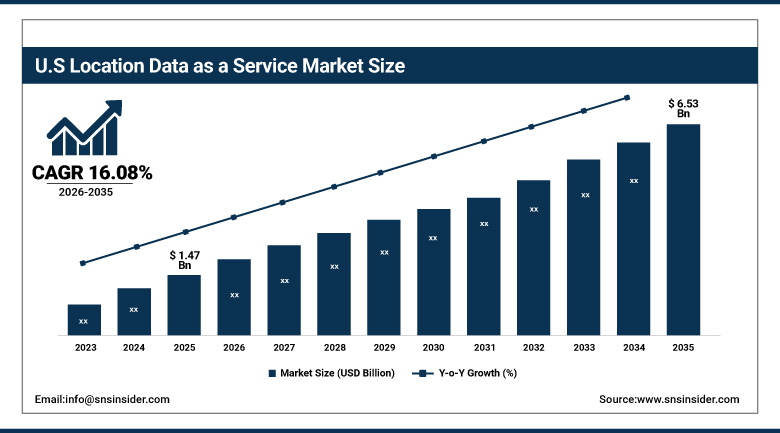
The U.S. Location Data as a Service Market was valued at USD 1.47 Billion in 2025 and is expected to reach around USD 6.53 Billion by 2035, growing at a CAGR of 16.08% from 2026–2035.
The US location data as a service market is expected to become very lucrative in the coming years owing to several reasons. Firstly, there is an increasing demand for real-time location intelligence, geospatial analysis, mapping, navigation, and tracking of assets, which is prompting businesses to use location data as a service. In addition to that, the presence of some big names from the technology, retail, transport, finance, healthcare, and government industry is also contributing to the rising demand. Secondly, the increasing use of Internet of Things (IoT) devices, connected cars, GPS-based systems, cloud technology, and AI is leading to the creation of huge amounts of location data.
In April 2026, Google Cloud introduced enhancements to its cross-cloud capabilities at Google Cloud Next ’26, focusing on cross-cloud connectivity, unified data management, and distributed infrastructure. For the location data as a service market, these developments support growing demand for scalable cloud-based location data, cross-platform integration, real-time data management, and geospatial services across distributed enterprise environments.
Location Data as a Service Market Segment Analysis
-
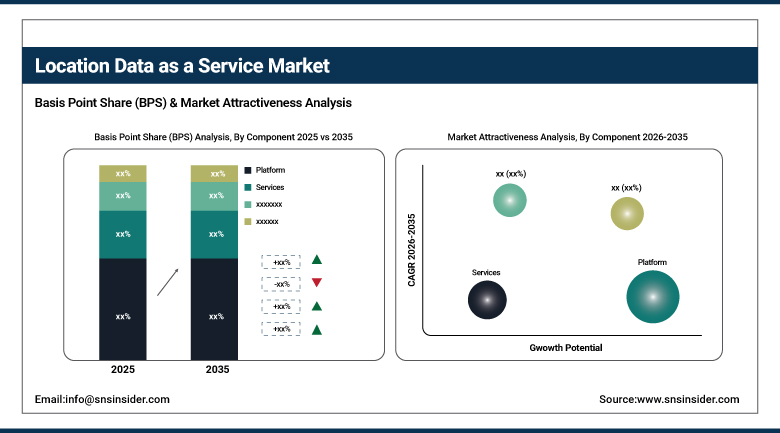
By Component, platform dominated the location data as a service market with a 58.50% share in 2025, while services is projected to be the fastest-growing segment, registering a 19.28% CAGR during 2026–2035.
-
By Data Type, real-time location data dominated the location data as a service market with a 39.70% share in 2025, while the real-time location data is projected to be the fastest-growing, registering a 19.36% CAGR during 2026–2035.
-
By Deployment Mode, cloud dominated the location data as a service market with a 72.40% share in 2025, while the cloud is projected to be the fastest-growing, registering an 18.41% CAGR during 2026–2035.
-
By Organization Size, large enterprises dominated the location data as a service market with a 68.40% share in 2025, while small and medium enterprises is projected to be the fastest-growing segment, registering a 21.14% CAGR during 2026–2035.
-
By Application, mapping and navigation dominated the location data as a service market with a 34.80% share in 2025, while advertising and marketing is projected to be the fastest-growing segment, registering a 20.57% CAGR during 2026–2035.
-
By End-User, retail dominated the location data as a service market with a 28.50% share in 2025, while transportation and logistics is projected to be the fastest-growing segment, registering a 20.33% CAGR during 2026–2035.
By Component, platform dominated the location data as a service market, while services is expected to grow fastest.
The platform sub-segment held the largest market share in 2025, driven by rising enterprise demand for centralized location data, mapping, geocoding, and location intelligence platforms. Growing integration of real-time location data with business applications and analytics is further supporting segment growth.
The services sub-segment is expected to register the highest CAGR during 2026–2035, supported by increasing demand for data integration, implementation, customization, consulting, maintenance, and managed services. Growing integration with APIs, IoT platforms, and analytics systems is further driving adoption.
By Application, mapping and navigation dominated the location data as a service market, while advertising and marketing is expected to grow fastest.
The mapping and navigation segment accounted for the major share in 2025 owing to rising demand for digital maps, route optimization, geocoding, navigation solutions, and location-based solutions. There has been increasing adoption of precise location information by retailers, transportation organizations, logistics firms, and technology platforms to enhance route planning, accessibility, deliveries, and location-based services.
The advertisement & marketing segment will have the fastest CAGR growth rate during the forecast period. Rising adoption of location intelligence to track movements of customers, find valuable audiences, create personalized marketing campaigns, and assess advertising performance is contributing towards its growth. The increasing availability of real-time location data via mobile devices and connected technology is also helping companies conduct effective marketing.
By End-User, retail dominated the location data as a service market, while transportation and logistics is expected to grow fastest.
Retail accounted for the largest market share in 2025 due to the rising use of location data for the purposes of store planning, customer analysis, targeted marketing, demand forecasting, and location-based promotions.
The segment of transportation and logistics is expected to register the highest CAGR during the forecast period. The increasing application of connected cars, fleet management systems, route optimization, tracking, and delivery intelligence solutions has led to a growing need for location intelligence. The growth of e-commerce and last-mile delivery operations has motivated logistics companies to use location intelligence solutions to optimize their fleet and delivery operations.
Regional Insights
|
Region |
Major Country |
Share within Region, 2025(%) |
|---|---|---|
|
North America |
United States |
84.60% |
|
Europe |
Germany |
27.38% |
|
Asia Pacific |
China |
45.72% |
|
Middle East & Africa |
Saudi Arabia |
22.84% |
|
Latin America |
Brazil |
21.63% |
North America Location Data as a Service Market Insights
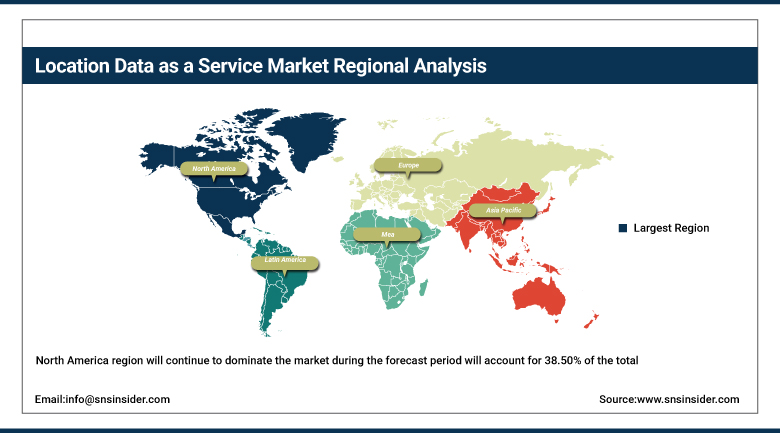
The North America region will continue to dominate the location data as a service market during the forecast period of 2025 to 2035 and will account for 38.50% of the total market by 2025. Some of the drivers of this regional market include the presence of location intelligence, cloud geospatial solutions, connected devices, IoT, and GPS-enabled solutions. In addition, the increasing demand from key sectors such as technology firms, retail, transportation and logistics, banks and other financial organizations, healthcare, and governments is propelling the demand for location data services in the region.
The US is the biggest country market in North America, driven by the adoption of location intelligence, real-time location intelligence, mapping and navigation, asset tracking, location-based advertising, and geospatial analytics. The increase in the deployment of connected cars, smartphones, IoT devices, and cloud platforms is creating large amounts of location data.
Get Customized Report as per Your Business Requirement - Enquiry Now
Europe Location Data as a Service Market Insights
The location data as a service market in Europe is predicted to remain in steady growth until 2035, driven by growing adoption of cloud location intelligence, digital transformation, geospatial analysis, and connectivity technologies. Germany can be considered the top country-level market in the region owing to its highly developed automotive, manufacturing, logistics, finance, and industrial tech industries.
Businesses in Europe are relying on location data for mapping and navigation purposes, tracking their assets, analyzing customers, managing risks, and location marketing. Countries in Europe such as the UK, France, Italy, and others are also fueling regional demand with investments in cloud computing, Internet of Things (IoT), connectivity, digital services, and geospatial technologies.
Asia Pacific Location Data as a Service Market Insights
Asia Pacific is forecasted to be the fastest-growing region in the location data as a service market, registering a 19.56% CAGR during 2026–2035. Growth will be supported by rapid digitalization, increasing smartphone and Internet of Things (IoT) adoption, connected vehicle deployment, e-commerce expansion, and rising demand for cloud-based location intelligence. China is expected to lead the regional market due to its strong technology ecosystem, expanding digital economy, connected infrastructure, and increasing demand for geospatial data services. Japan and South Korea will remain significant markets, supported by their advanced automotive, electronics, telecommunications, manufacturing, and technology industries.
India is also expected to witness strong growth as enterprises increasingly adopt cloud computing, digital platforms, and location-based services. Rising investments in smart cities, mobility solutions, logistics, and location-enabled applications will further strengthen regional demand.
Middle East & Africa and Latin America Location Data as a Service Market Insights
The Middle East & Africa and Latin America regions are anticipated to exhibit consistent growth of the location data as a service market during 2035, driven by digital transformation, growth in cloud infrastructure, smart city deployments, connectedness, and adoption of location intelligence by enterprises. The market in Saudi Arabia is one of the prominent markets within the Middle East & Africa region due to smart city initiatives and technology-enabled developments.
Brazil constitutes one of the prominent country markets in the Latin America region, driven by growing adoption of cloud solutions, digital commerce, transport solutions, finance solutions, retail platforms, and connected devices. Mexico and other Latin American countries are contributing to the regional growth due to increasing adoption of location-based solutions.
Growth Driver: Increasing demand for real-time location intelligence and geospatial data services is driving market growth
The rise in adoption of location technologies is one of the key factors responsible for the growth of the location data as a service market. Businesses are utilizing real-time and historic location data for various applications, such as map making, navigation, tracking, customer analysis, targeted advertisement, and decision-making. The proliferation of mobile phones, GPS devices, IoT devices, connected vehicles, and location-enabled applications is leading to the generation of large amounts of location data.
The developments in cloud computing, artificial intelligence, machine learning, geospatial analytics, and application programming interface (API) are facilitating the processing, integration, and analysis of location data. In addition to that, the rising requirement for real-time insights, route optimization, asset visibility, customer engagement, and location risk management is encouraging businesses to adopt location data as a service offering.
Restraint: Data privacy, security concerns, and integration complexity can limit market adoption
Data security and privacy concerns surrounding the acquisition, processing, storage, and exchange of location data may hinder the adoption of location data as a service. Location information can contain sensitive details about individuals, properties, assets, and organizational activities, requiring compliance with data protection, consent, access control, and data governance requirements. In addition, integrating location data services with existing enterprise applications, databases, Internet of Things platforms, and analytics systems can create technical and operational challenges.
High costs associated with data licensing, system integration, customization, security infrastructure, and skilled personnel may further discourage small and medium-sized organizations from adopting these services. Limited technical expertise, complex regulatory requirements, interoperability issues, and concerns regarding unauthorized access or misuse of location information may also increase implementation risks and slow adoption, particularly among organizations with limited budgets and resources.
Opportunity: Growing adoption of AI, IoT, connected vehicles, and geospatial analytics creates new market opportunities
With growing usage of Artificial Intelligence, Machine Learning, Internet of Things (IoT), Connected Cars, and Geospatial Analytics, there is rising scope for Location Data as a Service (DaaS) providers. Enterprises are showing increased interest in location-based services that would enable them to gain real-time insights and leverage them to optimize routes, track assets, engage customers, find risks, and make informed decisions.
Growing usage of smart cities, autonomous mobility solutions, e-commerce, last-mile deliveries, digital advertising, location-based apps, etc., is further adding to the demand for location data. AI-based location analytics, predictive analytics, real-time data analytics, and location-as-a-service cloud platforms can help companies draw out insights from huge geospatial data.
Recent Developments
-
March 2026: Google Cloud expanded its geospatial capabilities with enhancements to Google Maps Platform, strengthening location intelligence, mapping, routing, and location-based data services for enterprise applications.
-
April 2026: Microsoft expanded Azure Maps capabilities to support enterprise mapping, geocoding, routing, and location intelligence applications, enabling organizations to integrate location data into business workflows and customer-facing services.
-
February 2026: Esri enhanced ArcGIS Location Platform with additional location services and developer capabilities, supporting scalable access to geocoding, mapping, routing, and geospatial data for enterprise applications.
-
2026: HERE Technologies continued expanding its location platform capabilities for mapping, routing, traffic information, and location intelligence, supporting transportation, logistics, automotive, and enterprise applications requiring real-time location data.
Location Data as a Service Market Key Players are:
-
Google LLC
-
Microsoft Corporation
-
HERE Technologies
-
TomTom N.V.
-
Esri
-
Apple Inc.
-
Precisely Inc.
-
Oracle Corporation
-
Foursquare Labs Inc.
-
IBM Corporation
-
Zebra Technologies Corporation
-
Telenav Inc.
-
CARTO
-
Uber Technologies Inc.
-
Baidu Inc.
-
Tencent Holdings Limited
-
Alibaba Group Holding Limited
-
MapQuest Inc.
Location Data as a Service Market Report Scope:
| Report Attributes | Details |
|---|---|
| Market Size in 2025 | USD 4.51 Billion |
| Market Size by 2035 | USD 22.53 Billion |
| CAGR | CAGR of 17.47% From 2026 to 2035 |
| Base Year | 2025 |
| Forecast Period | 2026-2035 |
| Historical Data | 2022-2024 |
| Report Scope & Coverage | Market Size, Segments Analysis, Competitive Landscape, Regional Analysis, DROC & SWOT Analysis, Forecast Outlook |
| Key Segments | • By Component (Platform, Services) • By Data Type (Real-time Location Data, Historical Location Data, Geocoding Data, Demographic Data, Others) • By Deployment Mode (Cloud, On-Premises) • By Organization Size (Small and Medium Enterprises, Large Enterprises) • By Application (Mapping and Navigation, Advertising and Marketing, Asset Tracking, Risk Management, Other Applications) • By End-User (Retail, Transportation and Logistics, BFSI, Healthcare, Government, Other End-Users) |
| Regional Analysis/Coverage | North America (US, Canada, Mexico), Europe (Eastern Europe [Poland, Romania, Hungary, Turkey, Rest of Eastern Europe] Western Europe] Germany, France, UK, Italy, Spain, Netherlands, Switzerland, Austria, Rest of Western Europe]), Asia Pacific (China, India, Japan, South Korea, Vietnam, Singapore, Australia, Rest of Asia Pacific), Middle East & Africa (Middle East [UAE, Egypt, Saudi Arabia, Qatar, Rest of Middle East], Africa [Nigeria, South Africa, Rest of Africa], Latin America (Brazil, Argentina, Colombia, Rest of Latin America) |
| Company Profiles | Google LLC, Microsoft Corporation, HERE Technologies, TomTom N.V., Esri, Apple Inc., Mapbox Inc., Precisely Inc., Oracle Corporation, Foursquare Labs Inc., IBM Corporation, Trimble Inc., Zebra Technologies Corporation, Telenav Inc., CARTO, Uber Technologies Inc., Baidu Inc., Tencent Holdings Limited, Alibaba Group Holding Limited, MapQuest Inc. |
Frequently Asked Questions
The Location Data as a Service Market is expected to grow at a CAGR of 17.47% from 2026 to 2035.
The Location Data as a Service Market was valued at approximately USD 4.51 billion in 2025.
The market is primarily driven by increasing adoption of cloud-based location intelligence, real-time location data, geospatial analytics, connected devices, and location-based applications.
Platform dominated the Location Data as a Service Market in 2025, accounting for a 58.50% share.
