
Field Workforce AR Support Market Report Scope & Overview:
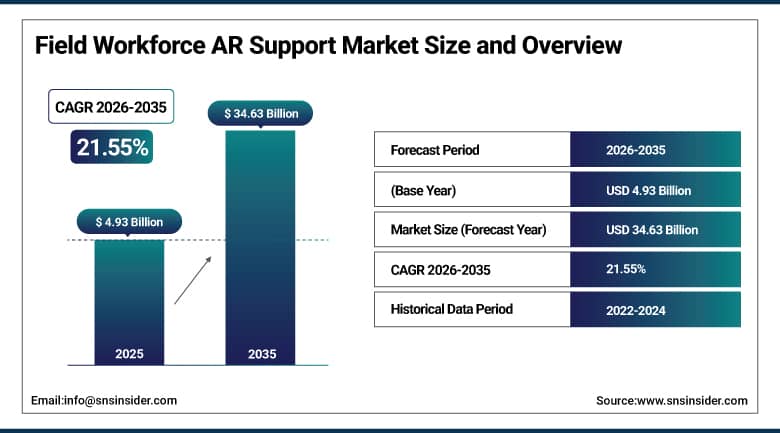
The Field Workforce AR Support Market was valued at USD 4.93 billion in 2025 and is expected to reach USD 34.63 billion by 2035, growing at a CAGR of 21.55% from 2026–2035.
There is significant growth in the global field workforce AR support market due to increasing deployment of augmented reality solutions by organizations to increase efficiency and productivity of their field and frontline workers. There is an increased need for remote support, hands-free instructions, and visual support that is driving the adoption of such solutions in sectors like manufacturing, utilities, oil & gas, construction, transportation and logistics, and telecommunication industries. The scarcity of skilled field technicians has led organizations to rely on augmented reality platforms.
In February 2026, Vuzix Corporation launched its Vuzix Solutions portfolio, including the Remote Assist solution, which combines enterprise smart glasses with native Microsoft Teams and Zoom support for hands-free remote assistance. The solution is designed for frontline applications such as field service, logistics, manufacturing, and industrial maintenance, enabling workers to share a live first-person view with remote experts for real-time guidance and troubleshooting.
To Get More Information On Field Workforce AR Support Market - Request Free Sample Report
Field Workforce AR Support Market Trends
-
The growing adoption of augmented reality in field operations is increasing demand for remote assistance and hands-free workforce support.
-
The expansion of 5G connectivity and edge computing is enabling low-latency AR applications for real-time guidance and troubleshooting.
-
The rising use of smart glasses, head-mounted displays, and wearable devices is supporting AR adoption among field workers.
-
Increasing demand for remote maintenance and repair is driving the use of AR-based visual guidance and expert assistance.
-
Growing adoption of AR in manufacturing, utilities, oil and gas, construction, and telecommunications is supporting market expansion.
-
Rising investments in Industry 4.0, artificial intelligence, IoT, and cloud-based AR platforms are accelerating field workforce AR deployment.
U.S. Field Workforce AR Support Market Outlook
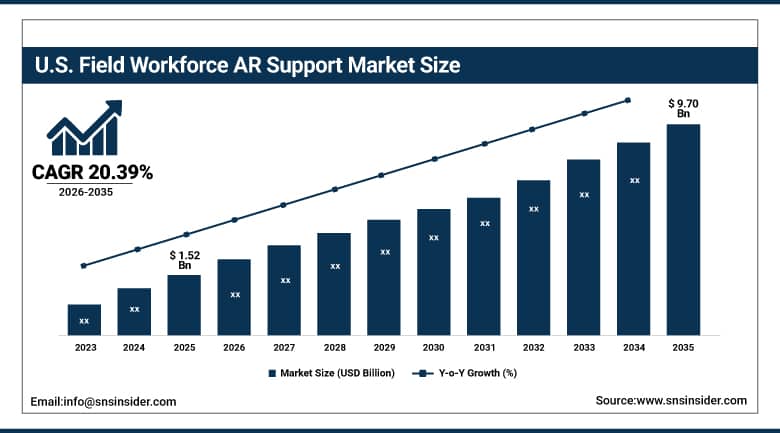
The U.S. Field Workforce AR Support Market was valued at USD 1.52 billion in 2025 and is expected to reach around USD 9.70 billion by 2035, growing at a CAGR of 20.39% from 2026–2035.
U.S. field workforce AR support market is on the rise because businesses have started using augmented reality to boost their field service efficiency, remote assistance, and technicians’ productivity. Increasing use of AR technology in sectors such as manufacturing, utilities, oil and gas, construction, transport and logistics, and telecoms will drive market growth. More use of smart glasses, head mounted displays, rugged tablets, and wearable cameras will facilitate hands-free access to digital instructions and remote expert help. Increasing use of 5G network, edge computing, artificial intelligence, and integrated AR will further enhance field operations in real time. Increased need for faster maintenance, lower downtime, first-time fix rates, and worker training will encourage adoption among U.S. businesses.
In May 2025, HCLTech partnered with CareAR and ServiceNow to enhance field workforce support through AR-enabled remote assistance. The collaboration integrates augmented reality into IT infrastructure services, enabling field technicians to receive real-time remote guidance, troubleshoot equipment, and resolve issues more efficiently. The initiative is particularly relevant to U.S. field-service operations, where organizations are increasingly using AR to reduce downtime, improve first-time resolution, and provide technicians with access to remote expertise.
Field Workforce AR Support Market Segment Analysis
-
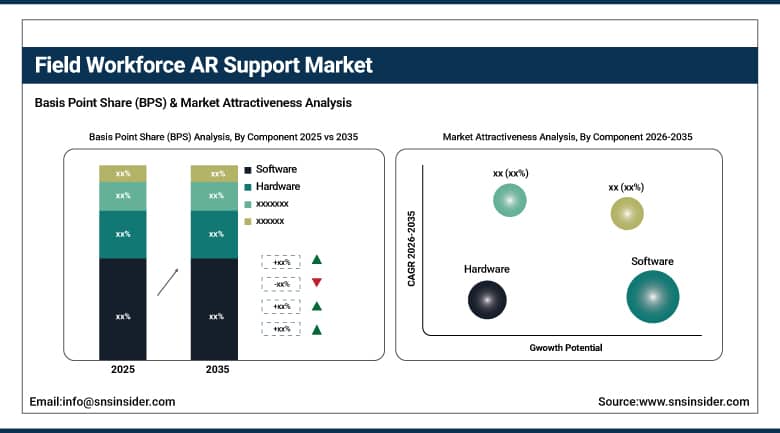
By Component, software dominated the market with 48.36% share in 2025; while software is the fastest growing segment with CAGR of 23.60% during 2026 to 2035.
-
By Technology, augmented reality dominated the market with 46.28% share in 2025; while edge computing and 5G-enabled AR is the fastest growing segment with CAGR of 27.75% during 2026 to 2035.
-
By Deployment Mode, cloud dominated the market with 62.74% share in 2025; while cloud is the fastest growing segment with CAGR of 23.41% during 2026 to 2035.
-
By Application, remote assistance dominated the market with 32.47% share in 2025; while training and simulation is the fastest growing segment with CAGR of 25.15% during 2026 to 2035.
-
By Industry Vertical, manufacturing dominated the market with 26.41% share in 2025; while oil and gas is the fastest growing segment with CAGR of 25.38% during 2026 to 2035.
By Component, software dominated the Field Workforce AR Support Market, while software is the fastest-growing segment.
Software holds the leading position due to the increasing adoption of AR platforms for remote assistance, digital work instructions, real-time collaboration, workforce training, maintenance support, and field-service management. AR software enables technicians to access contextual equipment information, visual instructions, maintenance procedures, remote expert guidance, and real-time operational data while working in the field. Integration with enterprise systems, asset management platforms, IoT devices, and cloud infrastructure allows organizations to connect field activities with centralized operational data, improving workflow visibility and technician productivity.
Software is also expected to remain the fastest-growing component as enterprises increasingly integrate artificial intelligence, computer vision, predictive analytics, IoT, and cloud technologies into AR workforce platforms. AI-enabled software can support equipment recognition, automated troubleshooting, intelligent workflow guidance, and real-time decision support. The growing preference for cloud-based and subscription-based AR platforms is further improving scalability and reducing deployment complexity, encouraging adoption across large enterprises as well as smaller field-service organizations.
By Technology, augmented reality dominated the Field Workforce AR Support Market, while edge computing and 5G-enabled AR is the fastest-growing segment.
Augmented Reality leads the technology segment because of its broad application across field service, maintenance, inspection, repair, manufacturing, utilities, telecommunications, and other industrial operations. AR-enabled smart glasses, head-mounted displays, tablets, and wearable devices allow technicians to view digital information directly within their working environment. Visual overlays, equipment data, step-by-step instructions, and interactive guidance can help technicians perform complex tasks more efficiently while reducing errors and improving first-time resolution.
Edge Computing and 5G-Enabled AR is expected to experience the fastest growth as enterprises increasingly require low-latency connectivity, high-speed communication, and real-time data processing for advanced field operations. Edge computing allows critical information to be processed closer to the point of use, while 5G supports faster communication between technicians, remote experts, connected equipment, and cloud platforms. The combination is particularly valuable for remote assistance, real-time diagnostics, connected maintenance, and applications where delays in receiving information can affect operational performance.
By Application, remote assistance dominated the Field Workforce AR Support Market, while training and simulation is the fastest-growing segment.
Remote Assistance leads the application segment because organizations increasingly require real-time expert support for equipment maintenance, troubleshooting, inspection, repair, and complex field-service activities. AR enables technicians to share live views of equipment and working conditions with remote specialists, who can then provide visual annotations, instructions, and guidance. This approach reduces the need for experts to travel to field locations, shortens response times, improves knowledge transfer, and helps organizations resolve technical issues more efficiently.
Training and Simulation is expected to be the fastest-growing application as organizations face workforce skill gaps, technician onboarding challenges, and increasing requirements for standardized technical training. AR-based training enables employees to practice maintenance, repair, inspection, and operational procedures in immersive and interactive environments. Organizations can use simulated scenarios to train workers on complex or hazardous equipment without interrupting live operations or exposing employees to unnecessary risks. Increasing demand for continuous workforce development, faster skill acquisition, and safer training methods is expected to further support adoption of AR-based training and simulation solutions.
Regional Insights
|
Region |
Major Country |
Share within Region, 2025(%) |
|---|---|---|
|
North America |
United States |
84.70% |
|
Europe |
Germany |
22.60% |
|
Asia Pacific |
China |
34.80% |
|
Middle East & Africa |
UAE |
18.50% |
|
Latin America |
Brazil |
39.50% |
North America Field Workforce AR Support Market Insights.
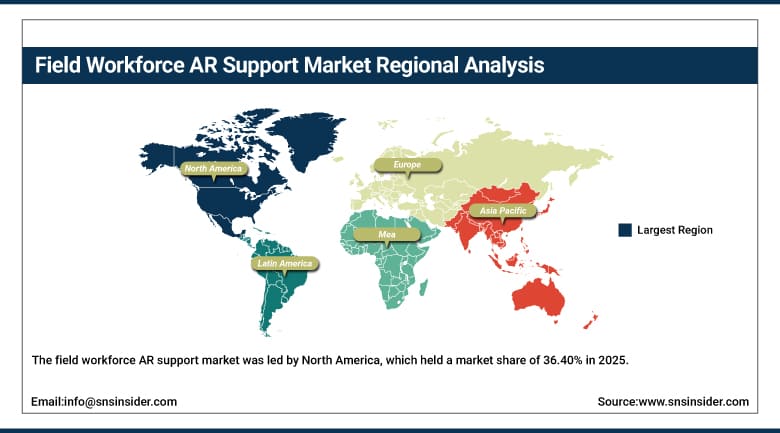
The field workforce AR support market was led by North America, which held a market share of 36.40% in 2025. The dominance of North America can be attributed to the widespread adoption of AR solutions across field services, manufacturing, utilities, telecommunications, oil and gas, and transportation and logistics. Higher demand is being witnessed due to the increasing adoption of AR-based remote assistance, digital work instructions, maintenance support, inspection, and workforce training.
The presence of established technology providers, advanced digital infrastructure, high enterprise spending on workforce technologies, and strong cloud adoption is further supporting regional growth. Organizations are increasingly integrating AR with artificial intelligence, computer vision, IoT, analytics, and 5G connectivity to provide technicians with real-time equipment information and contextual guidance. Growing workforce skill requirements and the need to reduce equipment downtime are also encouraging companies to adopt AR-enabled solutions for field operations.
Get Customized Report as Per Your Business Requirement - Enquiry Now
Europe Field Workforce AR Support Market Insights.
The European region has captured a sizeable portion of the field workforce AR support market in 2025 owing to the growing usage of AR-based field services and field workforce management solutions in industries such as manufacturing, automotive, utilities, construction, telecommunications, and transportation. AR is being used by various organizations for remote expert assistance, maintenance and repair, inspection, and technician training.
Increasing industrial automation and digital transformation are encouraging enterprises to modernize traditional field-service processes with connected and intelligent technologies. The growing use of cloud platforms, industrial IoT, connected equipment, and digital work instructions is further supporting AR adoption. In addition, the need to improve technician productivity, reduce travel costs, accelerate troubleshooting, and enhance first-time resolution rates is creating sustained demand for AR-based workforce support solutions across major European economies.
Asia Pacific Field Workforce AR Support Market Insights.
The Asia Pacific region is experiencing the fastest growth in the field workforce AR support market, registering a CAGR of 23.64% during 2026–2035. Growth is driven by rapid industrial digitalization, expanding manufacturing activities, widespread 5G deployment, and increasing adoption of AR-enabled field-service solutions across China, Japan, India, South Korea, and Southeast Asia.
The region's expanding industrial base and increasing investments in smart factories are creating significant opportunities for AR applications in maintenance, inspection, repair, remote assistance, and workforce training. Growing deployment of connected equipment, cloud computing, industrial IoT, and edge computing is enabling organizations to deliver real-time AR support to field technicians. Increasing workforce digitization, demand for skilled technicians, and adoption of immersive training solutions are expected to further accelerate regional market expansion throughout the forecast period.
Middle East & Africa and Latin America Field Workforce AR Support Market Insights.
Field Workforce AR Support solutions are gaining prominence in Middle East & Africa and Latin America, where companies are modernizing operations and expanding their digital footprint. This growing demand is fueled by increasing applications across sectors such as oil and gas, utilities, telecommunications, construction, manufacturing, and transportation. The implementation of cloud technology, remote collaboration, digital work instructions, and AR-enabled training is improving field workforce efficiency and supporting the expansion of AR-based services.
In the Middle East, investments in energy infrastructure, industrial projects, smart cities, and telecommunications are creating opportunities for AR-supported field operations. In Latin America, modernization of industrial facilities and increasing adoption of digital service platforms are encouraging enterprises to implement AR for maintenance, inspection, and remote technical assistance. Growing awareness of productivity benefits and declining barriers to cloud-based deployment are expected to support continued regional adoption.
Growth Drivers: Increasing Adoption of Augmented Reality for Field Service and Remote Assistance
The increasing usage of augmented reality in field service operations is generating high demand for field workforce AR support solutions. companies are increasingly using smart glasses, tablets, head-mounted displays, and mobile devices, which come with AR features, to offer technicians relevant equipment data, digital guidance on work tasks, remote assistance, and other workflow support. AR solutions enhance the productivity of technicians, minimize travel needs, cut down equipment downtime, and also boost first time resolution of issues. Cloud-based AR platforms along with advancements in artificial intelligence, computer vision, IoT, and 5G are further driving this trend in manufacturing, utilities, oil & gas, telecoms, transportation, and construction industries.
Restraints: High Implementation Costs and Integration Complexity
The deployment of field workforce AR support applications may be limited by high implementation and integration costs, especially for small and medium enterprises. The use of augmented reality hardware, software platform, connectivity and integration features needs considerable capital investment. There could also be problems in integrating AR technology with other field service management systems, enterprise resource planning system, asset management and IoT systems. There is also the challenge of maintaining hardware and software, upgrading the systems and ensuring cybersecurity measures are in place.
Opportunities: Integration of AI, 5G, Edge Computing, and Immersive Training
The growing integration of AI, 5G, edge computing, and analytics into AR platforms has opened up several opportunities for the Field Workforce AR Support Market. The use of AI-based computer vision technology can offer real-time object recognition and diagnostics, and 5G and edge computing can help in ensuring real-time communication and remote collaboration. The growing demand for immersive workforce training and simulations has also provided many opportunities for learning through AR systems that would enable technicians to carry out complex procedures in a controlled environment.
Recent Developments
-
2025: TeamViewer AG expanded its Frontline augmented reality platform for frontline productivity, supporting remote assistance, guided workflows, and field-service operations across industrial environments.
-
2025: PTC Inc. introduced an Enterprise plan for Vuforia Engine, strengthening its enterprise augmented reality capabilities with advanced object tracking, spatial navigation, and deployment options for industrial workforce applications.
-
2025: Microsoft Corporation continued enhancing Dynamics 365 Field Service with capabilities for frontline workers, including work-order management, resource scheduling, asset tracking, and mobile field-service operations.
-
2025: TeamViewer AG highlighted AR-based training and digital workflows through Frontline, including applications for workforce upskilling, technical training, manufacturing, and field service.
Field Workforce AR Support Market Key Players
-
Microsoft Corporation
-
Robert Bosch GmbH
-
Siemens AG
-
Honeywell International Inc.
-
Zoho Corporation Private Limited
-
PTC Inc.
-
TeamViewer AG
-
Magic Leap, Inc.
-
EON Reality, Inc.
-
RealWear, Inc.
-
Praxedo SAS
-
VIRNECT Co., Ltd.
-
Librestream Technologies Inc.
-
Scope AR LLC
-
Augmentir, Inc.
-
Kognitiv Spark Inc.
-
Atheer, Inc.
-
AMA XpertEye SAS.
Field Workforce AR Support Market Report Scope:
| Report Attributes | Details |
|---|---|
| Market Size in 2025 | USD 4.93 Billion |
| Market Size by 2035 | USD 34.63 Billion |
| CAGR | CAGR of 21.55% From 2026 to 2035 |
| Base Year | 2025 |
| Forecast Period | 2026-2035 |
| Historical Data | 2022-2024 |
| Report Scope & Coverage | Market Size, Segments Analysis, Competitive Landscape, Regional Analysis, DROC & SWOT Analysis, Forecast Outlook |
| Key Segments | • By Component (Software, Hardware, Services) • By Deployment Mode (On-Premises, Cloud) • By Technology (Augmented Reality, Mixed Reality, Edge Computing and 5G-Enabled AR, Internet of Things (IoT)-Integrated Augmented Reality (AR) Solutions) • By Application (Remote Assistance, Training and Simulation, Maintenance and Repair, Inspection and Quality Assurance, Other Applications) • By Industry Vertical (Utilities, Oil and Gas, Manufacturing, Construction, Transportation and Logistics, Telecommunications, Other Industry Verticals) |
| Regional Analysis/Coverage | North America (US, Canada), Europe (Germany, UK, France, Italy, Spain, Russia, Poland, Rest of Europe), Asia Pacific (China, India, Japan, South Korea, Australia, ASEAN Countries, Rest of Asia Pacific), Middle East & Africa (UAE, Saudi Arabia, Qatar, South Africa, Rest of Middle East & Africa), Latin America (Brazil, Argentina, Mexico, Colombia, Rest of Latin America) |
| Company Profiles | Microsoft Corporation; Robert Bosch GmbH; Siemens AG; Lenovo Group Limited; Honeywell International Inc.; Zoho Corporation Private Limited; PTC Inc.; TeamViewer AG; Magic Leap, Inc.; EON Reality, Inc.; RealWear, Inc.; Praxedo SAS; VIRNECT Co., Ltd.; Librestream Technologies Inc.; Vuzix Corporation; Scope AR LLC; Augmentir, Inc.; Kognitiv Spark Inc.; Atheer, Inc.; AMA XpertEye SAS. |
Frequently Asked Questions
The Field Workforce AR Support Market was valued at USD 4.93 billion in 2025.
Increasing AR adoption for remote assistance, digital training, cloud platforms, AI, IoT, computer vision, edge computing, and 5G technologies.
The software segment dominated the Field Workforce AR Support Market in 2025, accounting for a 48.36% share.
North America dominated the Field Workforce AR Support Market in 2025.
