
Frequency Tripling Devices Market Report Scope & Overview:
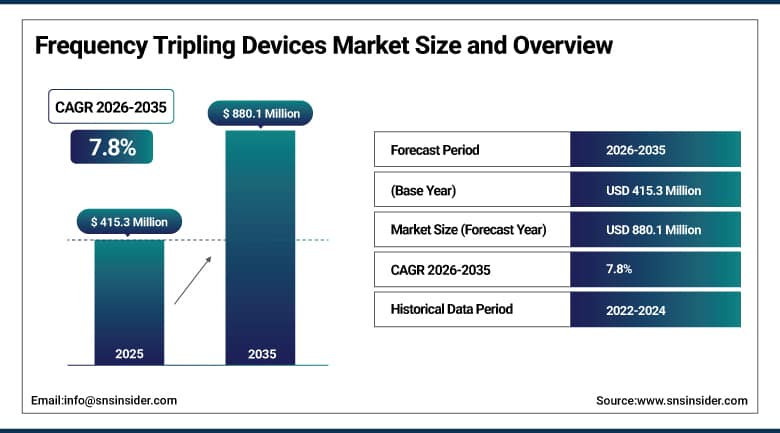
The Frequency Tripling Devices Market was valued at USD 415.3 Million in 2025 and is expected to reach USD 880.1 Million by 2035, growing at a CAGR of 7.8% from 2026 to 2035.
Frequency tripling devices enable the conversion of infrared radiation from fundamental laser wavelengths into ultraviolet light through nonlinear optical processes, a critical capability across telecommunications infrastructure, medical diagnostic systems, scientific research applications, and defense technology platforms. The market encompasses crystal-based devices, such as potassium dihydrogen phosphate and lithium triborate crystals, alongside nonlinear optical devices including periodically-poled lithium niobate modules, which represent a complementary and increasingly important technological approach. Telecommunications carriers worldwide continued upgrading optical communication systems to handle higher data rates in 2025, driving demand for frequency conversion technologies, and rising R&D investment, miniaturization trends, and integration of nonlinear optical materials kept propelling market expansion across a genuinely broad range of end-use applications.
In 2025, Menlo Systems released its ELMO 780 XHP ultrafast fiber laser, delivering over 1W of average power at 780 nm with approximately 100 femtosecond pulse durations, a platform compatible with third-harmonic generation chains that's increasingly enabling downstream ultraviolet applications in biomedical imaging and precision spectroscopy.
To Get More Information On Frequency Tripling Devices Market - Request Free Sample Report
Frequency Tripling Devices Market Trends
-
Thin-film lithium niobate integration is enabling third-harmonic generation modules to be embedded directly into standard photonic integrated circuits.
-
Growing demand for portable, laser-based diagnostic and surgical tools is driving interest in miniature tripling modules for biomedical applications.
-
Expanding research infrastructure investment from government science agencies continued sustaining demand for high-precision frequency conversion systems.
-
Compact ultraviolet and visible light sources produced through frequency tripling are gaining early interest for potential integration into consumer AR/VR devices.
-
Improved thermal management and temperature stabilization techniques are broadening device deployment into portable and field-based systems.
U.S. Frequency Tripling Devices Market Outlook
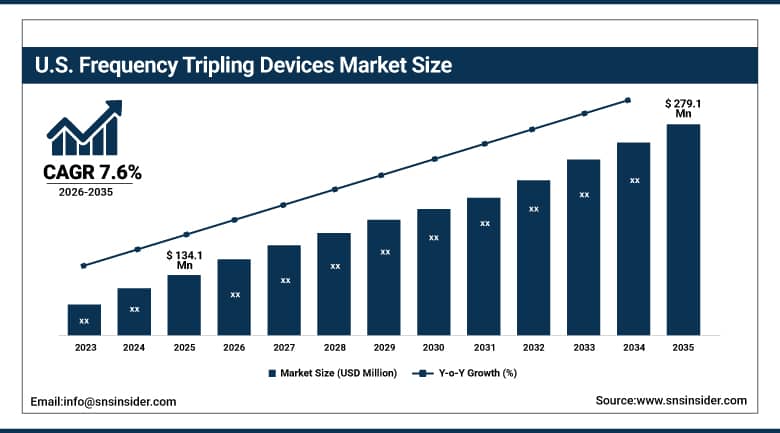
The U.S. Frequency Tripling Devices Market was valued at approximately USD 134.1 Million in 2025 and is expected to reach approximately USD 279.1 Million by 2035, growing at a CAGR of approximately 7.6% from 2026 to 2035.
The US also remained technologically ahead in photonic and laser-related research during 2025 with demand from the defense and aerospace industry, along with solid academic and national laboratory research base, continuing to be strong. Military agencies were still depending on frequency tripling technology for sophisticated target acquisition systems, high precision laser ranging and guided weapons system working in the ultraviolet and visible range of the spectrum, whereas research institutions dealing in physics, materials science and photochemistry laboratories were still requiring frequency tripling systems for their spectroscopic and nonlinear optical studies. Demand for precision frequency conversion systems was being fueled by continuous government funding through organizations such as the National Science Foundation.
Thorlabs further added to its list of nonlinear optical crystal products for telecommunication and laboratory applications in 2025, taking advantage of its already established reputation as a premier American supplier of precision photonics components to researchers, medical professionals and industrialists.
Frequency Tripling Devices Market Segment Analysis
-
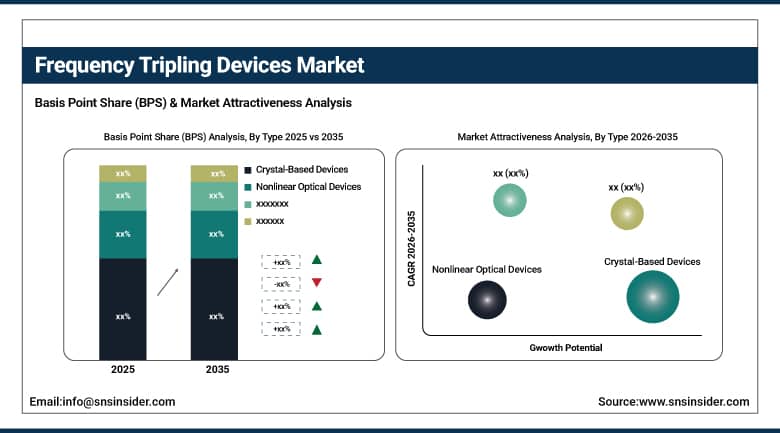
By Type, Crystal-Based Devices led the market with an estimated 60.4% share in 2025, while Nonlinear Optical Devices, including PPLN modules, were the fastest-growing type at a CAGR of 8.6%.
-
By Application, Telecommunications led with an estimated 34.0% share in 2025, while Medical applications were the fastest-growing segment, supported by rising adoption of frequency-tripled lasers in dermatology and ophthalmology.
By Type, Crystal-Based Devices lead, Nonlinear Optical Devices grow fastest
Crystal-based Devices were the more prominent category in the type segment in 2025, with about 60.4% of shares, because of the use of bulk nonlinear crystals such as KDP and LBO in the high energy physics application and laser systems due to its thermal stability and high damage threshold. The reliability and performance at higher power levels kept crystal-based devices as the leading technology used in lasers both industrially and for research purposes.
Nonlinear Optical Devices, constituting 39.6% of the market, had the fastest growing share in 2025, because of the trend towards photonics and telecommunication applications in the market. Periodically-polled lithium niobate waveguides allowed wavelength selection and tunability using quasi-phase-matching of nonlinear optics through manipulation of the poling period and operating temperatures as well as the compact form factors allowing fiber-coupling into telecommunication systems.
By Application, Telecommunications leads, Medical grows fastest
The telecommunications application segment had the biggest market share, estimated at 34.0% in 2025, owing to the continuous upgrades being made by telecom companies in their optical communication systems to support 5G and beyond networks. Thus, the constant cycle of investments continued making telecommunications the leading application for frequency tripling devices.
Medical applications grew the fastest in 2025 because of the increasing use of solid-state lasers that enabled ablation and photocoagulation procedures in medical imaging in the field of dermatology and ophthalmology. The increasing use of medical devices in minimally-invasive techniques and the demand for portable and laser-based equipment helped maintain the high growth rate of the medical applications segment above the telecommunications segment which was more dominant.
Regional Analysis
|
Region |
Major Country |
Share within Region, 2025 (%) |
|---|---|---|
|
North America |
United States |
80.20% |
|
Europe |
Germany |
25.15% |
|
Asia Pacific |
China |
31.40% |
|
Middle East & Africa |
UAE |
25.80% |
|
Latin America |
Brazil |
34.90% |
North America Frequency Tripling Devices Market Insights
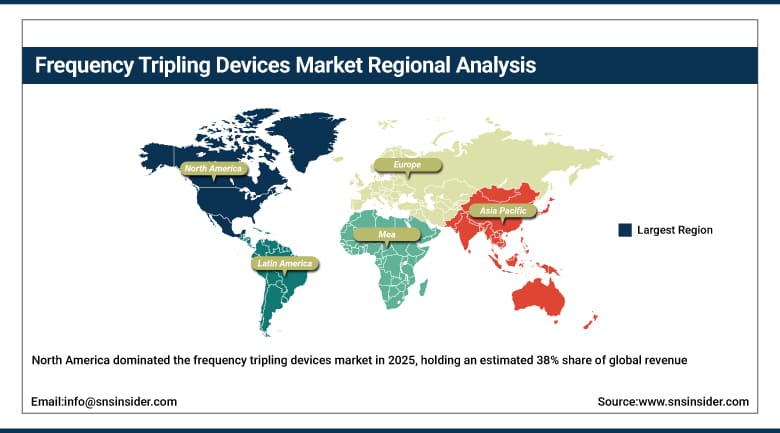
North America dominated the frequency tripling devices market in 2025, holding an estimated 38% share of global revenue, as the region remained a technological leader in photonics and laser-based research, maintaining strong demand in defense and aerospace sectors. A deep concentration of national laboratories, defense contractors, and photonics research institutions kept North America firmly at the center of both demand and continued innovation in this market.
The United States accounted for roughly 80.20% of regional revenue in 2025, anchored by sustained defense and aerospace investment alongside deep academic and national laboratory research infrastructure. Canada added further regional demand through its own photonics research ecosystem, and that combined regional strength kept North America the largest addressable market for frequency tripling device vendors through the forecast period.
Get Customized Report as Per Your Business Requirement - Enquiry Now
Europe Frequency Tripling Devices Market Insights
Europe held a meaningful share of the global frequency tripling devices market in 2025, supported by strong government-backed research funding through programs including the European Research Council and a genuinely deep base of specialized photonics manufacturers headquartered across the region. Regional specialists including EKSMA Optics, GWU-Lasertechnik, and Light Conversion continued competing through differentiated products and focused market strategies.
Germany led regional demand at roughly 25.15% of European revenue, supported by its strong research and precision manufacturing base. The UK and France contributed substantial additional demand, and continued European investment in photonics research infrastructure should keep regional demand for frequency tripling devices climbing steadily through the forecast period.
Asia Pacific Frequency Tripling Devices Market Insights
Asia Pacific was the fastest-growing region in the frequency tripling devices market in 2025, driven by rapidly expanding photonics manufacturing capability, growing telecommunications infrastructure investment, and rising government-backed research funding across the region's largest economies. Continued investment in domestic laser and optical component manufacturing kept the region's growth trajectory ahead of every other region tracked in this report.
China led the region, supported by substantial domestic investment in photonics manufacturing and telecommunications infrastructure expansion. Japan and South Korea contributed meaningful additional demand through their own mature laser and optical component manufacturing ecosystems, and that broadening base of regional production capacity kept Asia Pacific's growth outlook strong through the forecast period.
MEA & Latin America Frequency Tripling Devices Market Insights
The MEA and LATAM regions were marked by consistent but relatively low rates of frequency tripling devices adoption in 2025 as a result of ongoing investments in research infrastructure and telecommunications modernization within each of these regions. With the increase in the development of research infrastructure as well as telecommunications infrastructure, the demand for the use of frequency conversion technology rose, albeit at a much lower rate compared to more developed regions.
Demand in the MEA region was largely spearheaded by the UAE, which saw an increased governmental interest in advanced research infrastructure and telecommunications modernization. The SA region contributed to the demand in MEA with its own efforts aimed at establishing new research facilities. In the LATAM region, Brazil saw the highest regional revenue, thanks to the investments in the development of the academic and telecommunications infrastructure.
Market Dynamics
Growth Drivers: Telecommunications network expansion and rising medical device adoption
Growth in the frequency tripling devices market was driven by telecommunications network expansion supporting 5G and beyond-5G architectures, increasing medical device adoption for minimally-invasive procedures, expanding research infrastructure investment, and continued military modernization programs worldwide. As global data transmission requirements kept surging in 2025, telecommunications carriers continued upgrading optical communication systems to handle higher data rates, and that sustained infrastructure investment cycle kept driving frequency tripling device demand across the telecom sector specifically.
Rising R&D investment in nonlinear optical materials continued enhancing device efficiency and wavelength conversion capabilities throughout 2025, and the integration of frequency tripling components into industrial lasers and precision manufacturing tools kept boosting operational accuracy across a genuinely broad range of applications. Surging investment in scientific research and defense applications kept strengthening demand for ultra-stable, high-frequency laser systems, and that combination of telecommunications, medical, research, and defense demand is exactly what kept this market's growth trajectory dependable through the year.
Restraints: High costs of precision components and supply chain constraints
Frequency tripling devices depend on genuinely precise, high-quality nonlinear optical crystals and components, and the cost of manufacturing these components to the tolerances demanded by telecommunications and defense applications remained a real restraint on faster market-wide adoption in 2025, particularly for smaller research institutions and companies operating with constrained budgets. High-precision components require specialized fabrication processes that don't scale as easily as more commoditized electronic components.
Supply chain limitations for specialized nonlinear optical materials added a further restraint throughout 2025, since sourcing the precise crystal quality required for high-performance frequency tripling wasn't something every manufacturer could reliably guarantee at scale. These cost and supply constraints helped explain why frequency tripling device adoption, while growing steadily, remained concentrated among applications where the precision these devices deliver is genuinely mission-critical rather than a nice-to-have upgrade.
Opportunities: Photonic chip integration and expanding biomedical applications
Breakthroughs in thin-film lithium niobate and photonic integration represented a genuinely significant opportunity in 2025, as third-harmonic generation modules increasingly moved toward embedding directly into standard photonic integrated circuits. As downstream applications of material and substrate engineering research kept extending into on-chip nonlinear devices, vendors positioned early in wafer-level integration of frequency tripling capability stood to capture meaningful share of an emerging, higher-value product category.
Growth in portable, laser-based diagnostic and surgical tools offered a second substantial opportunity throughout 2025, as demand for miniature tripling modules kept expanding beyond traditional lab-bench applications into scalable commercial biomedical devices. As the technology kept transitioning from experimental research settings into real-world clinical and industrial applications, vendors with genuinely compact, cost-effective tripling modules stood to capture meaningful share of this expanding commercial opportunity well beyond the market's traditional research and defense stronghold.
Recent Developments:
-
2025: Menlo Systems released its ELMO 780 XHP ultrafast fiber laser, delivering over 1W of average power at 780 nm with approximately 100 femtosecond pulse durations. While the laser did not include a tripling module itself, its compatibility with third-harmonic generation chains made it an enabling platform for downstream ultraviolet applications in biomedical imaging, materials processing, and precision spectroscopy.
-
2025: Research into thin-film lithium niobate substrate engineering continued advancing toward wafer-level integration of nonlinear optical capability, with downstream applications increasingly targeting on-chip third-harmonic and higher-harmonic generation devices. The trend signaled a longer-term shift toward frequency tripling capability becoming a standard feature of photonic integrated circuits rather than a discrete, standalone component.
-
2025: Regional photonics specialists including Ekspla, Light Conversion, Amplitude Laser Group, and EKSMA Optics continued competing through differentiated product development and focused market strategies, with ongoing consolidation through strategic acquisitions and technology partnerships continuing to shape competitive dynamics across the European nonlinear optics supply base.
Frequency Tripling Devices Market key players are:
-
Coherent Corp.
-
Thorlabs, Inc.
-
Lumentum Holdings Inc.
-
Ekspla UAB
-
Light Conversion, UAB
-
Amplitude Laser Group
-
EKSMA Optics
-
APE Angewandte Physik und Elektronik GmbH
-
NKT Photonics A/S
-
GWU-Lasertechnik Vertriebsgesellschaft mbH
-
Covesion Ltd.
-
LEOS Instruments Ltd.
-
Sirah Lasertechnik GmbH
-
Core Optronics, Inc.
-
Precilasers Co., Ltd.
-
HC Photonics Corp.
-
Menlo Systems GmbH
-
Laser Quantum Ltd.
-
Newport Corporation (MKS Instruments, Inc.)
-
Edmund Optics, Inc.
Frequency Tripling Devices Market Report Scope:
| Report Attributes | Details |
|---|---|
| Market Size in 2025 | USD 415.3 Billion |
| Market Size by 2035 | USD 880.1 Billion |
| CAGR | CAGR of 7.8% From 2026 to 2035 |
| Base Year | 2025 |
| Forecast Period | 2026-2035 |
| Historical Data | 2022-2024 |
| Report Scope & Coverage | Market Size, Segments Analysis, Competitive Landscape, Regional Analysis, DROC & SWOT Analysis, Forecast Outlook |
| Key Segments | • by Type (Crystal-Based Devices, Nonlinear Optical Devices) • by Application (Telecommunications, Medical, Research, Industrial, Defense) |
| Regional Analysis/Coverage | North America (US, Canada, Mexico), Europe (Eastern Europe [Poland, Romania, Hungary, Turkey, Rest of Eastern Europe] Western Europe] Germany, France, UK, Italy, Spain, Netherlands, Switzerland, Austria, Rest of Western Europe]), Asia Pacific (China, India, Japan, South Korea, Vietnam, Singapore, Australia, Rest of Asia Pacific), Middle East & Africa (Middle East [UAE, Egypt, Saudi Arabia, Qatar, Rest of Middle East], Africa [Nigeria, South Africa, Rest of Africa], Latin America (Brazil, Argentina, Colombia, Rest of Latin America) |
| Company Profiles | Coherent Corp., Thorlabs, Inc., Lumentum Holdings Inc., Ekspla UAB, Light Conversion, UAB, Amplitude Laser Group, EKSMA Optics, APE Angewandte Physik und Elektronik GmbH, NKT Photonics A/S, GWU-Lasertechnik Vertriebsgesellschaft mbH, Covesion Ltd., LEOS Instruments Ltd., Sirah Lasertechnik GmbH, Core Optronics, Inc., Precilasers Co., Ltd., HC Photonics Corp., Menlo Systems GmbH, Laser Quantum Ltd., Newport Corporation (MKS Instruments, Inc.), Edmund Optics, Inc. |

Frequently Asked Questions
The Frequency Tripling Devices Market is expected to grow at a CAGR of approximately 7.8% from 2026 to 2035, based on triangulated secondary research estimates.
The Frequency Tripling Devices Market was valued at approximately USD 415.3 Million in 2025, based on triangulation across multiple independent research sources.
The major growth factor is telecommunications network expansion supporting 5G and beyond-5G architectures, combined with rising medical device adoption for minimally-invasive procedures.
The Crystal-Based Devices segment dominated the Frequency Tripling Devices Market by type, representing an estimated 60.4% of revenue in 2025.
North America dominated the Frequency Tripling Devices Market in 2025, holding an estimated 38% share of total global market revenue.
