
Quantum Photonics Market Report Scope & Overview:
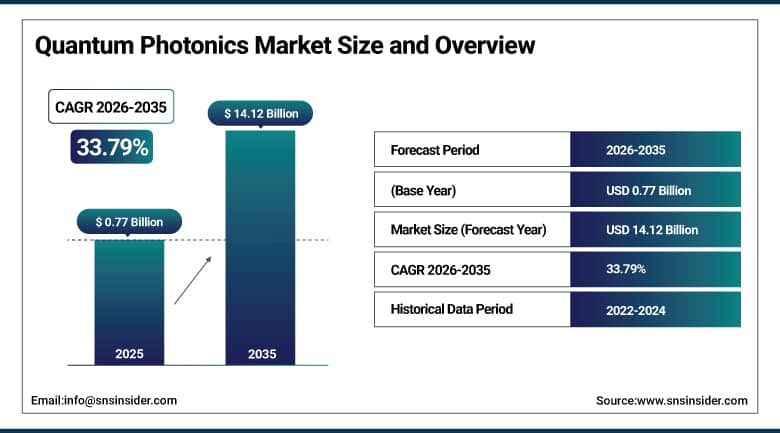
The Quantum Photonics Market size was valued at USD 0.77 billion in 2025 and is expected to reach USD 14.12 billion by 2035, growing at a CAGR of 33.79% from 2026–2035.
The global quantum photonics market is witnessing strong growth in the global market owing to increasing demand for advanced quantum technologies. Rising deployment of quantum communication systems, photonic integrated circuits, single-photon devices, and quantum sensing solutions is accelerating market expansion. Governments and technology providers are focusing on quantum computing integration, secure communication networks, high-performance photonic platforms, and scalable quantum infrastructure. Growing investments in quantum research, semiconductor manufacturing, and next-generation optical technologies are supporting technology advancement. Increasing demand for quantum computing, secure data transmission, precision sensing, and advanced measurement applications is further driving market adoption.
In the process of research at NIST, both quantum optics and integrated photonics platforms have been able to provide an accurate stabilization of phase in 120 kilometers of aerial fiber optic network using feedback and feed forward correction. Additionally, in another development involving international researchers at University of Ottawa and Federico II University in Italy, a photonic quantum simulator has been demonstrated through which more than 300 different quantum operations have been analyzed using three spatial light modulators.
To Get More Information On Quantum Photonics Market - Request Free Sample Report
Quantum Photonics Market Trends:
-
Rising commercialization of quantum computing is accelerating demand for advanced Quantum Photonics technologies across multiple industries globally.
-
Increasing adoption of photonic integrated circuits is improving processing speed, energy efficiency, and system reliability significantly.
-
Growing investments in quantum-enabled healthcare diagnostics are advancing high-precision imaging and next-generation medical sensing applications worldwide.
-
Expanding deployment of precision sensing technologies is strengthening aerospace, automotive, environmental monitoring, and industrial automation capabilities globally.
-
Continuous innovation in quantum imaging and sensing platforms is accelerating commercialization and expanding emerging application opportunities worldwide.
-
Increasing collaboration between technology companies and research institutions is driving rapid development of Quantum Photonics solutions globally.
U.S. Quantum Photonics Market Size Outlook:
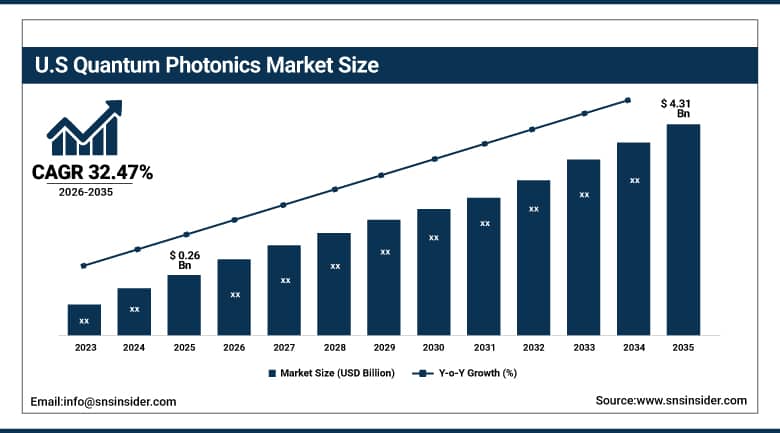
The U.S. Quantum Photonics Market was valued at USD 0.26 billion in 2025 and is expected to reach around USD 4.31 billion by 2035, growing at a CAGR of 32.47% from 2026–2035.
The U.S. quantum photonics market is expanding rapidly owing to rising development of advanced quantum technology infrastructure across research and commercial applications. Increasing adoption by government organizations, defense agencies, technology companies, and research institutions is supporting market growth nationwide. Rising investments in quantum communication, photonic integrated circuits, quantum computing platforms, and advanced sensing technologies are driving innovation and technological advancement. Growth in quantum research initiatives and semiconductor manufacturing capabilities is further accelerating quantum photonics deployments across industries. Technology providers are focusing on scalable quantum systems, high-performance photonic components, and secure communication solutions across diverse application segments. Increasing demand for quantum computing, precision measurement, and next-generation communication networks is strengthening long-term market penetration.
As per the European Centre for International Political Economy’s 2025 performance benchmark, technological research quality in the world has been found to be concentrated regionally. The United States contributes 34% of all top cited scientific papers in the field of advanced computing technologies, with China contributing 16% and Germany 4%. In addition, more than 30 countries have employed national strategies to enhance their infrastructure in order to improve their regional production capabilities for advanced lasers and integrated optical communications.
Quantum Photonics Market Segment Analysis:
-
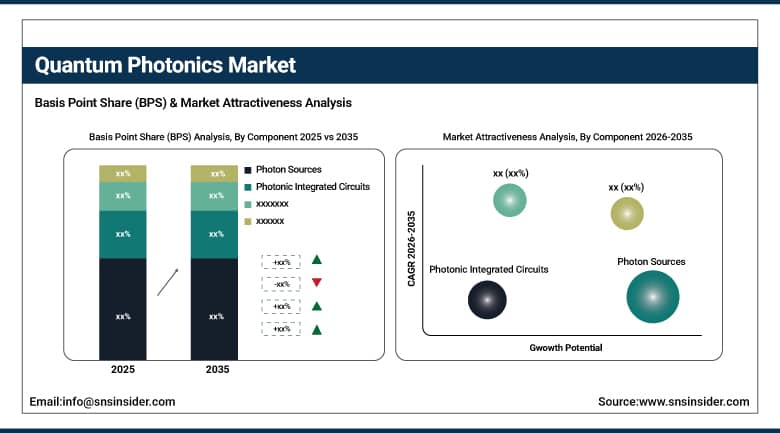
By Component, photon sources dominated the market with 31.97% share in 2025; while photonic integrated circuits are the fastest growing segment with CAGR of 39.07% during 2026 to 2035.
-
By Offering, systems dominated the market with 82.19% share in 2025; while services are the fastest growing segment with CAGR of 39.13% during 2026 to 2035.
-
By Technology Platform, silicon photonics dominated the market with 41.99% share in 2025; while thin-film lithium niobate is the fastest growing segment with CAGR of 40.14% during 2026 to 2035.
-
By End-User Industry, government and defense dominated the market with 36.51% share in 2025; while telecom and data-center operators are the fastest growing segment with CAGR of 39.12% during 2026 to 2035.
By Component, photon sources dominated the quantum photonics market, while photonic integrated circuits are the fastest growing segment.
Photon sources segment was the leading one in the quantum photonics market and held the dominating revenue share in 2025 because of their importance to help realize quantum communications, quantum computing, and quantum sensing applications. Demand for stable single photon generation, innovations in photon emission technology, and increase in spending on research infrastructure are contributing to the growth of this sub-segment. Photon sources contribute to the development of advanced quantum photonic systems in various sectors.
Photonic integrated circuits segment is anticipated to grow at the fastest CAGR in the forecast period due to rising demand for compact, scalable, and power efficient quantum photonic solutions. Innovations in manufacturing techniques of integrated photonics, improved quantum processing capabilities on chips, and increased adoption in quantum computing and communication applications are contributing to its growth. Increased investment in quantum semiconductor technologies is aiding its development.
By Offering, systems dominated the quantum photonics market, while services are the fastest growing segment.
Systems segment held a dominated share in the quantum photonic systems market in 2025 due to the growing demand for the quantum photonic platform as a whole. The category will be favored by increasing usage of the integrated quantum computing, communication, and sensing systems. The increased investments of governments, research organizations, and technology companies in quantum technologies are anticipated to drive the market growth. The demand for hardware solutions, such as photon sources, detectors, and integrated photonic devices, will contribute to the market share.
Services segment is predicted to have the fastest growth rate during 2026-2035 due to the increasing demand for the quantum photonics-related services. Consulting services and system integration are highly in demand. The high complexity of quantum photonic systems and lack of experience are anticipated to lead organizations to collaborate with service providers. Growing number of research studies, cloud quantum technology access, and quantum commercial deployment will promote the fast development of services category.
By Technology Platform, silicon photonics dominated the quantum photonics market, while thin-film lithium niobate is the fastest growing segment.
Silicon photonics segment holds the dominated revenue share in the quantum photonics market in 2025 due to its compatibility with present-day semiconductor processing technology and cost-effective mass production capability. Widespread use in quantum communication systems, optical interconnections, and high-speed data transfer applications helped increase business demand. Continuous development of photonic integrated circuits, scalable production process, low-power requirement, and increased collaboration in research have ensured widespread usage in both industry and research applications.
The thin-film lithium niobate segment is likely to register the fastest CAGR between 2026 and 2035. The growth will be attributed to excellent electro-optic properties, very low optical loss, and high-speed modulation required for complex quantum systems. Increasing application in the development of quantum computing devices, secure quantum communication, and precision measurement systems is increasing commercial adoption. Advancements in technology, fabrication processes, and investments in photonic integrated circuits will ensure continued market growth.
By End-User Industry, government and defense dominated the quantum photonics market, while telecom and data-center operators are the fastest growing segment.
Government & defense segment accounted for the dominated market share in terms of revenue generated in 2025, due to huge investments in secure quantum communication, quantum sensors, and modernizing defense systems. Quantum photonics technologies are being used extensively by governments globally for purposes of encrypted communications, navigation systems, surveillance, and defense intelligence services. Further funding for research activities, partnerships with technology providers, and growing investments in defense infrastructure based on quantum technologies boosted the dominance of this segment among the major developed nations.
Telecom & data center operators’ segment is anticipated to witness the fastest CAGR between 2026 and 2035, due to increasing needs for high-speed optical networks, data transmission, and secure quantum communication infrastructure. Investments in developing future generation fiber networks, cloud computing data centers, and quantum internet networks are fueling the growth in this segment.
Regional Analysis:
|
Region |
Major Country |
Share within Region, 2025(%) |
|---|---|---|
|
North America |
United States |
87.91% |
|
Europe |
Germany |
26.40% |
|
Asia Pacific |
China |
38.70% |
|
Middle East & Africa |
UAE |
16.30% |
|
Latin America |
Brazil |
43.10% |
North America Quantum Photonics Market Insights
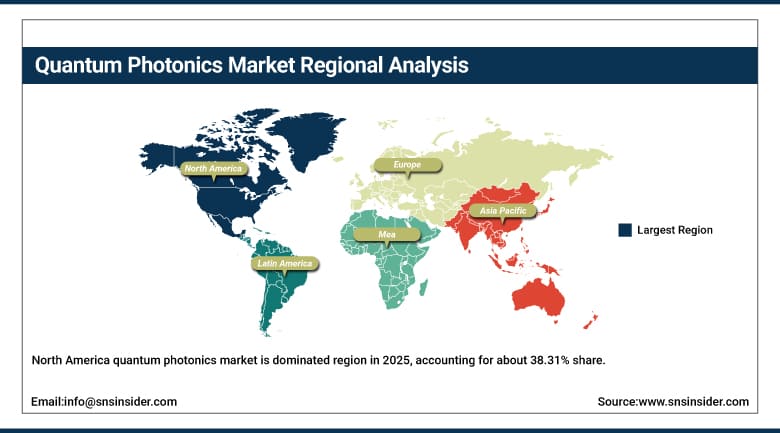
North America quantum photonics market is dominated region in 2025, accounting for about 38.31% share, driven by increasing investments in quantum computing, secure communication, and advanced photonic technologies across government and commercial sectors. The region benefits from strong research ecosystems, established semiconductor manufacturers, and leading quantum technology companies. Rising adoption of quantum sensors, integrated photonic circuits, and quantum encryption platforms is accelerating market expansion. Continuous public funding, strategic collaborations, and innovation initiatives further reinforce the region’s dominant position in the market.
As per the National Institute of Standards and Technology, the Quantum Manufacturing Engineering Center is aimed at facilitating the scalable manufacturing of cryostats, laser, and integrated photonics technology for use in quantum devices. Such technological developments enable the faster implementation of quantum technologies. QMECs are also required to help in meeting the requirements of the National Security Agency of CNSA 2.0 that demands shifting towards post-quantum cryptography from 2025, to be fully implemented by 2030–2033.
Get Customized Report as Per Your Business Requirement - Enquiry Now
Europe Quantum Photonics Market Insights
Europe quantum photonics market is characterized by stable growth in 2025 owing to increasing investments in quantum research infrastructure and advanced photonic technology development. Key countries include Germany, France, United Kingdom, Netherlands, and Switzerland. Rising deployment of quantum communication networks, photonic integrated circuits, and quantum sensing technologies is supporting market expansion. Increasing collaborations between research institutions, governments, and technology companies are strengthening long-term industry development. Technological advancements continue encouraging secure data transmission and high-performance quantum computing applications across the region.
The European Commission's "Quantum Europe Strategy: Quantum Europe in a Changing World" report published in July 2025 states that more than EUR 11 billion has been invested publicly within the European Union and its Member States towards the development of quantum technologies. This is being done through support for quantum light sources, photonics facilities, and EuroQCS hybrid systems that are coupled with the EuroHPC supercomputing network.
Asia Pacific Quantum Photonics Market Insights
Asia Pacific is the fastest growing region in the quantum photonics market, registering a CAGR of about 35.83% during 2026–2035. Rapid digital transformation and increasing investments in quantum technologies are driving strong market demand across China, Japan, South Korea, India, and Singapore. Rising adoption of photonic chips, quantum communication systems, and advanced semiconductor manufacturing is accelerating regional market growth. Growing government support, research collaborations, and technology commercialization initiatives continue supporting widespread Quantum Photonics deployment across emerging industries.
As per the report from Japan External Trade Organization released in 2025, improvements in the region have contributed to the industrialization of quantum computing through a partnership between Global Research and Development Center for Business by Quantum-AI Technology and OptQC, which helped improve the photonic detection systems. Besides, the efforts of the public sector have led to the deployment of 256 physical qubits in April 2025 and 144 physical qubits in July 2025.
Middle East & Africa and Latin America Quantum Photonics Market Insights
The Middle East & Africa along with Latin America regions are witnessing steady growth due to increasing digital transformation initiatives and expanding investments in advanced research infrastructure. Key contributing countries include Saudi Arabia, UAE, South Africa, Brazil, Mexico, and Chile. Growing adoption of secure communication technologies, photonic sensing systems, and quantum research collaborations is supporting market expansion. Continued investments in innovation ecosystems and technology development are strengthening long-term regional opportunities.
In accordance with the South African Quantum Technology Initiative, the government sponsored projects are extending their influence over six connected regional quantum research centers to develop the software, sensing and communication skills. Also, the São Paulo Research Foundation is dedicating R$150 million to the five-year long Quantum Technologies InitiAtive to enhance the laser optics, integrated photonics and quantum computers technology base.
Market Dynamics:
Growth Drivers: Quantum computing commercialization increases demand for advanced Quantum Photonics applications globally.
The fast commercialization process of the quantum computing technology is leading to widespread implementation of the Quantum Photonics technology in various commercial and industrial applications. The photonic integrated circuits enable faster data processing, less energy consumption, and better operational reliability than existing technologies. Growing investments by technology companies are aiding in fast development and manufacturing processes of the products. The healthcare industry, automotive industry, aerospace industry, and the telecom industry are increasingly implementing the quantum-enabled photonic solutions. This is paving the way for sustainable future growth.
As per the EU Commission Joint Research Centre’s 2025 analysis on quantum technologies, the global commercialization of high-end quantum photonic solutions proves that the European Union entities contribute 32% of all the quantum enterprises in the world. Moreover, the European Quantum Communication Infrastructure Implementation phase, which was successful till 2025, has led to the creation of terrestrial quantum key distribution networks in 27 member states.
Restraints:Limited skilled professionals and missing standards hinder widespread Quantum Photonics adoption.
The shortage of skilled professionals who have proficiency in quantum engineering and photonics technology keeps influencing market evolution around the globe. Companies are now finding more difficulties in hiring skilled researchers and engineers. The absence of globally recognized standards leads to problems associated with compatibility between various quantum photonic technologies and communication networks. The integration with the current digital technology makes the process even more complicated. Such constraints slow down the commercialization process and prevent wider business adoption.
Opportunities: Increasing healthcare diagnostics and precision sensing adoption expands Quantum Photonics commercial opportunities.
Increasing application of Quantum Photonics technologies in health care and precision sensing sectors is creating many business possibilities all around the globe. Quantum photonics-based sensing devices offer greater measuring precision, faster diagnostics, and better imaging capabilities. The rising demand for sensing devices that are accurate from the industrial sector is also fostering the adoption of such technologies in aerospace, automotive, environment monitoring, and manufacturing sectors. Innovations being made continuously in quantum-based sensing and imaging systems are promoting the commercialization of such technologies.
According to the Organization for Economic Cooperation and Development report that was issued in 2025, there are 18 member states and the European Union that have developed specialized national policies on quantum technologies. Such an advancement in policy directly fosters commercialization efforts of the technology in healthcare diagnostics and sensing technologies. Innovations have grown at a global level significantly, where patent families on quantum sensing have increased by 500% in the past decade.
Recent Developments:
-
2026: Quandela selected by DARPA for the Quantum Benchmarking Initiative to evaluate its utility-scale spin-photonic quantum computing concepts.
-
2025: PsiQuantum introduced Omega, a manufacturable silicon-photonic chipset purpose-built for scalable, million-qubit quantum datacenter architectures.
-
2025: Lightmatter achieved a world-first 16-wavelength bidirectional Dense Wavelength Division Multiplexing link operating on one standard single-mode optical fiber.
-
2024: ORCA Computing acquired a Texas-based integrated photonics division to enhance its in-house optical switching capabilities.
Quantum Photonics Companies are:
-
PsiQuantum
-
Quandela
-
ID Quantique
-
ORCA Computing
-
Lightmatter
-
Nu Quantum
-
Pixel Photonics
-
Qubitekk
-
Single Quantum
-
QuantumXchange
-
QuintessenceLabs
-
KEEQuant
-
Thorlabs
-
TundraSystems Global
-
AEGIQ
-
Quantum Dice
-
Menlo Systems
-
AUREA Technology
Quantum Photonics Market Report Scope:
| Report Attributes | Details |
|---|---|
| Market Size in 2025 | USD 0.77 Billion |
| Market Size by 2035 | USD 14.12 Billion |
| CAGR | CAGR of 33.79% From 2026 to 2035 |
| Base Year | 2025 |
| Forecast Period | 2026-2035 |
| Historical Data | 2022-2024 |
| Report Scope & Coverage | Market Size, Segments Analysis, Competitive Landscape, Regional Analysis, DROC & SWOT Analysis, Forecast Outlook |
| Key Segments | •By Component (Photon Sources, Single-Photon Detectors, Photonic Integrated Circuits, Waveguides and Couplers, Control and Readout Electronics, Other Components) •By Offering (Systems, Services) •By Technology Platform (Silicon Photonics, Indium Phosphide, Thin-Film Lithium Niobate, Diamond NV / SiC, Gallium Arsenide,Others) •By End-User Industry (Government and Defense, Telecom and Data-Center Operators, Financial Services, Healthcare and Life Sciences, Academia and Research, Other End-User) |
| Regional Analysis/Coverage | North America (US, Canada), Europe (Germany, UK, France, Italy, Spain, Russia, Poland, Rest of Europe), Asia Pacific (China, India, Japan, South Korea, Australia, ASEAN Countries, Rest of Asia Pacific), Middle East & Africa (UAE, Saudi Arabia, Qatar, South Africa, Rest of Middle East & Africa), Latin America (Brazil, Argentina, Mexico, Colombia, Rest of Latin America). |
| Company Profiles | Xanadu Quantum Technologies, PsiQuantum, Quandela, ID Quantique, ORCA Computing, QuiX Quantum, Lightmatter, Nu Quantum, Pixel Photonics, Qubitekk, Single Quantum, QuantumXchange, QuintessenceLabs, KEEQuant, Thorlabs, TundraSystems Global, AEGIQ, Quantum Dice, Menlo Systems, AUREA Technology |

Frequently Asked Questions
North America dominated the quantum photonics market in 2025.
The major growth is driven by quantum computing commercialization, secure communication demand, photonic integrated circuit adoption, expanding semiconductor investments, and increasing quantum sensing, imaging, and precision measurement applications.
The silicon photonics dominated due to semiconductor compatibility, scalable manufacturing, low-power operation, and broad quantum applications.
The quantum photonics market is expected to grow at a CAGR of 33.79% from 2026 to 2035.
The quantum photonics market was valued at USD 0.77 billion in 2025.
