
Fruit Puree Market Report Scope & Overview:
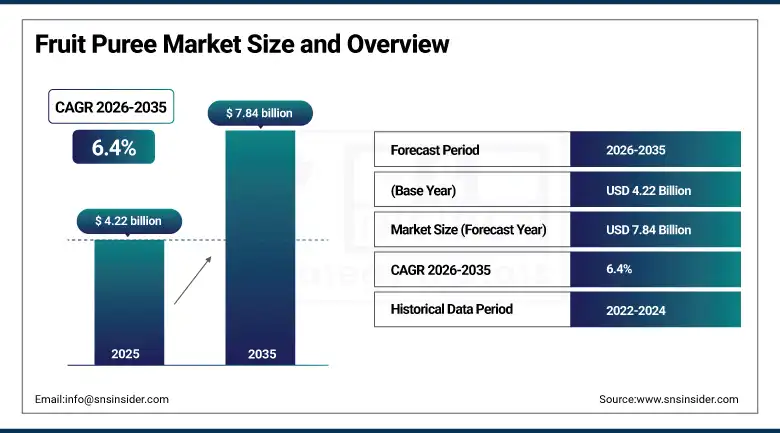
The Fruit Puree Market was valued at USD 4.22 billion in 2025 and is expected to reach USD 7.84 billion by 2035, growing at a CAGR of 6.4% from 2026-2035.
The Fruit Puree Market is witnessing continuous growth as there is an increased demand for foods with a clean label, which means foods that contain natural and minimally processed ingredients among consumers worldwide. Health awareness has resulted in the use of fruit products in drinks, baby food, and dairy segments. Growth in the processed food and beverages sector and increase in urbanization and fast-paced life has led to higher consumption of convenience foods. Moreover, innovations in food processing technology, improved cold chain logistics, and growing consumer preference for organic and sugar-free products are helping in market growth.
According to the Food and Agriculture Organization (FAO), global fruit production reached approximately 1.0 billion tonnes annually, reflecting strong upstream raw material availability supporting processed fruit ingredients like puree. The World Health Organization (WHO) reports that over 2.5 billion adults were overweight in 2022, driving higher demand for healthier, natural food alternatives with reduced artificial additives.
To Get more information On Fruit Puree Market - Request Free Sample Report
Fruit Puree Market Trends
-
Rising demand for natural, clean-label, and minimally processed food ingredients is driving the fruit puree market.
-
Growing consumption of ready-to-eat foods, beverages, and infant nutrition products is boosting market growth.
-
Expansion of the food and beverage industry, including bakery, dairy, and confectionery applications, is fueling puree demand.
-
Increasing focus on healthy snacking and sugar alternatives is shaping adoption trends.
-
Advancements in aseptic processing, cold chain logistics, and preservation technologies are enhancing shelf life and product quality.
U.S. Fruit Puree Market Size Outlook
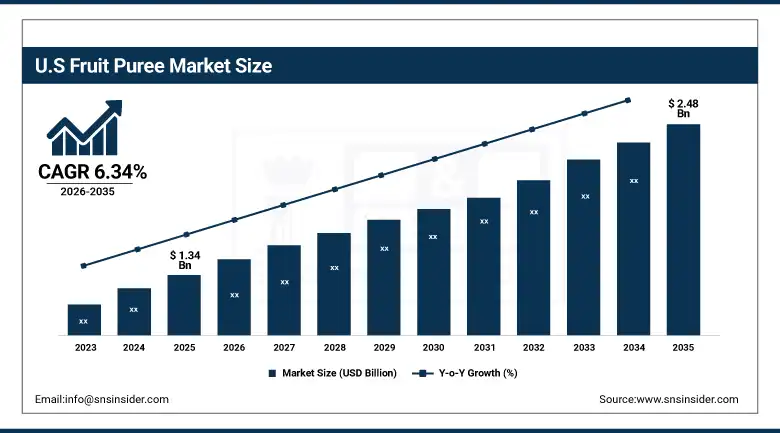
The U.S. Fruit Puree Market was valued at USD 1.34 billion in 2025 and is expected to reach USD 2.48 billion by 2035, growing at a CAGR of 6.34% from 2026-2035.
The U.S. Fruit Puree Market is experiencing consistent growth because of the rising demand among consumers for healthy food products that are free from artificial preservatives and additives. Health consciousness is driving the trend of using fruits as an ingredient for beverages, baby foods, and dairy products. The strong presence of processors of food products and advanced food processing facilities is contributing to market growth. Moreover, the rising preference for organic and sugar-free variants is also driving market demand.
The United Nations Department of Economic and Social Affairs (UN DESA) states that about 56% of the global population lives in urban areas (2024), expected to rise further, significantly increasing demand for convenient and ready-to-eat fruit-based products such as purees used in beverages, dairy, and baby food applications.
Fruit Puree Market Segment Analysis
-
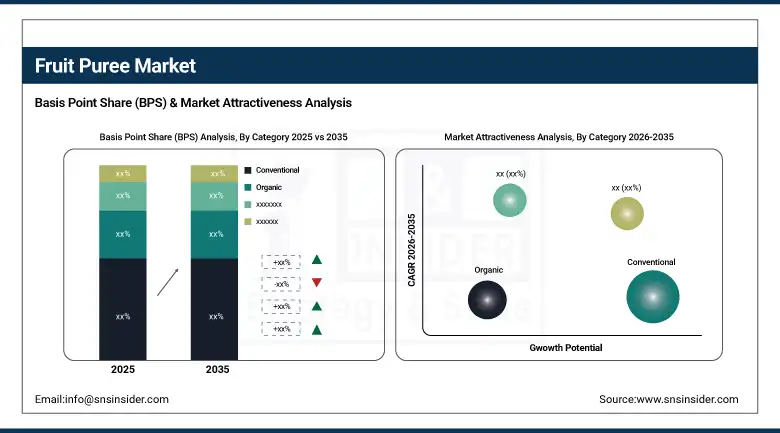
By Category, Conventional segment dominated the Fruit Puree Market in 2025 with 64% share; Organic segment is the fastest growing segment.
-
By Fruit Family, Berry Fruit segment dominated the market in 2025 with 35% share; Exotic Fruit segment is the fastest growing segment.
-
By Application, Beverages segment dominated the market in 2025 with 42% share; Baby Food segment is the fastest growing segment.
By Category, conventional segment dominates the fruit puree market, organic segment is the fastest growing
The conventional segment dominated the fruit puree market owing to its wide availability, low price range, and well-established supply chain network. They are widely preferred by food and beverages manufacturers who focus on quality and cost-effective purchasing. The conventional fruit purees also provide longer shelf life than organic fruit purees. There was high demand from the beverages industry, bakery products, and dairy industry for fruit purees that helped in the dominance of conventional fruit purees category. In addition, the well-developed agriculture systems and processing systems are contributing towards the dominant position of the conventional fruit purees.
The organic segment is the fastest growing in the fruit puree market due to growing consumer preference for organic food products free of any chemicals. Increasing health awareness and concerns related to chemical residues in the products is fuelling demand for organic products. The growing health consciousness among consumers has forced manufacturers to use organic fruit purees in order to match the premium positioning of products. In addition, the presence of favorable regulatory policies for the cultivation of organic fruits has been a significant driver.
By Fruit Family, berry fruit segment dominates the fruit puree market, exotic fruit segment is the fastest growing
The berry fruit segment dominated the fruit puree market due to their rich nutritive value, high antioxidant presence, and applications in various foods. Berries such as strawberries, blueberries, and raspberries are widely consumed in the production of smoothies, yogurt, and bakery goods. Their natural taste and health benefits make them popular among manufacturers. The increasing trend of health and immunity-boosting foods is adding impetus to their market share. Stable availability and familiarity among consumers are additional factors that have favored their dominance in the global fruit puree industry.
The exotic fruit segment is the fastest growing in the fruit puree market due to the rapidly increasing demand for distinctive tastes and superior quality experience. Fruits such as mangoes, passion fruit, guava, dragon fruit, and others are more frequently used in beverages, desserts, and various health foods. The growing globalization and experimentation within the product range are the key drivers of high penetration of this fruit sector. Moreover, the manufacturers often resort to using exotic fruits to create competitive advantage.
By Application, beverages segment dominates the fruit puree market, baby food segment is the fastest growing
The beverages segment dominated the fruit puree market owing to high consumption in juices, smoothies, flavored drinks, and functional beverages. The popularity of fruit purees is attributed to its natural flavor, color, and nutrients content. There has been an increase in demand for health and natural drinks which in turn boosted the dominance of this segment. In addition, growth in innovations in ready-to-drink beverage products and rising café culture is likely to drive the segment growth. The beverages industry remains dependent on fruit purees in enhancing flavor and differentiation of beverages.
The baby food segment is the fastest growing in the fruit puree market due to the high demand for natural and nutritious baby food products. An increasing number of parents are choosing baby foods based on fruit purees rather than other products made using preservatives and chemicals. Increasing awareness regarding infant nutrition, growing preference for organic and natural baby food products is driving the segment growth. In addition, urbanization and changing lifestyle, coupled with an increasing number of working parents, has led to the increasing demand for baby food products.
Regional Analysis
|
Region |
Major Country |
Share within Region (%) |
|---|---|---|
|
North America |
United States |
86.8% |
|
Europe |
United Kingdom |
23.9% |
|
Asia Pacific |
China |
58.2% |
|
Middle East & Africa |
UAE |
14.4% |
|
Latin America |
Brazil |
49.6% |
North America Fruit Puree Market Insights
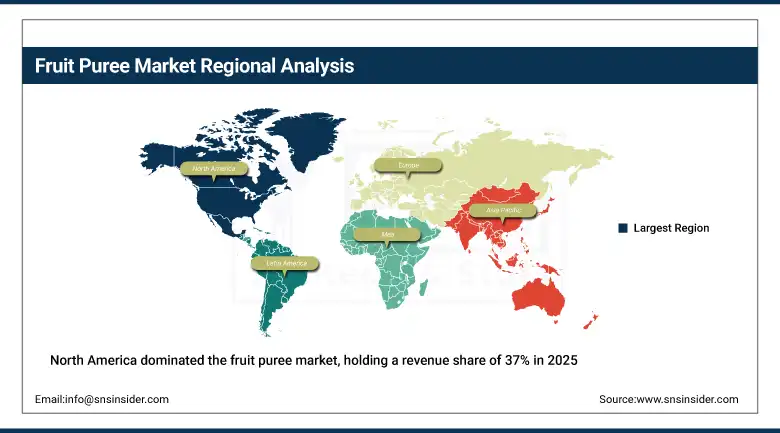
North America dominated the fruit puree market, holding a revenue share of 37% in 2025 driven by the significant consumption by the processed foods, beverages, and baby nutrition industries. This can be attributed to high consumer awareness of organic and convenient foods. North America enjoys a robust manufacturing base and sophisticated cold chain logistics. Growth is further boosted by increased consumption of smoothies, fruits-based beverages, and functional foods. Moreover, increasing health consciousness and busy lifestyles are prompting consumers to embrace fruit purees in retail and food services settings in North America.
Get Customized Report as per Your Business Requirement - Enquiry Now
Europe Fruit Puree Market Insights
Europe fruit puree market is fueled by high demand for organic, clean label, and minimally processed products. The presence of well-developed food processing industry and stringent quality requirements contributes to product excellence in the Europe fruit puree market. Fruit purees are being widely used in beverage, dairy, bakery, and baby food formulations and contribute to the robust growth in the market. There is a shift towards natural and plant-based products, which leads to increased demand for premium quality fruit purees.
Asia Pacific Fruit Puree Market Insights
The Asia Pacific region is witnessing the highest growth rate in the fruit purees market, growing at a CAGR of 7.45%. Factors such as increasing population, higher disposable income levels, and urbanization trends are driving the growth of this market. The rising food and beverages industry, particularly in applications like beverages, infant formulas, and dairy foods, has been propelling the demand for fruit purees. Moreover, consumers' changing perceptions towards nutritious and healthier diets have been contributing positively to the development of the fruit purees market. In addition, increasing agricultural production, advanced cold chain systems, and growing retail penetration are fueling regional growth for fruit purees products.
Middle East & Africa and Latin America Fruit Puree Market Insights
Middle East & Africa region and the Latin America fruit puree market is steadily expanding owing to increased urbanization, improved food distribution channels, and development in the processed food industry. High demand for low-cost packaged foods, fruit juices, and baby foods is aiding consumption. The availability of fruits in these regions is enabling cheap manufacturing as well as exports from these regions. Cold chain infrastructure issues hamper rapid growth in certain regions, but the increasing health consciousness and retail presence should enable market growth in the coming years.
Market Dynamics
Growth Drivers: Rising demand for natural and clean label ingredients in beverages and infant nutrition segments globally
The growing consumer preference for healthier eating habits has resulted in an increased demand for fruit purees that are made from naturally sourced ingredients and have been processed to a lesser extent. An increasing consumer awareness regarding the negative impact of artificial chemicals on human health has led companies to develop their products with clean labeling practices. This has seen the rise of cleaner labels in the beverages, dairy foods, smoothies, and baby food segments wherein consumers appreciate products that are more nutritious. Parents have been favoring the use of pure fruit purees for feeding their infants owing to their safety, easy digestibility, and nutritive value. Moreover, the increasing consumer health consciousness amongst the urban population has encouraged innovation of organic and no added sugar variants.
Restraints: High perishability and cold chain dependency increasing operational costs for fruit puree manufacturers globally sector
The manufacture of fruit purees is highly dependent upon fresh raw material, exposing them to spoilage and deterioration without appropriate storage facilities. The necessity of temperature-controlled operations in handling, processing, and transport of the products entails high operating costs for the company. In cases where adequate storage facilities may not be available, logistics become increasingly complex. Any breakdown of equipment used for refrigeration can result in losses and other related setbacks. Additionally, costs associated with investing in processing facilities, including aseptic packaging and flash pasteurization, will increase overheads. Small companies have found themselves disadvantaged by the infrastructure needs compared to their larger counterparts. The seasonality of fruits will further increase the difficulties of storage and sourcing,
Opportunities: Rising demand for organic fruit puree in premium baby food and functional beverage applications segment
The rising consumer trend of consuming organic and chemical-free food products has created ample opportunities in favor of the organic fruit puree market. With increasing concerns about child safety, nutrition, and the non-inclusion of pesticides or fertilizers, there has been an upward shift towards purchasing organic baby food products. This development has created an excellent opportunity within the infant nutrition market, which is characterized by fruit puree as one of its important ingredients. Moreover, functional beverages, particularly those used for detox, boosting immunity, and general wellness, are adding organic fruit puree to their products to add an advantage in their market positioning. Increasing discretionary incomes and premium living lifestyles have been instrumental in promoting the acceptance of organic products as well.
Recent Developments:
-
2026: Symrise opened a new Food & Beverage innovation studio in North America, expanding its fruit-based ingredient development capabilities. The site is used to co-develop fruit preparation systems, flavoring bases, and puree-style beverage concepts with customers for faster commercialization of fruit applications.
-
2025: Kerry expanded its Taste & Nutrition innovation programs, launching new beverage formulation systems where fruit puree and fruit-style bases are used for sugar reduction and natural sweetness delivery in beverages and dairy systems.
-
2025: Symrise launched Care & Wellness Division, integrating food, beverage, and nutrition technologies, including fruit-derived ingredient systems used in beverage and dairy innovation pipelines.
-
2024: Döhler expanded fruit ingredient capabilities after strengthening integration of SVZ fruit and vegetable processing assets, increasing global supply of berry purees, concentrates, and fruit bases used in beverages and dairy systems.
-
2023: Döhler GmbH Completed acquisition of SVZ, significantly expanding global production of fruit purees, concentrates, and vegetable-based ingredients used in beverages and dairy systems.
Fruit Puree Market Key Players are:
-
Döhler GmbH
-
AGRANA Beteiligungs-AG
-
Kerry Group
-
Ingredion Incorporated
-
SVZ International B.V.
-
Symrise AG
-
Tree Top Inc.
-
Oregon Fruit Products
-
Milne Fruit Products Inc.
-
SunOpta Inc.
-
Les vergers Boiron
-
The Perfect Purée of Napa Valley
-
Fénix S.A.
-
Grünewald International
-
Uren Food Group Limited
-
Brothers International Food Holdings
-
Nestlé S.A.
-
Danone S.A.
-
The Hain Celestial Group
-
Dole Food Company Inc.
Fruit Puree Market Report Scope:
| Report Attributes | Details |
|---|---|
| Market Size in 2025 | USD 4.22 Billion |
| Market Size by 2035 | USD 7.84 Billion |
| CAGR | CAGR of 6.4% From 2026 to 2035 |
| Base Year | 2025 |
| Forecast Period | 2026-2035 |
| Historical Data | 2022-2024 |
| Report Scope & Coverage | Market Size, Segments Analysis, Competitive Landscape, Regional Analysis, DROC & SWOT Analysis, Forecast Outlook |
| Key Segments | • By Category (Conventional, Organic) • By Fruit Family (Berry Fruit, Citrus Fruit, Exotic Fruit, Orchard Fruit) • By Application (Beverages, Baby Food, Desserts, Others) |
| Regional Analysis/Coverage | North America (US, Canada), Europe (Germany, UK, France, Italy, Spain, Russia, Poland, Rest of Europe), Asia Pacific (China, India, Japan, South Korea, Australia, ASEAN Countries, Rest of Asia Pacific), Middle East & Africa (UAE, Saudi Arabia, Qatar, South Africa, Rest of Middle East & Africa), Latin America (Brazil, Argentina, Mexico, Colombia, Rest of Latin America). |
| Company Profiles | Döhler GmbH, AGRANA Beteiligungs-AG, Kerry Group, Ingredion Incorporated, SVZ International B.V., Symrise AG, Tree Top Inc., Oregon Fruit Products, Milne Fruit Products Inc., SunOpta Inc., Les vergers Boiron, The Perfect Purée of Napa Valley, Fénix S.A., Grünewald International, Uren Food Group Limited, Brothers International Food Holdings, Nestlé S.A., Danone S.A., The Hain Celestial Group, Dole Food Company Inc. |
Frequently Asked Questions
North America dominated the Fruit Puree Market in 2025.
The Conventional segment dominated the Fruit Puree Market in 2025.
Rising demand for natural and clean label ingredients in beverages and infant nutrition segments globally.
The Fruit Puree Market was valued at USD 4.22 billion in 2025.
The Fruit Puree Market is expected to grow at a CAGR of 6.4% from 2026 to 2035.
