
Fusion Reactor Market Report Scope and Overview:
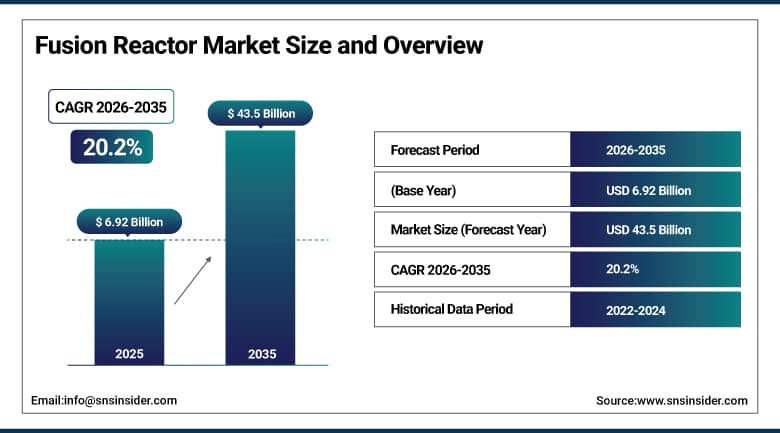
The Fusion Reactor Market was valued at USD 6.92 Billion in 2025 and is projected to reach USD 43.5 Billion by 2035, registering a CAGR of 20.2% from 2026 to 2035.
The Fusion Reactor Market is contributing to the commercialization of net-energy-gain reactors through technological advancements in the design of tokamaks, stellarators, and inertial confinement reactors that can manage high-temperature plasma. The market trends include the increasing flow of private and government funds for prototype reactors, the development of high-temperature superconducting magnetic systems, the building of infrastructures such as fuel cycle management and tritium management, and the application of reactors in grid-based power generation, defense research, and spacecraft propulsion. The increased occurrence of milestone demonstrations for prototypes, commercialization of the magnet systems, and offtake deals between reactors and utilities has been due to the large amount of capital used by developers of fusion reactors, government labs, and component suppliers.
In 2026, TAE Technologies made progress with its fusion platform using the field-reversed configuration, with an emphasis on plasma confinement, beam technology, and reactor design for future commercial production of fusion energy.
To Get More Information On Fusion Reactor Market - Request Free Sample Report
Fusion Reactor Market Trends
-
Expanding high-temperature superconducting magnet integration improves tokamak and stellarator confinement efficiency.
-
Growing private capital in laser-driven inertial fusion reactors shortens net-energy-gain demonstration timelines.
-
Rising utility and hyperscaler offtake agreements widen commercial deployment pathways for reactor platforms.
-
Increasing government investment in tritium breeding and fuel-cycle infrastructure strengthens reactor fuel self-sufficiency.
-
Growing integration of AI-based plasma control systems reduces disruption risk across prototype and demonstration reactors.
U.S. Fusion Reactor Market Outlook
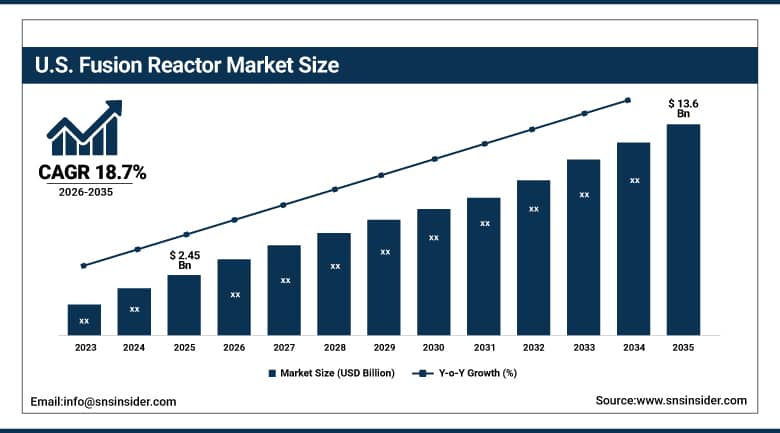
The U.S. Fusion Reactor Market was valued at approximately USD 2.45 Billion in 2025 and is projected to reach approximately USD 13.6 Billion by 2035, registering a CAGR of approximately 18.7% from 2026 to 2035.
The demand for reactor hardware produced within the domestic boundaries of the United States was prompted by vigorous funding campaigns carried out by the developers of fusion reactors who are striving to achieve milestones in terms of net energy gain and also Department of Energy and ARPA-E research funding. The adoption of high temperature superconducting magnets and plasma stabilizing platforms controlled by artificial intelligence in major American prototypes of reactors has strengthened America's status as the largest customer of fusion reactors worldwide due to increased applications of such reactors in the production of energy, defense studies, and industrial heating.
In September 2026, Pacific Fusion initiated its construction project in Albuquerque, New Mexico, in relation to the development of a fusion campus for high energy production. This will be funded through private means in conjunction with the U.S. National Nuclear Security Administration.
Fusion Reactor Market Segment Analysis
-
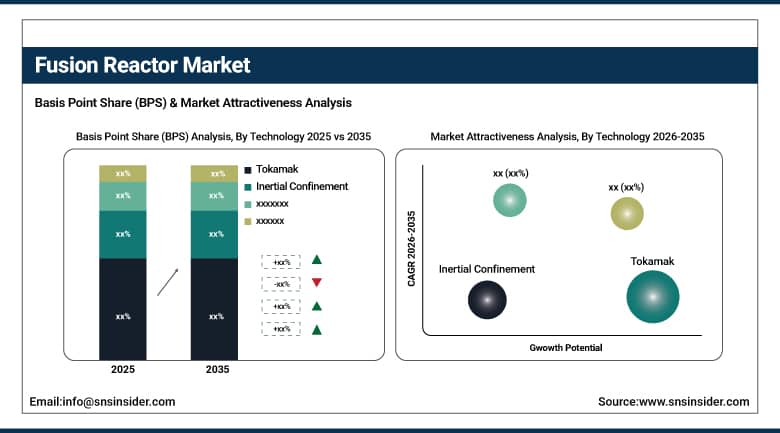
By Technology, Tokamak segment dominated the Fusion Reactor Market in 2025 with 64.3% share; Inertial Confinement segment is the fastest growing segment, registering a CAGR of 22.8% from 2026 to 2035.
-
By Component, Magnet & Coil Systems segment dominated the market in 2025 with 35.8% share; Diagnostics & Control Systems segment is the fastest growing segment, registering a CAGR of 22.4% from 2026 to 2035.
-
By Fuel Type, Deuterium-Tritium segment dominated the market in 2025 with 66.4% share; Deuterium-Helium-3 segment is the fastest growing segment, registering a CAGR of 24.1% from 2026 to 2035.
-
By Application, Electricity Generation segment dominated the market in 2025 with 54.7% share; Industrial Process Heat & Hydrogen Production segment is the fastest growing segment, registering a CAGR of 23.2% from 2026 to 2035.
-
By End User, Government & Research Institutes segment dominated the market in 2025 with 46.8% share; Utilities segment is the fastest growing segment, registering a CAGR of 22.6% from 2026 to 2035.
By Technology, Tokamak Dominates, Inertial Confinement Grows Fastest
The Tokamak type reactors have been the top players in the Fusion Reactor Market in 2025 due to years of fine tuning of engineering processes and the ability to maintain high temperature plasmas in a confined toroidal magnetic field configuration. The national labs, power companies and private firms have invested the biggest portion of their reactor capital in the tokamak reactors since the configuration holds out the best promise for achieving net energy gain operations in the nearest future. Commonwealth Fusion Systems has further solidified the trend through its SPARC tokamak reactor project.
The Inertial Confinement reactors are estimated to grow with the fastest rate out of all types of reactors up to 2035, driven by the rapid development of laser-driven technology following the confirmation of net energy gain at the National Ignition Facility. Focused Energy has bolstered this trend by expanding its manufacturing capabilities of laser targets and driver technology, which followed the largest Series A funding round ever achieved by the fusion industry; Xcimer Energy is continuing to develop large aperture laser fusion reactors for cost reduction and growth beyond the average.
By Component, Magnet & Coil Systems Lead, Diagnostics & Control Systems Grow Fastest
Magnet & Coil Systems accounted for the highest revenue share in the Fusion Reactor Market in 2025 due to the high temperature superconducting magnets which are used as the core and confinement mechanism in almost all tokamak and stellarator reactors currently being developed. Reactor builders have consistently invested in high field magnet purchases, since magnet performance is responsible for setting the limits of plasma pressure and compactness. The alliance between Commonwealth Fusion Systems and manufacturers of the magnets in order to increase the manufacture of REBCO coils and investments by Tokamak Energy in high field magnet production have helped sustain this lead.
Diagnosis & Control Systems are likely to register the highest growth rate within the reactor component segment due to the movement from manual observation of plasma in reactors to AI-based predictive controls that can automatically stabilize disruptions without human intervention. This can be exemplified by the digital twin collaboration between Commonwealth Fusion Systems and NVIDIA & Siemens, enabling reactor operators to observe the reactor behavior as a system. Increasing usage of machine learning-based disruption prediction in prototype reactors of Tokamak Energy and General Atomics will ensure continued high demand for diagnostics equipment until 2035.
By Fuel Type, Deuterium-Tritium Leads, Deuterium-Helium-3 Grows Fastest
The Deuterium-Tritium fuel cycle was the top performer in the Fusion Reactor Market in 2025 due to the lower ignition temperature and greater energy generation capacity compared to other types of fuel, which makes the fuel cycle the most scientifically validated method to gain energy from reactor models. ITER and Commonwealth Fusion Systems are still some of the most important companies that develop reactors on a deuterium-tritium basis, while the 2026 licensing of cryogenic pellet fueling technology by Oak Ridge National Laboratory to Type One Energy is an example of the ongoing fuel cycle innovations for this fuel cycle.
Deuterium-Helium-3 fuels is expected to witness the highest growth rate out of all the fuels available in terms of reactor fuel cycle. This can be attributed to the advancement in aneutronic fuel-cycle technologies that have been realized through firms such as Helion Energy in the reduction of neutron activation as well as minimizing the need for reactor shielding. The recent power purchase agreement of Helion Energy and Microsoft in terms of fusion electricity generation from the firm’s Orion Power Plant by 2028 has heightened the investors' focus on helium-3 reactor systems.
By Application, Electricity Generation Leads, Industrial Process Heat & Hydrogen Production Grows Fastest
Electricity generation dominated the Fusion Reactor Market as the largest end-user application segment in 2025 due to an increasing trend of power purchase agreements between power companies, hyperscale tech corporations, and reactor suppliers for generating power at a grid scale. The electricity generation application is backed by existing power transmission infrastructure and power company business models, which is evident from the power purchase agreement between Google and Commonwealth Fusion Systems for Fall Line Fusion Power Station in Virginia. The electricity generation application is the best funded reactor application worldwide.
Process Heat for Industrial Applications and Production of Hydrogen is the most rapidly developing reactor application, attracting increasing attention from companies looking for ways to decarbonize their manufacturing processes requiring high-temperature heat that cannot be economically provided by renewables alone. Kyoto Fusioneering’s development of heat-exchanger and hydrogen co-production systems for fusion reactors, including its recently opened tritium fuel cycle test facilities, shows rising business interest in non-electric applications of reactors. With industrial customers searching for reliable high-temperature heat sources other than fossil fuels, reactor manufacturers find themselves developing two-way systems for electricity and industry.
By End User, Government & Research Institutes Dominate, Utilities Gain Fastest Traction
The Government & Research Institutes constituted the leading end-user segment within the Fusion Reactor Market in 2025, given that national labs and multi-lateral initiatives like ITER will continue funding most of the extensive reactor experimentation and plasma physics studies. Significant funding on the part of the government sector in countries like the United States, European Union, and China is indicative of continued public interest in developing fusion reactors as an energy security solution in the long run, where national laboratories will continue acting as the key purchasers of reactor parts, diagnostic instruments, and magnet systems.
The utilities sector is forecast to register the highest growth rate among end-users as grid managers look to strike early-stage deals with reactor manufacturers to ensure carbon-free and dispatchable power before rising demand for data center and electrification applications. Recent listing on Nasdaq and the general fusion group’s framework agreement with Renexia are just examples of how utilities are increasingly getting involved in the commercialization of reactors. As tech firms continue to invest alongside utilities for the development of large-scale reactors, utilities are predicted to witness the highest growth rate in demand for reactors among all end-users by 2035.
Regional Analysis:
|
Region |
Major Country |
Share within Region, 2025 (%) |
|---|---|---|
|
North America |
United States |
87.90% |
|
Europe |
Germany |
32.50% |
|
Asia Pacific |
China |
43.80% |
|
Middle East and Africa |
Saudi Arabia |
27.10% |
|
Latin America |
Brazil |
30.90% |
North America Fusion Reactor Market Insights
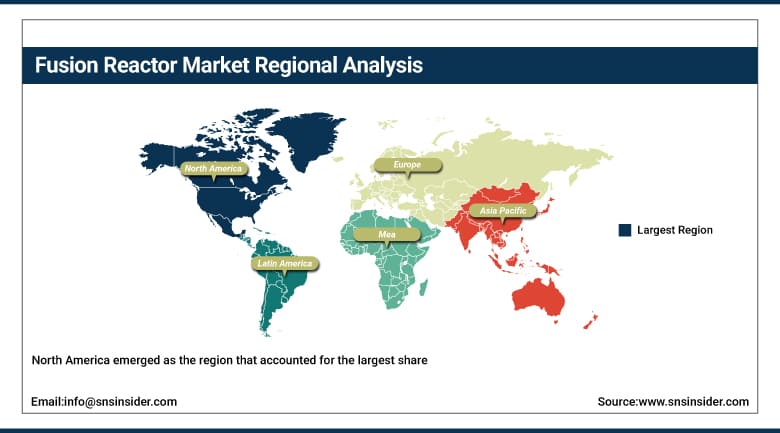
North America emerged as the region that accounted for the largest share in terms of the global Fusion Reactor Market in 2025, contributing 40.3% of the total share, thanks to steady private investments in prototypes and demonstrators reactors, the presence of the world’s most well-funded reactors developers, and ongoing research on magnetic and inertial fusion energy through the support of national laboratories and defense sector. Collaboration between reactors' developers, superconductive magnet producers, and power utilities companies ready to receive power from reactors in the future has helped the region solidify its market leadership, with the regulatory framework facilitating license issuance to advanced reactors developers becoming mature.
United States held a market share of around 87.90% for the entire Fusion Reactor Market of the region due to constant raising of capital through Commonwealth Fusion Systems, Helion Energy, and TAE Technologies along with power purchasing agreements from Microsoft and Google. The increased budgeting of the Department of Energy and ARPA-E for research on reactors along with the Nasdaq listing of General Fusion Group and framework agreements with Renexia have strengthened the dominance of North America, while Canada also contributes to research work on fusion reactors.
Get Customized Report as Per Your Business Requirement - Enquiry Now
Europe Fusion Reactor Market Insights
Europe has ensured that it has been able to sustain its share in global Fusion Reactor Market revenues due to the involvement of the multilateral project called ITER, strategic and visionary approaches towards fusion from various nations and significant investments in various stellarator and laser fusion reactors. Increased cooperation between the government and the private sector through entities like the UK Atomic Energy Authority and the German Federal Ministry for Research, Technology and Space has allowed European reactor manufacturers to focus on scalable magnet production and fuel cycle solutions making Europe the center of stellarator development.
Germany accounted for majority of the Fusion Reactor Market revenue share of Europe in 2025 owing to huge investments in clusters based on laser and magnetic reactors and availability of manufacturing facilities of Focused Energy, Marvel Fusion, and Proxima Fusion in Germany. The United Kingdom made a substantial contribution to the regional demand with the help of its spherical tokamak platform provided by Tokamak Energy along with cooperation between UKAEA and Eni in fuel cycle research. Both Germany and the UK were likely to retain Europe's status as the dominant region for reactor manufacturing and prototyping.
Asia Pacific Fusion Reactor Market Insights
Asia Pacific is expected to witness the highest growth rate of Fusion Reactor Market, registering a CAGR of 24.8% from 2026 to 2035, driven by huge investments by respective governments in tokamak facilities in China and Japan, growing regional emphasis on energy independence in the long run, and increasing production of superconducting magnets and reactors. National fusion strategies of several Asia Pacific nations, along with increased government spending on procurement of reactors components, further strengthen the position of the region as the world’s fastest-growing reactor market.
Asia Pacific's Fusion Reactor Market generated majority of its revenue from China owing to massive tokamak facility developments in terms of Burning Plasma Experimental Facility and superconducting compact high-field tokamak by Energy Singularity. The contribution of Japan was seen through joint development of reactor with Kyoto Fusioneering whereas that of South Korea was through its constant efforts towards the development of KSTAR tokamak systems making Asia Pacific well placed to catch up with North American dominance in the reactor market during the forecast period.
MEA and Latin America Fusion Reactor Market Insights
The Middle East and Africa and Latin America Fusion Reactor Market witnessed moderate growth in 2025 owing to rising investments by sovereign wealth funds into cutting-edge energy technology, energy diversification initiatives by governments, and increasing collaboration between research institutes in these regions and foreign reactor developers. Adoption of next-generation clean baseload reactors in the early stages is becoming increasingly significant in both regions, owing to the need for reducing reliance solely on renewable sources of energy to cater to growing energy needs in the future.
In the Middle East and Africa, Saudi Arabia was the major contributor of revenues from sovereign wealth funds by using advanced energy technologies and investing in nuclear and fusion research, while UAE did so by collaborating with emerging reactors. In Latin America, Brazil contributed the highest regional share due to extensive collaboration within the university research network and increasing plasma physics research programs, which will contribute to the global reactor demand in the coming period.
Market Dynamics:
Growth Drivers: Rising Private Investment in Demonstration Reactors and Expanding Utility Offtake Agreements
The Fusion Reactor Market is witnessing growth on account of increasing investors' confidence in the net-energy gain of prototype reactors, increased use of high-temperature superconducting magnet technology, investments in self-sufficiency of fuel cycle and tritium breeding and increased end-use applications including electricity generation, industrial process heating and hydrogen production. With increasing announcements of power purchase agreements for future fusion electricity supply, there is an increased requirement for credible commercialization and delivery timelines, which will further aid availability of capital in the entire supply chain of reactors ranging from manufacturers of magnets and vacuum vessels to system integrators and diagnostic platforms.
Increased cooperation of reactor designers with national laboratories, combined with increased commitment of power firms in ensuring carbon-free baseload energy before regulation on decarbonization of grids takes effect, adds more weight behind this trend. Increased allocation of capital to reactor prototyping and manufacturing capabilities through venture and sovereign investments is increasing the industry’s baseline deployment capabilities, while the recent public market presence, for instance the Nasdaq listing of General Fusion Group, opens new sources of capital that will continue supporting increased levels of reactor investment through the forecast period.
Restraints: High Capital Intensity and Technical Uncertainty in Net Energy Gain
Higher capital expenditure is an important obstacle to the growth of Fusion Reactor Market, since even the testing and demonstration reactors require millions of dollars worth of superconducting magnets, vacuum chambers, and laser driver systems before any income can be earned from it. Such high capital expenditure limits advanced research in the area of fusion reactors to only those organizations which have the necessary resources to undertake such venture with the help of venture capital or grants. This can be proved with the example of General Fusion’s requirement of bridge financing in 2025 before its public listing.
Technical uncertainties remain a problem because there is not currently a fusion reactor that can produce net energy continuously or sustainably, which requires financial planning well into the future before commercialization becomes feasible. Resolving such uncertainties involves further development in areas of plasma stability studies, materials science, and testing of magnets' lifespan, among others, and all require funding for a lengthy period, especially since there are different competing models of reactors taking different technical approaches to reach the same goal of net energy gain.
Opportunities: AI-Driven Plasma Control and Data Center Power Demand Growth
Increasing investments in AI-enabled plasma control systems and digital twins are a huge opportunity because developers are focusing on optimization projects for their reactors in areas of magnets, plasma diagnostics, and AI-controlled disruption mitigation in an entire reactor system. Companies that can secure early electricity offtake agreements like Commonwealth Fusion Systems, thanks to its deal with Google, are likely to have a huge share of the market because they are moving from one prototype demonstration to power reactors connected to the grid.
The second significant opportunity arises from the rising demand for power from data centers and artificial intelligence applications, with large-scale tech companies that work on power-starved grids looking for reliable sources of emission-free electricity, which could be provided by fusion power plants via long-term power purchase agreements. For example, Helion Energy, which is working towards delivering power to Microsoft via its Orion plant in as soon as 2028, highlights how such realistic delivery plans are translating into commercial commitments from buyers in the technology sector.
Recent Developments:
-
2026: Helion Energy's Polaris prototype became the first privately developed fusion reactor to demonstrate measurable deuterium-tritium fusion, reaching plasma temperatures of 150 million degrees Celsius as the company advances its Orion commercial power plant near Malaga, Washington.
-
2026: General Fusion Group Ltd. completed its business combination with Spring Valley Acquisition Corp. III, becoming the first publicly listed fusion reactor developer on Nasdaq under the ticker GFUZ and securing USD 150 Million to advance its LM26 magnetized target fusion demonstration machine.
-
2026: Commonwealth Fusion Systems raised USD 1 Billion in additional equity financing to accelerate construction of its SPARC tokamak reactor and support planning for its 400-megawatt Fall Line Fusion Power Station in Virginia.
-
2026: Focused Energy raised USD 240 Million in a Series A funding round, the largest in fusion industry history, to scale production of its laser-driven inertial fusion targets and laser-driver reactor platform.
-
2026: Kyoto Fusioneering opened a new tritium fuel-cycle testing facility to advance heat-exchange and hydrogen co-generation systems for commercial fusion reactor power plants.
Fusion Reactor Market key players are:
-
Commonwealth Fusion Systems
-
TAE Technologies, Inc.
-
Helion Energy, Inc.
-
Tokamak Energy Ltd
-
General Fusion Group Ltd.
-
Zap Energy, Inc.
-
Type One Energy Group
-
Focused Energy GmbH
-
Pacific Fusion Corp.
-
Xcimer Energy Inc.
-
Proxima Fusion GmbH
-
Marvel Fusion GmbH
-
Realta Fusion, Inc.
-
Shine Technologies, LLC
-
Renaissance Fusion SAS
-
Thea Energy, Inc.
-
Avalanche Energy Designs, Inc.
-
Kyoto Fusioneering Ltd.
-
General Atomics
-
Energy Singularity (Shanghai) Co., Ltd.
Fusion Reactor Market Report Scope:
| Report Attributes | Details |
|---|---|
| Market Size in 2025 | USD 6.92 Billion |
| Market Size by 2035 | USD 43.5 Billion |
| CAGR | 20.2% from 2026 to 2035 |
| Base Year | 2025 |
| Forecast Period | 2026-2035 |
| Historical Data | 2022-2024 |
| Report Scope & Coverage | Market Size, Segments Analysis, Competitive Landscape, Regional Analysis, DROC & SWOT Analysis, Forecast Outlook |
| Key Segments |
•By Technology (Tokamak, Inertial Confinement, Stellarator, Others) •By Component (Magnet & Coil Systems, Diagnostics & Control Systems, Vacuum Vessel & Blanket Systems, Heating & Power Supply Systems, Others) •By Fuel Type (Deuterium-Tritium, Deuterium-Helium-3, Deuterium-Deuterium, Others) •By Application (Electricity Generation, Industrial Process Heat & Hydrogen Production, Research & Defense, Space Propulsion) •By End User (Government & Research Institutes, Utilities, Industrial, Others) |
| Regional Analysis/Coverage | North America (US, Canada), Europe (Germany, UK, France, Italy, Spain, Russia, Poland, Rest of Europe), Asia Pacific (China, India, Japan, South Korea, Australia, ASEAN Countries, Rest of Asia Pacific), Middle East & Africa (UAE, Saudi Arabia, Qatar, South Africa, Rest of Middle East & Africa), Latin America (Brazil, Argentina, Mexico, Colombia, Rest of Latin America). |
| Company Profiles | Commonwealth Fusion Systems, TAE Technologies, Inc., Helion Energy, Inc., Tokamak Energy Ltd, General Fusion Inc., Zap Energy, Inc., Type One Energy Group, Focused Energy GmbH, Pacific Fusion Corp., Xcimer Energy Inc., Proxima Fusion GmbH, Marvel Fusion GmbH, Realta Fusion, Inc., Shine Technologies, LLC, Renaissance Fusion SAS, Thea Energy, Inc., Avalanche Energy Designs, Inc., Kyoto Fusioneering Ltd., General Atomics, Energy Singularity (Shanghai) Co., Ltd. |

Frequently Asked Questions
Key players in the Fusion Reactor Market include Commonwealth Fusion Systems, Helion Energy, TAE Technologies, Tokamak Energy, General Fusion Group, and Kyoto Fusioneering, among others.
Key opportunities in the Fusion Reactor Market include AI-driven plasma control and digital twin technologies, along with growth in data center power demand and expansion of utility power purchase agreements.
The market is driven by rising private and governmental investments in demonstration reactors, increasing adoption of high-temperature superconducting magnets, and growing demand for reliable carbon-free baseload electricity.
The Tokamak segment dominated the Fusion Reactor Market, accounting for approximately 64.3% market share.
The North America region dominated the Fusion Reactor Market in 2025 with a 40.3% share, driven by strong private investment in demonstration reactors and continued government research funding.
